Without recourse. All Rights Reserved. Tree of Life©
Statement
of belief: “Sanctify them through thy truth: thy
word is truth.” (John 17:17 KJV)
Updated
5929± 11 20 2025 [2009-02-16]
Updated
5925[(*??*)] 10 17 2029 [2013-01-29] – Revising Nero’s “civil… 1
Tishri…” to “Scripture 22 Tishri…”
Updated 5925[(*??*)] 02 27 2029
[2013-06-07] – Complete rebuild after MS Word messup of links. Cf. prior version.
Revision still pending…
The Regnal Years and Dates of Roman Emperors
from Julius Caesar thru Domitian
Abstract:
To
pursue a deeper
and better understanding of the fundamentals behind the within discoveries,
please send us an email requesting our free introductory course entitled Tour
Guide for… “Tuning into the frequency of the Creator…”
Once the
year of the Passover of Crucifixion is established it becomes a relatively easy
matter to place many other events more or less firmly in time. Under the guidance of Yahweh and based upon
an 19 CE crucifixion,
and/or upon 45± celestial
events dated using astronomical tables, a number of New Testament events, various rulers over
Israel and Judae, the War
and the Destruction of Jerusalem, and also the Regnal Years and Dates of all
Roman Emperors from Julius Caesar through Caesar Domitian, have been
identified and dated.
Key to my understanding of the time
references used by Josephus is:
1. A
visible crescent of the moon defining each New Moon,
2.
Josephus, not any particular ruler, culture, or country, determines what
calendar and what rules he is using to designate time,
3.
Josephus is using accession periods, e.g. accession year, accession months, etc.. This is very simple indeed! The reckoning is in terms of
the number of beginnings of calendar time periods that has been passed since
any given event, whether the beginning of a year, a New Moon, etc.. That is, the first year, etc. - counting in whichever
direction - of any time period, reign, etc., starts at the beginning of the
calendar year, calendar month, etc., following the event,
4. a difference in the wording used, e.g. “in” or “after”, may
define whether or not an inclusive count is used, but these items may not
always be reliably translated. In fact, the corresponding Hebrew prepositions,
“towards,” “within,” and “after,” are probably best understood in reference to
the markers in time indication the beginnings of whichever timeperiod. That is,
“towards the beginning of the upcoming year,” “between two harvest times,”
“after the beginning of the year,” etc.,
5.
Josephus is always very precise in his time statements,
6.
Josephus is recording Jewish history even while apparently recording Roman
history, e.g. when giving the history of Roman emperors who are in control of
Judea. If it is not relevant to Judea and to the people of Israel, Josephus may
not be considering it important.
7. Truth
is claimed by Josephus as being of highest priority re his books.
The
complete details of my study re the Roman Emperors may be seen below this
initial brief outline:
I.
The
death of Alexander the Great
§ “Alexander died in the hundred and
fourteenth Olympiad” and between Tishri 22, 327 BCE and the beginning of July
1, 326 BCE.
II. The death of Caesar Julius
§ Ides of March (March 15), 49 BCE.
§ Augustus was born September 23, 67 BCE [Note:
September 23, 67 BCE is a pre-Caesar Julius’ calendar revision date. September
23, 67 BCE in a
corrected calendar comes out to Elul 24 or 25, 67 BCE, but this date is not
when Augustus was born.]
§ Augustus’ (seasonally
corrected) date of delivery was June 28 [Sivan (or Tammuz) 26 (or 27), 67
BCE; Notice the number 26 as well as 3, i.e. the Third Moon, Sivan!] Augustus’
mother’s calculated LMP was September 21 (seasonally corrected) [Elul or Tishri
11, 68 BCE; Notice its relationship to the Day of At-One-Ment!] and Augustus
was most likely conceived October 4 (seasonally corrected) [Tishri 21, 68 BCE;
Notice its relationship to the Eighth Day and the beginning of the Scriptural year!]
[While Augustus was conceived on about October 4, 68 BC, Jupiter was in
Capricorn from December 24, 69 BC until January 6, 67 BC. Quickening may also
have happened within the month associated with Capricorn, however, using an
astrological chart based on the uncorrected pre-Julian calendar reform finds
Augustus being conceived in the sign of Capricorn.]
§ The beginning of Augustus’ reign: Adar 27 or 28, 47 BCE
[April 1 or 2, 47 BCE ± 1 lunar month (March 3 or May 1.)]
§ Augustus died “on the fourteenth day before
the Kalends of September at the ninth hour, just thirty-five days before his
seventy-sixth birthday,” i.e. Av 19 or 20, 10 CE [August 19, 10 CE.]
§ Tiberius was born on November 16, 56 BCE
(as dated per the then current Roman calendar) and on August 22, 56 BCE per a
seasonally adjusted calendar [Av (or Elul) 24 (or 25), 56 BCE.]
§ Tiberius was appointed the heir of Augustus
on June 26, 1 BCE [Tammuz 4 or 5, 1 BCE].
§ Tiberius died on 4 Adar I/Adar II, 23 CE
[after sunset March 15, 23 CE.]
V. Gaius (Caligula)
Caesar’s reign
§ Caius’ was born August 31, 4 BCE [Elul 8 (or 9,) 4 BCE.]
§ Caius’ accession period, per Josephus,
began on the eve of the visible new moon crescent at sunset February 10, 23 CE
[Tevet/Shevat 1, 23 CE,]
§ Caius’ de facto reign began after Tiberius
died after sunset on March 15, 23 CE.
§ Dio claims that Caius’ reign began March
26, possibly because as Suetonius puts it: “It had been provided by decree of
the senate that the execution of the condemned should in all cases be put off
for ten days” and “since [Tiberius’] cruelty endured even after his death.”
§ Caius died in the afternoon on January 24,
27 CE [Tevet (or Shevat) [10th (or 11th) Moon] 21, 27 CE.] (Notice: This is subsequent
to the expected solar
eclipse on Claudius’ birthday August 1, 26 CE!)
VI.
Claudius’
reign
§ Claudius was born August 1, 24 BCE [Tammuz or Av 26, 24
BCE.]
§ Claudius’ de jure reign began in his 50th
year of life when Caius died: In the afternoon on January 24, 27 CE [Tevet (or
Shevat) [10th (or 11th) Moon] 21, 27 CE.]
§ Claudius’ son Britannicus was born, most
likely, on January
20, 26 CE [Tevet or Shevat (10th or 11 Moon) 11 or 12, 26 CE,] (or less likely
in January or February, 27 CE) and he died before the end of extended
festivities attributed to the feast of Saturn in (December, 40 CE or) January
41 CE [Tevet or Shevat, (40/) 41 CE.]
§ Claudius’ daughter Octavia was born between
mid May, 28 CE and mid June, 29 CE.
§ Claudius’ wife Messalina, the mother of
Britannicus and Octavia, was killed in 32 CE after she married another man
behind Claudius’ back and conspired to have Claudius killed. Narcissus took the
initiative for this and was nominated as emperor of Rome for one day in order
to accomplish this purpose.
§ The marriage of Claudius and Agrippina, the
Agrippina’s killing of Octavia’s former fiancé Lucius Silanus, Octavia’s espousal
to Domitian (Nero,) and the adoption of Domitian as Claudius’ son all took
place in 33 CE – at a time when Domitian was 9 years old and Octavia was only 3
or 4 years old.
§ Octavia was married to Nero (between
December 15 and 31, 39 CE) at an age of only 10 or 11, Nero being then 16 years
old.
§ Josephus is making no statement as to the
length of Claudius’ “reign” per se, but is making instead a statement re the
length of time that Claudius was “administering the government.” Considering
the apparent fact that Claudius was a consul, and thus a part of the
government, prior to becoming emperor of Rome, I find that Josephus’ statement
“But Claudius himself, when he had administered the government thirteen years,
eight months, and twenty days, died” is referencing a time period beginning
with Tishri 22, 26 CE, and ending, when Claudius died, on either Zif 21 or
Sivan 21, 40 CE [May 22 or else June 20 or 21, 40 CE.]
§ Claudius’ death was concealed for almost 4
or 5 month until October 13, 40 CE when his death was finally made public.
VII.
Nero’s
reign
§ Nero was born December 15, 23 CE.
§ Nero began his de facto reign after a
period of co-regency with Claudius, which co-regency, based upon Josephus’
reckoning of Nero’s years of reign, began between Aviv 1, 39 CE [March 14 or 15
or April 14, 39 CE] and Tishri 22,
39 CE [September 30 or October 29 or 30, 39 CE.]
§ Nero’s 1st Scripture year of de jure reign began Tishri 22, 39 CE, [September 30, or October
29 (or 30,) 39 CE,] which year is largely concurrent with his 16th Scripture
year of life. He was not yet 17 years old, by Roman reckoning when Claudius
died.
§ Josephus counts Nero’s 1st sacred year of
reign from the beginning of Aviv 22, 40 CE [April 23 or May 22, 40 CE.]
Josephus is using sacred years of reign when referencing certain time periods
within the war of the Jews in his work The War of the Jews.
§ Nero’s reign, as recognized by Josephus,
ended on Aviv 9, 53 CE [March 19, 53 CE,] when he first “heard of the
insurrection in Gaul, on the anniversary of the day on which he killed his
mother,” i.e. at the beginning of the Civil War, and not at his death.
§ Nero died some time within a very few days
prior to the time when Galba, sometime between June 1 and June 6, 53 CE
[between Sivan 24 and 30, 53 CE,] received the “advice… from Rome that Nero was
slain…”
§ Other
events during Nero’s reign:
1. Nero’s poisoning of his step-brother
Britannicus ((14 or) 15 years old) before the end of extended festivities
attributed to the feast of Saturn in (December, 40 CE or) January, 41 CE [Tevet
or Shevat, (40/) 41 CE.]
2. Paul, the apostle, arrives to Rome [Monday
night July 19, or Tuesday July 20, 45 CE;]
3. Paul’s
release from bondage in Rome [October 1, 45 CE;]
4. Nero’s first Quinquennial games [October 3
or 5 through 12, 46 CE;]
5. Nero’s comet
[first seen in the lunar month between December 17, 46 CE and January 15, 47
CE;]
6. Nero’s matricide [March 19, 47 CE;]
7. The great earthquake in Pompeii [February
5, 48 CE;]
8. Nero “dearly loved Poppaea, whom he married
twelve days after his divorce from Octavia;”
9. Octavia was divorced and later, “in her
twentieth year,” killed, i.e. 19 years old [in the first half
of 48 CE;]
10. Nero’s daughter’s, Claudia Augusta, birth
and death [March(?) and June(?), 48 CE;]
11. Nero’s burning of Rome [July 19-26, 49 CE;]
12. Seneca’s first letter to Paul (Chapter XII)
re Nero’s fire of Rome and Nero’s persecution of Christians [March 28, 50 CE;]
13. The apostle Paul’s last
letter to Seneca [August 1, 50 CE;]
14. Nero’s second Quinquennial games [October 3
or 5 through 12, 50 CE;]
15. Seneca’s death [October, 50 CE;] and
16. The death of Nero’s wife Poppaea [October,
50 CE.]
17. The beginning of the War of the Jews: Artemisius
[Jyar,] 51 CE [between May 30 and June 28, 51 CE;]
VIII.
Galba’s
reign
§ Galba began his reign as Caesar of Rome
when, sometime between June 1 and June 6, 53 CE [between Sivan 24 and 30, 53
CE,] he received the “advice… from Rome that Nero was slain…”
§ Galba died after sunset on January 15, 54
CE [Day 15 in the 11th Moon, Shevat 15, 54 CE,] but Josephus counts Galba’s
reign as ending on January 8, 54 CE [Shevat 8, 54 CE] when…
Piso:
§ Piso was adopted as Galba’s son on January
8, 54 CE [Shevat 8, 54 CE.]
§ Piso was killed before sunset January 15,
54 CE [Day 14 in the 11th Moon, Shevat 14, 54 CE.]
IX.
Otho’s
reign
§ “II. The emperor Otho was born upon the
fourth of the calends of May [“IIII. Kal. Mai;”
28th April], in the consulship of Camillus Aruntius and Domitius Aenobarbus…”
§ Otho’s de facto reign began when Galba died
after sunset on January 15, 54 CE [Day 15 in the 11th Moon, Shevat 15, 54 CE.]
§ This allows for Otho’s accession period to be
reckoned, alternatively, all the way from the beginning of the Civil War Aviv
9, 53 CE [March 19, 53 CE.]
§ Otho died on Adar III 22, the 22nd Day of
the Fourteenth Moon, 54 CE [April 19, 54 CE.] Otho’s funeral was performed on
April 19, 54 CE.
§ Vitellius reign is recognized by Josephus
as having begun with the beginning of the Civil War on Aviv 9, 53 CE [March 19,
53 CE] on the anniversary of Nero’s matricide.
§ Vitellius died on Kislev 6 [December (24
or) 25,] 54 CE.
§ Upon Vitellius’ death Domitian, the son of
Vespasian, was first [briefly] celebrated as the new Emperor of Rome.
Astronomical correlations to Vitellius’
reign:
Dio is giving reference to a comet during
the reign of Vitellius as well as of a lunar eclipse in the middle of the
summer. The following event satisfies all criteria provided in
his record:
1. The comet observation is confirmed by
recordings of the ancient Chinese astronomers who states: “This comet had a
tail measuring about 5 degrees and was seen between June 9 and July 9 of that
year.” In 54 CE June 9 and July 9 are the days for the astronomical full moons,
not necessarily the duration of the observation of the comet.
2. There was a total lunar eclipse
lasting 1 hour 46 minutes on Wednesday August 7, 54 CE at 04:36 UT, the first
visible part of the eclipse beginning at 02:38 UT (i.e. beginning at 04:59
Jerusalem solar time.) (Also, on Tuesday, the Third Day of the Week, July 23,
54 CE at 11:41 AM and again on Wednesday, the Fifth Day of the week, August 21,
54 CE at 19:45 PM (local solar time from the Jerusalem horizon) there were
partial solar eclipses but none of them were visible from the Roman Empire
area.)
3. From the language of Dio’s record, which
could represent an indirect quote from a first hand observer, it appears as
though the above referenced comet may have been (?) eclipsed by the moon on the
very same day as the lunar eclipse, possibly (?) even concurrent with the lunar
eclipse. – However, I am not proposing that such a two-fold event can be proven
from Dio’s original Greek words alone!
§ Based upon Suetonius’ records Vespasian was
born November 17, 5 BCE [Heshvan (or Kislev) 16, 5 BCE:] “Vespasian was born in
the Sabine country, in a small village beyond Reate, called Falacrina, on the
evening of the fifteenth day before the Kalends of December, in the consulate
of Quintus Sulpicius Camerinus and Gaius Poppaeus Sabinus, five years before
the death of Augustus…”
- The Latin words translated “death of
Augustus” may alternatively be translated “withdrawal…” or “retirement of
Augustus…” As best I can tell this event is in reference of Tiberius being
appointed the heir of Augustus on June 26, 1 BCE.
§ Vespasian’s reign began:
As reckoned by Josephus,
i.
At
the beginning
of the Civil War, Aviv 9, 53 CE [March 19, 53 CE,] when “at Naples [Nero
first] heard of the insurrection
in Gaul, on the anniversary of the day on which he killed his mother” (C.
Suetonius Tranquillus, The Lives of the Caesars (ed. Alexander Thomson):XL.)
As reckoned by others:
ii.
Vespasian
was first acclaimed Emperor by Otho’s soldiers following
the death of Otho,
iii.
then
by Tiberius Alexander, governor of Egypt, on July 1, 54 CE,
iv.
then
by Vespasian’s own soldiers in Judea on July 3 (Tacitus,
Histories, Book 2:79, 81) or on July 11 (Suetonius,)
54 CE, and
v.
finally by the senate and
the populace in Rome following the death of Vitellius, though Vespasian’s
youngest son Domitian was
the one initially "greeted with the title Caesar" prior to the
arrival of Vespasian.
§ Vespasian’s 2nd year of reign –Josephus used sacred years in reference to the time period
corresponding to the War of the Jews; civil years for other time periods: Vespasian’s
2nd sacred year of reign corresponds to Aviv 1, 55 CE thru Adar, 56 CE [March
19, 55 CE thru April 4 or 5, 56 CE;] his 2nd civil year of reign covers Tishri
54 CE thru Elul 55 CE:
1. Sacred years (Aviv-Adar) – Used by Josephus when referencing an event during the War of
the Jews (Between Iyar 51 CE – Elul 55 CE)
2. Civil years (Tishri-Elul) - Used by Josephus when referencing an event outside of the time
frame of the War of the Jews (before Iyar 51 CE, or after Elul 55 CE:)
§ Vespasian died on June 24, 66 CE [Sivan or
Tammuz 11 or 12, 66 CE.]
§ Titus was born December 30, 26 CE [The 10th
(or 11th) Moon 1 or 2, 26 CE] (prior to Caius’ death, or else December 30, 27
CE [Tebeth (the
10th Moon) 12 or 13, 27 CE].)
§ Titus co-reigned from the beginning with
his father Vespasian whom he succeeded together with
his brother Domitian on June 24, 66 CE [Sivan or Tammuz 11 or 12, 66 CE,] (or
possibly 67 or 68) CE after his father Vespasian died.
§ Titus died on “the Ides of September,”
September 13, 68 CE [Elul 26 or 27, 68 CE,] (or possibly 69 CE or 70 CE) “in
the forty-second year of his age” as reckoned by Suetonius, i.e. following
either his 42nd birthday anniversary (if born prior to Caius’ death, or else,
if born after Caius’ death, following his 41st birthday anniversary.)
§ “Domitian was born on the ninth day before
the Kalends of November…” [October 24, 32 CE [Tishri 30, 32 CE] (or 33 CE
[Tishri or Heshvan 11, 33 CE.])]
§ Domitian’s reign began as a co-reign with
his father Vespasian and his brother Titus and is reckoned from the thirtieth
year of his age as referenced by Suetonius, very possibly beginning with his
30th birthday October 24, 62 CE [Heshvan 2, 62 CE] (or 63 CE [Tishri or Heshvan
(12 or) 13, 63 CE.])
§ Domitian died on “the fifth hour…” [between 11 AM and 12 AM (considering Suetonius’ use of
ordinals)] on “the fourteenth day before the Kalends of October…” September 18,
77 CE, [Elul or Tishri 11, 77 CE] “in the forty-fifth year of his age and the
fifteenth of his reign.”
§ Domitian’s death is anchored upon a rare
astronomical constellation in conjunction with Jerome’s
statement re the time of death of the apostle John.
XIV.
Nerva’s reign
§ Nerva’s brief reign lasted from September
18, 77 CE until January 27, 78 or 79 CE (Cf. Wikipedia)
XV.
Trajan’s reign
§ Trajan’s reign began on January 27, 78 or
79 CE (Cf. Wikipedia)
XVI.
Hadrian’s reign
§ …
XVII.
…
VII. -
XIII. : Please
click here to see VII – XIII !
I. The death of Caesar Julius:
The death of Caesar
Julius: None of the dates above builds on a date
connected with Ceasar Julius. Yet it is important to fit him into the overall
time frame. Caesar Julius died on
the Ides of March (March 15), 49 BCE as based upon the astronomical
data, i.e. a comet
and a solar
eclipse, identified by Ronald L. Conte Jr.
II. Caesar Augustus:
When was
Augustus born?
What may
be learnt re how Josephus records the age of man?
What
might be considered re the patriarchy of Augustus?
Solution
found!: Perfect agreement between Josephus and
Suetonius!
Quote from Ronald L. Conte Jr:
“According to Suetonius, Caesar
Augustus died just short of his 76th birthday. “He died…just
thirty-five days before his seventy-sixth birthday.”839 Dio
Cassius confirms this age: “…he passed away, having lived seventy-five
years, ten months, and twenty-six days (he had been born on the twenty-third of
September)….”840 So, both Suetonius and Dio give the date of
Augustus’ death as August 19. Josephus gives the length of Augustus’ life as 77 years.841 He does not, however, give the length of
Augustus’ life exact to the day, as he does when giving the length of his reign
or the reigns of other emperors.” (Conte Jr., Ronald L., Important Dates
in the Lives of Jesus and Mary, p.190.)
839
Suetonius, Lives of the Caesars, Loeb Classical Library,
2.100.1.
840 Dio,
Roman History, Volume VII, Loeb Classical Library, 56.30.5.
841 Josephus,
The Antiquities of the Jews, 18.32.
Assuming that Dio and Suetonius both are
using a Julian calendar, their respective statements as quoted by Ronald L.
Conte Jr. above makes perfect sense considering that August has 31 days. Assuming further that both Dio and Suetonius
counts birthday as we do today, i.e. from birthday to birthday regardless of
when the calendar year begins and ends, we then find that Augustus was
born September 23rd in the astronomical year – ( 76 – 10 ) = -66 = 67
BCE [Elul 24 or 25, 67 BCE.]
Please correct me where I am wrong, but I
am not aware of any culture where the age of man is not given in full years
only, though with optional, though rarely used, months and/or days added on
top, or on occasion as referenced by Suetonius above. What is known is that a majority of cultures
even today are using a much earlier starting point than the point of delivery
as used in Western – Roman based - cultures today. Most certainly an earlier point was used also
by Josephus. As it turns out Augustus was
seventy-seven years [plus four lunar months and eighteen or nineteen days] old
at his death, when his birth [=beginning] is counted from the beginning of the
sacred year within which he was conceived (LMP = December 17, 68 BCE [Kislev 30, 68 BCE.]) I believe this is
also the way the Torah is referencing the age of man, especially in patriarchal
times. Remember, Josephus was a Jewish priest! And it is apparent that Josephus
thought very highly of Augustus – who made a very important point of patriarchy
by reaching for and achieving recognition as Pater Patriae in commemoration of
his 25th year of reign! Notice that, by counting the birth of Augustus from the
beginning of a sacral year of conception, credit is given not only to the
biological father of Augustus, but also to the Father of sacred time. In the
first quote below, notice that babies were being killed for similar purposes
when Augustus was born , and 50 years later when
Yeshua was born. Please note re the quotes given below that almost certainly
the BCE years, as given by Earnest L. Martin, needs revision in accord with
Ronald L. Conte’s work!
“According to Julius Marathus, a personal
confidant of Augustus Caesar, the Roman Senate in the year 63 B.C.E ordered
all boy babies to be killed who were born in that year because prophetic
dreams and astrological signs suggested that a “King of the Romans” was to be
born.3 The
Senate ostensibly considered a “King of the Romans” to be anathema to the
government of the Republic. So concerned were some of the senators of this
astrological interpretation, whose wives were pregnant, that they refused to
register births from their wives in hopes that the signs applied to them. We
are informed that in that very year (23 September, 63 B.C.E.),
the person who later became the first emperor of the Romans (Augustus)
was born.
“Augustus celebrated
his 25th jubilee year of being emperor of the Romans (from the time he was
proclaimed “Augustus” on January 16, 27 B.C.E..)6 This year also coincided with the 750th
year of the founding of Rome as determined by the chronological records of the
Roman priests.7
In August of 2 B.C.E. (the month named after Augustus himself and still a month
we recognize today) there were festivities in Rome and throughout the provinces
and client kingdoms. People came to the festivities from all over the Empire
and even beyond. In Rome during this year there were magnificent displays and
carnival activities. There were sham sea-fights on the flooded Tibertine
fields, gladiators in abundance and wild beast hunts. The Roman Empire was in
great celebration. Along with this, Augustus, in 2 B.C.E., finally dedicated
the new Forum bearing his name after many delays and he sanctified the Temple
of Mars Ultor (Mars the Avenger).8
“Augustus was given his most prestigious
title: Pater Patriae (Father of the Country). In the previous year a
decree went out from Augustus that required “the entire Roman people”
scattered over the Empire to register their approval that Augustus should be
given the most prestigious title of his career, the Pater Patriae.
“This award itself
was given to Augustus by decree of the Senate and the people of Rome on
February 5, 2 B.C.E. This was the festival day
dedicated to Concord. It was the traditional day that honored peace and
reconciliation among all classes of people all over the Roman Empire.14 ” (From Martin, Earnest L., The Star that Astonished the World, Chapter 1.)
3 Jack Lindsay,
Origins of Astrology, 246.
6
The Oxford Classical Dictionary, 149.
7
E.J. Bickerman, Chronology of the Ancient World, 77.
8
B. Allan, Augustus Caesar, 216–218.
12
T. Lewin, Fasti Sacri, 135.
14 T. Lewin, Fasti Sacri, 135.
Quoting
Josephus:
The death of
Augustus: Josephus states “the Roman empire was translated
to Tiberius, the son of Julia, upon the death of Augustus, who had reigned
fifty-seven years, six months, and two days” (Josephus, The Antiquities of the
Jews, 18.32.)
Final
solution found!: Perfect
agreement between Josephus and Suetonius!
A simplified line of evidence for Augustus’ death on August 19, 10
CE.
Quoting Dio:
“For
in the following year, when Sextus Apuleius and Sextus Pompeius were consuls,
Augustus set out for Campania, and after superintending the games at Neapolis,
passed away shortly afterward at Nola.
Indeed,
not a few omens had appeared, and these by no means difficult of
interpretation, all pointing to this fate for him. Thus, the sun suffered
a total eclipse and most of the sky seemed to be on fire; glowing embers
appeared to be falling from it and blood-red comets were seen.” (Dio, Roman
History, Volume VII, Loeb Classical Library, 56.29.3.)
“For
the troops in Pannonia had mutinied as soon as they learned of the death of
Augustus…But when the moon suffered eclipse, they took the omen
to heart and their spirit abated, so that they did no further harm to this
detachment and dispatched envoys again to Tiberius.” (Cassius Dio, Roman
History, LVII, 4, Loeb Classical Library, Translation
by Earnest Cary Cf. this
link.)
Comprehensive eclipse data from Fred Espenak’s
Phases of the Moon tables [probable Hebrew month added:]
|
Julian year |
Astronomical New Moons with Solar eclipses |
Hebrew Month |
Astronomical Full Moons with Lunar eclipses |
|
9 CE |
Apr 13 20:10 - |
1 |
|
|
10 CE |
Jan 4 04:59 A |
10 |
|
|
10 CE |
Apr 3
07:01 - |
1 |
|
|
10 CE |
|
3 |
Jun 15 05:19 p |
|
10 CE |
Jun 30 11:05
T |
4 |
|
|
10 CE |
Nov 24 13:12 P |
9 |
Dec 10 03:26
t |
|
10 CE |
Dec 24 05:42 P |
10 |
|
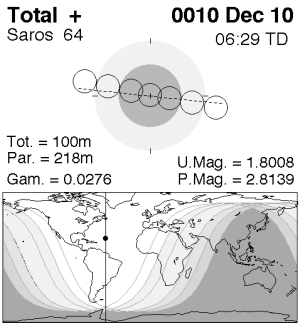
As may be seen above and below there was a total
lunar eclipse on December 10, 10 CE, i.e. less than four months following
Augustus’ death:
But why did Josephus use a reverse count for
Augustus’ reign?
Let’s remember that Josephus was a Jewish
priest. Time reckoning and the proper
rules for recording various time periods should be among the most sacred
objectives for Josephus as a priest. One
of the most sacred rules for counting and recording time is taught us through
the ante type of counting towards and keeping the Feast of Weeks. The counting
of time towards the Feast of Weeks, Hag Ha-Shavout, is a special annual lesson
for all, designed to make as many as will do so consider how the 49 year Sabbath
Cycles and the years of Jubilee are to be kept in order for blessings to
result. I’ve discussed the basis for a correct keeping of the Hag Ha-Shavout in a
special article which I would like for all interested to seriously
consider.
May I suggest this rational for the
recording of sacred counts of time based upon directives given by Yahweh, the
Creator, on the one hand, and on the other secular counts of time, based upon
ungodly, baseless, and erroneous foundations:
The creator has created everything in the entire universe upon solid
foundations. Cause and effect is one of
the most basic foundation stones of our existence. Man has a strong tendency to run ahead of
himself, do things prematurely, to keep on adding one error upon another, and
to rely on and delegate his powers to others when he is given the freedom and
authority to retain the Power Of Choice for himself, others who neither can,
nor will, take responsibility for another.
In the sacred way of counting as taught in the 50 year count of 49 years
towards the Feast of Weeks and the year of Jubilee, both the beginning partial
day/year and the final partial day/year are to be included according to the
biblical instructions - as also demonstrated in my Shavout article
as also referenced above.
However,
that still does not tell us why Josephus used a reverse count for Augustus,
when most certainly he knew which day Augustus died, does it? In comparison to many other rulers, it
appears that Augustus was a very wise emperor who was able to accomplish much
peace throughout the Roman Empire.
After his death apparently he was considered divine:
“…the
inscription of Tibur (called the lapis tiburtinus)… The phrase “divi Augusti” is
part of the text. This title, showing that the Senate reckoned Augustus as
divine, was only bestowed on him after Augustus’ death” (Martin, Earnest L., The
Star that Astonished the World)
Apparently
Josephus thought very highly of Augustus.
One of the primary differences between good and evil is life, life in
contradistinction to death. Such ones as
works towards more quality of life may be considered good, whereas such as
works towards death and suffering may be considered wicked or evil. True conversion should make one turn towards
the source and beginning of life, towards the One God, Yahweh Elohim, the One
that made heaven, and earth, and the sea, and the fountains of waters, the One
God located at the beginning of time.
Failing such conversion one is by default headed for death and
destruction.
One way
for Josephus, the priest and historian, to signify secretly that he thought
very highly of Augustus would be to count Augustus’ reign in the direction
towards the beginning of his reign, towards his source, towards the Creator of
life, and towards the One God who alone has power to give powers of any kind at
all, whether to kings, emperors, or anyone. At the same time a reverse count which
does not include the year of death will symbolically signify the worthlessness
of death as a basis for anything. Now,
doesn’t it make a lot of sense for Josephus not to count the year of death as
part of the total tally of years for Augustus’ reign? Doesn’t it make sense for Josephus to count
the years of Augustus in a reverse manner?
Additionally the number 58 is a number associated in the bible with
victory over severe trials. The fact
that Augustus reign lasted more than 57½ years when counted in a reverse manner
could have been a contributing factor in the mind of Josephus as well, who
knows?
After finding that Josephus is using
reverse counts also for some of the other Caesars, I find that perhaps his
choice of doing so may be either arbitrary, perhaps based upon a desire to
pinpoint exactly the beginning date, or else possibly when the new emperor is
not of the same family as the former.
Quoting Josephus:
“2. As Coponius, who we told you was sent
along with Cyrenius, was exercising his office of procurator, and governing
Judea, the following accidents happened. As the Jews were celebrating the feast
of unleavened bread, which we call the Passover, it was customary for the
priests to open the temple-gates just after midnight. When, therefore, those
gates were first opened, some of the Samaritans came privately into Jerusalem,
and threw about dead men's bodies, in the cloisters; on which account the Jews
afterward excluded them out of the temple, which they had not used to do at
such festivals; and on other accounts also they watched the temple more
carefully than they had formerly done. A little after which accident Coponius
returned to Rome, and Marcus Ambivius came to be his successor in that
government; under whom Salome, the sister of king Herod, died, and left to
Julia, [Caesar's wife,] Jamnia, all its toparchy, and Phasaelis in the plain,
and Arehelais, where is a great plantation of palm trees, and their fruit is
excellent in its kind. After him came Annius Rufus, under whom died Caesar, the
second emperor of the Romans, the duration of whose reign was fifty-seven
years, besides six months and two days (of which time Antonius ruled together
with him fourteen years; but the duration of his life was seventy-seven years);
upon whose death Tiberius Nero, his wife Julia's son, succeeded. He was now the
third emperor; and he sent Valerius Gratus to be procurator of Judea, and to
succeed Annius Rufus. This man deprived Ananus of the high priesthood, and
appointed Ismael, the son of Phabi, to be high priest. He also deprived him in
a little time, and ordained Eleazar, the son of Ananus, who had been high
priest before, to be high priest; which office, when he had held for a year,
Gratus deprived him of it, and gave the high priesthood to Simon, the son of
Camithus; and when he had possessed that dignity no longer than a year, Joseph
Caiaphas was made his successor. When Gratus had done those things, he went
back to Rome, after he had tarried in Judea eleven years, when Pontius Pilate
came as his successor.” (Josephus, Antiquities XVIII:2:2.)
Notice in the above passage how that the
translator makes it appear as though Caesar Augustus died under Annius Rufus
and prior to the accession of Tiberius Nero. Is this statement of Josephus
sufficient basis for disproving the within revision of history as based upon
exact astronomical records and historical records of many celestial events? If
not, does it represent an error on the part of Josephus? Or perhaps it is a
translation error based upon a correct Hebrew or possibly Greek original? Or, is it sufficient to say that every ruler
succeeding a prior ruler is also under such prior ruler? Thus, if Augustus did
indeed die under Valerius Gratus, he also died under Annius Rufus, didn’t he?
And “upon [Augustus’] death Tiberius Nero… succeeded [de facto as] the third
emperor,” though Tiberius de jure reign began June 26, 1 BCE when he was in
fact appointed as the heir of Augustus and after which date it appears as
though Augustus did retire from his post of duty in all but title, while
transferring most or all of the responsibilities to Tiberius.
Greek rendition of Josephus’ passage above:
“[29]
Κωπωνίου δὲ τὴν
Ἰουδαίαν
διέποντος, ὃν ἔφην
Κυρινίῳ
συνεκπεμφθῆναι,
τάδεπράσσεται.
τῶν ἀζύμων τῆς ἑορτῆς
ἀγομένης, ἣν
πάσχα καλοῦμεν,
ἐκ μέσηςνυκτὸς
ἐν ἔθει τοῖς ἱερεῦσιν
ἦν ἀνοιγνύναι
τοῦ ἱεροῦ τοὺς
πυλῶνας.
“[30]
καὶ τότε οὖν ἐπεὶ
τὸ πρῶτον
γίνεται ἡ ἄνοιξις
αὐτῶν, ἄνδρες
Σαμαρεῖταικρύφα
εἰς Ἱεροσόλυμα
ἐλθόντες
διάρριψιν ἀνθρωπείων
ὀστῶν ἐν ταῖς
στοαῖς καὶδιὰ
παντὸς τοῦ ἱεροῦ
ἤρξαντο μὴ
πρότερον ἐπὶ
τοιούτοις
νομίζοντες τά
τε ἄλλαδιὰ
φυλακῆς
μείζονος ἦγον
τὸ ἱερόν.
“[31]
καὶ Κωπώνιος
μετ᾽ οὐ πολὺ εἰς
Ῥώμην ἐπαναχωρεῖ,
διάδοχος δ᾽ αὐτῷ
τῆςἀρχῆς
παραγίνεται Μᾶρκος
Ἀμβιβουχος, ἐφ᾽
οὗ καὶ Σαλώμη ἡ
τοῦ βασιλέωςἩρώδου
ἀδελφὴ μεταστᾶσα
Ἰουλίᾳ μὲν Ἰάμνειάν
τε καταλείπει
καὶ τὴντοπαρχίαν
πᾶσαν, τήν τ᾽ ἐν
τῷ πεδίῳ
Φασαηλίδα καὶ Ἀρχελαΐδα,
ἔνθα
φοινίκωνπλείστη
φύτευσις καὶ
καρπὸς αὐτῶν ἄριστος.
“[32]
διαδέχεται δὲ
καὶ τοῦτον Ἄννιος
Ῥοῦφος, ἐφ᾽
οὗ δὴ καὶ
τελευτᾷ Καῖσαρ,δεύτερος
μὲν Ῥωμαίων αὐτοκράτωρ
γενόμενος ἑπτὰ
δὲ καὶ
πεντήκοντα τῆς
ἀρχῆςἔτη, πρὸς
οἷς μῆνες ἓξ ἡμέραι
δυοῖν
πλείονες,
τούτου δὲ αὐτῷ
τοῦ
χρόνουδεκατέσσαρα
ἔτη συνῆρξεν Ἀντώνιος,
βιώσας ἔτη ἑβδομηκονταεπτά.
“[33]
διαδέχεται
δὲ τῷ Καίσαρι τὴν
ἡγεμονίαν
Τιβέριος Νέρων γυναικὸς
αὐτοῦἸουλίας
υἱὸς ὤν, τρίτος ἤδη
οὗτος αὐτοκράτωρ,
καὶ πεμπτὸς ὑπ᾽
αὐτοῦ παρῆνἸουδαίοις
ἔπαρχος
διάδοχος Ἀννίῳ
Ῥούφῳ Οὐαλέριος
Γρᾶτος:
“[34]
ὃς παύσας ἱερᾶσθαι
Ἄνανον Ἰσμάηλον
ἀρχιερέα ἀποφαίνει
τὸν τοῦ Φαβί, καὶτοῦτον
δὲ μετ᾽ οὐ πολὺ
μεταστήσας Ἐλεάζαρον
τὸν Ἀνάνου τοῦ ἀρχιερέως
υἱὸνἀποδείκνυσιν
ἀρχιερέα. ἐνιαυτοῦ
δὲ
διαγενομένου
καὶ τόνδε
παύσας Σίμωνι
τῷΚαμίθου τὴν ἀρχιερωσύνην
παραδίδωσιν.
“[35]
οὐ πλείων δὲ καὶ
τῷδε ἐνιαυτοῦ
τὴν τιμὴν ἔχοντι
διεγένετο
χρόνος, καὶἸώσηπος
ὁ καὶ Καϊάφας
διάδοχος ἦν αὐτῷ.
καὶ Γρᾶτος μὲν
ταῦτα πράξας εἰςῬώμην
ἐπανεχώρει ἕνδεκα
ἔτη διατρίψας ἐν
Ἰουδαίᾳ,
Πόντιος δὲ Πιλᾶτοςδιάδοχος
αὐτῷ ἧκεν.”
(Flavius Josephus, Antiquitates Judaicae (ed. B. Niese) 18:29.)
Notice:
“τελευτᾷ”
means “to
complete, finish, accomplish” not necessarily “die.”
“διαδέχεται”
means “to
receive one from another” not die.
“ἡγεμονίαν”
means “a
leading the way, going first” or “authority,
rule, political supremacy, imperium, principality, governorship.”
Accordingly I conclude that Josephus’ text
as given in Greek provides no basis for concluding that Tiberius’ reign began
only after the death of Augustus. The Greek text certainly allows for Tiberius’
governorship as co-ruler with Augustus beginning June 26, 1 BCE, and thus also
for Gratus’ appointment beginning shortly after June 26, 1 BCE.
Conclusions:
§
Augustus was born
September 23, 67 BCE [Note: September 23, 67 BCE is a pre-Caesar Julius’
calendar revision date. September 23, 67 BCE in a corrected
calendar comes out to Elul 24 or 25, 67 BCE, but this date is not when
Augustus was born.]
§
Augustus’ (seasonally
corrected) date of delivery was June 28 [Sivan (or Tammuz) 26 (or 27), 67
BCE; Notice the number 26 as well as 3, i.e. the Third Moon, Sivan!] Augustus’ mother’s
calculated LMP was September 21 (seasonally corrected) [Elul or Tishri 11, 68
BCE; Notice its relationship to the Day of At-One-Ment!] and Augustus was most
likely conceived October 4 (seasonally corrected) [Tishri 21, 68 BCE; Notice
its relationship to the Eighth Day and the beginning of the Scriptural year!] [Quickening
may be associated with Capricorn, however, using an astrological chart based on
the uncorrected pre-Julian calendar reform finds Augustus being conceived in
the sign of Capricorn.]
§
The beginning of
Augustus’ reign: Adar
27 or 28, 47 BCE [April 1 or 2, 47 BCE ± 1 lunar month (March 3 or May 1)]
§
Augustus died “on the
fourteenth day before the Kalends of September at the ninth hour, just
thirty-five days before his seventy-sixth birthday,” i.e. Av 19 or 20, 10 CE
[August 19, 10 CE,]
III. Tiberius Caesar’s reign:
Quoting
Augustus Caesar:
“A third time, with the consular
imperium, p359and with my son Tiberius Caesar as my colleague, I performed
the lustrum in the consulship of Sextus Pompeius and Sextus Apuleius.37” (The
Res Gestae of Augustus, Monumentum Ancyranum, Part II)
- For the benefit of anyone who may claim
that Tiberius was not named Caesar until after Augustus’ death…
Quoting
Suetonius:
“5 Some have supposed that Tiberius was
born at Fundi, on no better evidence than that his maternal grandmother was a
native of that place, and that later a statue of Good Fortune was set up there
by decree of the senate. But according to the most numerous and trustworthy
authorities, he was born at Rome, on the Palatine, the sixteenth day before the
Kalends of December, in the consulship of Marcus Aemilius Lepidus and Lucius
Munatius Plancus (the former for the second time) while the war of Philippi was
going on. In fact it is so recorded both in the calendar and in the public
gazette. Yet in spite of this some write that he was born in the preceding
year, that of Hirtius and Pansa, and others in the following year, in the
consulate of Servilius Isauricus and Lucius Antonius.”
“73 Meanwhile, having read in the
proceedings of the senate that some of those under accusation, about whom he
had written briefly, merely stating that they had been named by an informer,
had been discharged without a hearing, he cried out in anger that he was held
in contempt, and resolved to return to Capreae at any cost, since he would not
risk any step except from his place of refuge. Detained, however, by bad
weather and the increasing violence of his illness, he died a little later in
the villa of Lucullus, in the seventy-eighth year of his age and the
twenty-third of his reign, on the seventeenth day before the Kalends of April,
in the consulship of Gnaeus Acerronius Proculus and Gaius Pontius Nigrinus.”
Quoting
Ronald L. Conte Jr:
“If Augustus died in A.D. 10, then
Tiberius’ sudden rise to power began in mid 1 B.C.E. Tiberius was adopted as
heir to Augustus on June 26.” (From Ronald L. Conte Jr with reference to
Finegan, Handbook of Biblical Chronology, revised edition, no. 183 and table
42, p. 86.)
Let’s see how this fits Josephus’
statements:
1. “Tiberius… died, after he had held the government twenty-two
years five months and three days”
(Josephus,
Antiquities, XVIII, Chapter 6:10.)
2. “This was told to
Tiberius by one of Agrippa's domestics, who thereupon was very angry, and
ordered Agrippa to be bound, and had him very ill-treated in the prison for six
months, until Tiberius died, after he had reigned twenty-two years, six months, and three days.”
(Josephus,
Wars of the Jews, II, Ch. 9:5.)
3. “Suetonius states that Tiberius died on March 16.976”
976 Suetonius, The
Twelve Caesars, p. 150. See also: Suetonius, Lives of the Caesars,
Loeb Classical Library, 3.73.1.
(Conte,
Important Dates in the Lives of Jesus and Mary.)
4. “Dio… states that Tiberius died on March 26, after a reign
of 22 years, 7 months, and 7 days.977.“
977 Dio, Roman
History, Volume VII, Loeb Classical Library, 58.28.5.
(Conte,
Important Dates in the Lives of Jesus and Mary.)
Two Calendars used by Josephus
for the year of Tiberius’ death?
1. Adding “five months” we arrive at the beginning of Adar 1, 23
CE. Adding a final “after [not in…] three
days” gives us the date of Tiberius’ death as Adar 4, 23 CE [i.e.
February 14, or else March 15 or 16, 23 CE, depending on the preceding
aviv and New Moons.]
2. Adding “six months” we arrive at the beginning of Adar II 1, 23
CE. Adding a final “after [not in…] three days” gives us the date of Tiberius’
death as Adar II 4, 23 CE [i.e. March 15 or 16, 23 CE.]
Notice that for the years 16 CE until 42
CE, 23 CE is the only year where the 4th day of a biblical month may possibly
fall on March 16, a fact which is strong confirmation for this being the
correct year of Tiberius’ death. Dio provides further confirmation, cf. below!
“Dio and Suetonius both place Tiberius’
death in the month of March…” and “Suetonius states that Tiberius died on March
16.” Quoting further from Ronald L.
Conte Jr.: “The ancient historians Josephus, Dio, and Suetonius… all give the
length of [Tiberius’] reign as greater than 22 years and less than 23
years.” (However, cf. the discussion about
Dio below.)
The one likely reason I’ve found so far for
why Josephus is writing “five months” in one book and “six months” in the other
book is simply that - probably due to an unusually late aviv in 22 CE - there
existed two different Jewish calendars for the year starting in 22 CE. March 14 (or 15), 23 CE would then correspond
to Adar 3, 23 CE in one calendar while in the other the same day corresponds to
Adar II 3, 23 CE. However, Adar 3 occurs
“five months, and three days” into the civil year, while Adar II 3 occurs “six
months, and three days, into the civil year.
Thus both statements of Josephus are correct, while Josephus is telling
us also that two different Hebrew calendars existed that particular year.
[Note re sacred vs. civil years: Mostly in
his work Wars of the Jews I have found that Josephus is using a sacred year
calendar beginning in Abib. After studying this usage I conclude that Josephus
uses sacred years when referencing points in time during civil war.]
An
important confirmation and a note re Dio: If Dio is correct and if he is using
a Julian calendar and if Tiberius died March 26, 23 CE, then Tiberius’ reign
began September 19 or 20, 1 BCE depending upon whether or not Dio is counting
the days inclusively. It is important to notice that Tishri 1, 1 BCE may well
correspond to September 19, 1 BCE, which is evidence that Dio is basing his
count of Tiberius’ reign upon a Jewish source, very possibly upon Josephus?,
while probably not fully understanding all the intricacies of the time
reckoning used by his Jewish source. However, the fact that his date falls on
Tishri 1 is strong confirmation that indeed Tiberius’ reign began in 1 BCE,
because from 11 BCE through 18 CE only 1
BCE and 8 CE allows for Tishri 1 to fall on either September 19 or 20, i.e. it
is a relatively rare incidence.
Re
Tiberius’ birth:
Given that Tiberius died March 16, 23 CE “in the seventy-eighth year of his age” and that he
was born “the sixteenth day before the Kalends of
December,” i.e. on November 16, we may now easily calculate
Tiberius’ year of birth: 23 CE – 78 = - 55 = 56 BCE. Thus Tiberius was born
November 16, 56 BCE. That is in a seasonally unadjusted pre-Julian reform
calendar. Adjusting this date to a seasonally corrected calendar in harmony
with the celestial bodies may be made thusly:
Recognizing that Caesar Julius corrected
the drifting Roman calendar years by making not 46 BCE (relative to the
conventional 44 BCE of Julius’ death,) but 51 BCE (revised date for Julius’
death being 49 BCE,) 445 days long, we may extrapolate as follows:
1. Assuming that 50 BCE was synchronous with the seasons as
intended;
2. Assuming also that the year of the founding of Rome (April 21,
753 BCE) was likewise synchronous with the seasons;
3. Assuming that the drift of the year from year to year was more
or less the same over the interval 753-50 BCE we may then extrapolate the total
drift which should be 365.25-445=79.75 days total, or about
79.75/(753-50)=79.75/703=0.113 days per year.
4. Tiberius was born (conception or delivery?) November 16, 56 BCE.
5. 56 BCE is 56-50=6 years before Julius’ calendar reform, thus the
correction should be 6x.113=0.68 days.
6. Accordingly, if the total correction was 90 days then the
appropriate correction should be 90-1=89 days in 56 BCE.
7. If the contemporary calendar read November 16 of that year when
Tiberius was born [conception or delivery?] then the seasonally corrected date
should be about 89 days prior to November 16. Counting November=16 days,
October=31 days, September=30 days I get 77 days total, which should bring me
to August 22 for Tiberius’ birthday (conception or delivery?)
8. If Tiberius’ seasonally corrected date of delivery EDC was
August 22 [Av (or Elul) 24 (or 25), 56 BCE] then his mom’s LMP should have been
November 15 [Heshvan 27, 57 BCE] and he should have been conceived around
November 26 [Chisleu 9, 57 BCE.]
9. Else if Tiberius’ seasonally corrected date of conception was
August 22 [Av (or Elul) 24 (or 25), 56 BCE] then his mom’s LMP should have been
August 11 [Av (or Elul) 13 (or 14), 56 BCE] and he should have been delivered
around May 18 [Zif/Ijjar 27, 55 BCE.]
Furthermore, this date may be confirmed by
the following words…
Tiberius’ astrologer Marcus Manilius had
this to say about him:
''Sed, cum autumnales coeperunt surgere Chelae,
felix aequato genitus sub pondere Librae. iudex examen sistet vitaeque necisque
imponetque iugum terris legesque rogabit. illum urbes et regna trement nutuque
regentur unius et caeli post terras iura manebunt.''
"When Autumn claws begin to rise, blessed
is the man born under the scales of Libra. As a judge he places the balance of
life and death: he will make laws and impose his yoke over the world. Cities
and kingdoms will tremble before him and be ruled by his will alone, and after
his time on earth, command of the heavens will await him."
(Astronomica
liber quartus, lines 547-552; Translation by Legis Nuntius.)
That is, after noticing also that Mars was
in Libra from Mars 24, 56 BCE – September 5, 56 BCE and that neither the sun,
moon, or any of the planets are in Libra on any of the other above dates in 55
or 57 BCE, or isn’t that so? And isn’t it relevant that it is Mars that is in
Libra considering that Tiberius was very much a general and a military man of
war?
Conclusions:
§ Tiberius was born on November 16, 56 BCE (as dated per the then
current Roman calendar) and on August 22, 56 BCE per a seasonally adjusted
calendar [Av (or Elul) 24 (or 25), 56 BCE.]
§
Tiberius was
appointed the heir of Augustus on June 26, 1 BCE [Tammuz 4 or 5, 1 BCE].
§
Tiberius died on 4
Adar I/Adar II, 23 CE [March 16, 23 CE.]
§
I find that Josephus
and Suetonius are in perfect agreement within them selves as well as with one
another, while Dio provides confirmatory evidence for these same data albeit
apparently not in full agreement while, as it may appear, Dio does not fully
comprehend the method of reckoning used by his Jewish source, which source may
well be Josephus.
§
Based upon Josephus’
dates as given while considering also the dates for the beginning of the last
prior Aviv, I conclude that most likely two different Hebrew calendars were in
use that year, such that Adar I of one calendar was concurrent with Adar II of
the other.
IV. Caius (Caligula) Caesar’s reign:
Quoting Suetonius:
“58 On the
ninth day before the Kalends of February at about the seventh hour he hesitated
whether or not to get up for luncheon,
since his stomach was still disordered from excess of food on the day before,
but at length he came out at the persuasion of his friends. In the covered
passage p495 through which he had to
pass, some boys of good birth, who had been summoned from Asia to appear on the
stage, were rehearsing their parts, and he stopped to watch and to encourage
them; and had not the leader of the troop complained that he had a chill, he
would have returned and had the performance given at once. 2 From this point
there are two versions of the story: some say that as he was talking with the
boys, Chaerea came up behind, and gave him a deep cut in the neck, having first
cried, "Take that,"108 º and that then the tribune Cornelius Sabinus, who was the
other conspirator and faced Gaius, stabbed him in the breast. Others say that
Sabinus, after getting rid of the crowd through centurions who were in the
plot, asked for the watchword, as soldiers do, and that when Gaius gave him
"Jupiter," he cried "So be it,"109 and as Gaius looked around, he split his jawbone with a
blow of his sword. 3 As he lay upon the ground and with writhing limbs
called out that he still lived, the others dispatched him with thirty wounds;
for the general signal was "Strike again." Some even thrust their
swords through his privates. At the beginning of the disturbance his bearers
ran to his aid with their poles,110 and presently the Germans
of his body-guard, and they slew several of his assassins, as well as some
inoffensive senators.
“59 He lived twenty-nine years and ruled three years, ten months and
eight days…”
(Suetonius,
The Lives of the Caesars, The Life of
Caligula, 58-59)
Quoting Ronald L. Conte Jr.:
Josephus gives the length of his
reign as 3 years and 8 months.978
978 Josephus, The Antiquities of the Jews, 19.201; The
Wars of the Jews, 2.204.
Suetonius, however, gives the
length of Gaius’ reign as 3 years, 10 months and 8 days.979
979 Suetonius, The Twelve Caesars, p. 183. See also:
Suetonius, Lives of the Caesars, Loeb Classical Library, 4.59.
Dio gives the length of his reign
as 3 years, 9 months and 28 days.980
980 Dio, Roman History, Volume VII, Loeb Classical Library,
59.30.1.
Dio records Caesar Claudius issuing a
proclamation re a solar eclipse on his birthday, August 1, 26 CE. This apparent
problem
[The beginning of the 202st Olympic year:
July 1, 23 CE.]
Quoting
Josephus:
“5. This was the end of Caius, after he had reigned four years, within four months.
He was, even before he came to be emperor, ill-natured, and one that had
arrived at the utmost pitch of wickedness; a slave to his pleasures, and a
lover of calumny;” Josephus, The Antiquities of the Jews, XIX:2:5
“1. NOW when
Caius had reigned three year's and eight months, and had been
slain by treachery, Claudius was hurried away by the armies that were at Rome
to take the government upon him; but…” Josephus, The Wars of the Jews,
II:11:1
Review of dated events in Caius’ life:
Caligula Gaius Caesar was appointed the
heir of Tiberius Caesar while Tiberius was still alive (Biography by Suetonius,
i.e. per Svensk Uppslagsbok; Caligula.) As will be seen below, the date
of Gaius’ death, which latter date is also the beginning of his
successor, Claudius Caesar, may be exactly determined as January 24, 27 CE
based upon the records of Josephus, Suetonius and Tacitus. Using a
reverse count such as Josephus used also for Augustus the day of appointment for
Claudius as Tiberius’ successor has been found, i.e. February 10, 27 CE. (Cf.
below!)
“3.
So Vitellius prepared to make war with Aretas, having with him
two legions of armed men; he also took with him all those of light armature,
and of the horsemen which belonged to them, and were drawn out of those
kingdoms which were under the Romans, and made haste for Petra, and came to
Ptolemais. But as he was marching very busily, and leading his army
through Judea, the principal men met him, and desired that he would not
thus march through their land; for that the laws of their country would not
permit them to overlook those images which were brought into it, of which there
were a great many in their ensigns; so he was persuaded by what they said, and
changed that resolution of his which he had before taken in this matter.
Whereupon he ordered the army to march along the great plain, while he himself,
with Herod the tetrarch and his friends, went up to Jerusalem to offer
sacrifice to God, an ancient festival of the Jews being then just approaching;
and when he had been there, and been honorably entertained by the multitude of
the Jews, he made a stay there for three days, within which time he
deprived Jonathan of the high priesthood, and gave it to his brother Theophilus.
But when on the fourth day letters came to him, which
informed him of the death of Tiberius, he obliged the multitude to take an oath
of fidelity to Caius; he also
recalled his army, and made them every one go home, and take their winter quarters there,
since, upon the devolution of the empire upon
Caius, he had not the like authority of making this war which he
had before…
[Given that Tiberius died on March 16, 23
CE it follows that the above events are subsequent to said date…]
“It was also reported, that when Aretas
heard of the coming of Vitellius to fight him, he said, upon his consulting the
diviners, that it was impossible that this army of Vitellius's could enter
Petra; for that one of the rulers would die, either he that gave orders for the
war, or he that was marching at the other's desire, in order to be subservient
to his will, or else he against whom this army is prepared. So Vitellius truly
retired to Antioch; but Agrippa, the son of Aristobulus, went up to Rome,
a year before the death of Tiberius, in order to
treat of some affairs with the emperor, if he might be permitted so to do.”
Josephus, Antiquities, XVIII:5:3
[Apparently Agrippa “went up to Rome” prior
to Tishri 22, 22 CE, possibly even prior to Tishri 22, 21 CE, i.e. if “a year
before” means “one full year before and not merely “in a year prior to the year
of Tiberius’ death.”]
“5. Now as the friendship which
Agrippa had for Caius was come to a great height, there happened some
words to pass between them, as they once were in a chariot together, concerning
Tiberius; Agrippa praying [to God] (for they two sat by themselves) that
Tiberius might soon go off the stage, and leave the government to Caius, who
was in every respect more worthy of it. Now Eutychus,
who was Agrippa's freed-man, and drove his chariot, heard these words,
and at that time said nothing of them; but when Agrippa accused him of stealing
some garments of his, (which was certainly true,) he ran away from him; but
when he was caught, and brought before Piso, who was governor of the city, and
the man was asked why he ran away, be replied, that he had somewhat to
say to Caesar, that tended to his security and preservation: so Piso bound him, and sent him to Capreae. But Tiberius, according to his usual custom, kept him still in bonds, being a delayer of affairs…” Josephus, Antiquities, XVIII:6:5.
[These events transpired subsequent to the
time when Agrippa “went up to Rome” and the late summer 22 CE when Agrippa was
imprisoned some six months prior to Tiberius’ death.]
“6. On this account it was that Eutychus
could not obtain a bearing, but was kept still in
prison. However, some time
afterward, Tiberius came from Capreae to Tusculanum, which is
about a hundred furlongs from Rome. Agrippa then desired of Antonia that
she would procure a hearing for Eutychus, let the matter whereof he
accused him prove what it would. Now Antonia was greatly esteemed by Tiberius
on all accounts… Then Tiberius asked him
what he had to say against a man who had given him his liberty. Upon which he
said, "O my lord! this Caius, and Agrippa with him, were once riding in a
chariot, when I sat at their feet, and, among other discourses that passed,
Agrippa said to Caius, Oh that the day would once come when this old fellow
will dies and name thee for the governor of the habitable earth! for then this
Tiberius, his grandson, would be no hinderance, but would be taken off by thee,
and that earth would be happy, and I happy also." Now Tiberius took these to be truly Agrippa's words, and
bearing a grudge withal at Agrippa, because, when he had commanded him
to pay his respects to Tiberius, his grandson, and the son of Drusus, Agrippa
had not paid him that respect, but had disobeyed his commands, and transferred
all his regard to Caius; he said to Macro,
"Bind this man…
“It was also very
hot weather…” Josephus, Antiquities, XVIII:6:6.
[Ditto (cf. my note above!)]
“7. Now Agrippa stood in his bonds before
the royal palace… And this was Agrippa's
condition for six months' time, and in this case were his
affairs.” Josephus, Antiquities, XVIII:6:7.
“8. But for Tiberius, upon his return
to Caprein, he fell sick. At first his distemper was
but gentle; but as that distemper increased upon him, he had
small or no hopes of recovery. Hereupon he bid Euodus, who was
that freed-man whom he most of all respected, to bring the children (23)
to him, for that he wanted to talk to them before he died…” Josephus, Antiquities,
XVIII:6:8.
“9. But when Tiberius had given order
to Euodus to bring the children to him the next day in the morning, he
prayed to his country gods to show him a manifest signal which of those
children should come to the government…
“This was the speech which Tiberius made,
which did not persuade Caius to act accordingly, although he
promised so to do; but when he was settled in the government, he
took off this Tiberius [i.e. Caesar’s grandson, /ed.,] as was predicted by the
other Tiberius; as he [Caesar Tiberius /ed.] was also himself,
in no long time afterward, slain by a secret plot laid against him.”
Josephus, Antiquities XVIII:6:9.
“10. So when
Tiberius had at this time appointed Caius to be his successor, he outlived but a few days, and then died,
after he had held the government twenty-two years five months and three days.”
Josephus, Antiquities, XVIII:6:10
[From these passages it is clear that
Tiberius’ illness began prior to the time when he “appointed Caius to be his
successor.” Counting from sunset February 10, 23 CE [Tevet/Shevat 1, 23 CE,]
there are indeed “but a few days” before Tiberius died on March 16, 23 CE, i.e.
18+15=33 days.]
There was a delay in setting Agrippa free
due to funeral and mourning traditions, which
pushes the end, and thus also the beginning, of said six months period forwards
in time, probably by several weeks or even months:
The end point of the “six months” “condition” of
Agrippa may well reference a day one or two days after the death of Tiberius
rather than Agrippa’s full release out of custody and his appointment as king.
Notice especially that “…although he was still in custody” Agrippa’s “evil condition” was apparently discontinued
when “the next day… Caius… gave order that Agrippa should be removed out of the camp,
and go to that house where he lived before he was put in prison.”
“10. So when Tiberius had at
this time appointed Caius to be his successor, he outlived but a few days, and
then died, after he had held the government twenty-two years five
months and three days. Now Caius was the fourth emperor. But when the
Romans understood that Tiberius was dead, they rejoiced at the good news, but
had not courage to believe it; not because they were unwilling it
should be true, for they would have given huge sums of money that it might be
so, but because they were afraid, that if they had showed their joy when the
news proved false, their joy should be openly known, and they should be accused
for it, and be thereby undone. For this Tiberius had brought a vast number of
miseries on the best families of the Romans, since he was easily inflamed with
passion in all cases, and was of such a temper as rendered his anger
irrevocable, till he had executed the same, although he had taken a hatred against
men without reason; for he was by nature fierce in all the sentences he gave,
and made death the penalty for the lightest offenses; insomuch that when the
Romans heard the rumor about his death gladly, they were restrained from the
enjoyment of that pleasure by the dread of such miseries as they foresaw would
follow, if their hopes proved ill-grounded. Now Marsyas, Agrippa's
freed-man, as soon as he heard of Tiberius's death, came running to tell
Agrippa the news; and finding him going out to the bath, he gave him a
nod, and said, in the Hebrew tongue, "The lion (26) is dead;" who,
understanding his meaning, and being ovejoyed at the news, "Nay,"
said he, "but all sorts of thanks and happiness attend thee for this news
of thine; only I wish that what thou sayest may prove true." Now the
centurion who was set to keep Agrippa, when he saw with what haste
Marsyas came, and what joy Agrippa had from what he said, he had a suspicion
that his words implied some great innovation of affairs, and he asked them
about what was said. They at first diverted the discourse; but upon his further
pressing, Agrippa, without more ado, told him, for he was already become his
friend; so he joined with him in that pleasure which this news occasioned,
because it would be fortunate to Agrippa, and made him a supper. But as
they were feasting, and the cups went about, there came one who said that
Tiberius was still alive, and would return to the city ill a few days. At which
news the centurion was exceedingly troubled, because he had done what might
cost him his life, to have treated so joyfully a prisoner, and this upon the
news of the death of Caesar; so he thrust Agrippa from the couch whereon he
lay, and said, "Dost thou think to cheat me by a lie about the emperor
without punishment? and shalt not thou pay for this thy malicious
report at the price of thine head?" When he had so said, he ordered
Agrippa to be bound again, (for he had loosed him before,) and kept a severer
guard over him than formerly, and in that evil condition was Agrippa
that night; but the next day the rumor increased in the city, and
confirmed the news that Tiberius was certainly dead; insomuch that men
durst now openly and freely talk about it; nay, some offered sacrifices on that
account. Several letters also came from Caius;
one of them to the senate, which informed them of the death of Tiberius, and of
his own entrance on the government; another to Piso, the governor of the city,
which told him the same thing. He also gave order
that Agrippa should be removed out of the camp, and go to that house where he
lived before he was put in prison; so that he was now out of
fear as to his own affairs; for although he was
still in custody, yet it was now with ease to his own affairs. Now,
as soon as Caius was come to Rome, and had
brought Tiberius's dead body with him, and had made a sumptuous funeral for
him, according to the laws of his country, he was much
disposed to set Agrippa at liberty that very day; but Antonia hindered him,
not out of any ill-will to the prisoner, but out of regard to decency in Caius,
lest that should make men believe that he received the death of Tiberius with
pleasure, when he loosed one whom he had bound immediately. However, there
did not many days pass ere he sent for him to
his house, and had him shaved, and made him change his raiment; after which he
put a diadem upon his head, and appointed him to be
king of the tetrarchy of Philip. He also gave him the tetrarchy of
Lysanias, (27) and changed his iron chain for a golden one of equal weight. He
also sent Marullus to be procurator of Judea.” Josephus, Antiquities
XVIII:6:10.
Only
a short time span between Agrippa’s becoming king and his “second year,”
or should it be translated “his next year,” as king:
The fact that Josephus seems to have
nothing to record between 1. Caius’ release of Agrippa (and his crowning
Agrippa to king,) and 2. an event in Caius’ “second year” of reign may
well be an indication that the corresponding time span is very short, i.e. less
than six months (Aviv-Elul) rather than 1 ½ years:
“10. So when Tiberius had at
this time appointed Caius to be his successor, he outlived but a few days… Now,
as soon as Caius was come to Rome, and had brought Tiberius's
dead body with him, and had made a sumptuous funeral for him, according to the
laws of his country, he was much disposed to set Agrippa at liberty that
very day; but Antonia hindered him, not out of any ill-will to the
prisoner, but out of regard to decency in Caius, lest that should make men
believe that he received the death of Tiberius with pleasure, when he loosed
one whom he had bound immediately. However, there did not many days pass ere he sent for him to his house,
and had him shaved, and made him change his raiment; after which he put a
diadem upon his head, and appointed him to be king
of the tetrarchy of Philip. He also gave him the tetrarchy of Lysanias, (27)
and changed his iron chain for a golden one of equal weight. He also
sent Marullus to be procurator of Judea.” Josephus, Antiquities XVIII:6:10.
”11. Now, in the second year of the
reign of Caius Caesar, Agrippa desired leave to be given him to sail home, and
settle the affairs of his government; and he promised to return again,
when he had put the rest in order, as it ought to be put. So, upon the
emperor's permission, he came into his own country, and appeared
to them all unexpectedly as asking, and thereby demonstrated to the men
that saw him the power of fortune, when they compared his former poverty with
his present happy affluence; so some called him a happy man, and others could
not well believe that things were so much changed with him for the better.”
Josephus, Antiquities XVIII:6:11.
[238]
Δευτέρῳ δὲ ἔτει
τῆς Γαΐου
Καίσαρος ἡγεμονίας
Ἀγρίππας ἠξίου
συγχώρησιν αὐτῷγενέσθαι
πλεύσαντι τήν
τε ἀρχὴν
καταστήσασθαι
καὶ τὰ ἄλλα εἰς
δέονοἰκονομησαμένῳ
ἐπανιέναι…
(Flavius
Josephus, Antiquitates Judaicae (ed. B. Niese.))
[The Greek word “Δευτέρῳ”
translated “second year” apparently may also be translated “next year” (cf.
entries in LSJ
and Middle
Liddell!) The context makes the latter more likely, especially considering
that the next civil year, as referenced by Josephus, would most likely not
begin before Tishri 22, 23 CE, which is already half a year after Tiberius’
death. Considering the sailing seasons and the dangers of sailing during the
winter season, most likely Agrippa sailed to Judea during the spring or summer
24 CE, or, if indeed “second year” is a correct translation, in 25 CE.]
The
last winter of Caius’ reign:
“2. Hereupon Caius, taking it
very heinously that he should be thus despised by the Jews alone, sent
Petronius to be president of Syria, and successor in the government to
Vitellius, and gave him order to make an invasion into Judea, with a
great body of troops; and if they would admit of his statue willingly, to erect
it in the temple of God; but if they were obstinate, to conquer them by war,
and then to do it. Accordingly, Petronius took the government of Syria,
and made haste to obey Caesar's epistle. He got together as great a
number of auxiliaries as he possibly could, and took with him two legions of
the Roman army, and came to Ptolemais, and there wintered,
as intending to set about the war in the spring.
He also wrote word to Caius what he had resolved to do, who commended him for
his alacrity, and ordered him to go on, and to make war with them, in case they
would not obey his commands. But there came many ten thousands of the
Jews to Petronius, to Ptolemais, to offer their petitions to him, that he would
not compel them to transgress and violate the law of their forefathers;
"but if," said they, "thou art entirely resolved to bring this
statue, and erect it, do thou first kill us, and then do what thou hast
resolved on; for while we are alive we cannot permit such things as are
forbidden us to be done by the authority of our legislator, and by our
forefathers' determination that such prohibitions are instances of
virtue." But Petronius was angry at them, and said, "If indeed I were
myself emperor, and were at liberty to follow my own inclination, and then had
designed to act thus, these your words would be justly spoken to me; but now
Caesar hath sent to me, I am under the necessity of being subservient to his
decrees, because a disobedience to them will bring upon me inevitable
destruction." Then the Jews replied, "Since, therefore, thou art so
disposed, O Petronius! that thou wilt not disobey Caius's epistles, neither
will we transgress the commands of our law; and as we depend upon the
excellency of our laws, and, by the labors of our ancestors, have continued
hitherto without suffering them to be transgressed, we dare not by any means
suffer ourselves to be so timorous as to transgress those laws out of the fear
of death, which God hath determined are for our advantage; and if we fall into
misfortunes, we will bear them, in order to preserve our laws, as knowing that
those who expose themselves to dangers have good hope of escaping them, because
God will stand on our side, when, out of regard to him, we undergo afflictions,
and sustain the uncertain turns of fortune. But if we should submit to thee, we
should be greatly reproached for our cowardice, as thereby showing ourselves
ready to transgress our law; and we should incur the great anger of God also,
who, even thyself being judge, is superior to Caius." ” Josephus, Antiquities
XVIII:8:2.
[The above transpired in the fall and early
winter season, 26 CE.]
“3. When Petronius saw by their words that
their determination was hard to be removed, and that, without a war, he should
not be able to be subservient to Caius in the dedication of his statue, and
that there must be a great deal of bloodshed, he took his friends, and the
servants that were about him, and hasted to Tiberias, as wanting to know in
what posture the affairs of the Jews were; and many ten thousands of the Jews
met Petronius again, when he was come to Tiberias. These thought they must run
a mighty hazard if they should have a war with the Romans, but judged that the
transgression of the law was of much greater consequence, and made supplication
to him, that he would by no means reduce them to such distresses, nor defile
their city with the dedication of the statue. Then Petronius said to them,
"Will you then make war with Caesar, without considering his great
preparations for war, and your own weakness?" They replied, "We will
not by any means make war with him, but still we will die before we see our
laws transgressed." So they threw themselves down upon their faces,
and stretched out their throats, and said they were ready to be slain; and this
they did for forty days together, and in the mean time left
off the tilling of their ground, and that while the
season of the year required them to sow it [I.e. during
the 8th and 9th months, i.e. October-December. Editor’s
comment.] (31) Thus they continued firm in their resolution, and proposed to
themselves to die willingly, rather than to see the dedication of the statue. ”
Josephus, Antiquities XVIII:8:3.
[The above transpired during the 8th and
9th months, i.e. October-December, 26 CE.]
“7. But king Agrippa,
who now lived at Rome, was more and more in the
favor of Caius; and when he had once made him a supper, and was careful
to exceed all others, both in expenses and in such preparations as might
contribute most to his pleasure; nay, it was so far from the ability of others,
that Caius himself could never equal, much less exceed it (such care had he
taken beforehand to exceed all men, and particularly. to make all agreeable to
Caesar); hereupon Caius admired his understanding and magnificence, that he
should force himself to do all to please him, even beyond such expenses as he
could bear, and was desirous not to be behind Agrippa in that generosity which
he exerted in order to please him. So Caius, when he had drank wine
plentifully, and was merrier than ordinary, said thus during the feast, when
Agrippa had drunk to him: "I knew before now how great a respect
thou hast had for me, and how great kindness thou hast shown me, though with
those hazards to thyself, which thou underwentest under Tiberius on that
account; nor hast thou omitted any thing to show thy good-will towards us, even
beyond thy ability; whence it would be a base thing for me to be conquered by
thy affection. I am therefore desirous to make thee amends for every thing in
which I have been formerly deficient; for all that I have bestowed on thee,
that may be called my gifts, is but little. Everything that may
contribute to thy happiness shall be at thy service, and that cheerfully, and
so far as my ability will reach." (34) And this was what Caius
said to Agrippa, thinking be would ask for some large country, or the revenues
of certain cities. But although he had prepared beforehand what he would ask,
yet had he not discovered his intentions, but made this answer to Caius
immediately: That it was not out of any expectation of gain that he formerly
paid his respects to him, contrary to the commands of Tiberius, nor did he now
do any thing relating to him out of regard to his own advantage, and in order
to receive any thing from him; that the gifts he had already bestowed upon him
were great, and beyond the hopes of even a craving man; for although they may
be beneath thy power, [who art the donor,] yet are they greater than my
inclination and dignity, who am the receiver. And as Caius was astonished
at Agrippa's inclinations, and still the more pressed him to make his request
for somewhat which he might gratify him with, Agrippa replied,
"Since thou, O my lord! declarest such is thy readiness to grant, that I
am worthy of thy gifts, I will ask nothing relating to my own felicity; for
what thou hast already bestowed on me has made me excel therein; but I desire
somewhat which may make thee glorious for piety, and render the Divinity
assistant to thy designs, and may be for an honor to me among those that
inquire about it, as showing that I never once fail of obtaining what I desire
of thee; for my petition is this, that thou wilt no longer think of the
dedication of that statue which thou hast ordered to be set up in the Jewish
temple by Petronius." ” Josephus, Antiquities XVIII:8:7.
[The above transpired in the winter, 26
CE.]
“9. This was the epistle which Caius wrote
to. Petronius; but Petronius did not receive it while Caius was alive,
that ship which carried it sailing so slow, that other letters came to Petronius
before this, by which he understood that Caius was dead; for God would
not forget the dangers Petronius had undertaken on account of the Jews, and of
his own honor. But when he had taken Caius away, out of his indignation of what
he had so insolently attempted in assuming to himself divine worship, both Rome
and all that dominion conspired with Petronius, especially those that were of
the senatorian order, to give Caius his due reward, because he had been
unmercifully severe to them; for he died not long
after he had written to Petronius that epistle which threatened him with
death. But as for the occasion of his death, and the nature of the plot
against him, I shall relate them in the progress of this narration. Now that
epistle which informed Petronius of Caius's death came first, and a little
afterward came that which commanded him to kill himself with his own hands. Whereupon
he rejoiced at this coincidence as to the death of Caius, and admired God's
providence, who, without the least delay, and immediately, gave him a reward
for the regard he had to the temple, and the assistance he afforded the Jews
for avoiding the dangers they were in. And by this means Petronius escaped that
danger of death, which he could not foresee.” Josephus, Antiquities
XVIII:8:9.
[The above transpired in the late winter
season, i.e. early 27 CE.]
“12. Cherea
consented to this delay; and when
the shows were exhibited, it was resolved to do the work the first day.
But fortune, which allowed a further delay to his slaughter, was too hard for
their foregoing resolution; and as three days of
the regular times for these shows were now over, they had much ado to get the
business done on the last day. Then Cherea called the conspirators together, and spake thus to
them: "So much time passed
away without effort is a reproach to us, as delaying to go through such a
virtuous design as we are engaged in; but more fatal will this delay prove if
we be discovered, and the design be frustrated; for Caius will then become more
cruel in his unjust proceedings. Do we not see how long we deprive all our
friends of their liberty, and give Caius leave still to tyrannize over them?
while we ought to have procured them security for the future, and, by laying a foundation
for the happiness of others, gain to ourselves great admiration and honor for
all time to come." Now while the conspirators had nothing tolerable to say
by way of contradiction, and yet did not quite relish what they were doing, but
stood silent and astonished, he said further, "O my brave comrades! why do
we make such delays? Do not you see that this is
the last day of these shows, and that Caius is about to go to sea? for he is
preparing to sail to Alexandria, in order to see Egypt. Is it therefore for your honor to let a man go out of
your hands who is a reproach to mankind, and to permit him to go, after a
pompous manner, triumphing both at land and sea? Shall not we be justly ashamed
of ourselves, if we give leave to some Egyptian or other, who shall think his
injuries insufferable to free-men, to kill him? As for myself, I will no longer
bear your stow proceedings, but will expose myself to the dangers of the
enterprise this very day, and bear cheerfully whatsoever shall be the
consequence of the attempt; nor, let them be ever so great, will I put them off
any longer: for, to a wise and courageous man, what can be more miserable than
that, while I am alive, any one else should kill Caius, and deprive me of the
honor of so virtuous an action?"” Josephus, Antiquities XIX:1:12
[The above events transpired January 21-24,
27 CE.]
When do the 1st years of the reigns of Caius
and Agrippa(I) begin per the reckoning used by Josephus?
Re Agrippa’s bondage under Tiberius:
Caesar Tiberius died on Adar I/Adar II 4,
23 CE [March 16, 23 CE.] Josephus, as it appears, has showed us that there were
two different calendars in use at the time for Tiberius’ death (cf. “Two
Calendars …” above.) Given that, and Josephus’ statement:
“And this
was Agrippa's condition for six months' time, and in this case were his affairs” (Josephus, Antiquities,
XVIII:6:7,”)
…I find that these “six months” most
likely comprises either the last six lunar months prior to the month of the
death of Tiberius, i.e. those named either Elul through Shevat or else named
Tishri through Adar I, [corresponding in either case to September 16 or 17
through March 12, 23 CE,] or else
including the month of the death of Tiberius, i.e. the months named either
Tishri through Adar I or else named Heshvan through Adar II, [corresponding in
either case to October 16, 22 CE through
April 10, 23 CE.] Thus, I
conclude that the event recorded as follows:
“Now Tiberius
took these to be truly Agrippa's words, and bearing a grudge withal at Agrippa,
because, when he had commanded him to pay his respects to Tiberius, his
grandson, and the son of Drusus, Agrippa had not paid him that respect, but had
disobeyed his commands, and transferred all his regard to Caius; he said to Macro, "Bind this man…
“It was also very
hot weather…” Josephus, Antiquities, XVIII:6:6.
…took place either in the lunar month named
either Av or Elul (depending on which calendar is being referenced by Josephus)
[i.e. August 18 through September 15 or 16,] or else in the lunar
month named either Elul or Tishri [September 16 or 17 through October 15, 22
CE.] Certainly there is nothing very unusual in there being “very hot weather” in August, perhaps even in
September, in Rome, Italy, is it?! Is this hot weather item perhaps a hint that
the above quoted event happened in August rather than later? Cf. the brief
discussion under “Abstract” at this link!
Re the evidence inherent in Dio’s
reference to the solar eclipse on Claudius’ birthday , and also re the
evidence of other “omens”
in the sky associated with the death of Caesar Claudius.
The details re timing in the quote below [cf.
each of the bracketed comments] falls into place only when it is discovered
that Agrippa’s 1st year of
reign is concurrent with Caius’ 2nd year of reign etc.:
“2.
Now when Agrippa
had reigned three years over all
Judea [i.e. Claudius’ 1st, 2nd, and
3rd years of reign and in Agrippa’s 4th, 5th, and 6th years of reign,] he came
to the city Cesarea, which was formerly called Strato's Tower; and there he
exhibited shows in honor of Caesar, upon his being informed that there was a certain festival celebrated to make vows for
his safety. At which festival a great multitude was gotten together of the
principal persons, and such as were of dignity through his province. On the
second day of which shows he put on a garment made wholly of silver… And when
he had been quite worn out by the pain in his belly for five days, he departed
this life, being in the fifty-fourth year of his age, and in the seventh year of his reign [i.e. Claudius’ 4th year of reign;] for he reigned four years under Caius Caesar [i.e. Caius’ 1st, 2nd, 3rd, and 4th years of reign
and Agrippa’s accession year, 1st, 2nd, and 3rd year of reign,] three of them were over Philip's tetrarchy only [i.e.
Caius’ 1st, 2nd, and 3rd year of reign,] and on the
fourth he had that of Herod added to it [i.e.
Caius’ 4th year and Agrippa’s 3rd year of reign; cf. Josephus, Antiquities,
XVIII:6:11 through XVIII:7:2 quoted above;] and he reigned, besides those, three years under the reign of Claudius Caesar [i.e.
Claudius’ 1st, 2nd, and 3rd year and Agrippa’s 4th, 5th, and 6th year of
reign;] in which time he reigned over the forementioned countries, and also had Judea added to them, as well as Samaria and Cesarea [i.e. Judea, Samaria, and Cesarea were added in
Claudius accession year.]” Josephus, Antiquities, XIX:8:2
|
The civil years of reign attributed by Josephus to Caius,
Claudius, and Agrippa(I) |
||||||||||||||||||
|
Each of the below civil years begins with Tishri 1 [within the
Julian year:] |
||||||||||||||||||
|
22 |
23 |
24 |
25 |
26 |
27 |
28 |
29 |
|
|
|
|
|
|
|
|
|
|
|
|
ac |
1 |
2 |
3 |
4 |
1 |
2 |
3 |
4 |
5 |
6 |
7 |
8 |
9 |
10 |
11 |
12 |
13 |
14 |
|
|
Agrippa(1)'s civil years of reign |
|||||||||||||||||
|
|
ac |
1 |
2 |
3 |
4 |
5 |
6 |
7 |
|
|
|
|||||||
Is it even possible that Agrippa could have
waited 2 ½ years, i.e. from March, 23 CE ( until the fall of 25 CE (the beginning
of Agrippa’s 2nd year of reign,) after having been given a kingdom before he
would even seek permission to travel to the kingdom given him? Isn’t it much
more likely, even necessary, that he would have “desired leave to be given
him” within a few months of his crowning, i.e. following shortly upon the
first Tishri 1 (which occurred in 23 CE?)
Considering the fact of Agrippa’s prompt
release upon the beginning of Caius’ reign and their close friendship it
appears unlikely that the kingship bestowal upon Agrippa was delayed much
beyond what’s required by the above constraints, i.e. beyond Tishri 22, 23 CE,
we may conclude that Agrippa was seeking Caius’ permission to sail home very
soon after the bestowal of his kingship and beginning with Agrippa’s accession
year. [The proof of this fact recorded by Josephus – which proof constitutes
also the solution unto our present quest for a definite answer as to the
beginning of Caius’ 1st year of reign! –
is found in Josephus, Antiquities, XIX:8:2. Cf. the above table!]
“11. Now, in the second year of the
reign of Caius Caesar, Agrippa desired leave to be given him to sail home,
and settle the affairs of his government; and he promised to return again, when
he had put the rest in order, as it ought to be put. So, upon the
emperor’s permission, he came into his own country, and appeared to
them all unexpectedly as asking, and thereby demonstrated to the men that saw
him the power of fortune, when they compared his former poverty with his
present happy affluence; so some called him a happy man, and others could not
well believe that things were so much changed with him for the better.”
Indeed, if there would have been a delay,
why would Josephus have used the words “appeared to them all unexpectedly…?”
Let’s now review Agrippa’s sojourn back and
forth between his home country and Rome to get a better grasp of the events as
they occurred in time:
Considering the unlikelihood that Agrippa
would “sail home” in the winter time, and considering also the possibility
that he “desired leave to be given him” at a point in time when
it was already “in the second year of the reign of Caius Caesar,”
it is necessary that Agrippa “came into his own country” in the
summer, i.e. in the latter part of either the 1st or 3rd year of Caius, i.e. in
either the civil year beginning Tishri 22, 24 CE or 26 CE. Considering the
delay in the actions of Herodias’ husband it seems most likely that Agrippa
subsequently wintered in “his own country,” i.e. in the winter(s)
of Caius’ 1st and/or 3rd year of reign, 24-25 CE or else 26 CE. But in the
winter of 26 CE we know from Josephus that Agrippa was back in Rome.
Accordingly, the rendition “second year” is impossible. Agrippa returned to
Rome, following in short suit after the deputy he sent to Caius, in the latter
part of Caius’ 2nd year of reign such that he had arrived at his home in Rome
by the winter of the 4th and last year of Caius’ reign, i.e. the winter of
early 26 CE. Cf. Josephus, Antiquties XVIII:Chapters 7 & 8:
Re journeys to Rome in the summer of Caius’
3rd year of reign:
“2. But for Herod, he opposed her
request at this time, out of the love of ease, and having a suspicion
of the trouble he should have at Rome; so he tried to instruct her better. But
the more she saw him draw back, the more she pressed him to it, and desired him
to leave no stone unturned in order to be king; and at last she left not
off till she engaged him, whether he would or not, to be of her
sentiments, because he could no otherwise avoid her importunity. So he
got all things ready, after as sumptuous a manner as he was able, and spared
for nothing, and went up to Rome, and took Herodias along with him. But
Agrippa, when he was made sensible of their intentions and preparations, he
also prepared to go thither; and as soon as he heard they set sail, he sent
Fortunatus, one of his freed-men, to Rome, to carry presents to the emperor,
and letters against Herod, and to give Caius a particular account of those
matters, if he should have any opportunity. This man followed Herod so
quick, and had so prosperous a voyage, and came so little after Herod, that
while Herod was with Caius, he came himself, and delivered his letters; for
they both sailed to Dicearchia, and found Caius at Bairn, which is itself a
little city of Campania, at the distance of about five furlongs from
Dicearchia.” Josephus, Antiquties XVIII:7:2.
The above quoted events seems most
consistent with a longer rather than a shorter stay for Agrippa in Judea, does
it not?
Re Agrippa’s home in Rome in Caius’ 4th
year of reign:
“7. But king Agrippa, who now
lived at Rome, was more and more in the favor of Caius…” Josephus, Antiquties
XVIII:8:7
Considerations:
It becomes obvious that I have thus far not
been aware of Suetonius’ statement re the exact date of Caius’ death:
“58 On the
ninth day before the Kalends of February at about the seventh hour he hesitated
whether or not to get up for luncheon,
since his stomach was still disordered from excess of food on the day before,
but at length he came out at the persuasion of his friends. In the covered
passage p495 through which he had to pass, some boys of good birth, who
had been summoned from Asia to appear on the stage, were rehearsing their
parts, and he stopped to watch and to encourage them; and had not the leader of
the troop complained that he had a chill, he would have returned and had the
performance given at once. 2 From this point there are two versions of the story:
some say that as he was talking with the boys, Chaerea came up behind, and gave
him a deep cut in the neck, having first cried, "Take that,"108º and that then the
tribune Cornelius Sabinus, who was the other conspirator and faced Gaius,
stabbed him in the breast. Others say that Sabinus, after getting rid of the
crowd through centurions who were in the plot, asked for the watchword, as
soldiers do, and that when Gaius gave him "Jupiter," he cried
"So be it,"109 and as Gaius looked around, he split his jawbone with a blow
of his sword. 3 As
he lay upon the ground and with writhing limbs called out that he still lived,
the others dispatched him with thirty
wounds; for the general signal was
"Strike again." Some even thrust their swords through his privates.
At the beginning of the disturbance his bearers ran to his aid with their
poles,110 and presently the Germans of
his body-guard, and they slew several of his assassins, as well as some
inoffensive senators.
“59 He lived twenty-nine years and ruled three years, ten months and
eight days…”
(Suetonius,
The Lives of the Caesars, The Life of
Caligula, 58-59)
“The ninth day before the Kalends of
February” is January 24.
How are Josephus’ statements re Caius’
length of reign applicable to such a date?
“5. This was the end of Caius, after he had reigned four years, within four months. He was, even before he came to be emperor,
ill-natured, and one that had arrived at the utmost pitch of wickedness; a
slave to his pleasures, and a lover of calumny;” Josephus, The Antiquities
of the Jews, XIX:2:5
“1. NOW when
Caius had reigned three year's and eight months, and had been
slain by treachery, Claudius was hurried away by the armies that were at Rome
to take the government upon him; but…” Josephus, The Wars of the Jews,
II:11:1
Considering Josephus’ consistently exact
dates I conclude that unless January 24 is part of an accession period January
24 must necessarily be also the first day of the lunar month, i.e. the day
beginning with the first observable new moon crescent on January 23rd of
whatever year. That would correspond to an astronomical new moon of January 21
or 22. Between 20-50 CE I find only the following such new moons, none of which
is close to 26 or 27 CE and the death of Caius:
1. Jan 21, 22 CE 00:17 UT
2. Jan 22, 30 CE 11:39 UT
3. Jan 20, 41 CE 23:38 UT
4. Jan 22, 49 CE 07:29 UT
Additionally, unless January 24 is part of
an accession period January 24 must be also either:
1) The 1st day of the 9th lunar month
beginning with Tishri of whatever preceding year while including any pertinent
intercalated Adar II, etc.. Accordingly, it must then be no earlier than the
Third Moon, Sivan, which date always falls in late spring or early summer and
never on January 24; OR, very unlikely…
2) If Josephus used a sacred year count,
the 1st day of the 9th lunar month beginning with Abib. However, the Ninth Moon
would necessarily have ended no later than January 9, 26 CE even with a very
late Aviv 1, 25 CE on April 18, 25 CE. For the 1st day of the Ninth Moon to
fall as late as January 24 I would have to add 29+(24-9)=44 days, meaning also
that Aviv 1 in such a year would have to be not much earlier than June 1 of
such a year, which I am not aware having ever happened.
[If Dio’s translated statement re the
August 1 solar eclipse is correct AND there is an error re Suetonius’ and Dio’s
“three years…” re Caius’ reign and also re their dates re Claudius:
[Thus I am forced to conclude that Josephus
must be placing January 24 in an accession period while using a reverse count.
I may then continue my reverse calculations based upon Tishri 1, 25 CE
considering also that January 24 and Caius’ death occurred prior to August 1,
26 CE and the expected solar eclipse in that year of Claudius’ reign – provided
Dio’s translated statement re that date is correct: Accordingly, by adding
“three years” I arrive at Tishri 22, 22 CE, and by adding “eight months” I
arrive at the beginning of the last two lunar months before Aviv 1, 22 CE,
which corresponds to sunset January 22 or sunset February 20 (or 21,) 22 CE,
which date would then be when Caius’ accession period began under Tiberius.]
If Dio’s translated statement re the August
1 solar eclipse is NOT correct:
Thus I am forced to conclude that Josephus
must be placing January 24 in an accession period while using a reverse count.
I may then continue my reverse calculations based upon Tishri 1, 26 CE
considering also that January 24 and that Suetonius’ and Dio’s statements re
Caius’ length of reign must be three plus years: Accordingly, by adding “three
years” I arrive at Tishri 22, 23 CE, and by adding “eight months” I arrive at
the beginning of the last two lunar months before Aviv 1, 23 CE, which
corresponds to sunset February 10, 23 CE [Tevet/Shevat 1, 23 CE,] which
date would then be when Caius’ accession period began under Tiberius.
[Tiberius died on 4 Adar I/Adar II, 23 CE [March 16, 23 CE.]]
Considerations re Suetonius’ reckoning of
the length of Caius’ reign:
“59 He lived
twenty-nine years and ruled three years, ten months and eight days…”
(Suetonius, The Lives of the Caesars, The Life of
Caligula, 59)
Re the death of Tiberius: “Detained, however, by bad weather and the increasing violence of
his illness, he died a little later in the villa of Lucullus, in the
seventy-eighth year of his age and the twenty-third of his reign, on the seventeenth day before the Kalends of April, in the consulship of Gnaeus Acerronius Proculus and Gaius Pontius
Nigrinus.” (Suetonius, The Lives of the
Caesars, The Life of Tiberius, 73.)
“The seventeenth day before the Kalends of
April” is March 15.
The “eight days” ending on January 24, 27
CE brings us back to January 16; “ten months” brings us back to March 16, 26
CE; and “three years” brings us back to March 16, 23 CE, which is when Tiberius
died.
Adding “eight days” to “the seventeenth day
before the Kalends…,” 23 CE, brings us to “the ninth day before the Kalends…,”
23 CE; adding “ten months” to April brings us to “the ninth day before the
Kalends of February…,” 24 CE; and adding “three years” brings us to “the ninth
day before the Kalends of February,” 27 CE, which is January 24, 27 CE, and
which also perfectly matches the date provided by Suetonius for Caius’ death:
“58 On the ninth day before the Kalends of February at about the
seventh hour he hesitated whether or not to get up for luncheon… the others dispatched him with thirty wounds; for the general signal was "Strike again." Some
even thrust their swords through his privates…”
(Suetonius,
The Lives of the Caesars, The Life of
Caligula, 58)
Considerations re Dio’s reckoning of the length
of Caius’ reign:
“Thus Gaius,
after doing in three years, nine months, and
twenty-eight days all that has been related, learned by actual
experience that he was not a god.” (Dio, Roman History, Volume VII, Loeb
Classical Library, 59.30.1.)
“Thus Tiberius,
who possible a great many virtues and a great many vices, and follow death set
in turn as if the other did not exist, passed
away in this fashion on the twenty-sixth day of March. He had
lived seventy-seven years, four months, and nine days, of which time he had
been emperor twenty-two years, seven months, and seven days. A public funeral
was accorded him and a eulogy, delivered by Gaius.” (Dio, Roman History, Volume
VII, Loeb Classical Library, 58.28.5.)
Consistent with Dio’s March 26 being 11
days past Suetonius’ March 15, Dio also reckons 11 days less for the total
duration of Gaius’ reign: 3:9:28 + 11 days = 3:10:8. Possibly this difference
between Suetonius could be based upon the fact underlying this statement of
Suetonius?:
75 The people were so glad of his death, that at the first news of it
some ran about shouting, "Tiberius to the Tiber," while others prayed
to Mother Earth and the Manes to allow the dead man no abode except among the
damned. Still others threatened his body with the hook and the Stairs of
Mourning, especially embittered by a recent outrage, added to the memory of his
former cruelty. 2 It
had been provided by decree of the senate that the execution of the condemned
should in all cases be put off for ten days, and it chanced that the punishment of some fell due on the day
when the news came about Tiberius. The poor wretches p401 begged the public for
protection; but since in the continued absence of Gaius there was no one who
could be approached and appealed to, the jailers, fearing to act contrary to
the law, strangled them and cast out their bodies on the Stairs of Mourning. 3 Therefore hatred of the tyrant waxed greater,
since his cruelty endured even after his death. When the funeral procession left Misenum, many cried
out that the body ought rather to be carried to Atella,102 and half-burned in
the amphitheatre; but it was taken to Rome by the soldiers and reduced to ashes
with public ceremonies. (Suetonius, The
Lives of the Caesars, The Life of Tiberius, 75.)
Accordingly Dio’s data re Caius’ death and
length of reign agree perfectly with both Suetonius and Josephus.
Re Caius’ birth:
“8 Gaius
Caesar was born the day before the Kalends of September…
“59 He lived
twenty-nine years and ruled three years, ten months and eight days…”
(Suetonius,
The Lives of the Caesars, The Life of Caligula, 8
& 59)
Thus, Caius 29th birthday was August 31, 26
CE. It follows that Caius’ birthday occurred in 26 CE – 29 years = -3, i.e. 4
BCE. Thus Caius’ was born August 31, 4 BCE [Elul 8 (or 9,) 4 BCE.]
Conclusions:
§
Caius’ was born
August 31, 4 BCE [Elul 8 (or 9,) 4 BCE.]
§
Caius’ accession period,
per Josephus, began on the eve of the visible new moon crescent at sunset
February 10, 23 CE [Tevet/Shevat 1, 23 CE,]
§
Caius’ de facto
reign began after Tiberius died after sunset on March 15, 23 CE.
§
Dio claims that
Caius’ reign began March 26, possibly because as Suetonius puts it: “It had
been provided by decree of the senate that the execution of the condemned
should in all cases be put off for ten days” and “since [Tiberius’] cruelty
endured even after his death.”
§
Caius died in the
afternoon on January 24, 27 CE [Tevet (or Shevat) [10th (or 11th) Moon] 21, 27
CE.] (Notice: This is subsequent to the expected solar
eclipse on Claudius’ birthday August 1, 26 CE!)
V. Claudius’
reign:
Quoting Josephus:
“But Claudius himself, when he had administered the government thirteen years, eight months, and twenty days, died,
and left Nero to be his successor in the empire.” The Wars of the Jews, II:12:8.
Quoting
from Conte Jr., Ronald L., Important Dates in the Lives of Jesus and Mary:
“Dio tells us an interesting
story about a solar eclipse that occurred during the reign of
Claudius.932 The
emperor Claudius knew from the calculations of Roman astronomers that a
solar eclipse would coincide with his birthday. The Roman people
considered eclipses in general to be omens of impending events, either of a
change in leadership or of some misfortune. An eclipse coinciding with the
birthday of an emperor is a very rare event and would have been interpreted by
the Romans as very significant. They would likely have interpreted this event
as indicating either an end to Claudius’ reign, or the beginning of some
misfortune or disaster during his reign. In order to forestall any disturbance among
the people as a result of this eclipse, Claudius issued a proclamation about
the eclipse. His proclamation explained when the eclipse would occur and how
long it would last, and gave a fairly scientific explanation as to why eclipses
occur.933 Dio’s
description of this proclamation shows us that the Roman scholars of that time
period could predict eclipses with a fair degree of accuracy. Dio is therefore
unlikely to have been mistaken that a solar eclipse coincided with Claudius’
birthday, both because the proclamation about the eclipse was an historical
event and because the scholars of Dio’s time period could have verified when
the eclipse occurred. …Claudius’ birthday was August 1 … In my
revised chronology, the solar eclipse on August 1 of A.D. 26 is the
eclipse mentioned by Dio. That eclipse also occurred in the morning and
was centered in Africa, but would not have been visible from Europe. The
scholars of Claudius’ time could predict the day and time when a solar eclipse
would occur. However, it is another matter altogether to be able to predict
where on earth the shadow of the moon will fall during a solar eclipse. To
predict the day and time, one must know the relative positions of the sun,
earth, and moon. … This eclipse coincides with the first year of
Claudius’ reign in my revised chronology (A.D. 26, revised). …But why
was Claudius concerned enough about a possible future solar eclipse to inquire
of Roman scholars when the next one would occur? Dio states only that “some other portents had already occurred.”937 …But in the
revised chronology, there was a solar eclipse visible from Rome on Feb. 6
of A.D. 26. This eclipse occurred only a couple of weeks after Claudius became
emperor. This first eclipse of A.D. 26 was a partial solar eclipse that was
visible from Rome at, and well after, dawn. This impressive eclipse
would have been seen by the Roman people as an omen associated with the reign
of Claudius, because it occurred so soon after he became emperor.”
932 Dio,
Roman History, Volume VII, Loeb
Classical Library, 60.26.1-5.
933 Dio,
Roman History, Volume VII, Loeb
Classical Library, 60.26.1-5.
934 Dio,
Roman History, Volume VII, Loeb
Classical Library, 60.26-27.
935 See
for example: Pliny, Natural History, 2.8-13.
936 Dio,
Roman History, Volume VII, Loeb
Classical Library, 60.26.1-5.
937 Dio,
Roman History, Volume VII, Loeb
Classical Library, 60.26.1.
Re the above quoted statement, “there
was a solar eclipse visible from Rome on Feb. 6 of A.D. 26.” Notice
that “on Feb. 6 of A.D. 26” Gaius was still alive! Gaius died
January 24, 27 CE. Thus, obviously, the February 6, 26 CE solar eclipse could
certainly have been regarded as an omen pertaining to Gaius, but not so to Claudius,
though no doubt Claudius may well have taken notice of such an event and learnt
from it.
The only years in the entire first century
CE when an August 1 solar eclipse occurred,
were 7, 26, 45, and 64 CE.
The only July 31 solar eclipse during the
1st century occurred in 18 CE. The only solar eclipse anywhere near August 1,
27 CE occurred on July 22, 27 CE at 03:55 Jerusalem solar time, and this
eclipse would predictably not have been visible anywhere within the Roman
Empire. [No January 23, 24, May 6, 7, 8, 24, 25, 26, 27 June 4, 5, or 6 solar eclipses occurred in that century,
thus “birthday” is not likely meaning accession day.] I conclude (provided the
Dio claim (above quoted) that “Claudius
issued a proclamation about the eclipse” may be considered reliable) that Claudius’
reference to a solar eclipse on his birthday is a reference most likely to an
event several years yet in the future, i.e. August 1, 45 CE, or else a
reference to the solar eclipse occurring during his consulship during the last
year of Caius’ reign, i.e. on August 1, 26 CE [Tammuz or Av 28, 26 CE.]
Cf. my table of astronomical events!
Quoting from Conte Jr., Ronald L.,
Important Dates in the Lives of Jesus and Mary:
“Suetonius gives the date of his death as Oct. 13 in the 14th year of his reign.984 ”
984 Suetonius, The Twelve Caesars, Penguin Books, p. 212. See
also: Suetonius, Lives of the Caesars, Loeb Classical Library, 5.45.
”Tacitus agrees that Claudius
died on Oct. 13.985 “
985 Tacitus, The Annals of Imperial Rome, p. 282. See also:
Tacitus, The Annals, Loeb Classical Library, 12.69.
Quoting from Conte Jr., Ronald L., Private
communication:
"He died on the third day before
the Ides of October in the consulship of Asinius Marcellus and Acilius
Aviola in the sixty-fourth year of his age and the fourteenth of his
reign."
984 Suetonius, The Twelve Caesars, Penguin Books, p. 212. See
also: Suetonius, Lives of the Caesars, Loeb Classical Library, 5.45.
“ "Then at mid-day on the third
day before the Ides of October...." my translation ”
985 Tacitus, The Annals of Imperial Rome, p. 282. See also:
Tacitus, The Annals, Loeb Classical Library, 12.69.
A calculation based upon Josephus
consistent practice as used in his Antiquities and in his Wars, Book II:
Counting Jewish years from the beginning of
the civil year following upon the death of Caius on Sivan 1, 27 CE
[May 26 (or 27,) 27 CE,] or, less likely, Sivan
1, 26 CE [May 7 (or 8) or
June 5 or 6, 26 CE.]
As derived from Josephus: Adding “thirteen
years” onto Tishri 1, 27 CE I arrive at the beginning of Tishri 1, 40 CE.
Adding “eight months” I arrive at the beginning of Zif (Ijar) 1, 41 CE
[including an Adar II] or Sivan 1, 41 CE [No Adar II.] Adding a full twenty
days [“when he had”] I arrive at the beginning of Zif (Ijar) 21, 41 CE
[May 11 or June 9 or 10, 41 CE,] or else
Sivan 21, 41 CE [June 9 or 10 or July 9, 41 CE.]
(Less likely, and also as derived from
Josephus: Adding “thirteen years” onto Tishri 1, 26 CE I arrive at the
beginning of Tishri 1, 39 CE. Adding “eight months” I arrive at the beginning
of Zif (Ijar) 1, 40 CE [including an Adar II] or Sivan 1, 40 CE [No Adar II.]
Adding a full twenty days [“when he had”] I arrive at the beginning of Zif
(Ijar) 21, 40 CE [May (21 or) 22, 40 CE,]
or possibly (adding 20 days inclusive) Zif (Ijar) 20, 40 CE [May (20 or)
21, 40 CE,] or else Sivan 21, 40 CE
[June 21 or 22, 40 CE,] or possibly
(adding 20 days inclusive) Sivan 20, 40 CE [June 20 or 21, 40 CE.] )
(Considering that Josephus, as I have
found, sometimes
bases his counts within The Wars of the Jews upon the sacred year, albeit
not, as I have found thus far, within Book II, I find reason to do the
corresponding calculations also upon a sacred year basis: Adding “thirteen
years” onto Aviv 1, 27 CE I arrive at the beginning of Aviv 1, 40 CE. Adding
“eight months” I arrive at the beginning of Bul (Heshvan) 1, 41 CE [including
an Elul II] or Kislev 1, 41 CE [No Elul II.] Adding a full twenty days [“when
he had”] I arrive at the beginning of Bul (Heshvan) 21, 41 CE [November
(4 or) 5 or less likely December 4 or 5, 41 CE,] or else Kislev 21, 41 CE [December 4 or 5 or
less likely January 3, 42 CE.] Notice that none of these dates give any support
for Suetonius’ and Tacitus’ claims that Claudius died October 13!)
Only the earliest dates, i.e. those in 26
CE, otherwise considered less likely, among the dates calculated above agrees
with the eclipse data re the August 1, 26 CE solar eclipse discussed by
Ronald L. Conte Jr., in his book (Important Dates in the Lives of Jesus and
Mary, Chapter 13: Roman Emperors, Section 17. Comets, Eclipses, Emperors.)
Likewise the earliest dates, those in 26 CE, are also the dates which best
agrees with – albeit the later dates may still be possible - the available comet
data possibly having been portents of Claudius’ death as discussed by
Ronald L. Conte Jr., in his book.
However, these dates disagree with Tacitus
and Suetonius. Why? Is the [October 13] result of my calculation (based on a
false assumption) above a coincidence? (Cf.
October 13 above!) A co-regency / antedating situation seems unlikely, doesn’t
it? Or are Tacitus’ and Suetonius’ reports based upon Josephus’ account while using
a faulty method of calculation? Am I in
error assuming that Josephus is using a lunar based calendar by default in all
instances - as apparently confirmed by the exact fits between many records - as
shown elsewhere within?
No basis for co-regency or antedating of
Claudius’ reign:
“1. WHEN the public affairs were in this
posture, Claudius was on the sudden hurried away out of his house; for the soldiers had a meeting together; and when
they had debated about what was to be done, they saw that a democracy was
incapable of managing such a vast weight of public affairs; and that if it
should be set up, it would not be for their advantage; and in case any
one of those already in the government should obtain the supreme power, it
would in all respects be to their grief, if they were not assisting to him in
this advancement; that it would therefore be right
for them, while the public affairs were unsettled, to choose Claudius emperor, who was uncle to the
deceased Caius, and of a superior dignity and worth to every one of those that
were assembled together in the senate, both on account of the virtues of his
ancestors, and of the learning he had acquired in his education; and who, if
once settled in the empire, would reward them according to their deserts, and
bestow largesses upon them. These were their consultations, and they
executed the same immediately. Claudius was therefore seized upon suddenly by
the soldiery.” Josephus, Antiquities XIX:2:1
“2. Now it happened that at this time Agrippa
sojourned at Rome, and that both the senate called him to consult with them,
and at the same time Claudius sent for him out of the camp, that
he might be serviceable to him, as he should have occasion for his service. So
he, perceiving that Claudius was in effect made Caesar already, went to
him, who sent him as an ambassador to the senate” Josephus, Wars,
II:11:2.
Claudius’ reign began in spring time:
Cf. Josephus, Antiquities XIX:1:12 as quoted under Caius’ reign above!
Did Josephus have anything to say about
Claudius’ reign ending on October 13?
“3. But I omit any further discourse about
these affairs; for there have been a great many who have composed the
history of Nero; some of which have
departed from the truth of facts out of favor, as having
received benefits from him;” Josephus, Antiquities, XX:8:3.
[Some irrelevant associations of thought
based upon a faulty calculation that Claudius may have died on December 25 (cf.
above): Perhaps Nero did not desire to make a
connection between the murder of Claudius and December 25? Or was he aware of
some of the following associations? What
are the secrets connected to this highly celebrated day, i.e. December 25? What exactly does the Swedish term
“midvinterblot” [“mid-winter blood”, or “mid winter sacrifice”] have to do with
this event – if anything? Claudius is
considered the 4th emperor. According to Josephus “Caius, after he had reigned
four years, within four months...” Thus, the 4th emperor based his reign upon a
4:4 of his predecessor, whose reign in turn was based upon 200 full Olympic
years, i.e. 40+40+40+40+40=200 x 4 years.
4 is also a most essential part of the design of every obelisk. But 4 is
the mid-point of seven. Wednesdays (the
Fourth Day) and the Mid-winter Sacrifice are both known as hedonistic days of
the highest rank. However, the name Adam
as written in Hebrew may also be written as 1:4:40. Additionally the Hebrew word for death is
“mot”, which may be written as 40:400.
Thus, valuable and not so valuable results may come to mind regardless
of whether an underlying assumption is valid or not! One should remember not to fall so much in
love with a given set of data that one will hesitate to leave a baseless
conclusion once one’s errors are revealed.]
Concerning Claudius’ comet:
Quoting from Conte Jr., Ronald L.,
Important Dates in the Lives of Jesus and Mary:
“Pliny the Elder lists
four comets which were seen (during the reigns of various emperors) “in the western sky,” including
the comet seen “about the time of the poisoning” of Claudius Caesar.921 Seneca
gives a different description of this comet: “The
Claudius comet rose from the north into the zenith and moved east, always
growing dimmer.”922 Later, he reiterates that the comet was seen in the
north, then rose straight up until it disappeared.923 “
“This location fits Seneca’s description
that the comet rose in the sky and grew dimmer, and that it moved eastward, but
it conflicts with Seneca’s statement that the comet was first seen in the
north.”
“A comet sighting was recorded by the
ancient Chinese astronomers in A.D. 39, from March 13 to April 30.
This comet had a conspicuous tail, with rays as long as 30 degrees.927 “
“Suetonius describes Claudius’ comet as “a long-haired star, known as a comet.”930 “
921 Pliny, Natural History, 2.23.
922 Lucius Annaeus Seneca, Natural Questions
II, ed. E. H. Warmington, trans. Thomas H. Corcoran, Loeb Classical
Library, (Cambridge, Massachusetts: Harvard University Press, 1972), “Comets,”
7.21.3.
923 Kronk, Cometography, p. 28.
927 Kronk, Cometography, p. 27.
930 Suetonius, The Twelve Caesars,
Penguin Books, 5.46.
Quoting from Conte Jr., Ronald L., Private
communication:
Re Claudius’ comet: “March 13, A.D. 39 to
April 29 of the same year, an appearance of 49 days. No other comet that year,
nor again till A.D.46”
Because Seneca was given personal
responsibility for the upbringing of Nero, and because he was thus an
eyewitness at a time and place very close to Claudius (From Biography by
Suetonius as quoted in Svensk Uppslagsbok; Seneca), he must be considered very
close to the source and given much attention. In comparison, the historians
Suetonius and Dio lived and worked some fifty to two hundred years later and
their records may have been colored by their own conclusions, e.g. in re to the
identity and appearance of Claudius’ comet. Tacitus and Pliny the Elder also
lived in the middle of the first century and were thus, like Seneca, close to
the events.
Conclusion:
Claudius began his reign when Caius died on
on Sivan 1, 26 CE [May 8, 26 CE.] Claudius died on either Zif 21 or Sivan 21,
40 CE [May 21 or else June 20 or 21, 40 CE.]
There appears to be a potential conflict
between Josephus and Suetonius (and Dio.) If Suetonius was to be correct, then Claudius
died October 13, 39 CE.
However Josephus has something to say about such dates:
“3. But I omit any further discourse about
these affairs; for there have been a great many who have composed the
history of Nero; some of which have
departed from the truth of facts out of favor, as having
received benefits from him;” Josephus, Antiquities, XX:8:3.
Regarding Claudius’ comet(s): Ronald L.
Conte Jr. is pointing out an apparent disagreement between the available sources
re Claudius’ comet. Possibly Pliny, Suetonius, and Seneca are describing two
different comets? Possibly the apparent gap in the records of the Chinese
astronomers, who usually faithfully records such events, extends from right
after the time when the long-haired comet in 39 CE was seen (and until 53 CE)?
Possibly there was yet another comet in 39 CE which thus the Chinese
astronomers failed to record? Or else, perhaps one of the observers is
reporting only a part of the event recorded by the other? Certainly there could also be an error in
recording, translation, or transcription somewhere along the line. Perhaps
Seneca was not an astronomer himself, thus being apt to make a mistake in his
description?
- - - - - - - - - - -
Considerations upon recognizing my error re
Caius’ death:
First of all we must remember re Claudius’
death that there was a considerable delay between the actual death of Claudius
and making the same official on October 13, by and through the maneuverings of
Agrippina, Nero’s mother, who was responsible for having Claudius, her husband,
poisoned and killed.
Having now established the death of Caius
by the consensus of each of Josephus, Suetonius, and Dio as January 24, 27 CE,
we shall now proceed to establish first that:
Quoting Suetonius:
11… Even in the case of Gaius, while he [Claudius /ed.] annulled all his [Gaius’ /ed.] acts, yet
he [Claudius /ed.] would not allow the day of his [i.e. Gaius’ /ed.]
death to be added to the festivals,
although it was also the beginning of his
own [i.e. Claudius’ /ed.] reign… (Suetonius, The
Lives of the Caesars, The
Life of Claudius, 11.)
Thus, Suetonius is himself here defining,
re his own reckoning, the beginning of Claudius’ rein: I.e. Claudius’
reign began when Gaius died on January 24, 27 CE [Tevet (or Shevat) [10th (or
11th) Moon] 21, 27 CE.]
Quoting Suetonius:
He died on the third day before
the Ides of October in the consulship of Asinius
Marcellus and Acilius Aviola, in the sixty-fourth year of his age
and the fourteenth of his reign. (Suetonius, The
Lives of the Caesars, The Life of Claudius, 45.)
Beginning with 27 CE as the 1st year (per
Roman inclusive reckoning,) the 14th year must be 40 CE.
Next I’ll proceed by…
Quoting Josephus:
“But Claudius himself, when
he had administered the government thirteen
years, eight months, and twenty days, died, and left Nero to be
his successor in the empire.” The Wars
of the Jews, II:12:8.
Although Caius died in the afternoon on
January 24, 27 CE [Tevet (or Shevat) [10th (or 11th) Moon] 21, 27 CE,] it is
also apparent from Suetonius’ statement re Claudius’ consulship in Caius’ 4th
year of reign that Claudius began “administering the government” in the
capacity of a consul prior to becoming emperor of Rome:
7 It was only under his nephew Gaius, who in the early part of his reign tried to gain popularity by every device, that he at
last began his official career, holding the consulship as his
colleague for two months; and it chanced that as he
entered the Forum for the first time with the fasces, an eagle that was flying
by lit upon his shoulder. He was p17 also allotted a second consulship, to be held four years later,23 and several times he presided at the shows in place
of Gaius, and was greeted by the people now with "Success to the emperor's
uncle!" and now with "All hail to the brother of Germanicus!"
“Sortitus est et de altero
consulatu p16 in quartum annum;”
Notice: Better
translations of “in quartum annum” than “four years later” are: “in year
four” or “for the fourth year.”
14 He held four consulships in
addition to his original one. Of these the first
two were in successive years, while the other two followed
at intervals of four years each, the last for six months, the others for two; and in his third he
was substituted for one of the consuls who had died, a thing which was without
precedent in the case of an emperor.
“14 Consulatus super pristinum quattuor gessit; ex quibus duos primos iunctim, sequentis per intervallum quarto quemque anno, semenstrem novissimum, bimenstris ceteros, tertium autem novo
circa principem exemplo in locum demortui suffectus.”
(Suetonius,
The Lives of the Caesars, The
Life of Claudius)
Based upon Josephus’ words “administered
the government…” and said consulship it seems reasonable to consider Claudius’
“administration [of] the government” beginning some time prior to Tishri 22, 26
CE, probably January 1, or else July 1, 26 CE. I also find support for this
interpretation of Josephus in his words:
“1. WHEN the
public affairs were in this
posture, Claudius was on the sudden hurried away out of his house; for the
soldiers had a meeting together; and when they had debated about what
was to be done, they saw that a democracy was incapable of managing such
a vast weight of public affairs; and that if it
should be set up, it would not be for their advantage; and in case any one of
those already in the government should obtain
the supreme power, it would in all respects be to their grief, if they were not
assisting to him in this advancement; that it would therefore be right for
them, while the public affairs were unsettled,
to choose Claudius emperor, who was uncle to the
deceased Caius, and of a superior dignity and
worth to every one of those that were assembled together in the senate, both on
account of the virtues of his ancestors, and of the learning he had acquired in
his education; and who, if once settled in the empire, would reward them
according to their deserts, and bestow largesses upon them. These were
their consultations, and they executed the same immediately. Claudius was
therefore seized upon suddenly by the soldiery.” Josephus, Antiquities
XIX:2:1
“2. Now it happened that at this time Agrippa
sojourned at Rome, and that both the senate called him to consult with them,
and at the same time Claudius sent for him out of the camp, that
he might be serviceable to him, as he should have occasion for his service. So
he, perceiving that Claudius was in effect made Caesar
already, went to him, who sent him as an ambassador to the
senate” Josephus, Wars, II:11:2.
Accordingly I find that, per Josephus’
reckoning, Claudius’ 1st year of “administer[ing] the government” began with
Tishri 22, 26 CE. Accordingly, “thirteen years” are completed at the beginning
of Tishri 22, 39 CE. Adding “eight months” I arrive at the beginning of either
Zif 1 or Sivan 1, 40 CE [depending on whether or not there was an Adar II at
the end of the civil year beginning Tishri 22, 39 CE.] Adding the final 20 days
brings me to the conclusion that Claudius died on either Zif 21 or Sivan
21, 40 CE [May 22 or else June 20 or 21, 40 CE.]
Alternative #1:
Using a reverse count again, beginning with
Tishri 1, 40 CE [September 26, 40 CE:] “Thirteen years” brings us back to
Tishri 22, 27 CE; adding “eight months” brings us back to the beginning of the
second moon prior to Aviv 1, 27 CE; and lastly adding “twenty days” brings us
back to Shevat 9 or 10, 27 CE [January 7, 27 CE.] Thus Claudius, albeit
not necessarily beginning his reign at that time, began his “administ[ration
of] the government…” on Shevat 9 or 10, 27 CE [January 7, 27 CE.]
- However, I really see little or no reason
for Josephus using such a reverse count for Claudius.
Alternative #2:
Provided Claudius “administered the
government” starting within a year before Tishri 22, 26 CE:
Thus, beginning at Tishri 22, 26 CE, I’ll add “thirteen years,” thus arriving
at Tishri 22, 39 CE; adding “eight months,” I’ll arrive at sunset May 1,
or 30 or 31, 40 CE; and lastly adding
“twenty days” I’ll arrive at sunset May 21 or June 19 or 20, 40 CE [Zif or
Sivan 21, 40 CE.] So, Claudius died May 22 or June 20 or 21, 40 CE [Zif
or Sivan 21, 40 CE.] Thus, it appears that the death of Claudius was
concealed four or five months, less about one week, before being made public on
October 13, 40 CE.
This second alternative finds support in
the following statements of Suetonius:
7 It was only under his nephew Gaius, who in the early part of his reign
tried to gain popularity by every device, that he
at last began his official career, holding the consulship as his colleague for
two months; and it chanced that as he entered the Forum for the first time with
the fasces, an eagle that was flying by lit upon his shoulder. He
was p17 also allotted a second
consulship, to be held four years later,23 and several times he
presided at the shows in place of Gaius, and was greeted by the people now with
"Success to the emperor's uncle!" and now with "All hail to the
brother of Germanicus!"
10 Having
spent the greater part of his life under these and like circumstances, he
became emperor in his fiftieth
year by a remarkable freak of fortune.
(Suetonius, The
Lives of the Caesars, The
Life of Claudius, 7 & 10.)
That first consulship of Claudius probably
began close to the beginning of Gaius’ reign, as per Suetonius’ statements:
15 Gaius himself tried to rouse men's devotion by courting popularity
in every way. After eulogising Tiberius with many tears before the assembled
people and giving him a magnificent funeral… After this… took his uncle
Claudius, who up to that time had been a Roman knight, as his colleague in the
consulship… (Suetonius, The Lives of the
Caesars, The
Life of Caius, 15.)
23… As for his uncle p441 Claudius, he spared him merely as a laughing-stock. (Suetonius,
The Lives of the Caesars, The
Life of Caius, 23.)
9… Finally, when the conspiracy of Lepidus and Gaetulicus24 was detected and he was sent to
Germany as one of the envoys to congratulate the emperor, he was really in
peril of his life, since Gaius raged and fumed because his uncle of all men had
been sent to him, as if to a child in need of a guardian. So great, indeed, was
his wrath that some have written that Claudius was even thrown into the river25 clothes and all, just as he had
come. 2 Moreover, from that time
on he always gave p19 his opinion in the senate among the consulars, having
the question put to him after all the rest by way of humiliation. (Suetonius,
The Lives of the Caesars, The
Life of Claudius, 9.)
It follows that Claudius’ 2nd consulship
occurred in 26 CE and in Caius’ 4th year of reign.
When was Claudius’ born:
“2 Claudius was born at
Lugdunum on the Kalends of Augustus in the
consulship of Iullus Antonius and Fabius Africanus, the very day when an altar
was first dedicated to Augustus in that town,11 and he received the
name of Tiberius Claudius Drusus. Later, on the adoption of his elder brother
into the Julian family, he took the surname Germanicus. He lost his father when he was still an infant, and throughout
almost the whole course of his childhood and youth he suffered so severely from
various obstinate disorders that the vigour of both his mind and his body was
dulled, and even when he reached the proper age he was not thought capable of
any public or private business… (Suetonius, The
Lives of the Caesars, The
Life of Claudius, 2.)
“10 Having spent the greater part of his life under these and like
circumstances, he became emperor
in his fiftieth year” (Suetonius, The Lives of the Caesars,
The
Life of Claudius, 10.)
27
CE – 50 years = -23 or 24 BCE: Thus, Claudius was born August 1, 24
BCE [Tammuz
or Av 26, 24 BCE.]
When was Messalina, Claudius’ wife, killed
– by Caesar Narcissus?!:
Considering that Narcissus was set up as
Caesar for one day, I find it important to consider also whether or not this
event may have been used in the reckoning of time of Josephus:
XXXIII. There was equal alarm on the
emperor's side. They put but little trust in Geta, who commanded the
prætorians, a man swayed with equal ease to good or evil. Narcissus in concert with others who dreaded the same fate,
declared that the only hope of safety for the emperor lay in his transferring
for that one day the command of the soldiers to one of the freedmen, and he
offered to undertake it himself. And that Claudius might not be induced by
LuciusVitellius and LargusCæcina to repent, while he was riding into Rome, he
asked and took a seat in the emperor's carriage. (Tacitus, The
Annals, Book
11:33.)
XXXVIII. Then
for the first time she understood her fate and put her hand to a dagger. In her
terror she was applying it ineffectually to her throat and breast, when a blow
from the tribune drove it through her. Her body was given up to her [p.
249] mother. (Tacitus, The
Annals, Book
11:38.)
Claudius married Agrippina on January 1,
but what year? Was it before Nero became sixteen years old?:
29…
he put to death his father-in‑law
Appius Silanus and the two Julias, daughters of p61 Drusus and Germanicus,
on an unsupported charge and giving them no opportunity for defence; also
Gnaeus Pompeius, the husband of his elder daughter, and Lucius Silanus who was betrothed to his younger one.
2 Of these Pompey was stabbed in the
embraces of a favourite youth, while Silanus was
compelled to abdicate his praetorship four days before the Kalends of January
and to take his own life at the beginning of the year, the very day of the
marriage of Claudius and Agrippina… (Suetonius, The
Lives of the Caesars, The
Life of Claudius.)
Thus, Claudius and Agrippina were
officially married January 1, but of which year? And, what about Messalina’s
year of death?
Quoting from Tacitus, The Annals:
1. THE destruction of Messalina…
5. In the
year of the consulship of Caius Pompeius and
Quintus Veranius, the marriage arranged between Claudius
and Agrippina was confirmed both by popular rumour and by their own
illicit love. Still, they did not yet dare to
celebrate the nuptials in due form, for there was no precedent
for the introduction of a niece into an uncle's house. It was positively
incest, and if disregarded, it would, people feared, issue in calamity to the
State…
9. It was
then resolved to delay no longer. Memmius
Pollio, the consul-elect, was induced by great promises to deliver a speech,
praying Claudius to betroth Octavia to Domitius. The match was not unsuitable
to the age of either, and was likely to develop still more important results.
Pollio introduced the motion in much the same language as Vitellius had lately
used. So Octavia was betrothed, and Domitius,
besides his previous relationship, became now the emperor's affianced
son-in-law, and an equal of Britannicus, through the exertions
of his mother and the cunning of those who had been the accusers of Messalina,
and feared the vengeance of her son.
22. In the same consulship…
25. In the consulship of Caius Antistius and Marcus Suilius, the adoption of Domitius was hastened on by the influence of Pallas. Bound to Agrippina,
first as the promoter of her marriage, then as her paramour, he still urged Claudius
to think of the interests of the State, and to provide some support for the
tender years of Britannicus. "So," he said, "it had been with
the Divine Augustus, whose stepsons, though he had grandsons to be his stay,
had been promoted; Tiberius too, though he had offspring of his own, had
adopted Germanicus. Claudius also would do well to strengthen himself with a
young prince who could share his cares with him."
Overcome by these arguments, the
emperor preferred Domitius to his own son, though he was but two years older,
and made a speech in the senate, the same in substance as the representations
of his freedman. It was noted by learned men, that no previous example of
adoption into the patrician family of the Claudii was to be found; and that
from Attus Clausus there had been one unbroken line.
41. In the
fifth consulship of Tiberius Claudius with Sextius Cornelius Orfitus for his
colleague, Nero was prematurely invested with
the dress of manhood, that he might be thought qualified for political life.
The emperor willingly complied with the flatteries of the Senate who wished
Nero to enter on the consulship in his twentieth year, and meanwhile, as
consul-elect, to have proconsular authority beyond the limits of the capital
with the title of "prince of the youth of Rome…"
43. Several prodigies occurred in that year. Birds of evil omen perched on
the Capitol; houses were thrown down by frequent
shocks of earthquake, and as the panic spread, all the weak were
trodden down in the hurry and confusion of the crowd. Scanty crops too, and
consequent famine were regarded as a token of calamity. Nor were there merely
whispered complaints; while Claudius was administering justice, the populace
crowded round him with a boisterous clamour and drove him to a corner of the
forum, where they violently pressed on him till he broke through the furious
mob with a body of soldiers. It was ascertained that Rome had provisions for no
more than fifteen days, and it was through the signal bounty of heaven and the mildness of the winter that its desperate plight was relieved. And yet in
past days Italy used to send supplies for the legions into distant provinces,
and even now it is not a barren soil which causes distress. But we prefer to
cultivate Africa and Egypt, and trust the life of the Roman people to ships and
all their risks.
44. In the same year…
50… Then a frightful winter…
52. In the consulship of Faustus
Sulla and Salvius Otho…
55. Not long afterwards…
56. About the same time…
58. In the consulship
of Didius Junius and Quintus Haterius, Nero,
now sixteen years of age, married Octavia, the emperor's daughter.
69. At last, at noon on the 13th of
October, the gates of the palace were suddenly thrown open, and Nero… was
unanimously greeted as emperor.
(Tacitus, The
Annals, Book
12:1-69.)
Thus I notice that Nero married Octavia in
the 4th consulship – i.e. of the consulships mentioned in Tacitus’ The Annals -
following the consulship in which Claudius and Agrippina were married. In the
interim Tacitus mentions “the mildness of [one] winter” and “then a frightful
winter.” Thus, it is apparent that 1. Claudius and Agrippina were married on
January 1 following the death of Messalina, and 2. that there were several
consulships and at least one of more years after that wedding of Claudius and
Agrippina before Nero was 16 years old and married Octavia. Accordingly, I see
no evidence that either Josephus, Suetonius, or Tacitus reckoned the end of
Claudius’ administration, and/or reign, based upon anything related to
Messalina’s death or Narcissus’ one day of reign. Furthermore, considering
Suetonius’ statement re the consulships of Claudius:
"As soon as Claudius's nephew Gaius
Caligula became Emperor and tried every means of gaining popularity, Claudius
entered on his belated public career as Caligula's colleague in a two-months'
consulship; and when he first entered the Forum with the consular rods, an
eagle swooped down and perched on his shoulder. He also drew lots for a second
consulship, and won one that would fall due four years later...
"Claudius held four more consulships:
the first two in successive years, the others at
four/yearly intervals. The fourth lasted for six months, the
remainder only for two; and he took over the third from a Consul who had just
died - a thing which no other emperor has ever done, before or
since."
(Suetonius,
Gaius Tranquillus, The Twelve Caesars, Translated by Robert Graves, p.
187, 190.)
"14 Consulatus super pristinum quattuor gessit;
ex quibus duos primos iunctim, sequentis per
intervallum quarto quemque anno, semenstrem novissimum,
bimenstris ceteros, tertium autem novo circa principem exemplo in locum
demortui suffectus..." (C. Suetonii Tranquilli, De Vita XII Caesarum,
Claudius.)
It becomes apparent that if “the first two in
successive years” occurred in 26 and 27 CE, then the next two would have
occurred no later than in 31 and 35 CE, respectively. Thus Tacitus’ statement:
41. In the fifth consulship of Tiberius Claudius with Sextius
Cornelius Orfitus for his colleague, Nero was
prematurely invested with the dress of manhood… (Tacitus, The Annals, Book
12:1-69.)
…must reference an event in 35 CE when Nero
was 11 years old. Thus it appears also, based upon Tacitus’ The Annals that the
marriage of Claudius and Agrippina, the Agrippina’s killing of Octavia’s former
fiancé, and Octavia’s espousal to Domitian (Nero) took place in 33 CE – at a
time when Nero was 9 years old and Octavia was only 3 or 4 years old! Well,
perhaps the latter could be excused as a reversible formality, but what about
the killing of “Lucius Silanus who was betrothed to his younger one,” i.e. to
Octavia? How old was Lucius Silanus? Was he too a mere child?
“29 Wholly under the control of these and of
his wives, as I have said,83 he played the part, not of a prince, but of a servant
lavishing honours, the command of armies, pardons or punishments, according to the
interests of each of them, or even their wish or whim; and that too for the
most part in ignorance and blindly. Not to go into details about less important
matters (such as revoking his grants, rescinding his decisions, substituting
false letters patent, or even openly changing those which he had issued), he
put to death his father-in‑law Appius Silanus and the two Julias,
daughters of p61Drusus and Germanicus, on an unsupported charge and giving them
no opportunity for defence; also Gnaeus Pompeius, the husband of his elder
daughter, and Lucius Silanus who was betrothed to his younger one.
2 Of
these Pompey was stabbed in the embraces of a favourite youth, while
Silanus was compelled to abdicate his praetorship four days before the Kalends
of January and to take his own life at the beginning of the year, the very day
of the marriage of Claudius and Agrippina.” (Suetonius, The Lives of
the Caesars, The Life of Claudius.)
Conclusions re Claudius:
§
Claudius was born
August 1, 24 BCE [Tammuz or
Av 26, 24 BCE.]
§
Claudius’ de jure
reign began in his 50th year of life when Caius died: In the afternoon on
January 24, 27 CE [Tevet (or Shevat) [10th (or 11th) Moon] 21, 27 CE.]
§
Josephus is making
no statement as to the length of Claudius’ “reign” per se, but is making
instead a statement re the length of time that Claudius was “administering the
government.” Considering the apparent fact that Claudius was a consul, and thus
a part of the government, prior to becoming emperor of Rome, I find that
Josephus’ statement “But Claudius himself, when he had administered the
government thirteen years, eight months, and twenty days, died” is referencing
a time period beginning with Tishri 22, 26 CE, and ending, when Claudius died,
on either Zif 21 or Sivan 21, 40 CE [May 22 or else June 20 or 21, 40 CE,] i.e.
almost 4 or 5 month prior to October 13 when Claudius’ death was finally made
public.
§
Claudius’ son
Britannicus was born in January or February 26 or 27 CE and Octavia was born
between mid May, 28 CE and mid June, 29 CE.
§
Claudius’ wife
Messalina, the mother of Britannicus and Octavia, was killed in 32 CE after she
married another man behind Claudius’ back and conspired to have Claudius
killed. Narcissus took the initiative for this and was nominated as emperor of
Rome for one day in order to accomplish this purpose.
§
The marriage of
Claudius and Agrippina, the Agrippina’s killing of Octavia’s former fiancé
Lucius Silanus, Octavia’s espousal to Domitian (Nero,) and the adoption of
Domitian as Claudius’ son all took place in 33 CE – at a time when Domitian was
9 years old and Octavia was only 3 or 4 years old.
§
Alternative #1 – an
unlikely scenario! – Using reverse count per Josephus:
§
Thus Claudius, albeit
not necessarily beginning his reign at that time, began his “administ[ration
of] the government…” on Shevat 9 or 10, 27 CE [January 7, 27 CE.]
§
Alternative #2 –
Using forward count per Josephus:
§
Provides that
Claudius “administered the government” starting within a year before Tishri 22,
26 CE [(September 23 or) October 22, 26 CE.]
§
Claudius died May 22
or June 20 or 21, 40 CE [Zif or Sivan 21, 40 CE.]
§
Claudius’ death was
not published until October 13, 40 CE, though his actual death was concealed
for some time before that date.
VII. - XIII. : Please click here to see VII – XIII !
Comments and
donations freely accepted at:
Tree of Life©
c/o General Delivery
Nora [near SE-713 01]
eMail: TreeOfLifeTime@gmail.com
The GateWays into Tree of Life Chronology Forums©
The GateWays into Tree of Life Chronology©
The
GateWays of Entry into the Tree of Life Time Chronology Touching upon the Book
of Daniel©
Pearls & Mannah – “I found it!”
Feel free to use, and for sharing freely with others,
any of the truth and blessings belonging to God alone. I retain all the
copyrights to the within, such that no one may lawfully restrain my use and my
sharing of it with others. Including also all the errors that remain. Please
let only me know about those. I need to know in order to correct them. Others
don’t need to be focused upon the errors that belong to me alone. Please
respect that, and please do not hesitate to let me know of any certain error
that you find!
Without recourse. All Rights Reserved. Tree of Life©