Without recourse. All Rights Reserved. Tree of Life©
Statement of belief: “Sanctify
them through thy truth: thy word is truth.”
(John 17:17 KJV)
Updated 5925[(*??*)] 08
27 2029 [2012-12-12]
Updated 5926[(*??*)] 04
07 2030 [2014-07-07]
Edit 5927[(*??*)] 13
16 2031 [2015-04-04] – Adding
a link to view the lunar eclipse of King Saul at En-Dor before the last
pole-shift.
Edit 5938[v2016-12-14-21:32] 04 08 2035 [2019-06-13] – Cf. rows #0 - #2 of the table below!
Cross Correlating the
Recorded
History
of
the New Testament Era vs.
Exactly
Dated Astronomical Events
A listing of more than 57± celestial and 5 other events (the earliest
one dated to June 11, 1469 BCE; one dated May 7, 1431 BCE; one dated most
likely to March 23, 1028 BCE that is being matched to the death of Saul, King
of Israel; one dated in 588 BCE, one of two key anchor points for the Olympic
Calendar; eleven in the Greek era; and the remainder mostly from 222 BCE thru
212 CE.) All matched to historical records tied to the reigns of various Roman
Emperors and other dated historical events.
Abstract:
Below is a table listing two (2)
pole shifts, twelve (12) comets, seventeen (17) solar eclipses, twenty (20)
lunar eclipses, one (1) comet eclipse, five (5) meteor showers, one (1)
unexplained 16 hour long darkness over the New England area, two (2) earth
quakes, one (1) or possibly two volcanic eruptions, and one (1) dated lunar
zodiac constellation, each of which has been matched to key historical events
from 1431 BCE, through 1886 CE. And, in addition to that there are the many and
numerous celestial events recorded on the Babylonian clay tablet VAT4956… Based
upon these matches, plus a large number of matches based upon the New Moons of
the biblical calendar as referenced in the New Testament and by Josephus, I
cannot avoid concluding that…
It is time for a paradigm shift re the
dating of historical events, not only surrounding the beginning of the
Christian era, but re most of ancient history prior to 300± CE!
In order to arrive at a more correct and reliable chronology of history
many dates presently considered well known and well established by conventional
historians - though without matches to celestial events described in historical
records - must be shifted back in time between five and fifteen years relative
to the dates usually provided within conventional historical works. This
applies to all the events in the New Testament as well as to the regnal periods
of the Roman Emperors.
Josephus, Suetonius
and Tacitus constitute three apparently independent witnesses agreeing with one
another perfectly in most instances, while also being more or less concurrent
in time with the events here described.
Josephus is describing a number of exactly dated events which presently
seem to have been nailed down fairly solidly upon the cross of exact
astronomical tables of solar and lunar eclipses and phases of the moon.
Josephus is referencing one important lunar eclipse (9 BCE) and one comet (54
CE) within the period of time here considered.
One historical
fingerprint with many particulars is the period of time surrounding Herod the
Great’s reign.
I gratefully acknowledge the tremendous work done by Ronald L. Conte Jr.
in identifying perhaps half of the within correlations between historical and
celestial events, or most of the 18 or so correlations that I was aware of when
I began this article. One part of the within work consists merely in
consolidating the astronomical events already identified by Ronald L. Conte
Jr., and in further establishing and revising the exact dates based [primarily]
upon Josephus’ works and upon the available quotes from Suetonius and Tacitus. Another most important part of the within
work is based [primarily] upon the most reliable Greek manuscripts of the New
Testament, the Textus Receptus, and the references to time as there specified.
Further verification has been found in Shem Tov’s Hebrew Matthew, which is a
late transcript of an original Hebrew text of the Gospel of Matthew from which
the Greek manuscripts of Matthew are obviously translated (cf. this link!)
For additional
detail of the below table please click here!.
For a listing of
dated New Testament events and the supporting calculations and
references click here.
For a listing of the
starting and ending dates of the twelve Roman Emperors from Julius Caesar
through Domitian, and the supporting calculations and references, click
here.
For an outline of
the events of the War and the Destruction of Jerusalem by Titus,
and the supporting calculations and references, click here.
In contrast to data presented
in the table below, please notice the
glaring absence of any significant correlations between exactly dated
celestial events and conventional Roman and New Testament chronologies.
NOTICE: To see the movies you
may need to download the free
Quicktime 6.0 or later software. Or else go get your copy of the Starry Night
Backyard software, per chance you’ll find a free trial offer (Mac; and please, if you have
trouble getting your free trial version to work, send me an email! Perhaps I can help…,) and
make your own studies of the starry skies as I did mine.
|
# |
What: |
When: |
References and Quotes: |
||||||||||||
|
0 |
A Scripture date stamp found in Numbers 10:11, 13 |
Beginning at sunset June 11, 1469 BCE, the Second Day of
the week as the week days were reckoned prior to the last two poleshifts. |
Numbers
10:11 KJV And it came to pass on the twentieth day of the second month, in the second year, that the cloud was taken up from off the tabernacle of
the testimony. Num
10:13 TLT And within the First [Day
of the week] they took their journey
according to the commandment of the Yehovah by the hand of Moses. |
||||||||||||
|
1 |
A
partial lunar eclipse |
May
7, 1431 BCE |
Joshua 5:10 – Seventh Day Sabbath / Passover
Preparation / Feast of Firstfruits / Abib 14 Jos 5:10 TLT And the
children of Israel encamped[1] at Gilgal.[2] [3] And they observed the Passover[4] in the fourteenth day of the month during
the twilight hour[5] of both evenings the first one of which
included an eclipse[6] of
the Moon[7] [8] Or, as more fully
expressed, using these [explanatory [bracketed] and/or italic] words… Jos 5:10 TLT And the
children of Israel encamped[9] at Gilgal.[10] [11] And they
observed the Passover [at
the beginning of the Seventh Day Sabbath and at the beginning of the Feast of
Unleavened Bread] in the fourteenth day of the month during the twilight
hour[12] of both evenings the first one of which
included an eclipse[13] of the Moon[14] [See the pictures below! In fact, at
sunset the eclipsed Moon of May 7, 1431 BCE was rising over the SSE horizon
while moving thence onwards above Jericho in the SSW as viewed from
the hills NNE of Jericho.] [15] Jos 5:10 KJV And the children
of Israel encamped in Gilgal, and kept
the passover on the fourteenth day of the month at even in the plains of Jericho. |
||||||||||||
|
2 |
A pole shift; the second of the three pole
shifts identified by Charles Hapgood. |
Mon(!) June 30, 1425 BCE,
Joshua’s Long Day. |
Joshua 10:12 “Then spake Joshua to the LORD in the day when the
LORD delivered up the Amorites before the children of Israel, and he said in
the sight of Israel, Sun, stand thou still upon Gibeon; and thou, Moon, in
the valley of Ajalon.” |
||||||||||||
|
3a Cf.
#3b below! |
IF there
has been no significant pole shift since the time of King Saul: - Tied (?) in the Holy
Scriptures to the sunrise of a Seventh-day Sabbath further defined by a
certain numbered month of the Scriptural calendar year, which month is
identified by the record found in 1 Samuel 27:7. More… |
Quoting the Holy Scriptures: Tied to the death of King
Saul of Israel are the familiar words out of 1 Samuel 28:13, 14 (KJV) “I saw gods ascending
out of the earth… An old man cometh up; and he is covered with
a mantle…,” which words are
probably better translated (TLT ©) “I saw gods [the
sun and the moon] being above the
horizon of the earth… A waxing old [mature and/or setting] entity [the
‘old moon’] above [the horizon of the earth]; and it was covered with
a cover[ing shadow, i.e. a lunar eclipse.]” For a detailed study,
please cf. this link
to another article of mine. |
|||||||||||||
|
3b |
If the
solar event in the 15th year of
Hezekiah, King of Judah, was a pole-shift, then Mt. Tabor, at the time
of King Saul, may have been located at about 13 S; 41 W, and… - Tied (?) in the Holy
Scriptures to the sunrise of a Seventh-day Sabbath further defined by a
certain numbered month of the Scriptural calendar year, which month is
identified by the record found in 1 Samuel 27:7. More… |
Quoting the Holy Scriptures: Tied to the death of King
Saul of Israel are the familiar words out of 1 Samuel 28:13, 14 (KJV) “I saw gods ascending
out of the earth… An old man cometh up; and he is covered with
a mantle…,” which words are
probably better translated (TLT ©) “I saw gods [the
sun and the moon] being above the
horizon of the earth… A waxing old [mature and/or setting] entity [the
‘old moon’] above [the horizon of the earth]; and it was covered with
a cover[ing shadow, i.e. a lunar eclipse.]” For a detailed study,
please cf. this link
to another article of mine. |
|||||||||||||
|
4 |
A pole shift; the third of the three
pole shifts identified by Charles Hapgood. |
An
event that took place within the year beginning with Tishri 22, 699 BCE, King
Hezekiah’s 15th year of reign. |
Isa 38:8 8 Behold, I will
bring again the shadow of the degrees, which is gone down in the sun dial of
Ahaz, ten degrees backward. So the sun returned ten degrees, by which degrees
it was gone down. 2 Kings 20:8-11 8 And
Hezekiah said unto Isaiah, What shall be the sign
that the LORD will heal me, and that I shall go up into the house of the LORD
the third day? 9 And Isaiah said, This sign shalt thou have of the
LORD, that the LORD will do the thing that he hath spoken: shall the shadow
go forward ten degrees, or go back ten degrees? 10 And Hezekiah answered, It is a light thing for
the shadow to go down ten degrees: nay, but let the shadow return backward
ten degrees. 11 And
Isaiah the prophet cried unto the LORD: and he brought the shadow ten degrees
backward, by which it had gone down in the dial of Ahaz. Flynn, David, Temple at the Center of Time, p. 2: ”Plato, Timaeus…
Further in this work is the story of Atlantis… that had disappeared ”in a
single day and night of misfortune”. ” (Plato, The
Timaeus, translated by Benjamin Jowett (New York, Liberal Arts Press, 1949).) |
||||||||||||
|
5 |
Solar eclipse prediction |
July 29, 588 BCE |
Notice: This solar
eclipse is one of two very important anchor points for the Olympic calendar
and its use in ancient times. The second one is the November 24, 29 CE total solar eclipse. (A third one, August
15, 310 BCE, is being claimed by some as an anchor point for the ancient
Olympiad calendar, but this one was not specifically dated by the original
source in terms of Olympiad years and cannot be relied upon as a certain
anchor point in time. Please cf. my article at this link
for further details!) Notice: This total solar eclipse is, more than likely, the
one being referenced by Pliny as having occurred in the 4th year of the 48th
Olympiad, which year began July 1, 588 BCE. This July 29, 588 BCE annular
solar eclipse was visible from northern Greece: Cf. Fred Espenak’s map of solar eclipses from 600 BCE –
581 BCE, his map of this eclipse, and his interactive map of this eclipse! It follows also that, if Pliny as quoted is
correct, then AUC 1 began in 758 BCE! Quoting MrEclipse.com: "The original discovery (of the cause of eclipses) was made in
Greece by Thales of Miletus, who in the fourth year of the 48th
Olympiad (585/4 BC) foretold the eclipse of the Sun that occurred in the
reign of Alyattes, in the 170th year after the foundation of Rome (584/3 BC)" “Probably refers to the
total solar eclipse of 28 May 585 BC. Click
here and here for Fred Espenak's maps of the 585
BC eclipse. |
||||||||||||
|
6 |
Numerous celestial events
observed and recorded upon the Babylonian clay tablet VAT 4956 |
April 22, 568 BCE – April
13 or 14, 567 BCE |
The Babylonian clay
tablet originally recorded in Nebuchadnezzar’s 37th and 38th year of reign. For details
and links to screen shots from my astronomy software re the particulars of
the observations upon the clay tablet, please cf. my analysis and comments at
this link. |
||||||||||||
|
7 |
A pre-dawn lunar eclipse
covering 83% of the lunar diameter. |
September 26, 554 BCE |
Quoting Nabonides’
Chronicle (B.M. 35382; aka. Nabon. No. 24; aka. Stele H1, B:) “In the beginning of my everlasting reign they sent me a dream. Marduk, the great lord, and Sin, the
luminary of heaven and the netherworld, stood together. Marduk spoke with me: 'Nabonidus, king of Babylon…“ (Nabonides
Chronicle [i.8-ii.25] From GTR4, p. 116.) |
||||||||||||
|
8 |
An evening total lunar
eclipse beginning at 8:55 PM, local time in Babylon, and visible until 12:33
AM. |
January 29, 551 BCE |
Quoting Nabonides’
Chronicle (B.M. 35382; aka. Nabon. No. 24; aka. Stele H1, B:) “At the beginning of the third
year [Nissan 551 BCE], they aroused him, Cyrus, the king
of Anšan, his second in
rank.[2] He scattered the vast Median hordes with his small army. He
captured Astyages, the king of the Medes, and took him to his country as
captive. Such was the word
[that is, the message provided by means of this eclipse shortly before the
beginning of Nabonides’ 3rd Babylonian year of reign / TLT © comment] of the great lord Marduk
[the Sun] and of Sin [the Moon,] the luminary of heaven and the netherworld,
whose command is not revoked.” (Nabonides
Chronicle [i.8-ii.25] From GTR4, p. 116.) |
||||||||||||
|
? |
A total lunar eclipse |
August 27, 413 BCE ? |
Notice: This
eclipse correlation is based solely upon the below reference and has no
correlation, that I am so far aware of, with my chronology. Accordingly, so
far as I am concerned, this may well be a flawed correlation! I am retaining
the reference for potential future use… Cf. Nicias’ eclipse below! Quoting a recent conventional
authority: But on that very night, the moon, being full, was totally
eclipsed,b and
not only Nicias himself, but all the Greeks with him, were paralyzed with
fear by what they considered a terrific portent. After consulting a diviner,
Nicias declared that the army could not embark until the moon had completed
another revolution. He was approaching his destruction, and even nature
seemed to conspire with ill fortune to ruin him. In total inactivity he
passed his time in sacrificing to the gods, while his diviner consulted the
auguries presented by the victims. His ships lay idly at anchor, their seams
opening under the blazing sun; his disheartened soldiers made no attempt to
prevent the Syracusans from hemming them in; hundreds died of the malarial
sickness spread by the pestilential swamp. b ) The eclipse dates the
battle: August 27, 413 B.C. (Crawford,
Francis Marion, The Rulers of the South, Part 2 of 3, p. 143.) |
||||||||||||
|
9 |
Total solar eclipse |
January 18, 402 BCE at
9:13± AM 2. Saros map 3. Total and Annular Solar Eclipse Paths 320-301 BCE 4. Index to colored Saros maps of all solar eclipses
from 2000 BCE through 3000 CE |
Quoting Thucydides re Pericles’ eclipse: “28. Also the same summer, on the first
day of the month according to the moon (at which time it seems only
possible), in the afternoon happened an eclipse of the sun. The which, after it had appeared in the form of a
crescent and withal some stars had been discerned, came afterwards again to the
former brightness.” History
of the Peloponnesian War, Book II, Thucydides 2.47 Quoting Plutarch re Pericles’ eclipse: “But
when the ships were already manned, and Pericles had gone aboard his own
trireme, it chanced that the sun was eclipsed and darkness came on, and all were thoroughly
frightened, looking upon it as a great portent. 2 Accordingly,
seeing that his steersman was timorous and utterly perplexed, held up his
cloak before the man's eyes, and, thus covering them, asked him if he thought
it anything dreadful, or portentous of anything dreadful. "No,"
said the steersman. "How then," said Pericles, "is yonder
event different from this, except that it is something rather larger than my
cloak which has caused the obscurity?" At any rate, this tale is told in
the schools of philosophy.” Plutarch, The
Parallel Lives, Vol III., The Life of Pericles Notice: For a detailed
analysis of this placement in time of the above quoted events re Pericles’
eclipse in the latter part of the 1st year of the Peloponnesian
War, that is, vs. the common placement some thirty years prior, please cf. my
article at this link! For as brief and to the point analysis of the fundamental
error behind conventional dating, please follow this
link! |
||||||||||||
|
10 |
Total lunar eclipse |
August 18, 385 BCE from
moonrise at sunset until 9:11 PM local Syracuse time. |
Quoting Plutarch re Nicias’ eclipse: “23 But just as
everything was prepared for this and none of the enemy were on the watch,
since they did not expect the move at all, there came an
eclipse of the moon by night.” Plutarch, Parallel
Lives, The Life of Nicias, Vol
III:23 For details of this identification, please follow this
link! For as brief and to the point analysis of the fundamental
error behind conventional dating, please follow this
link! |
||||||||||||
|
11 |
Hybrid solar eclipse |
Nov 5, 380 BCE observed at
8:00 AM local solar time from Boeotia, Greece as a partial solar eclipse of
0.9 magnitude. |
Quoting Plutarch re Agesilaüs’ eclipse: “17… 2 Agesilaüs now marched through the pass of
Thermopylae, traversed Phocis, which was friendly to Sparta, entered Boeotia, and
encamped near Chaeroneia. Here a
partial eclipse of the sun occurred, and at the same time news came to him of the death of
Peisander, who was defeated in a naval battle off Cnidus by Pharnabazus and Conon..”
Plutarch,
Parallel Lives, The Life of Agesilaüs, Vol
V:17 For details of this identification, please follow this
link! For as brief and to the point analysis of the fundamental
error behind conventional dating, please follow this
link! |
||||||||||||
|
12 |
Annular solar eclipse |
Oct 6, 350 BCE at 8:25 AM
local solar time visible at Thebes as a partial solar eclipse of 0.928
magnitude.. |
Quoting Plutarch re Pelopidas’ eclipse: “31. .
. 2 The Thebans readily decreed
what they desired, and soon everything was in readiness and the commander about to set out, when the sun was eclipsed and the city was
covered with darkness in the day-time.[16]” Plutarch, Parallel Lives, The
Life of Pelopidas, 31:2 For details of this identification, please follow this
link! For as brief and to the point analysis of the fundamental
error behind conventional dating, please follow this
link! |
||||||||||||
|
13 |
Total solar eclipse |
July 4, 336 BCE visible as
a 85% partial eclipse from Syracuse, Sicily. |
Quoting Plutarch re Helicon’s eclipse: “Helicon of
Cyzicus, one of Plato's intimates, predicted an eclipse of the
sun. This took place as he had predicted, in consequence of which he was
admired by the tyrant and presented with a talent of silver.” Plutarch,
Parallel Lives, The
Life of Dion, 19:6 For details of this identification, please follow this
link! For as brief and to the point analysis of the fundamental
error behind conventional dating, please follow this
link! |
||||||||||||
|
14 |
Total lunar eclipse |
September 20, 331 BCE Gaugamela, Iraq horizon:
moonrise: 17:52:33; sunset: 18:03:29;
total eclipse from 20:36:32 until 21:47:13 Syracuse, Italy horizon:
partially eclipsed moonrise: 18:00:10; sunset: 18:07:19; total eclipse from 18:52:00 until
19:58:00 |
Quoting Plutarch re Alexander the Great’s eclipse: 6 Now, the great
battle against Dareius was not fought at Arbela, as most writers state, but
at Gaugamela.59 7 The word signifies, we are told, "camel's
house," since one of the ancient kings of the country, after escaping
from his enemies on a swift camel, gave the animal a home here, assigning
certain villages and revenues for its maintenance. 8 It so happened that
in
the month Boëdromion the moon suffered an eclipse,[17] about the beginning of the
Mysteries at Athens, and on the eleventh night after the eclipse, the armies
being now in sight of one another, Dareius kept his forces under arms, and
held a review of them by torch-light; 9 but Alexander, while his
Macedonians slept, himself passed the night in front of his tent with his
seer Aristander, celebrating certain mysterious sacred rites and sacrificing
to the god Fear. (Plutarch,
Parallel Lives, The
Life of Alexander, Vol 4:6) Quoting Plutarch re Dion’s eclipse: 23…
4 It was not until later times that the radiant repute of Plato, because
of the life the man led, and because he subjected the compulsions of the
physical world to divine and more sovereign principles, took away the obloquy
of such doctrines as these, and gave their science free course among all men.
At any rate, his friend Dion, although the moon suffered
an eclipse at the time when he was about to set out from Zacynthus on his
voyage against Dionysius, was in no wise disturbed, but put to sea, landed
at Syracuse, and drove out the tyrant.[18] (Plutarch, Parallel
Lives, The
Life of Nicias) 24
But after the libations and the customary prayers, the moon was
eclipsed.[19] 25:
6 Thereupon a boisterous wind from the north rushed down upon them,
raised a great sea, and drove the ships away from Sicily, while flashes of
lightning and peals of thunder, now that Arcturus was just rising,[20] conspired to pour down
from the heavens against storm of furious rain. (Plutarch, Parallel
Lives, The
Life of Dion) Quoting Plinivs Secundus re both Alexander’s and Dion’s
eclipse: “CHAP. LXX. “Of
the unequall rising of the Starres: of the Eclipse, both where and how it
commeth. “...At what time as Alexander the Great wan
that famous victorie at Arbela, the moone (by report) was eclipsed at the
second houre of the night: but at the very same time in Sicilie, she [came
forth (out of the eclipse…) / ToL edit]” (C.
Plinivs Secvndvs, The
Second Booke of the Historie of Natvre, Chapter LXX) “LXXII “Ideo defectus solis ac lunae vespertinos orientis incolae non
sentiunt nec matutinos ad occasum habitantes, meridianos vero serius nobis
illi. apud Arbilam Magni Alexandri victoria luna defecisse noctis
secunda hora est prodita eademque in Sicilia exoriens.” (C. Plinivs Secvndvs, Liber II, Chapter LXXII) For details of this identification, please follow this
link! For as brief and to the point analysis of the fundamental
error behind conventional dating, please follow this
link! |
||||||||||||
|
15 |
Total solar eclipse |
August 15, 310 BCE 2. Saros map |
Quoting Diodorus Sicilus re Agathocles’ eclipse of the sun: “5…
5 On the next day there occurred such an
eclipse of the sun that utter darkness set in and the stars were seen
everywhere;** wherefore Agathocles' men, believing that the prodigy
portended misfortune for them, fell into even greater anxiety about the future…” Diodorus Sicilus, Library of History, Book XX, with original
editor’s footnotes. There are two reliable
anchor points for the ancient Olympiad calendar: 1) July 29, 588 BCE, and 2) Nov 24, 29 CE. Notice: Although this solar
eclipse is no doubt the one experienced by Agathocles, it is being
incorrectly associated with “Ol. 117, 3” and can definitely not be relied
upon as a certain anchor point for the reckoning of Olympiad years! For
details, please cf. my article under this link! For as brief and to the point analysis of the fundamental error
behind conventional dating, please follow this
link! |
||||||||||||
|
16 |
Total lunar eclipse |
November 14, 222 BCE
visible for less than ½ hour as a partially eclipsed moon in west north west
at sunset/moonrise. |
Quoting Polybius re Attalus’ eclipse of the moon: 78 While he [Attalus] was here, an eclipse of the moon
took place,[21] and the Gauls,
who had all along been aggrieved by the hardships of the march — since they
made the campaign accompanied by their wives and children, who followed them
in wagons — 2 considering this a bad omen, refused to advance further.
3 King Attalus, to whom they rendered no service of vital importance, and
who noticed that they detached themselves from the column on the march and
encamped by themselves and were altogether most insubordinate and
self-assertive, found himself in no little perplexity. (Polybius, The Histories, Book
V) For details of this identification, please follow this
link! For as brief and to the point analysis of the fundamental
error behind conventional dating, please follow this
link! |
||||||||||||
|
17 |
Total solar eclipse |
Quoting Cassius Dio re Hannibal’s eclipse of the sun: “Accordingly, the Romans entered the conflict well marshalled and eager, but Hannibal and the Carthaginians listless and dejected. This was owing in part to a total eclipse of the sun; for in view of the other circumstances, Hannibal suspected that this, too, augured nothing auspicious for them.” (Cassius
Dio, Roman History, Vol. II:14,
p. 264) For details of this identification, please follow this
link! For as brief and to the point analysis of the fundamental
error behind conventional dating, please follow this
link! |
|||||||||||||
|
18 |
Partial lunar eclipse |
October 3, 145 BCE visible
from the Baghdad vicinity, beginning at sunset / moonrise at about 5:45 PM. Maximum
magnitude was 48.8% |
Quoting A. T. Olmstead,
Cuneiform
Texts and Hellenistic Chronology: “Mithradates I conquered Seleucia before
the lunarc eclipse of year 171, Duzu 13
(July 22, 141 B.C.)…” (A. T. Olmstead, Cuneiform
Texts and Hellenistic Chronology, Classical Philology, Vol. 32, No. 1
(Jan. 1937,) pp 1-14.) For details of this identification, please follow this
link! For as brief and to the point analysis of the fundamental error
behind conventional dating, please follow this
link! |
||||||||||||
|
19 |
Total lunar eclipse |
June 1, 139 BCE between 8
PM and 1 AM |
Quoting
Plutarch: “7 Now, when night
had come, and the soldiers, after supper, were betaking themselves to rest
and sleep, on a sudden the moon, which was full and high in the heavens, grew
dark, lost its light, took on all sorts of colours in succession, and finally disappeared. 8 The Romans,
according to their custom, tried to
call her light back by the clashing of bronze utensils and by holding up many
blazing fire-brands and torches towards the heavens; the Macedonians, however, did
nothing of this sort, but amazement and terror possessed their camp, and a
rumour quietly spread among many of them that the portent signified an
eclipse of a king. 9 Now, Aemilius was not altogether without knowledge
and experiences of the irregularities of eclipses, which, at fixed periods,
carry the moon in her course into the shadow of the earth and conceal her from sight, until she passes beyond the
region of shadow
and reflects again the light of the sun; 10 however, since he was very
devout and given to sacrifices and divination, as soon as he saw the moon beginning to emerge from
the shadow, he sacrificed
eleven heifers to her…” Plutarch, The Life of
Aemilius 17.7 Quoting C. Plinivs Secvndvs: “The reason verily of both eclipses, the first Romane that
published abroad and divulged, was Sulpitius Gallus,
who afterwards was Consul, together with M. Marcellus: but at that time being
a Colonell, the day before
that king Perseus was vanquished by Paulus, he was brought forth
by the Generall into open audience before the whole hoast, to fore-tell the eclipse which should happen the next morrow:
whereby he delivered the armie from all pensivenesse and fear, which might
have troubled them in the time of battaile, and within a while after hee
compiled also a booke thereof. But among the Greekes, Thales Milosius was the
first that found it out, who in the 48 Olympias, and the fourth yeere
thereof, did prognosticate and foreshew the Sunnes eclipse that happened in
the raigne of Halyattes, and in the 170 yeere after the foundation of the
citie of Rome.” C. Plinivs Secvndvs, The Second Booke of
the Historie of Natvre, Chap. VII Notice: For a detailed analysis of this placement in time of the above
quoted events re the Battle at Pydna, that is, vs. the common placement some
thirty years prior, please cf. my article at this link! For as brief and to the
point analysis of the fundamental error behind conventional dating, please
follow this
link! |
||||||||||||
|
20 |
A partial lunar eclipse
(Maximum magnitude: 0.5098.) |
As seen from the Numantine
horizon in Spain on May 1, 109 BCE: Moonrise at 18:37 with 24% umbral eclipse-19:04;
penumbral eclipse -20:26. Sunset was at 19:08 local solar time. |
Quotes re Aemilius Lepidus’ lunar eclipse: “[§82] The siege of Pallantia was long
protracted, the food
supply of the Romans failed, and they began to suffer from hunger. All their
animals perished and many of the men died of want. The
generals, Aemilius and Brutus, kept heart for a long time. Being compelled to yield at last, they
gave an order suddenly one night, about the last watch, to retreat. The
tribunes and centurions ran hither and thither to hasten the movement, so as
to get them all away before daylight. Such was the confusion that they left
behind everything, and even the sick and wounded, who clung to them and
besought them not to abandon them. Their retreat was disorderly and confused and much like a flight,
the Pallantines hanging on their flanks and rear and doing great damage from
early dawn till evening. When night came, the Romans, worn with toil and hunger,
threw themselves on the ground by companies just as it happened, and the Pallantines, moved by some divine interposition,
went back to their own country. And this was what happened to Aemilius.“ (Appian’s History of Rome) “Suffering
from a lack of food, the Romans were compelled to retreat and desperately
tried to decamp under cover of darkness. "Such was the confusion that
they left behind everything, and even the sick and wounded, who clung to them
and besought them not to abandon them." Only a lunar eclipse saved the Romans from
being pursued. Lepidus
was deprived of his command while still in the field (the first time that
such an abrogation ever had occurred) and recalled to Rome in disgrace.” Notice: For a detailed analysis of this placement in time of the above
quoted events re the Aemilius Lepidus’ lunar eclipse, please cf. my article
at this link! For as brief and to the
point analysis of the fundamental error behind conventional dating, please
follow this
link! |
||||||||||||
|
21 |
49 BCE, April 14 – May 12 |
Pliny quoting Augustus: “ ‘On the very days of my Games a comet was
visible for seven days in the northern part of the sky. It was [in “the
eleventh hour of the day”], and was a bright star visible from all lands.’ ” (Pliny, Natural History, 2.23.) Quoting Ronald L.
Conte Jr.: “This comet is often
depicted in ancient images of Julius Caesar. “In 49 B.C., Chinese
astronomers recorded seeing a comet during the lunar month of April 14 to May
12 in the constellation Cassiopeia.819 This constellation, as seen
from Rome during that time period, was in the northern part of the sky. The
comet of 49 B.C. would also have been seen in the northern part of the sky,
matching the words of Augustus closely. Also, the time of year is… correct
for the comet following the death of Julius Caesar, who died in mid March. “The comet associated
with the death of Julius Caesar was seen either an hour before, or a little
after, sunset. This time frame for the visibility of the comet fits the 49
B.C. comet. During this time period (April 14 to May 12), the constellation
Cassiopeia was above the horizon and clearly visible from Rome before,
during, and after sunset.820 At about the time of sunset,
Cassiopeia was almost exactly due north, as viewed from Rome. Thus the comet
of 49 B.C. would have been clearly visible in the north, as the sky first
began to dim, a little after sunset. “Based on the above
information, the comet of 49 B.C. is the only fit for the information given
by Pliny and Augustus for the comet following the death of Julius Caesar.
This comet was located in the northern part of the sky, was visible about the
eleventh hour of the day, and could well have been rising at that time of
day. “The above information on
both comets and solar eclipses points to the same conclusion… Julius Caesar
died in mid March of 49 B.C...” 810 Pliny, Natural History, 2.23. The
same comet is also mentioned by numerous other ancient writers. See Kronk, Cometography, p. 22, for a
listing. 819 Kronk, Cometography, p. 21. 820 RedShift
3 astronomy software. Cometary data are from Gary W. Kronk, Cometography, A Catalog of Comets, (Cambridge, United Kingdom: Cambridge University Press, 1999) |
|||||||||||||
|
22 |
Solar eclipse |
49 BCE,
August 9, at 10:17 UT |
Pliny: “Portentous and protracted eclipses of the sun occur, such as the
one after the murder of Caesar the dictator….” Pliny, Natural History, 2.30. Julius Caesar
is obviously the one referred to as the dictator who was murdered. The
circumstances of his death, described by Suetonius, Josephus, and others make
it clear Julius Caesar was murdered. And he was long thought of, and referred
to, in ancient Rome, as a dictator. |
||||||||||||
|
23 |
A comet |
32 BCE, in the lunar month beginning on
February 6 |
Dio: “…and for many days a flaming torch was seen to rise over the sea
in the direction of Greece, and to soar aloft in the sky.” Dio, The Roman History, Penguin Books, p.
40. See also: Dio, Roman History, Volume V, Loeb Classical Library,
50.8.2. |
||||||||||||
|
24 |
Matthew 2:1-9… - A partial lunar eclipse
and a series of conjunctions between Jupiter, Venus, Mercury, the Moon, the
star Regulus in the Lion constellation, the eastern horizon; with Jupiter on
one occasion “standing in the south,” while turning to retro-grade motion
while being positioned 10 degrees straight south from zenith… that is, in the
direction of Bethlehem (as perceived from Jerusalem…) |
16 BCE thru 14 BCE: 1)
July 31, 16 BCE at 1:52 AM; 2)
about 3 AM, on Sept 1, 16 BCE; 3)
mid-July, 15 BCE; 4)
Oct 6, 15 BCE
– 2 separate eclipses!; 5)
November 17, 15 BCE; and 6)
Jan 10, 14 BCE… |
This item was created shortly after midnight on 5941[(?)] 09
22 2027 [2010-12-29] on the incentive of a good friend; after listening to Rick Larson’s
presentation [on God Channel] of certain celestial events in 3 BCE and 2 BCE, purportedly The Star of
Bethlehem, which events, in many particulars, are reminiscent of the series of
events here being presented; and after reviewing once again the
productions of Earnest L. Martin. The Star of Bethlehem? On July 31, 16 BCE
there was at 1:52 AM rising above the eastern horizon a conjunction of
Jupiter and Venus in the constellation Gemini, the Twins, and two days later
at the same time the two of them, the planets, were joined by the aging moon.
This would be at the time of the (4th or) 5th moon of the Scripture year and
also at the time of the (4th or) 5th month of Elizabeth's pregnancy. Cf. Luke 1:24, 36! At the time when
the cock crows, about 3 AM, on Sept 1, 16 BCE, Venus could be seen rising
over the eastern [Jerusalem] horizon while in conjunction with Regulus, in
the constellation Lion, while also in conjunction with the Moon. This would
correspond to the 26th day of the (5th or) 6th month of the Scripture year,
and thus also with the time when Mary got her message from the angel Gabriel
as recorded in Luke 1:26-38. While the last of the stars were disappearing in
the dawn of the morning, Mercury, “the messenger star,” could be seen rising
above the eastern horizon while trailing behind Jupiter, Venus, and the Moon. After the middle of
July, 15 BCE, within (a few days, or) a month of Yeshua's delivery, Jupiter became visible rising over the eastern horizon shortly
before sunrise (thus becoming the ruler of the day, so to speak) while
located quite close to the mouth of the Lion, the mouth of the Hydra, and the
mouth of the Crab (cf. Rev 12:4!) and while on its way towards Regulus, with
which it was in conjunction on Oct 6, 15 BCE, while there was on the very
same evening also a 60% partial lunar eclipse with its maximum at the time of
moonrise.[22] A short distance
after passing Regulus, Jupiter would then appear to stand still on November
17, 15 BCE at about 4:45 AM before turning back, and then again coming into
conjunction with Regulus on Jan 11, 14 BCE. Obviously these latter dates,
October through January, would correspond to a time when Yeshua had been
nursing his mother for 4-7 months’ time, thus being also within the correct time
frame for the visiting men from the East as recorded in Matthew. At about 1 AM on
Jan 11, 14 BCE Jupiter would have been visible at its highest position on the
sky that night [above Bethlehem,] only about 10 degrees off zenith... in a
southerly direction… That is, in the very same direction in which Bethlehem
is located relative to Jerusalem. However, that is probably not the
significant part of that celestial event: The one really significant
astronomical event is the timing and the position at the point of Jupiter
stopping and turning into an apparent retrograde motion upon the sky. This
event was the one that took place at about 4:45 AM Nov 17, 15 BCE… at which
time Jupiter was indeed located 12 degrees exactly south of the zenith of the
sky! (cf. Matthew 2:1, 9!) Thus, if indeed this is the real star of Bethlehem
referenced by Matthew, then this last dated event would be the one defining
for us the exact date of the wise men leaving Jerusalem for Bethlehem! That
is, they left Jerusalem for Bethlehem on the early morning of Nov 17, 15 BCE,
which would be Bul 25, 15 BCE, the First Day of the 2nd week
following King Jeroboam’s feast day. Interestingly, I’ve come to notice that
said reckoning of time following Bul 15, seems to correlate with the current tradition
of Christmas Advent, that is, this event of the wise men seems to correlate
with the First Day of the 2nd Advent before Christmas, or with the
First Day of the 2nd week of priestly temple services, or the 9th
day of 50…[23] Cf. 1 Kings 12:32! On another cue, I
notice that the conjunction between Jupiter and Regulus was less intimate on
Jan 11, 14 BCE than on its first approach on Oct 6, 15 BCE. Could it be that
the wise men took this as a clue from the Almighty that it would be better
not to approach Herod so closely upon their returning home? (For those who
perhaps didn’t already know:) Jupiter and Regulus are both being associated with
kingship, while Venus and the Moon are both being associated with motherhood
and fertility. How's that for a
variety show and for the smiles of the One Most High of all, the Almighty! Praise the Lord of
Hosts, the Creator of the Universe! |
||||||||||||
|
25 |
A comet |
15/16 BCE, most likely sometime between March and
December |
Associated historical
events: 1. After Agrippa died. 2.
Yeshua’s birth / Quirinius – at the time of the census / Augustus. “…connected with Agrippa’s death.” Dio, Roman History, Volume VI, Loeb Classical
Library, 54.30.1. |
||||||||||||
|
26 |
A total lunar eclipse |
9 BCE, “Nov 28
18:41 t” - UT |
Josephus: “But Herod deprived this Matthias of the
high priesthood, and burnt the other Matthias, who had raised the sedition,
with his companions, alive. And that very night there was an eclipse of the moon.” Josephus, Antiquties, XVII:6:4. |
||||||||||||
|
27 |
“The sun suffered a total
eclipse” |
5 CE, March 28 (hybrid) and
September 22 (Annular) – both eclipses visible in north east Africa, or… 9 CE, January 15 (annular) visible on the African east coast and Madagascar, or… 10 CE, June 30 at 11:19
hours (time of greatest eclipse). Only visible as partial eclipse over the Roman Empire. |
Dio Cassius describes a solar
eclipse as one of the portents occurring before the death of Caesar Augustus: “During
a horse-race at the Augustalia, which were celebrated in honour of
his birthday [Caesar Augustus’ birthday was September 23 (pre-Julian revision
date,)] a madman seated himself in the chair which was dedicated to Julius
Caesar, and taking his crown, put it on. This incident disturbed everybody,
for it seemed to have some bearing upon Augustus, as, indeed, proved true.
For in the following year, when Sextus Apuleius and Sextus Pompeius
were consuls, Augustus set out for Campania, and after
superintending the games at Neapolis, passed away shortly afterward at Nola.
Indeed, not a few omens
had appeared,
and these by no means difficult of interpretation, all pointing to this fate
for him. Thus, the sun
suffered a total eclipse and most of the sky seemed to be on fire; glowing embers
appeared to be falling from it and blood-red comets were seen.” (Dio,
Roman History, Volume VII, Loeb Classical Library, 56.29.3.) |
||||||||||||
|
28 |
A total lunar eclipse |
10 CE, December 10 at 03:30 UTC (04:44± solar
time in Pannonia) |
Dio : “For the
troops in Pannonia
had mutinied as soon as they learned of the death of Augustus…But when the moon suffered eclipse, they took the omen to heart and their spirit
abated, so that they did no further harm to this detachment and dispatched
envoys again to Tiberius.” (Cassius Dio, Roman History, LVII, 4, Loeb Classical Library, Translation by
Earnest Cary. Cf. this link.) |
||||||||||||
|
29 |
A solar eclipse |
April 8, 4 CE; March 28, 5
CE; September 22, 5 CE; February 15, 17 CE; or June 29, 19 CE. |
Origen (“ca 185 - ca 254 A.D.,”) "Contra Celsus"
(248 A.D.:) "And
with regard to the eclipse in the time of Tiberius Caesar, in whose reign Jesus
appears to have been crucified, and the great earthquakes which then took
place, Phlegon too, I think, has written in the thirteenth or fourteenth book
of his Chronicles;" (Origen,
Contra Celsum, II:33 (Google Book search;) Origen, Contra Celsus, Book II, Chapter 33 (New Advent)) "Phlegon mentioned
the eclipse which took place
during the crucifixion of the Lord Jesus and no other (eclipse); it is clear that
he did not know from his sources about any (similar) eclipse in previous
times . . . and this is shown by the historical account of Tiberius
Caesar." - Phiopon, De. opif. mund. II21 "Phlegon records
that, in the time of Tiberius Cæsar, at full moon, there was a full
eclipse of the sun
from the sixth hour to the ninth - manifestly that one of which we speak. But
what has an eclipse in common with an earthquake, the rending rocks, and the
resurrection of the dead, and so great a perturbation throughout the
universe? . . . And calculation makes out that the period of 70 weeks, as noted
in Daniel, is completed at this time." - Julius Africanus,
Chronography, 18.1 "In the fourth
year, however, of Olympiad 202, an eclipse of the sun happened, greater and
more excellent than any that had happened before it; at the sixth hour, day
turned into dark night, so that the stars were seen in the sky, and an
earthquake in Bithynia toppled many buildings of the city of Nicaea." -
Phlegon's 13th book quoted in Jerome's translation of Eusebius' Chronicle,
202 Olympiad (The
last three quotes above were found at Never Thirsty) About
about A.D. 52 [1] Thallus wrote a history about the Middle East from the time
of the Trojan War to the first century A.D. The work has been lost and the
only record we have of his writings is through Julius Africanus (AD 221).
Below Julius Africanus refers to Christ's crucifixion and the darkness that covered the
earth prior to his death. "On
the whole world there pressed a most fearful darkness; and the rocks were rent by an earthquake, and many
places in Judea and other districts were thrown down. This darkness Thallus,
in the 263 third book of his History, calls, as appears to me without reason,
an eclipse of the sun. For the Hebrews celebrate the passover on the 14th day
according to the moon, and the passion of our Savior fails on the day before
the passover [see Phlegon]; but an eclipse of the sun takes place only when
the moon comes under the sun. And it cannot happen at any other time but in
the interval between the first day of the new moon and the last of the old,
that is, at their junction: how then should an eclipse be supposed to happen
when the moon is almost diametrically opposite the sun?" - Julius Africanus, Chronography, 18.1 (The
last two quotes above were found at Never Thirsty) |
||||||||||||
|
30 |
Albeit having taken place
40 days after the actual day of Yeshua’s crucifixion on Friday May 12, 19 CE, this solar eclipse fits
the records of Matthew, Mark, and Luke as recorded in these passages: Matthew 27:45 KJV Now from the sixth hour there was darkness
over all the land unto the ninth hour. Mark 15:33 KJV And when the sixth hour was come, there was
darkness over the whole land until the ninth hour. Luke 23:44 KJV And it was about the sixth hour, and there
was a darkness over all the earth until the ninth hour. As
best I can tell there must have been an early error either
in the transcription of the original Hebrew manuscripts of the Gospels, if
those were accurately quoting a Roman/Latin date, such as “XI. Kal. Iul.,” or
else even earlier, in an official Hebrew translation of a Roman report of the
solar eclipse issued in the Latin language, which report was subsequently
used by Matthew, Mark, and Luke. Please
note that such and error as the above said does not in any way deter from the
truthfulness of the above passages so far as the direct observations of the
firsthand witnesses are concerned, provided only that the local weather
situation created a scenario such as reported by said Gospel authors. More… |
||||||||||||||
|
31 |
Phases of the moon
correlations |
1) Tishri 1, 1 BCE [Common Jewish
calendar] vs. September 19, 1 BCE. 2) Adar 4, 23 CE vs. March 16, 23 CE. |
Two examples out of many, too numerous to
count, within this revised chronology: Re Caesar Tiberius’ reign: 1) “Dio… states that Tiberius died
on March 26, after a reign of 22 years, 7 months, and 7 days.977.“ 977 Dio, Roman History, Volume VII,
Loeb Classical Library, 58.28.5. (From Conte, Important
Dates in the Lives of Jesus and Mary.) An important
confirmation and a note re Dio: If Dio’s
statement above is correct and if he is using a Julian calendar and if
Tiberius died March 26, 23 CE, then, per the above quote, Tiberius’ reign
began September 19 or 20, 1 BCE depending upon whether or not Dio is counting
the days inclusively. It is important to notice that Tishri 1, 1 BCE (the
beginning Tiberius 1st civil year of reign as reckoned by a Jewish
calendar, but not including his accession year) may well correspond to September 19, 1 BCE, which is evidence that Dio is basing his count of
Tiberius’ reign upon a Jewish source, very possibly upon Josephus?, while
probably not fully comprehending all the intricacies of the time reckoning
used by his Jewish source. However, the fact that Dio’s date falls on Tishri
1 is strong confirmation that indeed Tiberius’ reign began in 1 BCE, because
from 11 BCE through 18 CE only 1 BCE
and 8 CE allows for Tishri 1 falling on either September 19 or 20, i.e. it is
a relatively rare incidence. 2)
A.
“This was told to
Tiberius by one of Agrippa's domestics, who thereupon was very angry, and
ordered Agrippa to be bound, and had him very ill-treated in the prison for
six months, until Tiberius died, after he had reigned
twenty-two years, six months, and three days.” (Josephus, Wars of the
Jews, II, Ch. 9:5.)
B.
“Suetonius states that Tiberius died
on March 16. 976” 976 Suetonius, The Twelve Caesars, p. 150.
See also: Suetonius, Lives of the Caesars, Loeb Classical Library, 3.73.1. (Conte, Important Dates in the Lives of Jesus and
Mary.) Notice: For the years 16 CE until 42 CE, 23 CE, the only
year where the 4th day of a biblical month may possibly fall on
March 16 is 23 CE. This fact is strong confirmation for this being the
correct year of Tiberius’ death. Dio provides further confirmation, cf.
above! |
||||||||||||
|
[Cf. #33!] |
A solar eclipse and a
proclamation issued by Caesar Claudius. |
Cf. item #32below! Shortly before the death of
Caesar Caius [Caius died on January 24, 27 CE] there was a total solar eclipse on the birthday
(August 1) of Claudius (who was then probably a Roman consul and) who was to
become the next emperor on the Roman throne. Although Claudius may or may not
have been aware of this celestial event at the time it occurred, it might
have had an impact upon him at a later date.
Dio states: “In
mental ability he [Claudius] was by no means inferior, as his faculties had
been in constant training (in fact, he had actually written some historical
treatises); but he was sickly in body, so that his head and hands shook
slightly.” (Cassius Dio, Roman History, Book LX.) |
|||||||||||||
|
32 |
A solar eclipse |
NASA: Path, timing (path cashed;
for Jerusalem solar time add 2 hrs 21 min to UT; i.e. 09:12 UT = 09:12 + 2:21
= 11:33 AM Jerusalem solar time = “6th hour” =
“about noon” = “at midday”) and detailed eclipse data. Photo of total eclipse as viewed from W Turkey 12 min (real eclipse time) movie of total eclipse as
viewed from W Turkey |
Notice: This solar eclipse is
one of two very important anchor points for the Olympic calendar and
its use in ancient times. The
first one is the July 29, 588 BCE annular solar eclipse. (A third one,
August 15, 310 BCE, is being claimed by some as an anchor point for the
ancient Olympiad calendar, but this one was not specifically dated by the
original source in terms of Olympiad years and cannot be relied upon as a certain
anchor point in time. Please cf. my article at this
link for further details!) Quoting Origen (“ca 185 - ca 254 AD:”) "And Phlegon also who compiled the
Olympiads writes about the same things in his 13th book in the following
words: 'In the fourth year of the 202nd Olympiad, an eclipse of the Sun
took place greater than any previously known, and night came on at
the sixth hour of the day, so that stars actually
appeared in the sky; and a great earthquake took place in
Bithynia and overthrew the greater part of Niceaea;" (“From: Phlegon,
Olympiades, fragment 17. Quoted in Historical Eclipses and Earth's Rotation,
by F Richard Stephenson, Cambridge University Press, 1997, page 359.v;” Solar
Eclipse Newsletter, Vol. 8:11, Nov 2003. Cf. Google
Book Search and MrEclipse.com.) Quoting Paul, the Apostle: “Salute… Phlegon… and the brethren which are with
them.” (From The Epistle of
Paul the Apostle to the Romans, Chapter 16, verse 14, KJV.) Notice: Considering the date of this event (29 CE) while considering also the
date of Paul’s Epistle of the Romans (43 CE,) I
find no good reason for not believing that this Phlegon of Paul is the very
same one as is being referenced by Origen above, do you? Indeed, considering
the timing specified by Phlegon, “at the sixth hour of the day,” I find it
plausible that either Phlegon himself was one among Saul’s party, or else
that he received his report from one who was among those men traveling with
Saul to Damascus… Cf. Saul’s experience as reported by Luke in Acts 9:3-9;
22:6-11 as further analyzed and discussed also below! However, based upon Paul’s experience as
recorded in Acts, where Paul seems to
be referencing a halo and no mention
of stars of total darkness, I get the impression that indeed Paul was not
within the area of total eclipse. Nevertheless, Phlegon could have gotten his
initial report of this event from Saul’s party, and then, being interested in
pursuing this event, he may have investigated and gotten reports from
firsthand witnesses of the total solar eclipse, complete with darkness and
stars, from people located within the area north and north east from Damascus
as seen at this
link. Notice that for someone to have experienced
firsthand this solar eclipse within the 6th hour of the day, local time, he
must have been located somewhere along the path of the solar eclipse shadow
between the point where said solar eclipse path intersects longitude 35° E
and 44° E, that is, no further west than Mersin or Adana on the southern
coast of Turkey and no further east than Hafar Al Batin in Saudi Arabia (cf.
the interactive Google map at this
link!) That is, said report of Phlegon did indeed originate somewhere not
far from Damascus! Saul’s party was traveling towards Damascus, which does
not exclude the possibility of their arriving from the north or north east.
Notice, however, that Phlegon reports that the stars were seen during this
eclipse. For the stars to have been seen the observer would have had to have
been located between the blue parallel lines shown in the above linked map.
Per the data available by means of said interactive Google map, in Damascus
the solar disc diameter was only 97% eclipsed, which, however, certainly does
make this solar eclipse noticeable from Damascus even though it would not
totally have darkened the skies from that particular vantage point. [I notice
however, that on my Starry Night Backyard software (ver. 3.1.2; and likewise
on Starry Night Pro Plus 6.2.3… but not 6.4.3!), this eclipse is showing as
total for an observer located at Damascus… A newer version of Starry Night
(Pro Plus ver. 6.4.3) correlates better with the latest version of NASA’s
website, but whereas the discrepancy on the earlier version was about 112
miles off NASA’s eclipse path in a SW direction, version 6.4.3 is off about
80 miles in a NE direction… Indeed, that makes me reflect also upon the issue
of how much the NASA eclipse path might deviate from the actual real time
eclipse path…] Notice and disclaimer re the below TLT
translations re Saul’s conversion experience as quoted from Acts: Although I’ve tried my best to get appropriate
help with the below translations re Saul’s conversion experience, I have yet
to find someone fluent in Greek, especially
ancient Greek, who is willing to confirm or agree with me that these
texts do indeed represent a solar eclipse. May I suggest that you, the
reader, make your own assessment based upon the best text material available
below and elsewhere? In the mean time I very much do appreciate all the
help I have been getting with these translations! Please notice that all
responsibility for any errors in the TLT translations, not also inherent in
the KJV translations, are on me and on none other. Cf. Saul’s conversion experience: Acts 9:3 TLT And as he journeyed, he came
near Damascus: and suddenly there appeared to him a halo shaped star removing the
light off of the heaven: Act 9:3 KJV And
as he journeyed, he came near Damascus: and suddenly
there shined round about him a light from heaven: Act 9:3 GNT-TR+ εν1722 PREP δε1161 CONJ τω3588 T-DSM πορευεσθαι4198 V-PNN εγενετο1096 V-2ADI-3S αυτον846 P-ASM εγγιζειν1448 V-PAN τη3588 T-DSF δαμασκω1154 N-DSF και2532 CONJ εξαιφνης1810 ADV περιηστραψεν4015 V-AAI-3S αυτον846 P-ASM φως5457 N-NSN απο575 PREP του3588 T-GSM ουρανου3772 N-GSM Acts 22:6 TLT And it came to pass, that, as I made my
journey, and was come nigh unto Damascus about noon, suddenly out of
the sky the rays of a halo shaped star was manifested round
about me. Act 22:6 KJV And it came to pass, that, as
I made my journey, and was come nigh unto Damascus about noon,
suddenly there shone from heaven a great light round
about me. Act 22:6 GNT-TR+ εγενετο1096 V-2ADI-3S δε1161 CONJ μοι3427 P-1DS πορευομενω4198 V-PNP-DSM και2532 CONJ εγγιζοντι1448 V-PAP-DSM τη3588 T-DSF δαμασκω1154 N-DSF περι4012 PREP μεσημβριαν3314 N-ASF εξαιφνης1810 ADV εκ1537 PREP του3588 T-GSM ουρανου3772 N-GSM περιαστραψαι4015 V-AAN φως5457 N-NSN ικανον2425 A-NSN περι4012 PREP εμε1691 P-1AS Translating Acts 26:13, Paul’s own quoted words,
word for word from the Greek: Acts 26:13 TLT ημέρας
μέσης (At midday)
κατά την οδόν (while on
route) είδον
(I saw) βασιλεύ (Your Majesty)
ουρανόθεν (from heaven) υπέρ (covering) [or] (the
upper portion of)
την
λαμπρότητα
του ηλίου (the solar disc)
περιλάμψαν με (investing-me-…)
και τους (and those) συν
εμοί
πορευομένους
(journeying with me) (…with-a-glorious) φως (light.) Or… Acts 26:13 TLT
At midday while traveling I saw the moon covering the brilliancy of the sun light that was shining around me and those journeying with me. Or… Acts 26:13 TLT
At midday while traveling I saw, Your Majesty, from heaven the
upper sliver of the solar disc investing-me-… and those journeying with me with-a-glorious light. Or perhaps something like my first
impression of this passage: Acts 26:13 TLT At midday, while traveling, I beheld a sovereign
from the sky across the brilliancy of the sun being illuminated on its edges
by a halo and shining round about me and them which journeyed with me. Act 26:13 KJV At midday, O king, I saw in the way a light from
heaven, above the brightness of the sun, shining round about
me and them which journeyed with me. Act 26:13 GNT-TR+ ημερας2250 N-GSF μεσης3319 A-GSF κατα2596 PREP την3588 T-ASF οδον3598 N-ASF ειδον1492 V-2AAI-1S βασιλευ935 N-VSM ουρανοθεν3771 ADV υπερ5228 PREP την3588 T-ASF λαμπροτητα2987 N-ASF του3588 T-GSM ηλιου2246 N-GSM περιλαμψαν4034 V-AAP-ASN με3165 P-1AS φως5457 N-ASN και2532 CONJ τους3588 T-APM συν4862 PREP εμοι1698 P-1DS πορευομενους4198 V-PNP-APM |
||||||||||||
|
33 |
A proclamation by Caesar
Claudius: - Re a potentially visible total
solar eclipse on his birthday. |
Proclamation: Issued some time between 29‑38 CE. Solar eclipse: August 1, 45 CE; greatest eclipse at 09:18 UT
(10:06 AM Rome solar time,) but only visible as partial eclipse
( < 40% ) from Rome. |
A Solar Eclipse was
Predicted on Caesar Claudius’ Birthday Quoting Dio: “Since there was to be an eclipse of the sun on his birthday, he feared that there might be
some disturbance in consequence, inasmuch as some other portents had already occurred; he therefore issued a
proclamation in which he stated not only the fact that there was to be an eclipse, and when, and for how long, but
also the reasons for which this was bound to happen… This, then, is what
happens to the sun, and it was made public by Claudius at that time.” (Dio, Roman History, Volume VII, Loeb
Classical Library, 60.26.1.) -
Dio’s statement re Claudius’ proclamation re a future solar eclipse
on his birthday is found in a context that makes it apparent that the
proclamation was made no earlier than in Claudius’ 3rd year of
reign (29 CE) and no later than two years prior to his being poisoned and
killed (38 CE; cf. footnote 1.) -
Notice that there is nothing in Dio’s statement implying that said
solar eclipse was expected to occur in the year of Claudius’ proclamation
about it! It was a (potentially visible) future event several years yet in
the future:” -
The only years in the entire first century CE when an August 1 solar eclipse occurred, were 7, 26, 45, and 64 CE.
There are no August 1 astronomical new moons (and thus no
potential August 1 solar eclipses) between the 26 CE and 45 CE total solar
eclipses! (The only July 31 solar
eclipse during the 1st century occurred in 18 CE.) -
Dio’s statement, “some other portents had already
occurred,” could refer to just about
anything. Based upon the within chronology the following are potentially
visible solar eclipses and lunar eclipses that occurred during those years of
Claudius’ reign (29-38 CE:) ·
Cf. footnote 2! ·
In 36 CE
there were two total lunar eclipses in one calendar year, both visible from
Rome. Although lunar eclipses occurs every year, two total lunar eclipses
within one year being visible from one place is a somewhat rare event and the
only such event that occurred between 26 and 40 CE. Footnote: Cf. the following sequence of words from Cassius Dio, Roman History, Book LX: “He was in his fiftieth year…,” “The next year…,” “The
next year…,” “there was to be an eclipse of the sun on his birthday…,” “at
the close of that year…,” and Book
LXI: “In the following year, which was the eight hundredth
year of Rome…,” and “during the night the poison took effect and he passed
away…” Footnote 2: Cf. the following solar eclipses, each of which occurred during Rome daylight hours,
and which may accordingly have been a cause for concern if known of by
Claudius in advance: 1) Nov 24, 29 CE (total;) 2) Apr 28, 32 CE (partial;) 3) Sept 23, 32
CE (partial;) 4) Mar 19, 33 CE (total;) 5) Sept 12, 33 CE (annular; cf. August 1, 2008!) 6) Sept 1, 34 CE (annular;) 7) Aug 10, 36 CE (partial;) 8) Dec 25, 37 CE
(annular;) and 9) Jun 21, 38 CE (hybrid.) |
||||||||||||
|
34 |
39 CE, March 13 to April 30 |
Gary W. Kronk: “The Hou Han shu (445) is the oldest source
describing this "broom star". The object appeared in the Mao [the Pleiades] on
39 March 13.
The date and location indicate it was in the evening sky, implying a UT of
March 13.5. The object is described as exhibiting "rays measuring
30°."
The text adds, "It moved slightly toward the northwest and entered
Ying–Shih [α and
β Pegasi].
It then trespassed against Li–Kung [η, λ, μ, ο, τ,
and υ Pegasi]." The comet was last detected after it had reached
Tung–Pi [α Andromedae and γ Pegasi] on April 30.
The date and location indicate it was in the morning sky, implying a UT of
April 29.8. It "went out of sight after an appearance of 49 days." “Full moon: March 28, April 27 “Sources: Hou Han shu (445), pp. 148–9; A. G. Pingré (1783), pp. 284, 581–2; J. Williams (1871), p. 11; Ho Peng Yoke (1962), pp. 148–9; I. Hasegawa (1980), p. 66.” Kronk, Cometography, Vol 1. Conte quoting Gary W. Kronk: “A comet sighting was recorded by the ancient Chinese astronomers in A.D. 39, from March 13 to April 30. This comet had a conspicuous tail, with rays as long as 30 degrees. [Kronk, Cometography, p. 27. ]” (Conte Jr., Ronald L., Important Dates in the Lives of Jesus and Mary.) Suetonius: “main omens of Claudius’ death included the
rise of a long-haired star, known as a comet….” Suetonius, The Twelve Caesars, Penguin Books,
5.46. “a
long-haired star, known as a comet.” Suetonius, The Twelve Caesars, Penguin Books, 5.46. “exortus[24] crinitae[25] stellae,[26] quam[27] cometen[28] uocant[29] ” (C. Suetonius Tranquillus, De Vita
Caesarum
(ed. Maximilian Ihm) life cl., chapter
46, section 1) Pliny the Elder: “Pliny the Elder lists four comets which were seen (during the
reigns of various emperors) “in the western sky,”
including the comet seen “about the time of the poisoning” of Claudius
Caesar. [Pliny, Natural History, 2.23.]” (Conte Jr., Ronald
L., Important Dates in the Lives of Jesus and Mary.) Dio: “seen for a
very long time….” (Dio, Roman
History, Volume VIII, Loeb Classical Library.) Seneca (the original Latin; cf. translation below!:)
“[28,3] Fecit hic cometes, qui Paterculo
et Vopisco consulibus apparuit, quae ab Aristotele Theophrastoque sunt
praedicta; fuerunt enim maximae et continuae tempestates ubique, at in Achaia
Macedoniaque urbes terrarum motibus prorutae sunt.” (Quaestiones Naturales,
Liber VII DE COMETIS:[28,3]) Gary W. Kronk quoting a translation of Seneca’s
Latin text above: (Cf
Macedonian earthquake; next item below!) “Seneca said, "The comet which appeared in the consulship of Paterculus and Vopiscus did
what was predicted by Aristotle
and Theophrastus: for there were very violent and continuous storms
everywhere, and in Achaia
and Macedonia cities were destroyed by earthquake." ” Quaestiones Naturales
(63), book 7, pp. 262–3, 270–1, 286–9. Cf. Cometography, Vol. 1, Kronk, Gary W. Notice: If indeed Seneca’s
earthquake in Macedonia is the same as the earthquake referenced in Acts
16:12-40 then the comet here referenced by Seneca is probably the 39 CE
comet, isn’t it? But then, as a consequence, “the consulship of Paterculus and Vopiscus” must be placed at the
time of this comet, i.e. in 39 CE. I find no relevant
reference, in Finegan’s or any other published lists of Roman consuls, to
“Paterculus and Vopiscus.” One “Vopisco” is found however at “AUC 867 AD 114,” but that is much too late.
Neither do I find them in Tacitus’ Annales or in other readily available lists of Roman consuls. Consequently, I’ll venture
to place “the consulship of Paterculus and Vopiscus” where it seems it should
fit the best: At this time in my study this will be after the consulship of
D. Iunius Silanus Torquatus and Q. Haterius Antoninus and before the
consulship of M. Asinius Marcellus and M. Acilius Aviola. (In doing this it
appears as though one problem I see in the Roman consulship is resolved, i.e.
having anchor points in 27 CE and 46 CE there seemed to be one consulship
missing for the number of years available.) Conte quoting Kronk
quoting Seneca: “Seneca gives a different description of this comet: “The Claudius comet rose from the north
into the zenith and moved east, always growing dimmer.” [Lucius Annaeus Seneca, Natural Questions II,
ed. E. H. Warmington, trans. Thomas H. Corcoran, Loeb Classical Library,
(Cambridge, Massachusetts: Harvard University Press, 1972), “Comets,”
7.21.3.] Later, he reiterates that the
comet was seen in the north, then rose straight up until it disappeared.
[Kronk, Cometography, p. 28.]“ (Conte Jr., Ronald L., Important
Dates in the Lives of Jesus and Mary.) |
|||||||||||||
|
35 |
In the fall of 40 CE |
“12 Macedonia… 14 And
a certain woman named Lydia, a
seller of purple, of the city of
Thyatira … 23 prison… 25 at midnight… 26 And
suddenly there was a great earthquake, so that the foundations of the prison were shaken:
and immediately all the doors were opened, and every one's bands were
loosed. 27 And the keeper of the
prison awaking out of his sleep, and seeing the prison doors open, he drew
out his sword, and would have killed himself, supposing that the prisoners
had been fled. 28 But Paul cried
with a loud voice, saying, Do thyself no harm: for we are all here. 29 Then he called for a light, and
sprang in, and came trembling, and fell down before Paul and Silas, 30 And brought them out… 40 And they went out of the prison, and entered into the house of Lydia: and when they had seen the brethren, they
comforted them, and departed. Seneca
(the original Latin text:) “[28,3]
Fecit hic cometes, qui Paterculo et Vopisco consulibus apparuit, quae ab
Aristotele Theophrastoque sunt praedicta; fuerunt enim maximae et continuae
tempestates ubique, at in Achaia Macedoniaque urbes terrarum motibus prorutae
sunt.” (Quaestiones Naturales, Liber VII DE COMETIS:[28,3]) Gary W.
Kronk quoting a translation of Seneca’s Latin text above: “Seneca said, "The comet which appeared in the
consulship of Paterculus and Vopiscus did what was predicted by Aristotle and Theophrastus: for there were
very violent and continuous storms everywhere, and in Achaia and Macedonia cities were
destroyed by earthquake."
” Quaestiones Naturales (63), book 7, pp. 262–3, 270–1, 286–9. Cf. Cometography, Vol. 1, Kronk, Gary W. |
|||||||||||||
|
36 |
Beginning in the lunar
month between December 17, 46 CE and January 15, 47 CE (as thus far
understood) and “visible for 20 days” or else for “six months.” |
Gary W. Kronk: “46 - The Chronicle of Koguryo
contained in the Korean text Samguk Sagi (1145) is the only source of information
on this object. It says a "sparkling
star" appeared sometime
during the month of 46 December 17 and 47 January 15. The object was in the
south and remained visible for 20 days. Ho Peng Yoke (1962) noted that
ancient Korean records were frequently inaccurate. “Full moon: December 31 “Sources: Samguk Sagi
(1145), p. 149; Ho Peng Yoke (1962), p. 149; I. Hasegawa (1980), p. 66.”
(Excerpt from volume 1 of Gary W. Kronk’s Cometography series.) Seneca: “OCT. Let the stormy seas seek cordial companionship
with the stars and let fire mingle with water, let the very heavens descend
and take the place of grim Tartarus, let balmy light amicably join hands with
hideous darkness, and bright clear day ally itself with the dewy night,
before my mental tenderness could harmonize with the impious disposition of
that wicked husband of mine. I am ever mindful of my murdered brother, I wish
that the ruler of the heavenly gods would make ready to cut short with his
lightnings, the terrible life of that cruel emperor—that deity, who so often
shakes the earth with his frightful thunderbolts and terrifies our very
souls with his awful igneous displays and novel wonders (fresh prodigies).
But I have witnessed of late a blazing phenomenal splendor in the
heavens,6 a comet that has exposed to my view its
ominous fiery torch, (tail) just where slow-moving Boötes, stiff as it were
with the Arctic cold, drives his wagon at each turn of the night continually; behold, the very atmosphere seems polluted with the
horrible breath of that cruel ruler. The angry stars actually seem to be
threatening the people with some fresh disasters, whom that impious potentate
holds in domination.” (Lucius
Annaeus Seneca, Octavia, translated, with notes, by Watson Bradshaw. London: Swan Sonnenschein & Co.,
Paternoster Square (1902.)) “...uidimus caelo iubar (L.
ANNAEI SENECAE OCTAVIA: lines 231-4) Kronk quoting Seneca: "This last comet ran
across half the sky in only six months." Seneca added, "this recent
comet started its motion in the north and passing through the west it arrived
in the southern region and its orbit passed out of sight as it was
rising." (Seneca, Lucius Annaeus, Quaestiones Naturales, (63),
book 7, pp. 262–3, 270–1, 286–9 [Quote out of private email from Gary W.
Kronk.])
"We have seen a comet, a blazing
radiance in the sky, spread out its hostile torch where slow Boötes guides
his wagon in the endless turning of the night." (Seneca, Lucius
Annaeus, Octavia, scene II, lines 230–4. [Quoted out of private email
from Kronk, Gary W. with an excerpt out of his Cometography, Vol. 1.]) Conte quoting Seneca: “The
poet Seneca describes a comet
during the reign of Nero, when Paterculus and Vopiscus were consuls, … This comet began in the north, passed through
the west, and ended in the southern sky. [Kronk, Cometography, p.
31.]” Conte Jr., Ronald L., Important Dates in the Lives of Jesus and
Mary. Tacitus: “XIV:22. A comet meantime blazed in the sky, which in popular opinion always portends
revolution to kingdoms. So people began to ask, as if Nero was already
dethroned, who was to be elected. In every one's mouth was the name of
Rubellius Blandus, who inherited through his mother the high nobility of the
Julian family... ” (Tacitus, The
Annals, Book XIV:22) Suetonius: (Re
“a blazing star” and the subsequent conspiracies of Piso [in which Seneca was
also implemented and then killed] and of Vinicius:) “XXXVI. Nor did he proceed with less cruelty against those who were not
of his family. A blazing star, which is vulgarly
supposed to portend destruction to kings and princes, appeared above the horizon
several nights successively 610. He felt great anxiety on account of this
phenomenon, and being informed by one Babilus, an
astrologer, that princes were used to expiate such omens by the sacrifice of
illustrious persons, and so avert the danger foreboded to their own persons,
by bringing it on the heads of their chief men, he resolved on the
destruction of the principal nobility in Rome. He was the more
encouraged to this, because he had some plausible pretence for carrying it
into execution, from the discovery of two conspiracies against
him; the former and more dangerous of which was that formed
by Piso
611, and discovered at Rome; the other was that
of Vinicius 612, at Beneventum.” “610 (return) This comet, as well as one
which appeared the year in which Claudius died, is described by Seneca,
Natural. Quaest. VII. c. xvii. and xix. and by Pliny, II. c. xxv.” “611 (return) See Tacitus, Annal. xv. 49-55. “612 (return) The sixteenth book of Tacitus,
which would probably have given an account of the Vinician conspiracy, is
lost. It is shortly noticed by Plutarch.” (The
Lives of the Twelve Caesars by C. Suetonius Tranquillus; NERO CLAUDIUS CAESAR:XXXVI, The Translation of Alexander Thomson,
M.D.)
Conte quoting
Suetonius: “Suetonius
mentions a comet observation before he describes the burning of Rome. [Suetonius, Lives of the Caesars, Loeb
Classical Library, 6.36.] But he makes no association between the comet and
that great fire, so the comet did not immediately precede the fire, and must
have occurred many months, or even a few years, earlier. Pliny the Elder: “[Comet] during Nero’s principate shining almost
continuously and with a terrible glare.” (Pliny, Natural History, 2.23.) Another translation provides: “And in our own age, about the time when Claudius Cæsar was poisoned and
left the Empire to Domitius
Nero, and afterwards, while the latter was Emperor7 , there was one [comet] which was almost constantly seen and was
very frightful. It is thought
important to notice towards what part it darts its beams, or from what star
it receives its influence, what it resembles, and in what places it shines.
If it resembles a flute, it portends something unfavourable respecting music;
if it appears in the parts of the signs referred to the secret members,
something respecting lewdness of manners; something respecting wit and
learning, if they form a triangular or quadrangular figure with the position
of some of the fixed stars; and that some one will be poisoned, if they
appear in the head of either the northern or the southern serpent.” ”7 Seneca refers to the four comets that were
seen, [1] after the death of Cæsar, [2] in the time of Augustus, [3] of
Claudius, and [4] of Nero; Quæst. Nat. i. 7. Suetonius mentions the comet
which appeared previous to the death of Claudius, cap. 46, and Tacitus that
before the death of Nero, Ann. xiv. 22.” (Pliny the Elder, Natural
History, Book
II:23) Additional spin-off discoveries… |
|||||||||||||
|
37 |
Volcanic eruption &
earthquake |
Vesuvius’
1st eruption &
earthquake destroying Pompeii: February 5, 48 CE |
Tacitus: "48.
In the consulship of Publius Marius and Lucius Asinius..." (Tacitus, The
Annals, Book XIV:48. Cf. Book XIV:17.) "22...
During the same consulship a gymnasium was wholly consumed by a stroke of
lightning, and a statue of Nero within it was melted down to a shapeless mass
of bronze. An earthquake too demolished a large part of Pompeii, a populous town
in Campania..." (Tacitus, The Annals, Book XV:22.) "23.
During the consulship of Memmius Regulus and Verginius Rufus, Nero welcomed
with something more than mortal joy the birth of a daughter by Poppaea, whom
he called Augusta, the same title having also been given to Poppaea..."
(Tacitus, The Annals, Book XV:23.) Seneca: “This earthquake took place upon the Nones of
February, in the consulate of Regulus and Virginius, and brought great
slaughter and desolation upon Campania, a district that had never been safe
from this affliction, but whose previous escape from injury had on each
occasion increased its freedom from fear…”
(Seneca, Nat. Quaest. vi. 1) Other
references: “Seneca reports that an
earthquake occurred on 5 February “POMPEII…
The Eruption of Mount Vesuvius in A.D. “VESUVIUS… The first recorded [But cf. the entry re Pompeii
above!] eruption occurred on Aug. 24, A.D. |
||||||||||||
|
|
|
|
|
||||||||||||
|
38 & 39 |
Two comets |
Conte quoting Kronk: “These comets were seen sometime
between February 27and March 27, and sometime between June 9 and July 9, 54
CE, respectively. The dates ranges provided are from new moon to new moon
[probably astronomical vs. China,] with the comet sighting taking place any
time within that date range. (Kronk, Cometography, p. 29-30, &
footnote #1147”,) (Ronald L. Conte Jr., Important Dates in the Lives of Jesus
and Mary.) -
Correction: Actually the June 9 to July 9, 54 CE dates represent full
moon to full moon. Josephus: “Thus there
was a star resembling a sword,
which stood over the city, and a comet, that continued for a whole year.” Josephus, The Wars of the Jews, VI:5:3.
[Re the phrase
“continued for a whole year” cf. my considerations re a
revised meaning for the Greek word “διετία,” which Greek word may
or may not lay at the basis for this phrase and which to the best of my
understanding means “through the remainder of the civil biblical year,” i.e.
until Tishri 22 (or sometimes referencing the entire 7th month,
ie. from Tishri 1 through Tishri 22.) Accordingly, it appears as though this
last comet was visible through Tishri 22, 54 CE [sunset
November 11, 54 CE (sic; cf. Adar
III, 54 CE and end
of Elul, 54 CE! Cf. also the double eclipse item below!)]] “the signs
that were so evident and did so plainly foretell their future desolation.” Josephus, The Wars of the Jews, VI:5:3. “…the Conflagration of the Holy House….the Signs that Preceded this
Destruction.” Josephus, The
Wars of the Jews, VI:5:heading. -
The main temple building was set on fire on the Seventh Day of the
week Av 12, 55 CE [Saturday July 26, 55 CE.] -
“AND thus was Jerusalem taken, in
the second year of the reign of Vespasian, on the eighth day of the month
Gorpeius [Elul,]”which day was the Fifth Day of the week, Elul 8, 55
CE [Thursday August 21, 55 CE.] |
|||||||||||||
|
40 |
Double eclipse: 1. Lunar
eclipse, and 2. the moon eclipsing the comet (cf. the above item!) |
54 CE, August 7, pre-dawn
on Wednesday as seen from the Roman Empire. |
There was a total lunar eclipse lasting 1 hour 46 minutes on
Wednesday August 7, 54 CE at 04:36 UT, the first visible part of the eclipse
beginning at 02:38 UT
(i.e. beginning at 04:59 Jerusalem solar time.) From the language of Dio’s record,
which could represent an exact quote from a first hand observer, it appears
as though the above referenced comet was in fact (?) eclipsed by the moon on
the very same day as the lunar eclipse, possibly (?) even concurrent with the
lunar eclipse. Quoting Dio quoting an unknown
source: “Οτι ο
Ούίτελλιος…
Πράττοντι δ'
αυτω ταύτα
σημεία πονηρα
εγενετο. και
γαρ κομήτης
αστήρ
εφαντάσθη και
ή σελήνη παρά
το καθεστηκος
δίς
εκλελοιπεναι
έδοξε' και γαρ
τεταρταία και
εβδομαία
εσκιάσθη. και ηλίους
δύο άμα, εκ τε
των ανατολών
και εκ των
δυσμών, τούτον
μεν ασθενή και
ωχρον εκείνον
δε λαμπρον και
ισχυρόν, εϊδον.” (Dio, Roman History,
Volume VIII:64:8:1.) Perhaps the following translation [and interpretation] of mine
(albeit with MUCH credit to WordReference forum helpers) would be
true to the facts and to the intent of the original Greek text?: “Vitellius…
While he was
behaving in this way, evil omens occurred. For both (και
γαρ) a
comet star (κομητης
αστηρ) visible (εφαντασθη)
[at that time] and (και) the moon (η σεληνη,) in an uncommon and impressive
display (παρα
το καθεστηκον)
[with the moon resting initially just beneath the comet] were observed to be involved in (εδοξε) a two-fold (δις) eclipse (εκλελοιπεναι.) For both (και γαρ) were obscured on [the fourth watch of] the Fourth Day [of the week]
(τεταρταια) and (και) the Seventh day [of the month
(εβδομαια) while the moon was
obscured from below] by
a shadow laid upon it (εσκιασθη)
[by the eclipsing earth hiding the moon while the moon was at the same time
eclipsing the comet from underneath.] And (και)
[this happened] while (αμα) they saw (ειδον) simultaneously (αμα) two (δυο) great luminaries (ηλιους,) one in the east (εκ τε των
ανατολων) and one in the west (και εκ των
δυσμων,) the latter (τουτον
μεν) weak
and pale (ασθενη
και ωχρον) [the moon setting over the
western horizon,] the
former (εκεινον
δε) brilliant
and powerful (λαμπρον
και ισχυρον) [the sun
rising in the east.]” A classical translation which may be a little misleading: “Vitellius… While he was
behaving in this way, evil omens occurred. A comet was seen, and the moon,
contrary to precedent, appeared to suffer two eclipses, being obscured on the
fourth and on the seventh day. Also people saw two suns at once, one in the
west weak and pale, and one in the east brilliant and powerful.” (Dio,
Roman History, Volume VIII:64:8:1.) |
||||||||||||
|
41 |
A comet - The length of the
observation was fairly long, 113 days. |
55/56 CE, Dec. of A.D. 55
to March of A.D. 56. |
|
||||||||||||
|
42 & 43 |
A pairing of a solar and a
lunar eclipse within 15 days |
Lunar eclipse on May 26, 58
CE. Solar eclipse on May 11, 58 CE:
Total solar eclipse visible
from Siberia to North Pole -
the
penumbra covered eastern Mediterranean and the Black Sea in the Roman Empire
at local sunrise. |
Pliny: “For the eclipse of both sun and moon
within 15 days of each other has occurred even in our time, in the year of the third consulship of the elder Emperor
Vespasian and the second consulship of the younger.” Pliny, Natural History, 2.10. Photo
- View from the moon, Close up photo from the moon,
Photo - View from Jerusalem, Photo - Close up view from Jerusalem, Photo - Close up view from Jerusalem less daylight, Movie
- View from the moon, and Close
up movie from the moon
|
||||||||||||
|
44 |
A solar eclipse |
Apr 30, 59 CE |
Pliny the Elder: "The
eclipse of the sun which occurred the day before the calends of May, in the
consulship of Vipstanus and Fonteius3, not
many years ago, was seen in Campania between the seventh and eighth hour of the day;
the general Corbulo informs us, that it was seen in Armenia, between the tenth
and eleventh hour;" Translator’s footnote #3: "It took place on the 30th of April, in the
year of the City 811, A.D. 59;" (Pliny
the Elder, The Natural History (As modified [cf. below] from the original translation by: eds. John Bostock, M.D., F.R.S., H.T. Riley, Esq.,
B.A.,) CHAP. 72.
[Latin version 2.75] --IN WHAT PLACES ECLIPSES ARE INVISIBLE, AND WHY THIS IS THE CASE.)
The original [mis-]translation reads: "…seen
in Armenia, between the eleventh and twelfth hour;" An analysis and careful consideration of this record of Pliny the
Elder indicates that the commonly
available lists of Roman consulships are in need of considerable revision, at
the very minimum re the relative placement of “the consulship of Vipstanus and Fonteius” vs. the concurrent Roman
Emperors! As best I can tell, Pliny the Elder is giving reference to
an eclipse, then recent, occurring when Vespasian was the Emperor of Rome.
Notice, in the quote above, Pliny the Elder’s own words, “not
many years ago!” Pliny’s book is dedicated to Emperor Titus Vespasian, the son and successor of Emperor Vespasian! The
point Pliny is attempting to emphasize to the reader is that the earth is a
globe. That being the case, why should he give reference to a solar eclipse
that occurred during the reign of Caesar Nero, who died a minimum of 14 years
before the dedication of Pliny the Elder’s book The Natural History? |
||||||||||||
|
|
|
|
|
||||||||||||
|
45 |
A comet |
60 CE, in August |
Pliny mentions a comet
associated with Titus, but seen before he became emperor. “ ‘Javelin-stars’ quiver like a dart;
these are a very terrible portent. To this class belongs the comet about
which Titus Imperator Caesar in his 5th consulship wrote an account in his
famous poem, that being its latest appearance down to the present day.” Pliny, Natural History, 2.22. |
||||||||||||
|
46 |
A comet |
65/66 CE - Jan.-April of
A.D. 66 & July-Sept. A.D. 65 |
Dio tells us about Vespasian: “To those who said anything to him about
the comet he said: ‘This is an omen, not for me, but for the Parthian king;
for he has long hair, whereas I am bald.’ ” Dio, Roman History, Volume VIII, Loeb
Classical Library, 66.17.3. Dio adds that the comet “was visible for a long time.” Dio, Roman History, Volume VIII, Loeb
Classical Library, 66.17.2. |
||||||||||||
|
|
|
|
|
||||||||||||
|
47 |
Volcanic eruption |
Vesuvius’
2nd eruption: August 24,
66 CE |
“On the 24th of August, about one in the afternoon, my mother desired him [Pliny the Elder] to
observe a cloud which appeared of a very unusual size and shape. He had just
taken a turn in the sun and, after bathing himself in cold water, and making
a light luncheon, gone back to his books: he immediately arose and went out
upon a rising ground from whence he might get a better sight of this very
uncommon appearance. A cloud, from which mountain was uncertain, at this
distance (but it was found afterwards to come from Mount Vesuvius), was
ascending, the appearance of which I cannot give you a more exact description
of than by likening it to that of a pine tree, for it shot up to a great
height in the form of a very tall trunk, which spread itself out at the top
into a sort of branches; occasioned, I imagine, either by a sudden gust of
air that impelled it, the force of which decreased as it advanced upwards, or
the cloud itself being pressed back again by its own weight, expanded in the
manner I have mentioned; it appeared sometimes bright and sometimes dark and
spotted, according as it was either more or less impregnated with earth and
cinders.” (The first letter (6:16:26) re Mt
Vesuvius’ eruption written by Pliny the Younger to Cornelius Tacitus,
the historian.) “THE
LETTER which, in compliance with your request, I wrote to you concerning the
death of my uncle [Pliny the Elder] has raised, it seems, your
curiosity to know what terrors and dangers attended me while I continued at
Misenum; for there, I think, my account broke off: “Though my shock’d soul recoils, my
tongue shall tell.” My uncle having left us, I spent such time as was
left on my studies (it was on their account indeed that I had stopped behind
[Pliny the Younger “stopped behind” when his uncle, Pliny the Elder, sailed
towards the erupting mountain/ed. comment]), till it was time for my bath.
After which I went to supper, and then fell into a short and uneasy sleep.
There had been noticed for many
days before a trembling of the earth, which did not alarm us much, as this is
quite an ordinary occurrence in Campania; but it was so particularly violent
that night that it not only shook but actually overturned, as it would seem,
everything about us. My mother rushed into my chamber, where she
found me rising, in order to awaken her. We sat down in the open court of the
house, which occupied a small space between the buildings and the sea. I was at that time but eighteen years
of age…” (The second letter re Mt Vesuvius’ eruption
written by Pliny the Younger to Cornelius Tacitus, the
historian) Suetonius: “There happened in his
[Titus’] reign some dreadful accidents; an eruption of Mount Vesuvius, in Campania, and a
fire in Rome, which continued during three days and three nights; besides a
plague, such as was scarcely ever known before.” (Suetonius, The Lives of the Twelve
Caesars, TITUS:VIII) Josephus: “2. But for the marriage of
Drusilla with Azizus, it was in no long time afterward dissolved upon the
following occasion: While Felix was procurator of Judea, he saw this Drusilla, and fell in love with her;
for she did indeed exceed all other women in beauty; and he sent to her a person
whose name was Simon one of his friends; a
Jew he was, and by birth a Cypriot, and one who pretended to be a magician,
and endeavored to persuade her to forsake her present husband, and marry him;
and promised, that if she would not refuse him, he would make her a happy
woman. Accordingly she acted ill, and because she was desirous to avoid her
sister Bernice's envy, for she was very ill treated by her on account of her
beauty, was prevailed upon to transgress the laws of her forefathers, and to
marry Felix; and when he had had a son by her, he named him Agrippa. But after what manner that
young man, with his wife, perished at the conflagration of the
mountain Vesuvius, in the days
of Titus Caesar…”
Josephus, Antiquities, XX:7:2 Other
references: Titus’ reign: June 23, 66 CE - September 13, 68 CE. (Per the
within Tree of Life Chronology© discoveries.)
“…just two months after Titus took over from his father, the eruptions of Vesuvius began…” (unrv.com) “The
eruption of Mount Vesuvius occurred in the first year of the reign of
Titus, only a couple of months
after the death of Vespasian. Pliny the Elder died as a result of that
disaster… August 23-24, 66 A.D..”
(Ronald L. Conte Jr.) “[Pliny
the Elder] perished, in the fifty-sixth year of his age.” ("THE ELDER PLINY." LoveToKnow 1911 Online
Encyclopedia. © 2003, 2004 LoveToKnow.) “POMPEII… The Eruption of Mount
Vesuvius in A.D. “VESUVIUS… The first recorded [But cf. the entry re Pompeii
above!] eruption occurred on Aug. 24, A.D. |
||||||||||||
|
48 |
Constellation between the moon, Aquarius, and a
given date in the Julian calendar:
“The 5th hour” of “the fourteenth day before the Kalends of
October.” |
Between 10:00-12:00 o’clock
on September 18, 77 CE. |
Suetonius re Caesar Domitian: “14 1 …
He had long since had a premonition of the last year and day of his life, and
even of the very hour and manner of his death. In his youth astrologers had
predicted all this to him… “16. 1 The day
before he was killed he… declared that on the following day the moon would be
stained with blood in Aquarius,e and that a deed would be done of
which men would talk all over the world…
2... Then he asked the time, and by
pre-arrangement the sixth hour was announced to him, instead
of the fifth, which he feared. Filled with joy at this, and
believing all danger now past, he was hastening to the bath, when his
chamberlain Parthenius changed his purpose by announcing that someone had
called about a matter of great moment and would not be put
off. Then he dismissed all his attendants and went to his bedroom,
where he was slain.” “17:3 He was slain on the fourteenth day before the Kalends of October in the forty-fifth year of his age and the fifteenth of his reign…” Footnote:
“e Domitian was murdered the following day,
September 18, A.D. 96, at the fifth hour…” (C. Suetonius Tranquillus, The Lives of the Twelve Caesars, The Life of Domitian. Cf. also the original Latin text.) Reviewing the Swiss ephemeris charts from 60 CE through 96 CE I find only four years in
which the moon was in Aquarius on September 18 of the Julian calendar. Those
years are 66 CE, 77 CE, 85 CE, and 96 CE. Thursday September 18, 77 CE finds
the moon in Aquarius the full 24 hours. (96 CE is the conventional history
placement of this same event.) Naturally,
using astronomy software such as the Starry
Night Backyard software easily
confirms the very same constellations. |
||||||||||||
|
49 |
A total solar eclipse |
On February 19, 174 CE, at
06:57 AM a 2 min 12 second total solar eclipse traveled across southern Italy |
Was
this Pertinax’s total solar eclipse?? Quoting from Historia Augusta, The
Life of Pertinax: “14… 3, And
on the day before he [Pertinax] died [“V kal. Apr.”] stars of great
brilliancy were seen near the sun in the day-time…” (Historia
Augusta, The
Life of Pertinax) For details of this identification, please follow this
link! For as brief and to the point analysis of the fundamental
error behind conventional dating, please follow this
link! |
||||||||||||
|
50 |
A total solar eclipse |
On August 14, 212 CE, at
the beginning of the 2nd hour of the day [06:05 AM local solar
time] this eclipse was visible as a 0.963 partial solar eclipse from the Rome
horizon. |
Was this Gordian III’s total solar eclipse?? Quoting from Historia Augusta, The
Three Gordians: “23…
(Dexippus says that p423Gordian the third was the child of Gordian's son). But
shortly afterwards, when it was understood among the veterans that Gordian
was ruling alone, a peace was confirmed between the populace and
the soldiers and veterans, and an end of the civil strife was made when the
boy was given the consulship.[30] 2 There was an omen,
however, that Gordian was not to rule for long, which was this: there occurred an
eclipse of the sun,[31]
so black that men thought it was night and business could not be transacted
without the aid of lanterns.” (Historia Augusta, The
Three Gordians 23.2) For details of this identification, please follow this
link! For as brief and to the point analysis of the fundamental
error behind conventional dating, please follow this
link! |
||||||||||||
|
51 |
“A comet…” followed in the
subsequent year by “Constant eclipses of the moon… night after night…” That is, an exceptionally
large comet and, most likely, extensive volcanic activity in a year when
there were also 3 lunar eclipses visible from Rome. |
A comet was seen from about
March 19 through mid April, 400 CE. 3 total lunar eclipses were
visible from Rome: 1)
Dec 17, 400 CE, 2)
June 12, 401 CE, and 3)
Dec 6, 401 CE. |
Notice: The most reliable correlation between the historical
record of Claudian
and the astronomical reality is here provided by the Chinese and Korean
astronomical observations of comets as recorded also in Kronk’s
Cometography, which is here relating an
exceptionally large comet, that seems to fit well the description
provided by Claudian. (Unfortunately this particular comet in not part of the
info available on my Starry Night Backyard.[32]) It should be noted also
that Claudian’s record is not giving any particulars whatsoever to any common
lunar eclipse! Rather, it appears as though Claudian’s record is providing
for us the evidence of a great deal of volcanic action within the year
subsequent to the year when this extraordinary comet was seen. Cf. Bill
Thayer’s footnote! Please notice also that Bury’s
words “three” and “huge” do not find any direct correlation in Claudian’s
record! I do not find any reference of his in support of these words of his.
Nevertheless, it appears that those words do indeed describe the real events
accurately. Quoting History of the
Later Roman Empire, by J. B. Bury: The
approaching disruption of the Empire was indeed hidden from Claudian and all
others at the end of the fourth century. The Empire still reached from the
Euphrates to the Clyde. Theodosius, who ruled a larger realm than Augustus,
had steered it safely through dangers apparently greater than any which now
menaced, and Stilicho was the military successor of Theodosius. The sway of
Rome, if the Roman only looked at the external situation, might seem the
assured and permanent order of the world: nec terminus umquam Romanae
dicionis erit. Yet
there was a very uneasy feeling in these years that the end of Rome might
really be at hand. It was due to superstition. The twelve vultures that
appeared to Romulus had in ages past been interpreted to mean that the life
of Rome would endure for twelve centuries, and for some reason it was thought
that this period was now drawing to a close: tunc reputant annos interceptoque volatu vulturis incidunt properatis saecula metis.91 The
ancient auspice seemed to be confirmed by exceptional natural phenomena — the appearance of a
huge comet in the
spring of A.D. 40092 and
three successive eclipses of the moon.a Before
these signs appeared, Honorius and Stilicho had allowed the altar of Victory
which had been removed from the Senate-house by Theodosius to be brought
back, a momentary concession to the fears of the Roman pagans. And it is very
probably due to superstitious fears that the work of restoring the walls of
Rome was now taken in hand.93 a ) The
occurrence of two eclipses in a European year is so frequent as not to elicit
mention; but three, while a perfectly normal event, is a rare one, recurring
every few hundred years. For details, see NASA's page (by Fred Espenak) on
the Saros cycle. For an example of modern superstition along these lines,
however, see What Do
Muslims Believe In? where the apparently erroneous statement that three
eclipses are not possible in a year is in fact correct, since by year is
meant the Moslem lunar year, in which, essentially by definition, the third
eclipse of any possible tight series of three will be in the following year,
on the (lunar) anniversary of the first. 92 ) Claudian,
ib. 243 sqq. The comet is also referred to by eastern writers
(e.g. Socrates, VI.6), and its appearance is recorded in Chinese annals.
In the same passage, 233 sqq., are mentioned the eclipses which occurred
in Dec. 17, 400, June 12 and Dec. 6, 401. (J. B. Bury, History of the Later Roman Empire,
Capter V, p. 136-137) Constant eclipses of the moon alarmed us and night after nightb
throughout the cities of Italy sounded wailings and the beating of brazen
gongs to scare the shadow from off her darkened face. Men would not believe
that the moon had been defrauded of her brother the sun, forbidden to give
light by the interposition of the earth; they thought that Thessalian
witches, accompanying the barbarian armies, were darkening her rays with
their country's magic spells. Then with
these new portents their troubled minds link the signs of the past year and any omens that
perchance peaceful days had neglected — showers of stones, bees swarming in
strange places, furious fires destroying houses from no known cause, a comet — ne'er seen in heaven without disaster — which first rose where Phoebus[33] lifts his rosy morning beam and old Cepheus shines together with
starry Cassiopeia, his spouse;
then it withdrew little by little to the constellation of Lycaon's
daughterVII,[34]
and with its errant tail dimmed the
stars of the Getic Wain[35] until at last its dying fires grew feeble and
vanished.c b ) Constant eclipses of the moon night after night: The
translation is accurate, but it is also clear that Claudian knew too much
about eclipses to imagine that they could occur on successive nights, whether
many or even two; as he points out a bit further on, it's not believable. At
the same time he gives the impression that the light of the moon really was
obscured several nights running, or even for some longer period. Since all
but the very darkest lunar eclipses in fact leave the moon visible but
darkened and reddened, one is tempted to see in this passage the description
of atmospheric disturbances due to a volcanic eruption that would have done
the same thing: if powerful enough, such an eruption could have been anywhere
on earth, and no Roman need have known of the eruption itself. VII )
i.e. The Great Bear. c ) a comet appearing
in Cepheus and vanishing in Ursa Major:
To the naked-eye observer, comets tend to
pop out full blown, the gradual build-up not being noticeable at first; they
disappear as described, because we're watching them. Prima facie, this
particular track is possible, since unlike meteors, comets need not travel in
the plane of the solar system; I leave it to the astronomer to investigate
further into the specifics. (Claudian, The Gothic War, p.
144-145.) Discovered:
400 March 18.0 (Δ=0.30 AU, r=0.73
AU, Elong.=23°) Last
seen: 400 April Closest
to the Earth: 400 March 31 (0.0733
AU) Calculated
path: AND (Disc), CAS (Mar. 26),
CEP (Mar. 28), UMi-CAM (Mar. 30), UMi-DRA-UMa (Mar.31), CVn (Apr. 1), COM
(Apr. 3), VIR (Apr. 5) The
astronomical chapters of the Chinese text Chin shu (635) date the
appearance of this “sparkling star” as 400 March 19. The object measured about 30° long and “appeared
at Khuei [β, δ, ε, ζ, η, ν, and π Andromedae, and σ,
τ, υ, φ, χ, ψ, and 65 Piscium].” The text adds, “Its
upper portion reached Ko-Tao [ε, θ, ι, φ, and χ Cassiopeiae] and
the western wall of the Tzu-Wei Enclosure [Draco, Ursa Minor, Cepheus, and Camelopardalis].”
The date and location indicate a morning observation, implying a UT of March 18.9. Although
not as detailed, the Korean text Chronicle of Paekche, a part of the Samguk
Sagi (1145), notes a “sparkling star” was discovered in spring, sometime
during the month of March 12 to April 9. The object was seen among Khuei and
Lou [α, β, and γ Arietis]. The
Chin shu continues by noting the comet “entered the box of Pei-Tou
[the Big Dipper] and went as far as San-Thai [ι, κ, λ, μ, ν, and
ξ Ursae Majoris].” Although the orbit below indicates the comet was very
close to Pei-Tou on March 31, it did not enter the “box”. Finally,
the Chin shu states that during the month of April 10 to May 9 “it
passed Wu-Ti [β, 85, 95, SAO 99812, and SAO
99827 Leonis] and Tuan-Mên [space between βand γ
Virginis].” The orbit indicates the comet would have passed Wu-Ti at the
beginning of the lunar month [April 10], while it would have passed Tuan-Mên
around April 13. The
Chinese text Wéi shu (572) gives essentially the same information as
the Chin shu, but notes the comet was first seen in the third month
instead of the second. Several
European accounts are available which describe a great comet seen in 400. The
Roman historian Philostorgius wrote Ecclesiasticae Historiae (425) and
said a “sword-shaped star” predicted a disaster. The Byzantine church
historian Socrates Scholasticus wrote Ecclesiastical history (450) and
said a “very large comet [was seen] stretching from the sky to the ground,
such as no-one had seen. . . .” The Roman lawyer and historian Hermias
Sozomen wrote Ecclesiastical History around 443. At one point he is
discussing the attack of Constantinople by Gainas in 400 and says, “His
enterprise was pre-announced by the appearance of a comet directly over the
city: this comet was of extraordinary magnitude, larger, indeed, than any
that had previously been seen.” Hasegawa
(1979) computed the parabolic orbit below. The orbit indicates the comet was within
20° of the sun from near the end of 399 December until March 15, and
reached a minimum solar elongation of 6° on February 17. The comet then
reached its most northerly declination of +89° (apparent) on March 30, and a maximum solar elongation of 142° on April 10.
ABSOLUTE MAGNITUDE: H10=6.0
(Kronk) FULL MOON: March 26, April 24 SOURCES: Ecclesiasticae
Historiae (425), book 11, ch. 7; Ecclesiastical History (443),
book 8, ch. 4; Ecclesiastical History (450), book 8, ch. 4; Wéi shu
(572), p. 161; Chin shu (6350, p. 243; Samguk Sagi (1145), p.
161; A. G. Pingré (1783), pp. 306-7, 598; J. Williams (1871), p. 30; Ho Peng
Yoke (1962), p. 161; A. A. Barrett (1978), pp. 105-6; I. Hasegawa (1979), pp.
260-1. |
||||||||||||
|
52 |
Halley’s Comet being eclipsed by the Moon (Cf. also the Halley’s
Comet event of Nov 13, 1833 CE!) |
At dawn on
September 25, 1453
CE, at 5 AM, the waning Moon (21.3 days old,) eclipsed the widest portion
of Halley’s comet. This event was observed and recorded in Constantinople,
Turkey, as an event at the beginning of the Byzantine year 6962
(which Byzantine
years begin with September 1 of the Julian calendar years.) |
Quoting Georgii
Phranzae: “In
the beginning[36] of the [Byzantine] year 6962 [beginning September 1,
1453 CE][37] a comet looking like a sword[38] became visible in that
portion of the sky which is located between the first light of dawn and the
darker portions towards the western horizon[39]; and, when the full
moon was
past, it so happened that it [the comet] became eclipsed by the moon[40] according to the order and orbit of the heavenly stars,
as is the custom. Some, seeing the sword-shaped[41] comet, and its [appearance of] moving from the west and [of]
making its way to the east [i.e. by means of the head of the comet pointing
in that direction] and having pursued an encounter with, and [having
successfully] come into an intimate [apparent] connection with the moon,[42] and having seen the gloom[43] of the eclipse[44] [that is, the
brightness of the moon paling in comparison to the brightness of the
embracing comet,] were considering that the sword-shaped
comet and the darkening[45] of the moon
thus indicate that the Christians, perpetrators from the west, have come
against the Turks, and will conquer them. The Turks were observing and they
fell into not a little fear and reflections. But also those nights, being a
full moon, flashes of lightning and thunders left no interval throughout each
evening until even the second watch of the night [~9PM-midnight.] Moreover,
early in the morning of day 18 [of September, 1453 CE; a Tuesday] there were
some light earthquakes.[46] And there was not a little burning heat in those days.” (Phrantzae, Georgii, Annales, p.
378-379)
Notice: Although I wasn’t sure before, thanks to Bernard
Taylor’s generous help with translations, I believe I can now confidently say
that Georgii Phranzae’s original Greek text is powerful confirmation for the
accuracy of the above Starry Night Backyard simulation of this event. More… More
pictures of the Halley’s Comet vs. Moon encounter… On the value and importance of cleaning out the cubbard,
that is, our traditional schools of thought: Notice: This eclipse event has been seriously misunderstood and
erroneously timed to either 1450 or 1454 due to the poor understanding, among
even the best of translators generally, that is, re the frequently very
different concepts of timing between different calendars used by different
people at various times. For instance, re this event, originally recorded in Greek,
then translated into Latin,[47] the commonly accepted
scientific language at the time, and then, as a third step, into German or
English…
Excellent translations of said German tertiary translation/interpretation
(i.e. the Moon Comet by J. W. Schmitz) into English and
into Swedish are now
also available… Thanks to the generous courtesy of my teacher Bernard Taylor, Ph.D., M.Phil.
at Loma Linda University I am happy to be able to provide at this time also an
English translation based upon Georgii Phrantzae’s original Greek text as
well as a translation
of the Latin translation of said original. Based
upon Bernard Taylor’s translation of the Greek original text of Georgii
Phrantzae, based upon my Starry Night Backyard astronomy software, based upon
Fred Espenak’s Phases of the Moon Tables, and more I am presenting above what I believe is a
translation that is even more true to Georgii Phrantzae’s intent and to the
event, as it really happened, than is any of the translations, above linked. More…: An outline of how the
“science” of this event went wrong… |
||||||||||||
|
53 |
Meteorite shower |
November
7, 1492 CE |
“And this despite many occasions when stones fell before the eyes of a
crowd, as did the aerolite in the presence of Emperor Maximilian and his
court in Ensisheim, Alsace, on November 7, 1492. (C. P. Olivier, Meteors
(1925), p. 4.” (Velikovsky, Immanuel, Worlds in Collision, p. 41.) |
||||||||||||
|
54 |
Darkness covering New
England from 9 AM to midnight, and then, at 1:30 AM making the rising full
moon red, that is, an event lasting for 16+ hours. Considering the relatively
limited extent of this darkness (200 mile diameter,) a local event may seem
most likely, e.g. a forest fire in present Canada, but then it would seem
that such an event would eventually have become known, and the smell of smoke
ought to have been mentioned… I have not found a
completely satisfactory astronomical explanation for this event thus far…
However, I cannot rule out the possibility that it was caused by a dust cloud
composed largely of carbon and coal like substances trailing Halley’s Comet. More…
Also, there was a partial
lunar eclipse (U. Mag.: 0.9620) 35-40 hours prior to (!) this darkness,
which, however, could not possibly have been the cause for this darkness. The lunar events from the
Boston, MA, horizon: Moon rise: May 17, 1780 CE at 06:25:25 PM (EST);
penumbral shadow: May 18, 1780 CE at 03:17 AM (EST); moonset: 04:18:07 (EST)
with 90% penumbral eclipse... |
May 19,
1780 CE |
“The great dark day:” An event greatly emphasized by Seventh-day
Adventists as fulfillment of prophecy. Cf. Matthew 24:29; Joel 2:31; and Acts
2:20. Indeed, there might very well be a connection between the cause for
this event and the very similar event associated with the 9th plague
in Egypt. Cf. Exodus 10:21-22! Quote from SDA Bible Commentary, Vol. 5, p. 502: “Matthew 24:29 “The Sun. The
darkening of the sun here foretold took place on May 19, 1780, known since
then as the great dark day. This was the first of the signs in the heavens
ordained to herald the imminence of our Lord’s return. “The Moon. On the
night of May 19, 1780, the light of the moon was veiled, even as the light of
the sun had been during the preceding daytime hours.” Quote from The Great Controversy by Ellen Gould
White, pp. 306-308: Twenty-five years later appeared the next
sign mentioned in the prophecy—the darkening of the sun and moon. What
rendered this more striking was the fact that the time of its fulfillment had
been definitely pointed out. In the Saviour’s conversation with His disciples
upon Olivet, after describing the long period of trial for the church,—the
1260 years of papal persecution, concerning which He had promised that the
tribulation should be shortened,—He thus mentioned certain events to precede
His coming, and fixed the time when the first of these should be witnessed:
“In those days, after that tribulation, the sun shall be darkened, and the
moon shall not give her light.” Mark 13:24. The 1260 days, or years,
terminated in 1798. A quarter of a century earlier, persecution had almost
wholly ceased. Following this persecution, according to the words of Christ,
the sun was to be darkened. On the 19th of May, 1780, this prophecy was
fulfilled. {GC 306.1} “Almost, if not altogether alone, as the
most mysterious and as yet unexplained phenomenon of its kind, ... stands the dark day of May 19,
1780,—a most unaccountable darkening of the whole visible heavens and
atmosphere in New England.”—R. M. Devens, Our First
Century, page 89. {GC 306.2} An eyewitness living in Massachusetts
describes the event as follows: “In the morning the sun rose clear, but was
soon overcast. The clouds became lowery, and from them, black and ominous, as
they soon appeared, lightning flashed, thunder rolled, and a little rain
fell. Toward
nine o’clock, the clouds became thinner, and assumed a brassy or coppery
appearance, and earth, rocks, trees, buildings, water, and persons were
changed by this strange, unearthly light. A few minutes later, a heavy black
cloud spread over the entire sky except a narrow rim at the horizon, and it
was as dark as it usually is at nine o’clock on a summer evening.... {GC 306.3} “Fear, anxiety, and awe gradually filled
the minds of the people. Women stood at the door, looking out upon the dark
landscape; men returned from their labor in the fields; the carpenter
left his tools, the blacksmith his forge, the tradesman his counter. Schools
were dismissed, and tremblingly the children fled homeward. Travelers put up
at the nearest farmhouse. ‘What is coming?’ queried every lip and heart. It
seemed as if a hurricane was about to dash across the land, or as if it was
the day of the consummation of all things. {GC 306.4} “Candles were used; and hearth fires shone
as brightly as on a moonless evening in autumn.... Fowls retired to their
roosts and went to sleep, cattle gathered at the pasture bars and lowed,
frogs peeped, birds sang their evening songs, and bats flew about. But the
human knew that night had not come.... {GC 307.1} “Dr. Nathanael Whittaker, pastor of the
Tabernacle church in Salem, held religious services in the meeting-house, and
preached a sermon in which he maintained that the darkness was supernatural.
Congregations came together in many other places. The texts for the
extemporaneous sermons were invariably those that seemed to indicate that the
darkness was consonant with Scriptural prophecy.... The darkness was most
dense shortly after eleven o’clock.”—The Essex
Antiquarian, April, 1899, vol. 3, No. 4, pp. 53, 54. “In most parts of the
country it was so great in the daytime, that the people could not tell the
hour by either watch or clock, nor dine, nor manage their domestic business,
without the light of candles.... {GC 307.2} “The extent of this darkness was
extraordinary. It was observed as far east as Falmouth. To the westward it
reached to the farthest part of Connecticut, and to Albany. To the southward,
it was observed along the seacoasts; and to the north as far as the American
settlements extend.”—William Gordon, History of the Rise,
Progress, and Establishment of the Independence of the U.S.A., vol. 3,
p. 57. {GC 307.3} The intense darkness of the day was
succeeded, an hour or two before evening, by a partially clear sky, and the
sun appeared, though it was still obscured by the black, heavy mist. “After
sundown, the clouds came again overhead, and it grew dark very fast.”
“Nor was the darkness of the night less uncommon and terrifying than that of
the day; notwithstanding there was almost a full moon, no object was
discernible but by the help of some artificial light, which, when seen from
the neighboring houses and other places at a distance, appeared through a
kind of Egyptian darkness which seemed almost impervious to the rays.”—Isaiah
Thomas, Massachusetts Spy; or, American Oracle of Liberty, vol. 10,
No. 472 (May 25, 1780). Said an eyewitness of the scene: “I could not help
conceiving at the time, that if every luminous body in the universe had been
shrouded in impenetrable shades, or struck out of existence, the darkness
could not have been more complete.”—Letter by Dr. Samuel Tenney, of Exeter,
New Hampshire, December, 1785 (in Massachusetts Historical Society
Collections,1792, 1st series, vol. 1, p. 97). Though at nine o’clock that night the
moon rose to the full, “it had not the least effect to dispel the deathlike
shadows.” After midnight the darkness disappeared, and the moon, when first
visible, had the appearance of blood. {GC 307.4} May 19, 1780, stands in history as “The
Dark Day.” Since the time of Moses no period of darkness of equal density,
extent, and duration, has ever been recorded. The description of this event,
as given by eyewitnesses, is but an echo of the words of the Lord, recorded
by the prophet Joel, twenty-five hundred years previous to their fulfillment:
“The sun shall be turned into darkness, and the moon into blood, before the great
and terrible day of the Lord come.” Joel 2:31.{GC 308.1} (SNB May 19, 1780 CE Boston,
Mass., horizon sunset: 19:02:42; moonrise:
May 20, 1780 at 01:21:24.) [This item was
first added at the beginning of Day Five 5923[(*??*)] 05 15 2027 [Wednesday evening 2011-09-14.]] |
||||||||||||
|
55 |
Meteorite shower |
July 24,
1790 |
“The fall of meteorites on July 24, 1790 in
southwest France was pronounced “un phénomène physiquement impossible.” (P.
Bertholon, Pubblicazióni della specola astronomica Vaticana (1913).”
(Velikovsky, Immanuel, Worlds in Collision, p. 41.) |
||||||||||||
|
56 |
Meteorite shower |
April 26,
1803 |
“…until the year 1803 when, on April 26, a
shower of meteorites fell at l’Aigle in France and was investigated bh Biot
fro the Frenc Academy of Sciences…” (Velikovsky, Immanuel, Worlds in
Collision, p. 41.) |
||||||||||||
|
57 |
Halley’s comet passing a point where it was almost
in line with the Sun, the Moon, the Earth, and with Jupiter, at a distance of 0.675172 au from the Earth, that
is, the “great star shower” occurred at a time when the tail of Halley’s
Comet was pointing away, not only from the head of the comet, but also away
from the Earth! (Cf. also the Halley’s
Comet event of Sep 25, 1453 CE!; as well as also the item below re
another great meteor shower in 1886.) |
November
13, 1833 CE, from 2 AM until well after sunrise. |
“The great star shower of November 13, 1833:” An event greatly
emphasized by Seventh-day Adventists as fulfillment of prophecy. Cf. Matthew
24:29; Joel 2:31; and Acts 2:20. Notice: Although the time when Halley’s
Comet was located, per Starry Night Backyard 3.1.2, at its nearest point to
the Earth on November 24, 1833 (0.573518 au,) and at the point most close to
being exactly aligned with the Sun and the Earth on November 16, 1833 CE at
07:00 UT (0.639471 au,) the great star shower was only reported as having
taken place on November 13, 1833 CE, which, however, is close to the time
when the Sun, the Moon, the Earth, and Halley’s Comet, were all closest to
being aligned, which occurred on November 12, 1833 CE at 17:00 UT (All per my
Starry Night Backyard 3.1.2 astronomy software.) Quote from Gary Kronk: “The night
of November 12-13, 1833, not only marks the discovery of the Leonid meteor
shower, but it marks the actual birth of meteor astronomy.” (Kronk, Gary, Meteor Showers Online,
Observing the Leonids) Quote from SDA Bible Commentary, Vol. 5, p. 502: “Matt 24:29 – The Stars.
This sign was fulfilled on Nov. 13, 1833, when there occurred what is
undoubtedly the greatest star shower in all history…” Quote from a Biography re Ellen Gould White, p.
19: Just two weeks before Ellen’s sixth
birthday the local
Portland Advertiser reported: {1BIO 19.2} We are told by the early risers ... that
the sky yesterday morning [Nov.13], before sunrise, was full of meteors and
luminous traces, shooting athwart the heavens in all directions. The
sky, some say, seemed to be on fire—others add that the stars appeared to be
falling.—November 15,1833. {1BIO 19.3} But in nearby Gorham little Ellen slept
soundly through the night when the stars fell. She knew nothing yet of
William Miller and his message, and in November, 1833, she was probably
just starting to attend school. It is logical to assume that like any healthy
youngster she must have used the carefree moments of her childhood to learn
more about the things around her. {1BIO 19.5} Quote from The Great Controversy 1888 ed. by
Ellen Gould White, pp. 332-334: In 1833, two years after Miller began
to present in public the evidences of Christ’s soon coming, the last of
the signs appeared which were promised by the Saviour as tokens of his second
advent. Said Jesus, “The stars shall fall from heaven.” [Matthew 24:29.] And
John in the Revelation declared, as he beheld in vision the scenes that
herald the day of God: “The stars of heaven fell unto the earth, even as a
fig-tree casteth her untimely figs, when she is shaken of a mighty wind.”
[13">Revelation 6:13.] This prophecy received a striking and impressive
fulfillment in the great meteoric shower of November 13, 1833. That was
the most extensive and wonderful display of falling stars which has ever been
recorded; “the
whole firmament, over all the United States, being then, for hours, in fiery
commotion.
No celestial phenomenon has ever occurred in this country, since its first
settlement, which was viewed with such intense admiration by one class in the
community, or such dread and alarm by another.” “Its sublimity and awful
beauty still linger in many minds.... Never did rain fall much thicker than the
meteors fell toward the earth; east, west, north, and south, it was the same. In a word,
the whole heavens seemed in motion.... The display, as described in Professor
Silliman’s journal, was seen all over North America.... From two o’clock until broad
daylight, the sky being perfectly serene and cloudless, an incessant play of
dazzlingly brilliant luminosities was kept up in the whole heavens.” {GC88
332.4} “No language indeed can come up to the
splendor of that magnificent display; no one who did not witness it can form
an adequate conception of its glory. It seemed as if the whole starry heavens
had congregated at one point near the zenith, and were simultaneously
shooting forth, with the velocity of lightning, to every part of the horizon;
and yet they were not exhausted—thousands swiftly followed in the track of
thousands, as if created for the occasion.” “A more correct picture of a
fig-tree casting its figs when blown by a mighty wind, it is not possible to
behold.” {GC88 333.1} On the day following its appearance, Henry
Dana Ward wrote thus of the wonderful phenomenon: “No philosopher or scholar
has told or recorded an event, I suppose, like that of yesterday morning. A prophet
eighteen hundred years ago foretold it exactly, if we will be at the trouble
of understanding stars falling to mean falling stars, in the only sense in
which it is possible to be literally true.” {GC88 334.1} Quote from The Great Controversy by Ellen Gould
White, p. 334: In the New York Journal of
Commerce of November 14, 1833, appeared a long article
regarding this wonderful phenomenon, containing this statement: “No
philosopher or scholar has told or recorded an event, I suppose, like that of
yesterday morning. A prophet eighteen hundred years ago foretold it
exactly, if we will be at the trouble of understanding stars falling to mean
falling stars, ... in the only sense in which it is possible to be literally
true.” {GC 334.1} [This item was first added at the beginning of
Day Five 5923[(*??*)] 05
15 2027 [Wednesday evening 2011-09-14.]] |
||||||||||||
|
58 |
Yet another meteor
shower… or, are there more things of
importance to learn?... |
For further
consideration re the real causes behind the most dazzling meteor showers… Is
this an example of how an annual meteor event, such as the Taurid Meteor
shower, is being greatly enhanced by an alignment between the Sun, the Earth,
a comet, and others, e.g. the Moon or Jupiter? (For details, please consider
the line of thought within this
article of mine!) Perhaps(?)
one example of Kronk’s “most exciting meteor showers on record;” while also
perhaps(?) an example of the annual “Taurid meteor shower,” which peaks
annually on November 4/5 (cf. this link!) Cf. the item above re the Nov 13, 1833 CE Halley’s Comet event! Quote from Ellen G. White in Europe 1885-1887 by
D.A.Delafield, p. 236-8; and from Manuscript 73, 1886 by Ellen G. White: Leaving Valence on
Wednesday, November 3, Ellen White and the
Ingses took third-class passage and found themselves in the midst of
thirty-three Italians emigrating back to Italy from America. {EGWE 236.2} At Modane the party was able to transfer
to second class, and that evening arrived safely in Turin, where they
spent the night. The next morning it was on to Torre Pellice for her
third and final visit to the Piedmont valleys.{EGWE 236.4} The same evening she arrived in Torre
Pellice, Ellen White witnessed an unusual occurrence, a spectacular star
shower.
She
had been but a girl of five when the “stars fell” on November 13, 1833,
and probably slept through it all. [A spectacular part of
the 1833 star shower occurred very early in the morning in
Portland, Maine, her home town. (See The Great Controversy, 332-334.)]
But she didn’t miss this November star shower.{EGWE 237.3} “Here I was looking upon a sight I never
expected to see—the starry heavens ablaze with shooting, falling stars, each leaving
a tail of light in its passage across the heavens, and then disappearing.
They were crisscrossing in every direction, yet we could not miss any of
these bright jets of light. With emotions I cannot described, we looked for
hours upon these shooting, flashing meteors. I looked upon the snowcapped
Alps, and the flashing lights seemed to fall directly upon them.... What did it
mean? “When we returned at midnight the same
scenes continued. But for all the hundreds of stars flying across
the heavens, we could not miss one—not a single glory in the starry host
seemed to be missing. The following nights we had no such scene
repeated.
God’s
host still shines in the firmament of the heavens.”—Manuscript 73, 1886. [This item was first added at the beginning of
Day Five 5923[(*??*)] 05
15 2027 [Thursday 2011-09-15.]] |
|||||||||||||
|
59 |
A potential for an encounter
with a comet??? Possibly with fragments from the 3D/Biela comet that split
and disappeared in 1852, or with debris in the path of Halley’s Comet? |
Sometime in the interval between
11-11-2011 and 6-1-2012… |
This
hypothetical, but potentially most important, 2012 related item is being suggested by a coded message in the
Bible as published also in The Bible Code by Michael Drosnin. Cf. also the
book Computorah by Moshe Katz. If someone could contribute to my
work along these lines by sending me a version of Moshe Katz’ software that
is compatible with either Windows XP or Windows 7/64-bit version, I would
very much appreciate it. Thanks! The software I bought with the book
years ago is designed for a 286/16-bit computer. For
more details re this item, please press this
link! |
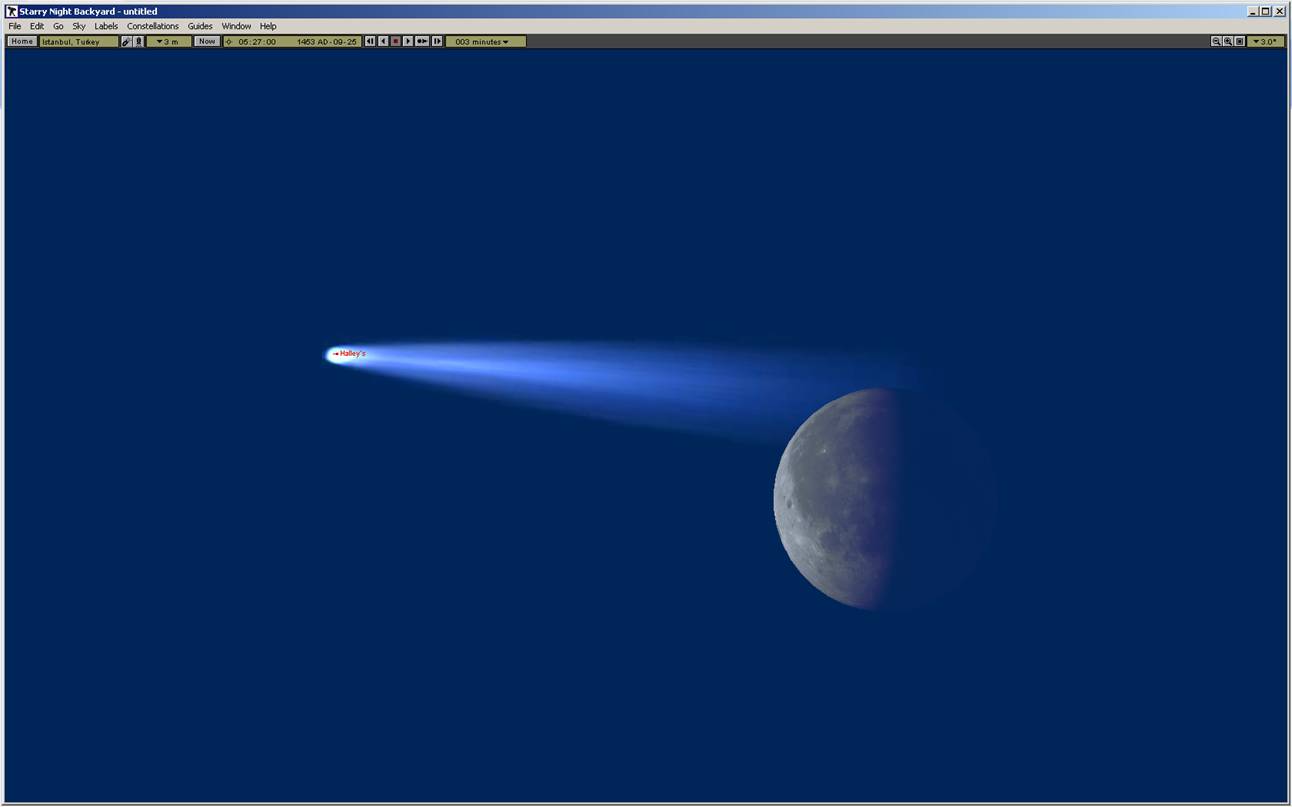
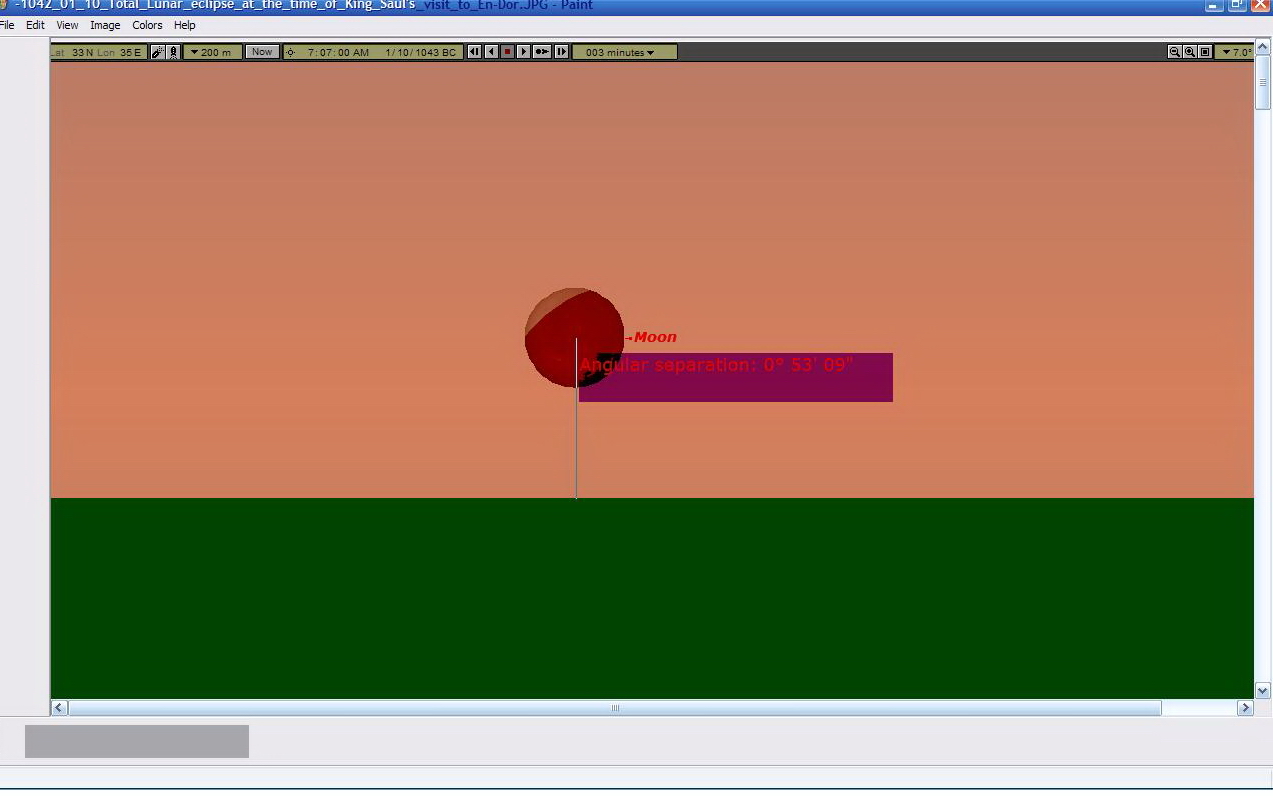
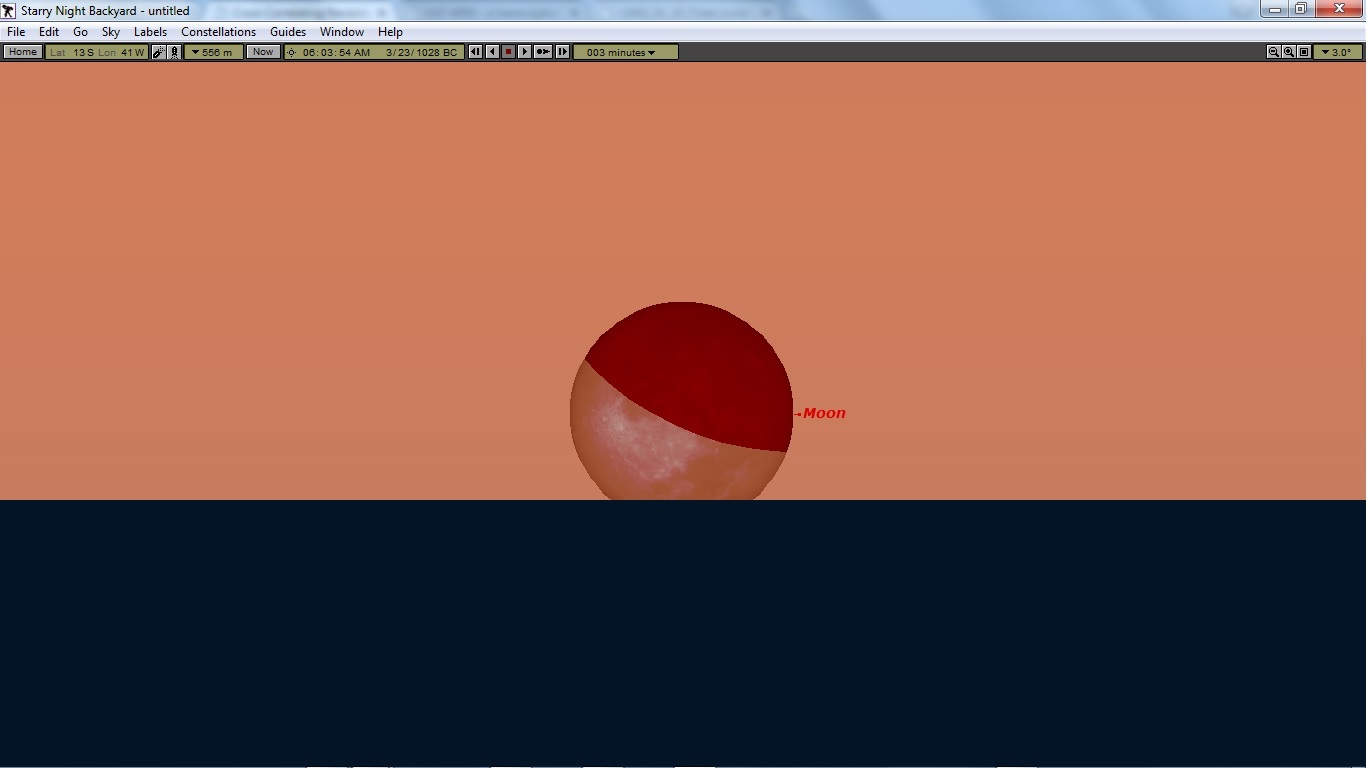
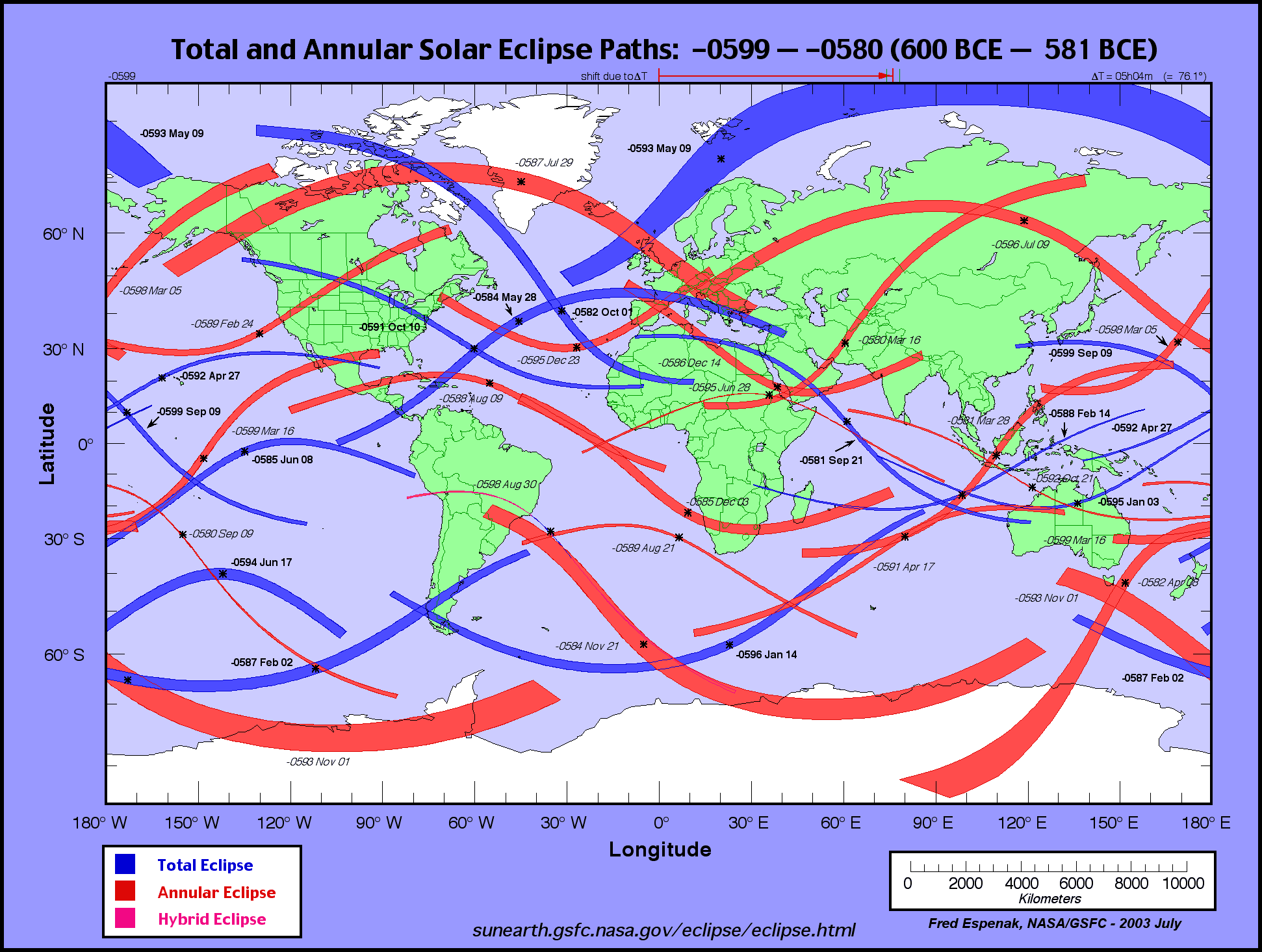
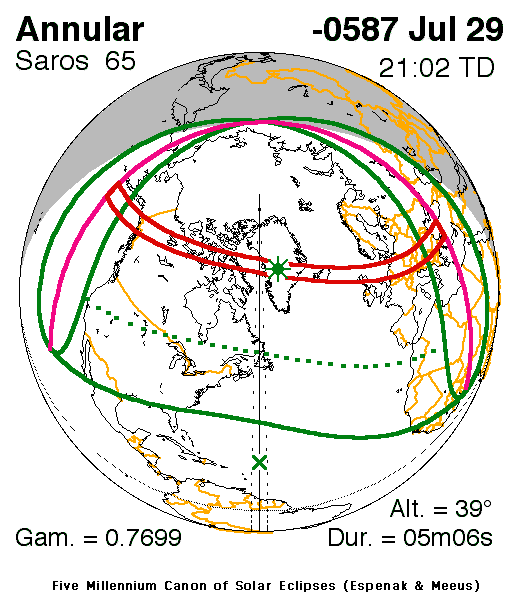
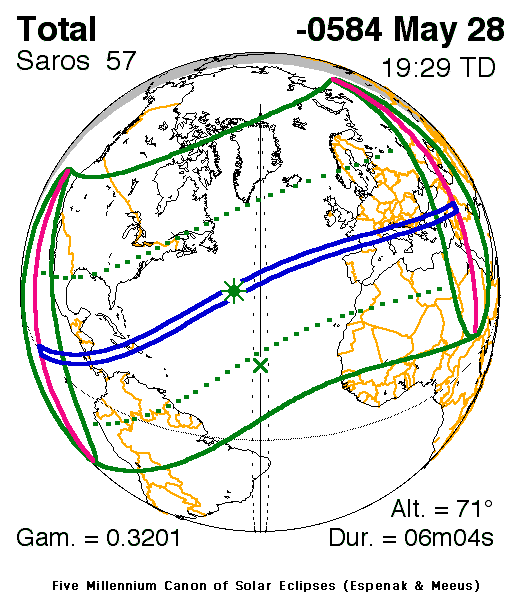
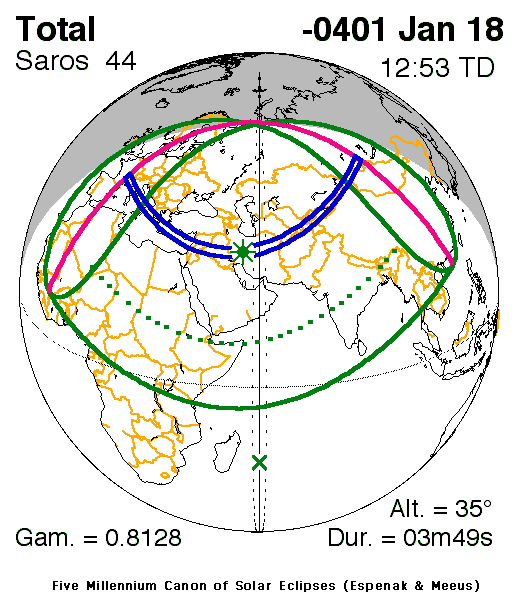
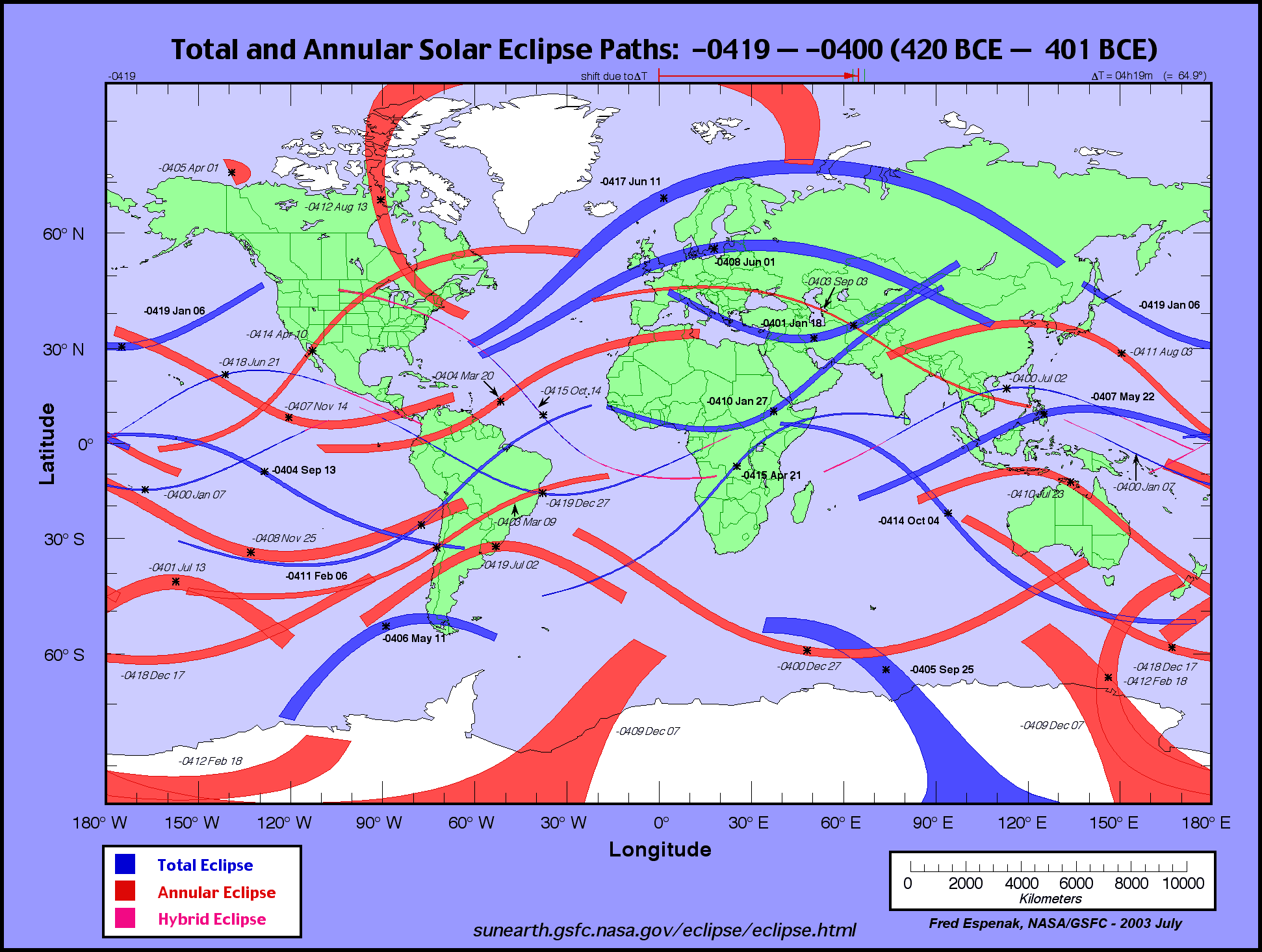
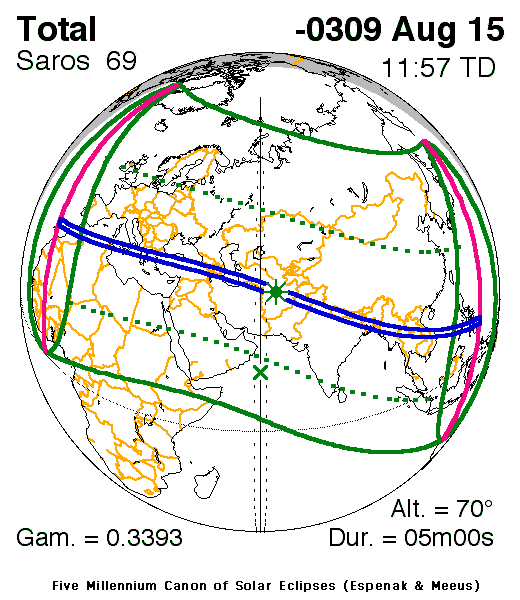
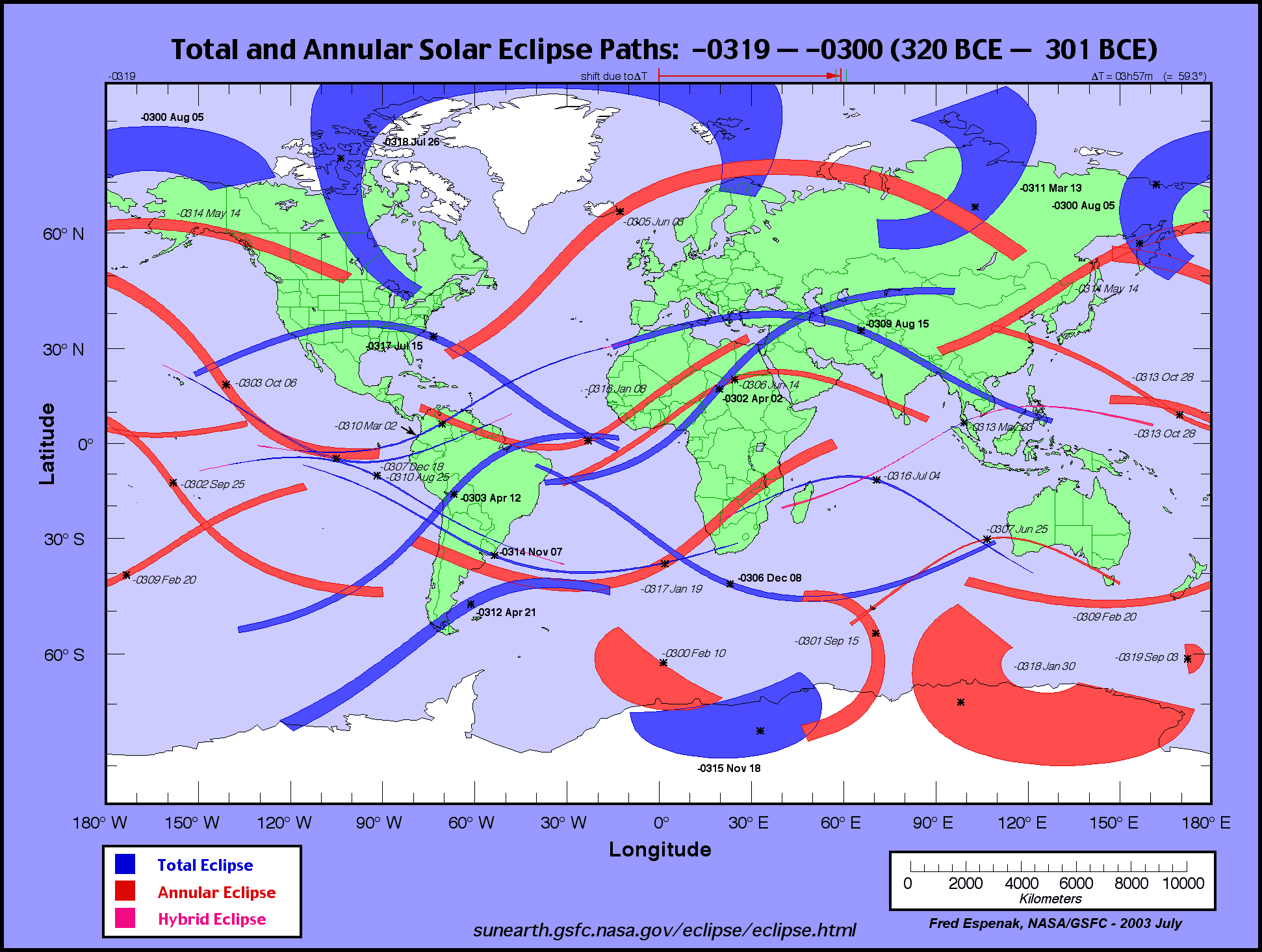


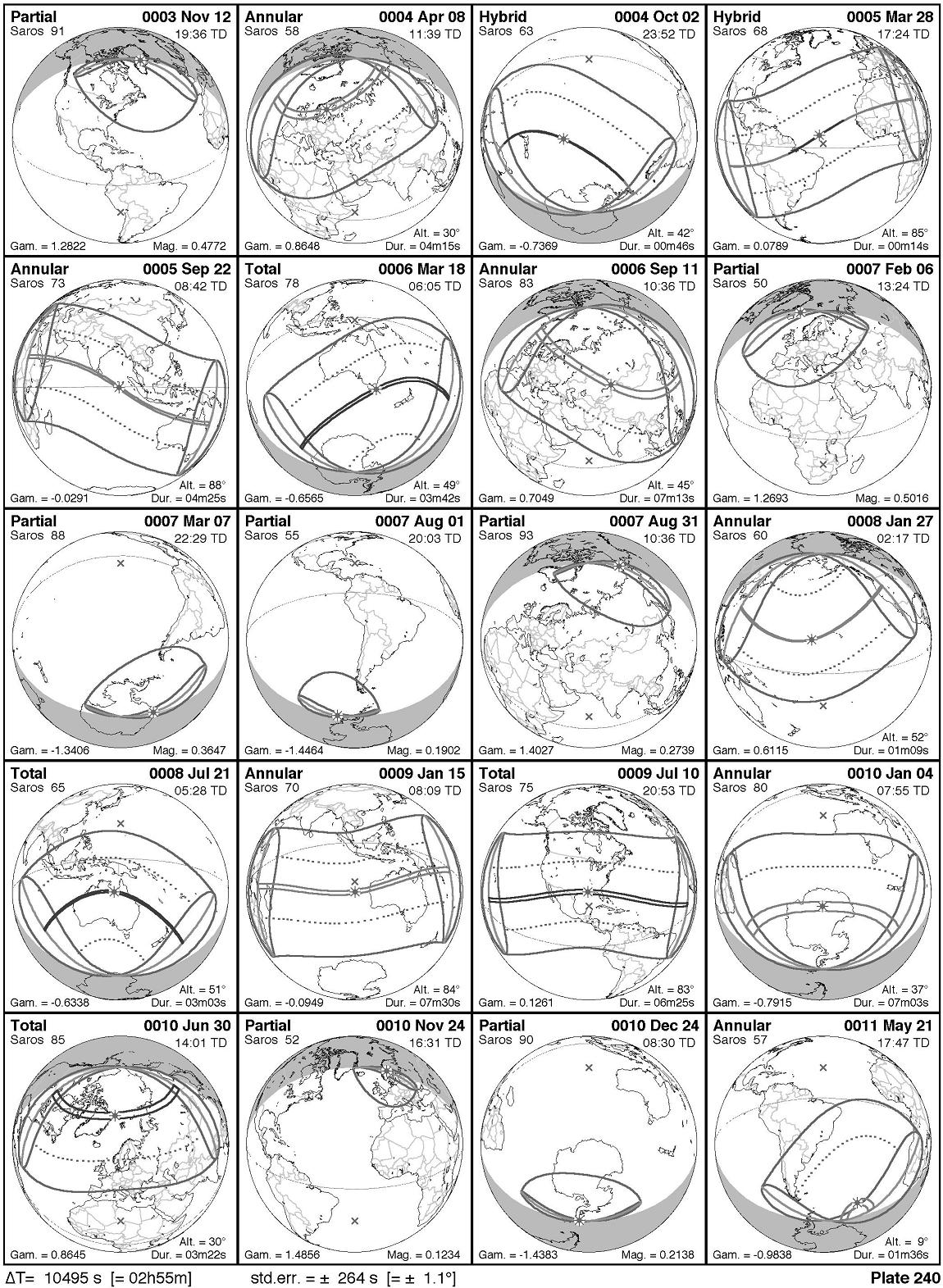


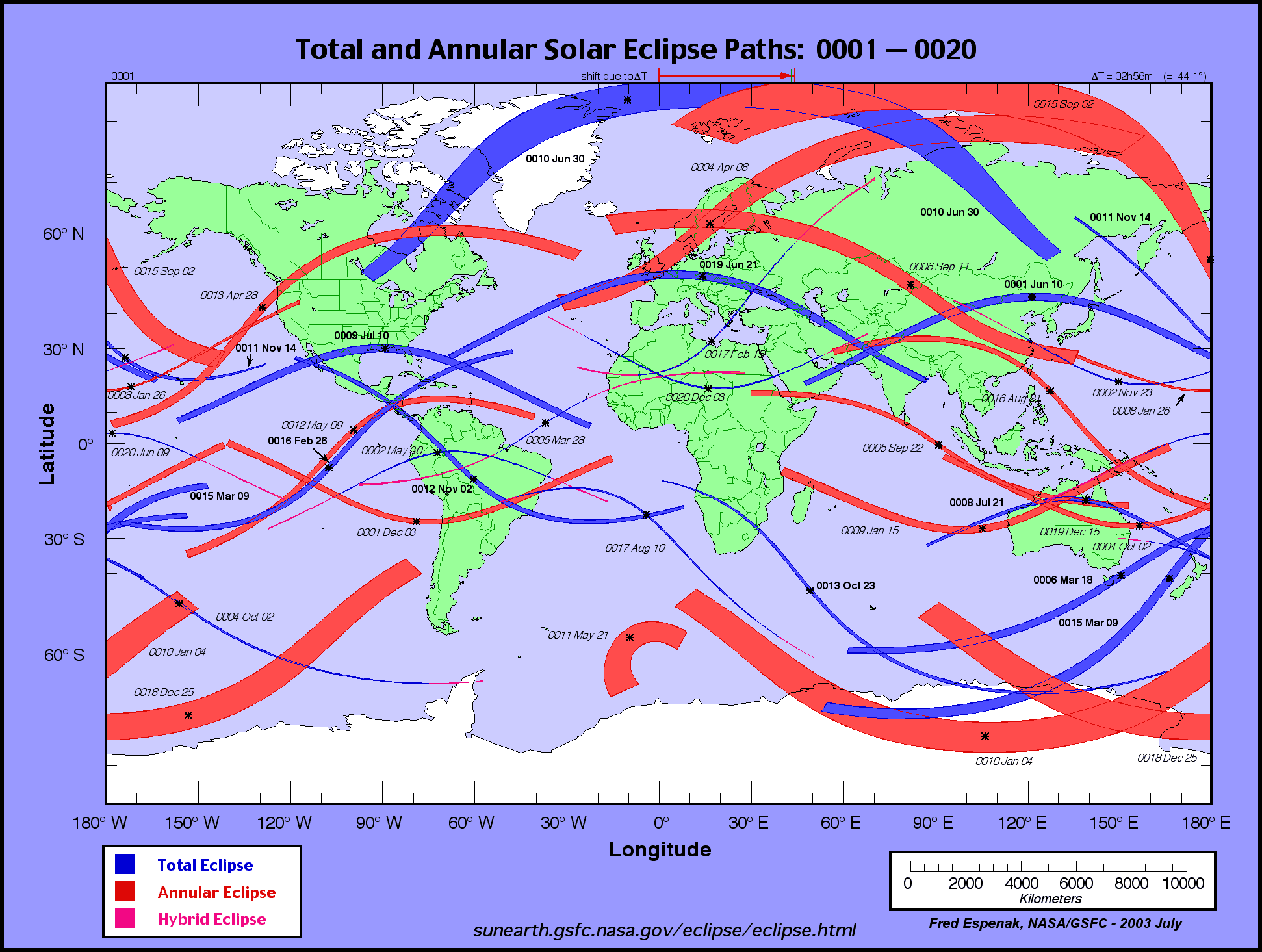


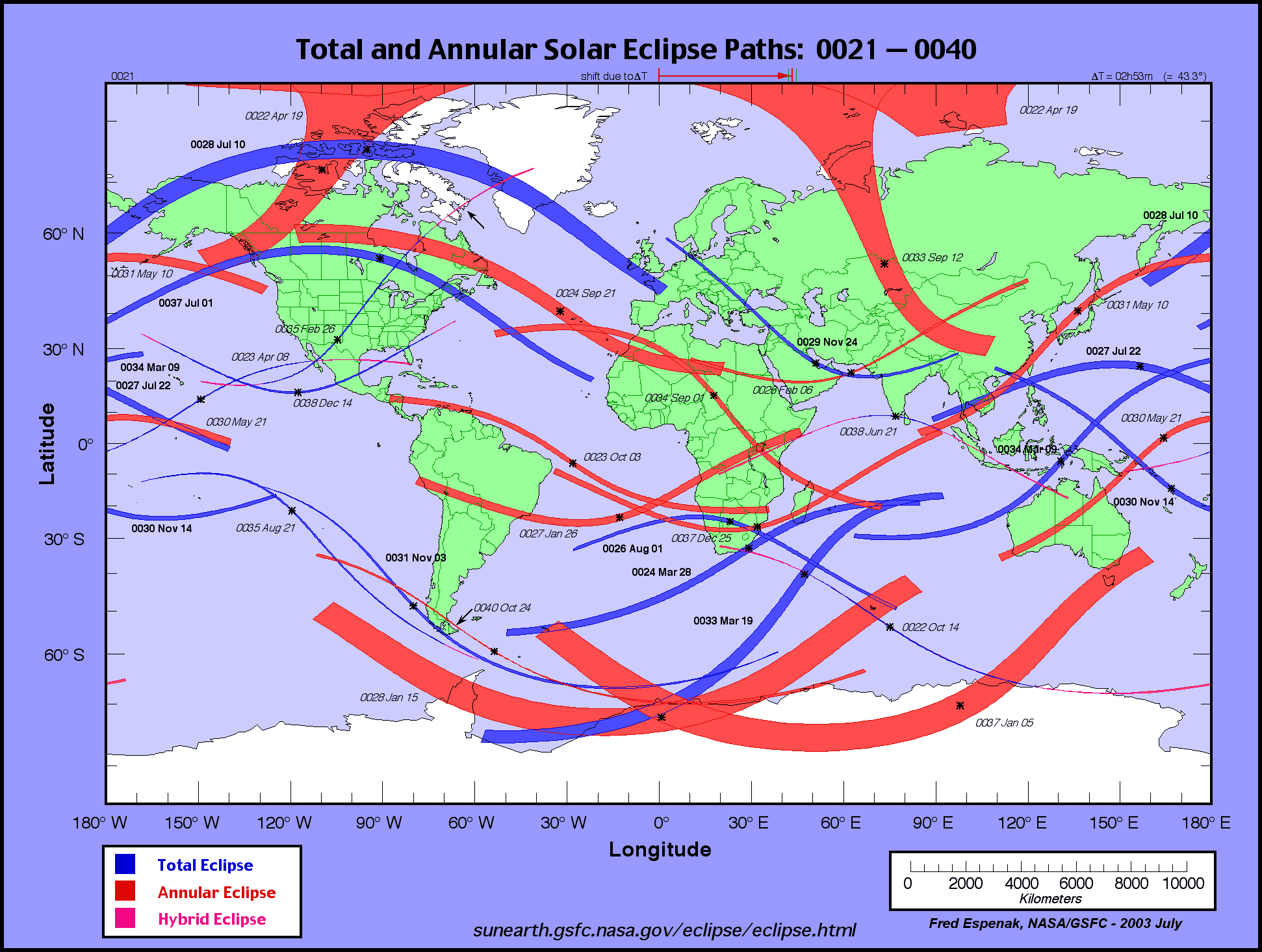


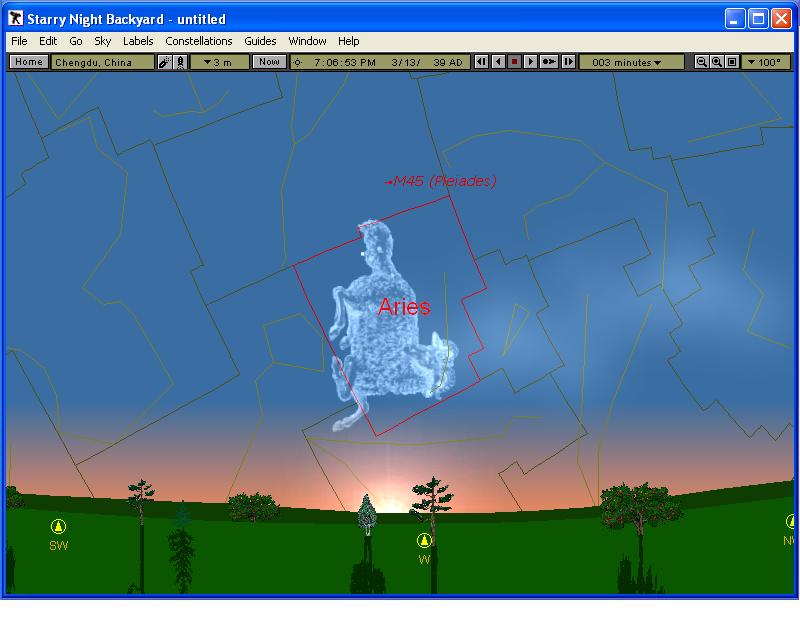
![the Pleiades] on 39 March 13](39CEComet/0390313PleiadesWith30degreesDirectedAwayFromSun.JPG)
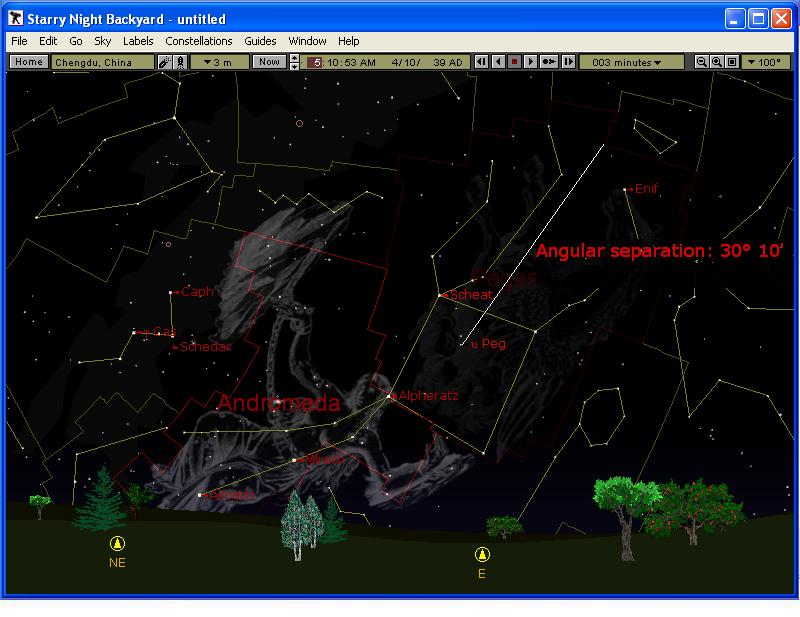
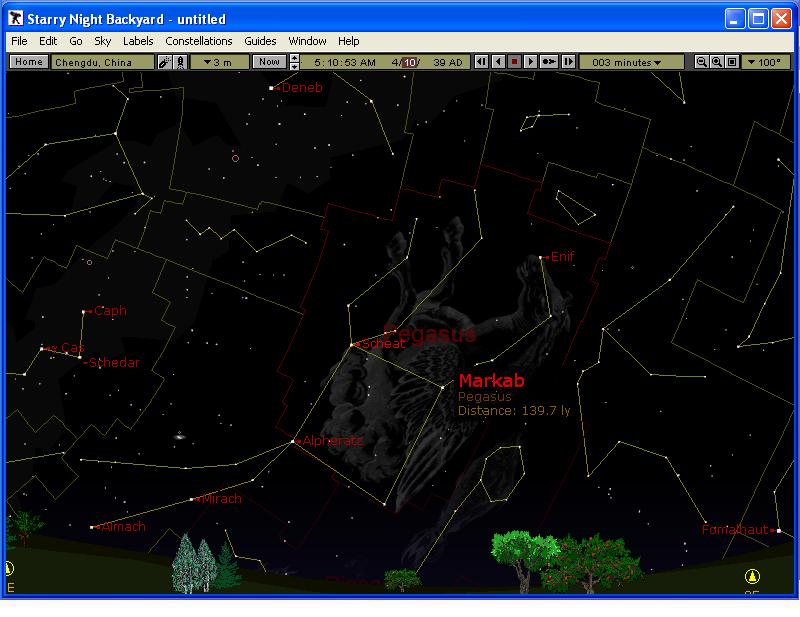
![[α Andromedae and γ Pegasi]](39CEComet/0390430-AlpheratzAlphaAndromeda-AlgenibGammaPegasi.JPG)

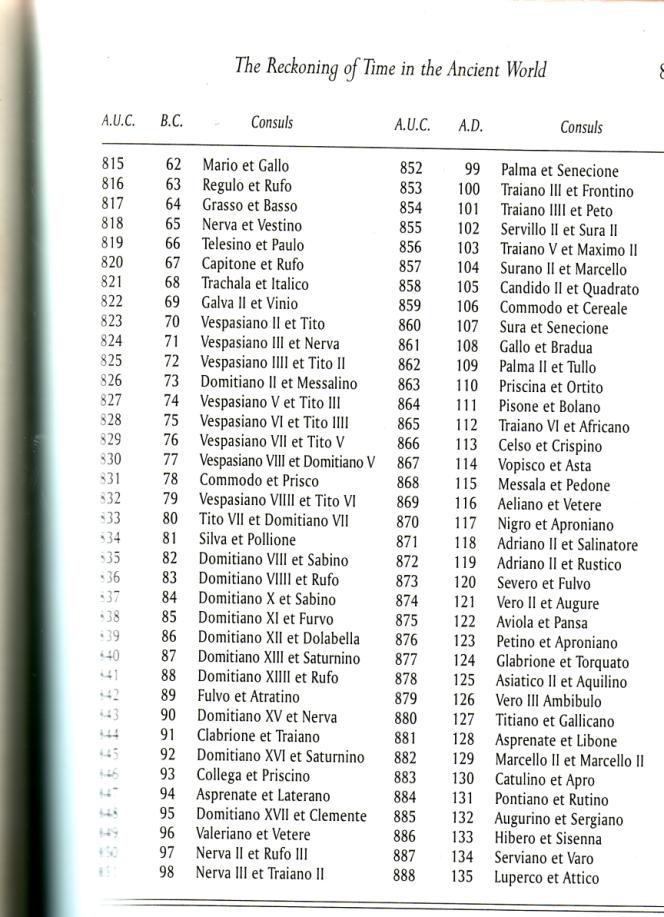


Comments and donations freely
accepted at:
Tree of Life©
c/o General
Delivery
Nora [near SE-713
01]
Sweden Republic©
in Adamah Republic©
eMail: TreeOfLifeTime@gmail.com
You are hereby
cordially invited to subscribe to our free email course:
 You’ll discover firsthand the fundamentals for understanding Scripture
time reckoning as used by the ancient historian Josephus as well as by all the
authors of the Holy Scriptures! Much of this knowledge has - until now - been
lost to the best of scholars for many centuries.
You’ll discover firsthand the fundamentals for understanding Scripture
time reckoning as used by the ancient historian Josephus as well as by all the
authors of the Holy Scriptures! Much of this knowledge has - until now - been
lost to the best of scholars for many centuries.
“Great truths which have been neglected and
unappreciated for ages will be revealed by the Spirit of God, and new meaning
will flash out of familiar texts. Every page will be illuminated by the Spirit
of truth. The Bible is not sealed but unsealed. The most precious truths are
revealed; the living oracles are heard by wondering ears, and the consciences
of men are aroused into action.”
You will make many surprising and exciting discoveries re the exact
dates for Jesus’ birth, crucifixion, resurrection, ascension… as well as the
exact dates of many, many more events found in your Bible, especially re the
New Testament times.
You’ll discover the exact dates for the 12+ Roman Caesars beginning with
Julius Caesar, Augustus, Tiberius, Gaius, Claudius, Nero, Vespasian, Titus…
You’ll discover the exact dates of most of the kings of Judah beginning
with Hyrcanus in the 2nd century BCE, Herod the Great, Agrippa, and
many other Judean kings and proconsuls, e.g. Pontius Pilate…
You’ll discover many things re the Scripture traditions honored by all
the disciples and believers of the Apostolic times – as well as by the Jews –
traditions that have been long forgotten or not correctly restored when
previously re-discovered…
Be prepared to re-think and to re-learn… Things may not be as you always
thought they were… But you’ll decide!
“Get
Your Tree of Life © 1st Century Chronology & Scripture Calendar
Introductory Course NOW…”:
It is a very simple Basics 101 type course entitled:
Tour
Guide towards “Tuning into the Frequency of the Creator & Becoming Oriented
in His Time…”
It is
one short email per week for you to enjoy with your family and friends…
The GateWays into Tree of
Life Chronology Forums©
Without recourse. All Rights Reserved. Tree of Life©