Without recourse.
All Rights Reserved. Tree of Life©
Statement
of belief: “Sanctify them through thy truth: thy word
is truth.” (John 17:17 KJV)
Created
5926[(*??*)] 07 22 2030 [2013-10-28]
Updated
5926[(*??*)] 10 14 2030 [2014-01-16] – A Notice added re an alternative
reading of the Joshua text, which in the end I find the most likely scenario.
Addition
5926[(*??*)] 10 15 2030 [2014-01-17] –Adding Results & abstract,
which summarizes the results of the Considerations below.
Addition
5926[(*??*)] 10 19 2030 [2014-01-21] – Under Results & abstract,
adding a paragraph re the Hebrew word studies I found necessary to make for this article.
Complete review
and revision begun on 5938[v2016-12-14-21:32] 01 29 2035
[2019-05-04] – Cf. the last prior version!
Complete review
and revision, intermediary results, including also complete revision of all
herewith inconsistent parts of the end Considerations, 5938[v2016-12-14-21:32]
03 18 2035 [2019-05-24] – Cf. the last prior version!
Complete review
and revision, intermediary results prior to further revision of Joshua 2-6
based on Jasher 88:8, 14; Jasher was only confirmatory re Deut 34 and Joshua 1;
5938[v2016-12-14-21:32] 03 25 2035 [2019-05-31] – Cf. the last prior version!
Complete review
and revision, 5938[v2016-12-14-21:32] 04 21 2035 [2019-06-25] – Cf. the last prior version!
Complete review
and revision, 5938[v2016-12-14-21:32] 04 21 2035 [2019-06-25++] –
Cf. the last prior version!
Complete review
and revision, begun 5953[v2020-12-11] 12 11 2035 [2020-01-07] – Cf. the last prior version! – Paused work on this version almost
immediately, after changing two lines of 1431 into 1445 and then being reminded
in those footnotes (e.g. footnote #4) that all pre-Joshua’s Long Day are JD
minus one Day, which has not been implemented in versions XIII through XXIII,
and which must be accordingly revised in version XXIV…
Ongoing editing 5904[v2020-01-28] 13 02 2035 [2020-01-28] –13 10 2035 [2020-02-05]… - suspended for reasons presently forgotten.
Complete review
and revision, begun 5967[v2023-12-04] 09
14
2039 [Wed 2023-12-27] – Based on
The Sacred Calendar of the Creator in Progress (version XXIX.0).xls
Jehovah
speaking – Praise the Lord of Hosts!: Multi-coincidence
discovery re Joshua 1:1-2 vs the
Pre-Joshua’s Long Day 7th
Day Sabbath morning, JD Mar 30,
1456 BCE, pre-Abib
New Moon annular solar eclipse, vs made
on 5967[v2023-12-04] 12 20 2039 [7th Day Sabbath morning JD Mar 30, 2024 CE], two weeks prior to the Mon Apr 8, 2024
CE, biblical pre-Abib New Moon total solar eclipse over Mexico, USA, and Canada.
When Was Jordan Crossed?
Date
stamps of the Book of Joshua
Building upon the
many astronomical
events recorded in ancient scriptures, and most especially as indicated
throughout the Holy Scriptures, as referenced throughout this and other
articles of mine, I find
good support for identifying the date stamps in the Book of Joshua specified
throughout this article.
In order
to arrive at a reliable result in answering the question at the
head of this article, and as a further addition to my astronomy-based
chronology studies of many years[1], while writing this
article I have been induced to make several new Scripture based Hebrew word
studies, which studies are being abundantly fruitful. For instance, one study
re the word “בעוד” (cf. this link, and below!) and another study re the words “שׁלשׁת” vs “שׁלשׁה,” re the
term “x days and x nights,” and re the term “x days’ journey” (cf. this link.)
This article of mine
is now extensively revised in consequence of my discoveries as first reported in my
article The Date Stamp Provided in Numbers 10:11, 13...
Considerations:
As discovered elsewhere, it is important to recognize that
the pre-Joshua’s Long Day calendar, including the event of the crossing of
Jordan, is shifted from the Julian Day calendar by 48 hours:
|
Calendar |
JD |
||||
|
7 |
5 |
||||
|
1 |
6 |
||||
|
2 |
7 |
||||
|
Joshuas One (1) Long Day |
3 |
1 |
|||
|
3 |
2 |
||||
|
4 |
3 |
||||
|
5 |
4 |
||||
|
6 |
5 |
||||
|
7 |
6 |
||||
|
1 |
7 |
||||
|
2 |
1 |
||||
|
3 |
2 |
||||
|
4 |
3 |
||||
|
5 |
4 |
||||
|
6 |
5 |
||||
|
7 |
6 |
||||
|
1 |
7 |
||||
|
2 |
1 |
||||
|
3 |
2 |
||||
|
4 |
3 |
||||
|
5 |
4 |
||||
|
Hezekiah's One (1) Long Day |
6 |
5 |
|||
|
6 |
6 |
||||
|
7 |
7 |
||||
|
1 |
1 |
||||
|
2 |
2 |
||||
|
3 |
3 |
||||
|
4 |
4 |
||||
|
5 |
5 |
||||
|
6 |
6 |
||||
Accordingly, and as indicated[2] by the table above,
a 5th JD day, Thursday, corresponds to a 7th day,
Saturday, of any Pre-Joshua’s Long Day calendar (top row in the above table).
Additionally, one must also remember other differences between calendars, e.g.
midnight to midnight UT reckoning in the JD calendar vs. sunset to sunset local
Jericho time reckoning on the occasion of the crossing of the Jordan river.
Ascertaining the year of the crossing of Jordan: (1456
BCE[3], each Scripture calendar year beginning with[4] the Eighth Day
Feast [Tishri
22,] except as specifically reckoned from the Exodus or from the Crossing
of Jordan…)
On the 1st
day[5]
of the 11th month, Shevat, of the 40th year after the
Exodus, beginning at sunset JD Sun Jan 2, 1456 BCE =
PJ (Pre-Joshua’s Long Day) Tue Jan 4, 1456 BCE; or JD (Julian Day) Mon Jan 31, 1456 BCE = PJ
(Pre-Joshua’s Long Day) Wed Feb 2, 1456 BCE:
Deut 1:3
ויהי בארבעים
שׁנה
בעשׁתי־עשׂר
חדשׁ
באחד
לחדשׁ דבר משׁה אל־בני ישׂראל ככל אשׁר צוה יהוה אתו אלהם׃
Deut
1:3 KJV And it came to pass in the fortieth year, in the
eleventh month, on the first day of the month, that Moses spake unto the children of Israel,
according unto all that the LORD had given him in commandment unto them;
Deu 31:14 KJV And the LORD said unto Moses, Behold, thy days
approach that thou must die: call Joshua, and present yourselves in the tabernacle
of the congregation, that I may give him a charge. And Moses and Joshua went,
and presented themselves in the tabernacle of the congregation.
Same
date as above re Deut 1:3:
Deut 31:2
ויאמר אלהם בן־מאה
ועשׂרים
שׁנה
אנכי
היום לא־אוכל עוד לצאת ולבוא ויהוה אמר אלי לא תעבר את־הירדן הזה׃
Deut
31:2 KJV And he said unto them, I am an hundred and twenty years old this day; I
can no more go out and come in: also the LORD hath said unto me, Thou shalt not
go over this Jordan.
Deut 34:7
ומשׁה בן־מאה
ועשׂרים
שׁנה במתו לא־כהתה עינו ולא־נס לחה׃
Deut
34:7 KJV And Moses was an hundred and twenty years old when he died: his eye
was not dim, nor his natural force abated.
Jasher 87:10 And Moses went up as the Lord had commanded him, and he
died there in the land of Moab by the order of the Lord, in the fortieth year from the Israelites going forth from the
land of Egypt.
Throughout
the 30 days of Adar I, 1456 BCE [from the New Moon at sunset JD Mon Jan 31, 1456 BCE = PJ Wed Feb
2, 1456 BCE, until the New Moon at the end of the 30th day at sunset
JD Wed Mar 2, 1456 BCE = PJ Fri Mar 4, 1456 BCE:]
Deut 34:8 ויבכו בני ישׂראל את־משׁה בערבת מואב שׁלשׁים
יום ויתמו
ימי בכי אבל משׁה׃
Jasher[6] 87:11 ויבכו בני ישׂראל את־משׁה בערבות מואב שׁלשׁים
יום ויתמו
ימי בכי אבל משׁה׃
Deut 34:8 TLT
And the children of Israel wept for Moses in the plains of
Moab throughout the thirty days of the month:[7]
And thus they perfected all the days of weeping and of mourning for Moses.[8]
Deut 34:8 KJV
And the children of Israel wept for Moses in the plains of
Moab thirty days: so the days of weeping and mourning for Moses were ended.
Having discovered that the ancient Hebrew words
behind the words “x days,” when not using the format “x days and x nights,” or,
as in Daniel 8:14, 26: “evenings and mornings,” are consistently used for
pointing out the first “x days” of a Hebrew calendar week, month, or year, I
find that, re the “perfected… days of weeping…”, given that Moses died within
the 40th year at some point following the 1st day of the
11th month referenced at the beginning of Deuteronomy, the first
concluded set of 30 days, e.g. 30 day lunar month, following the death of Moses
was a potential 30th day of the 11th month, Shevat,
followed by a potential 30th day of Adar. Given also the direct
statements within Jos 1:1, 2, and 11, without more, I may conclude two things
(provided there was no inclement weather etc.):
1. Re the length
of each month:
The lunar month (10th or 11th?)
from JD Sun Jan 2, 1456 BCE = PJ Tue Jan 4,
1456 BCE: Lag: 90 min 24 sec; Illum.: 4.10%;
to JD Mon Jan 31, 1456 BCE = PJ (Pre-Joshua’s
Long Day) Wed Feb 2, 1456 BCE: Lag: 81 min 7 sec; Illum.: 2.10%.;
was 29 days;
The lunar month (11th or 12th?)
JD Mon Jan 31, 1456 BCE = PJ Wed Feb 2, 1456
BCE: Lag: 81 min 7 sec; Illum.: 2.10%;
to JD Wed
Mar 2, 1456 BCE = PJ Fri Mar 4, 1456 BCE: Lag: 129 min 46 sec; Illum.: 3.90%.
was 30 days;
The lunar month (12th or 13th?)
from JD Wed Mar 2, 1456 BCE = PJ Fri Mar 4, 1456
BCE: Lag: 129 min 46 sec; Illum.: 3.90%;
to JD Thu Mar 31, 1456 BCE = PJ Sat Apr 2, 1456
BCE: Lag: 97 min 10 sec; Illum.: 2.02%.
was 29 days;
The lunar month (13th or 1st?)
from JD Thu Mar 31, 1456 BCE = PJ Sat Apr 2,
1456 BCE: Lag: 97 min 10 sec; Illum.: 2.02%;
to Sat Apr 30, 1456 BCE = PJ Mon May 2, 1456
BCE: Lag: 138 min 38 sec; Illum.: 3.54%.
was 30 days;
2. Except for the
absence of any word re such, the Bible text provides no direct indication for
an intercalated 13th month, and thus far I perceive no other
indication either for or against a 13th month in 1456 BCE.
Knowing the rule re Scripture exactness is necessary
for recognizing the very precise Hebrew concepts of time as expressed with very
few words.
Accordingly, I find that:
1. The Hebrew
words of Deut 34:8 “the
first thirty days of a month… perfected all the days of weeping…” (cf. above!) helps me understand
that the days of weeping for Moses were concluded at the time of the New Moon at the end of a complete 30-day long
Scripture month; and
2. The Hebrew words,
apparently without more, of Jos 1:1, 2, 11, may be an indication that there was
no intercalary 13th month in 1456 BCE?
Please consider the linguistic rule deducted from this
and other similar Scripture passages!
Given that:
1) Abib 10 fell
out on the Third Day of the seven-day cycle [week] (Jos 1:11, 3:2, and 4:19;)
2) Version XXIX.0
requires that New Moon #1, Abib, was observed on JD Wed Mar 2, 1456 BCE = PJ Fri Mar 4, 1456 BCE; on JD Thu Mar 31, 1456
BCE = PJ Sat
Apr 2, 1456 BCE; or on
JD Sat Apr 30, 1456 BCE = PJ Mon May 2,
1456 BCE,
3) and that
accordingly, [PJ] Abib 10, 1456 BCE began at sunset PJ Sun Mar 13; PJ Apr Mon 11; or PJ Wed May 11, 1456 BCE,
4) In 1456 BCE,
Abib 10 being a Third Day, is only possible in the month of April.
It follows that:
a) Abib 10 began
at sunset PJ Mon April 11, 1456 BCE;
b) Abib 1 began at
sunset PJ Sat April 2, 1456 BCE; and
c) Adar, whether
Adar I or Adar II, began on PJ Fri Mar 4, 1456 BCE.
But, if Abib 1 began on PJ Apr 2, then it is
impossible that the prior month, beginning no earlier than PJ Mar 4, 1456 BCE,
had more than 29 days.
It follows that, if there was a full 30 days of
mourning within one lunar month, that lunar month must necessarily be month #12
of 13, beginning JD Jan 31, 1456 BCE. That is, given that Moses was still alive
on the 1st day of month #11, neither month #11, nor month #13 could
possibly have 30 days.
Accordingly:
Moses died within the month of New Moon #11 JD
Sun Jan 2, 1456 BCE = PJ Tue Jan 4, 1456 BCE.
[To find the JD date of the astronomical New
Moon and other Phases of the Moon use this link.]
[To find the JD week day, please use Steve’s Julian Day Calculator,
the Julian Day and Civil
Date Calculator, or else download the JD
Calculator by clicking this last link; then renaming the extension “.exe”
to “.mht”; then lastly by clicking on the renamed file name… It will then be
activated in Internet Explorer.]
To find the PJ week day, add two days to the JD
week day. E.g. Sun Tue, Mon Wed, etc..
The date stamps I have found thus far in the Book of
Joshua are shown below. (Please find my bases for dates given within the
associated footnotes!)
It appears as though in this instance God was speaking
to Joshua by means of a partial solar eclipse (85.011% obscuredd):
On the
next to the last Seventh Day Sabbath[9] prior to Abib 10; at the time of the solar eclipse on
the Seventh Day Sabbath morning the 29th day of Adar II[10], 1456 BCE [which day began at sunset JD Wed
Mar 30, 1456 BCE = PJ Fri Apr 1, 1456 BCE [11].
:]
Jos 1:1
ויהי אחרי
מות
משׁה עבד יהוה ויאמר יהוה אל־יהושׁע בן־נון משׁרת משׁה לאמר׃
Jasher 88:1
ויהי אחרי
מות
משׁה, ויאמר הי אל
יהושׁע בן
נון לאמר׃
Jos 1:1 KJV Now after the death of Moses the servant of the LORD it came to pass that the LORD
spake unto Joshua the son of Nun, Moses' minister, saying.
Jos 1:2 KJV Moses
my servant is dead; now therefore arise, go over this Jordan,
thou, and all this people, unto the land which I do give to
them, even to the children of Israel.
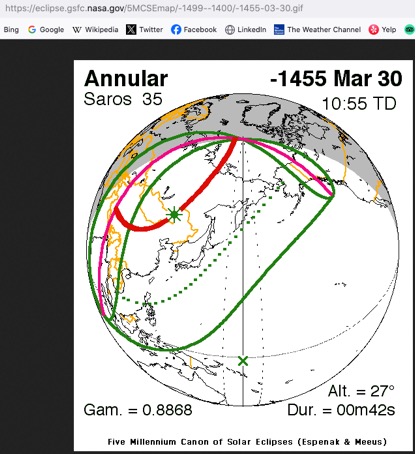
Notice the proximity between Pre-Joshua’s Long
Day Mt. Nebo (at the point indicated in the middle of the picture below)
and the path of the total solar eclipse (above
and below)!
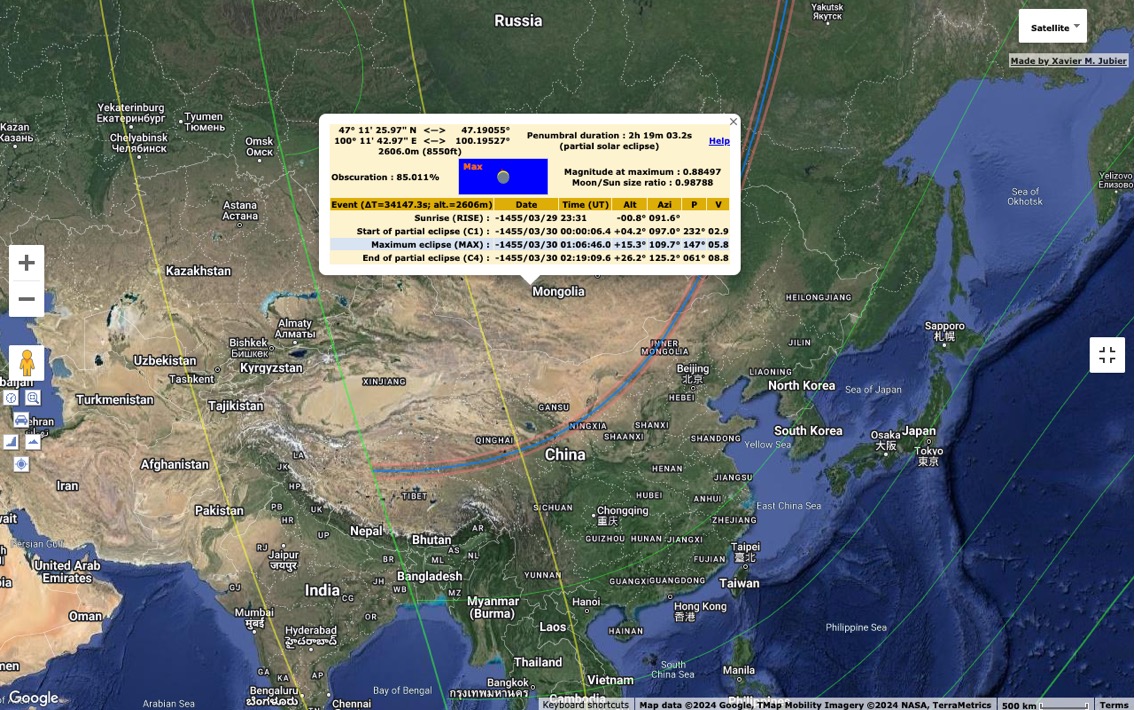
Sunrise (RISE): 23:31 UT = 06:12 local solar time at 100°12’E.
Maximum eclipse (MAX): 01:06:46.0 UT = 07:47:34.0
local solar time at 100°12’E = 1 hr 36 min after sunrise.
[Same image as above except URL reference etc.
at the top. (To satisfy copy right request.)]
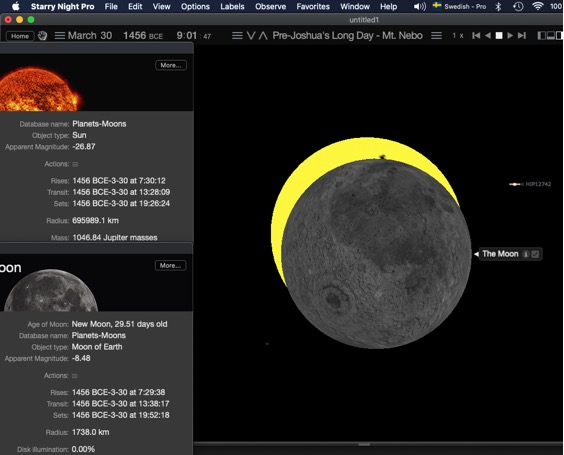
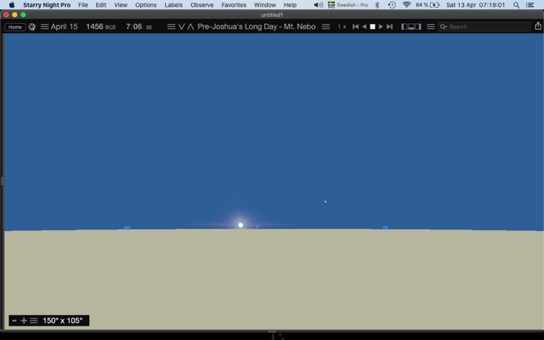
The JD Mar 30, 1456 BCE solar eclipse
as viewed from Pre-Joshua’s Long Day Mt. Nebo 91 minutes after sunrise (at 47°12’N 100°12’E) using SN8.
(The sunrise etc. times given in this
SN8 image are based upon current political time zones which differ greatly from
local solar time!)
(Considering the small margins and
the distance in time, it is not impossible but that this could have been a
total solar eclipse?
That is, due to potential errors re
the Mt. Nebo coordinates and/or errors in the path of the total solar eclipse.)
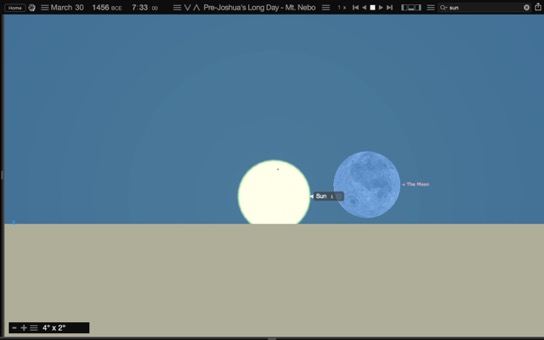
Click on the above image to see a movie representation of the eclipse as
it might have appeared from Joshua’s location at at 47°12’N 100°12’E. Only the
shadow of the Moon across the Solar disc would have been visible to the naked
eye, not the Moon per se as imaged above. The partial eclipse, as viewed from
Joshua’s location, would have begun 35 minutes past sunrise; maximum 96[12] minutes past sunrise;
then ended 2 hours 49 minutes past sunrise. That early in the morning and that
close to the horizon, it should have been quite noticeable, weather permitting.
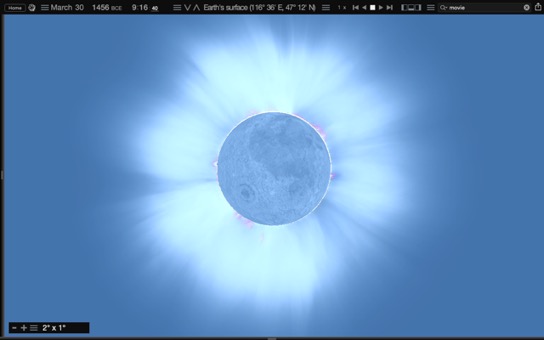
Click
the image above to see a movie representation of the annular eclipse (at
maximum) as it may have appeared at 47°12’N 116°36’E; i.e. 16°24’ East from the above
indicated Joshua’s location.
Day One
[of the week], Abib 1,[13] 1456 BCE [beginning at sunset PJ Sat Apr 2, 1456 BCE
= JD Thu Mar 31, 1456 BCE:]
Jos 1:10 ויצו יהושׁע את־שׁטרי העם לאמר׃
Jos
1:10 KJV Then Joshua commanded the officers of the
people, saying,
Referencing the Third Day of the week, Abib 10,[14] 1456 BCE [beginning at sunset PJ Mon Apr 11, 1456 BCE
= JD Sat Apr 9, 1456 BCE.] Cf. this link!:
Jos 1:11
עברו בקרב המחנה וצוו את־העם לאמר הכינו לכם צידה כי
בעוד
שׁלשׁת
ימים אתם עברים את־הירדן הזה לבוא לרשׁת את־הארץ אשׁר יהוה אלהיכם נתן לכם לרשׁתה׃
Jasher 88:5
...עברו ב... מחנה וצוו את העם לאמר׃ הכינו לכם צידה, כי בעוד
שׁלשׁת
ימים אתם עוברים את הירדן לרשׁת את הארץ.
Jos 1:11 TLT Pass through the
host, and command the people, saying, Prepare you victuals; for within the Third Day beyond the next Third Day ye shall pass over this Jordan, to go in to possess
the land, which Yehovah your God giveth you to possess it.
Jos 1:11 KJV Pass through the host, and command the people, saying,
Prepare you victuals; for within three
days ye shall pass over this Jordan, to go
in to possess the land, which the LORD your God giveth you to possess it.
Jasher 87:5…
Pass
through the camp and command the people, saying, Prepare for yourselves
provisions, for in three days more you will pass the Jordan to
possess the land.
On the
eve of the PJ First Day of the week, Abib 1,[15] 1456 BCE [beginning at sunset PJ Sat Apr 2, 1456 BCE
= JD Thu Mar 31, 1456 BCE:]
Jos 2:2
ויאמר למלך יריחו לאמר הנה אנשׁים באו הנה הלילה מבני ישׂראל לחפר את־הארץ׃
Jos 2:2 KJV And it was told
the king of Jericho, saying, Behold, there came men in hither to night of the children of Israel to search out the country.
Spoken in the late evening of the First Day of the week, Abib
1, 1456 BCE [beginning at sunset PJ Sat Apr 2, 1456 BCE = JD Thu Mar 31, 1456
BCE] while referencing Days One through Three of the week, Abib 1-3, 1456 BCE
[beginning at sunset Saturday night – end of twilight PJ Sat Apr 2 – late Tue
night Apr 5, 1456 BCE = JD sunset Thu Mar 31 – late Sun night Apr 3, 1456 BCE:]
Jos 2:16
ותאמר להם ההרה לכו פן־יפגעו בכם הרדפים ונחבתם שׁמה שׁלשׁת
ימים
עד שׁוב הרדפים ואחר תלכו לדרככם׃
Jos 2:16 TLT And she said unto
them, Get you to the mountain, lest the pursuers meet you; and hide yourselves
there these first three days of this week, until the pursuers be returned: and afterward may ye go
your way.
Referencing
Days One through Three of the week, Abib 1-3, 1456 BCE [beginning at sunset
Saturday night – end of twilight PJ Sat Apr 2 – late Tue night Apr 5, 1456 BCE
= JD sunset Thu Mar 31 – late Sun night Apr 3, 1456 BCE:]
Jos 2:22
וילכו ויבאו ההרה וישׁבו שׁם שׁלשׁת
ימים עד־שׁבו הרדפים ויבקשׁו הרדפים בכל־הדרך ולא מצאו׃
Jos 2:22 TLT And they went,
and came unto the mountain, and spent[16] there the
first three days of the week, until the pursuers were returned: and the pursuers
sought them throughout all the way, but found them not.
On the eve
of Day Seven[17] of the week, Abib 7, 1456 BCE [beginning at sunset,
or even at the 12th hour of the day, the last hour before sunset—Fri
evening Apr 30, 1396 BCE:]
Jos 2:23
וישׁבו שׁני האנשׁים וירדו מההר ויעברו
ויבאו אל־יהושׁע בן־נון ויספרו־לו את כל־המצאות אותם׃
Jasher 88:8
ויבואו
מקץ שבעת ימים
אל יהושׁע
המחנה
ויאמרו לו ׃
Jos 2:23 KJV So the two men
returned, and descended from the mountain, and passed over, and came
to Joshua the son of Nun, and told him all things that befell them:
Jasher 88:8 TLT And after the first beginning of the
Seventh Day Shabbat[18]
they
came to Joshua in the camp and said to him, The Lord has delivered the whole
land[19] into our hand, and
the inhabitants thereof are melted with fear because of us.
Jasher 88:8 And at the end of seven days they came to Joshua
in the camp and said to him, The Lord has delivered the whole land into our
hand, and the inhabitants thereof are melted with fear because of us.
On Day
One of the week, Abib 8, 1456 BCE [PJ Sat Apr 9, 1456 BCE = JD Thu Apr 7, 1456
BCE:]
Jos 3:1
וישׁכם יהושׁע
בבקר ויסעו מהשׁטים ויבאו
עד־הירדן
הוא
וכל־בני
ישׂראל
וילנו שׁם טרם יעברו׃
Jos 3:1 TLT And Joshua rose early in the morning; and they removed from the Acacia trees, and came to Jordan, he and all the children of Israel, and lodged there before they passed over.
Jos 3:1 KJV And Joshua rose early in the morning; and they removed from Shittim, and came to Jordan, he and all the children of Israel, and lodged there before they passed over.
On the eve of Day Three of the week, Abib 10, 1456 BCE
[beginning at sunset PJ Mon Apr 11, 1456 BCE = JD Sat Apr 9, 1456 BCE:]
Jos 3:2
ויהי מקצה
שׁלשׁת
ימים ויעברו השׁטרים בקרב המחנה׃
Jos 3:2 TLT And it came to pass after the beginning of Day Three of seven days, that the officers went through the host;
On the
eve of Day Three of the week, Abib 10, 1456 BCE [beginning at sunset PJ Mon Apr
11, 1456 BCE = JD Sat Apr 9, 1456 BCE,] while referencing the morning hours of
Day Three of the week, Abib 10, 1456 BCE [PJ Tue AM Apr 12, 1456 BCE = JD Sun
AM Apr 10, 1456 BCE:]
Jos 3:5
ויאמר יהושׁע אל־העם התקדשׁו כי מחר יעשׂה יהוה בקרבכם נפלאות׃
Jos 3:5 TLT And Joshua
said unto the people, Get ready, cleanse yourselves: for tomorrow the YHWH will do wonders among you.
Jos 3:5 KJV And Joshua said
unto the people, Sanctify yourselves: for to morrow the LORD will do wonders among you.
On Day
Three of the week, Abib 10, 1456 BCE [PJ Tue AM Apr 12, 1456 BCE = JD Sun AM
Apr 10, 1456 BCE:]
Jos 3:7
ויאמר יהוה אל־יהושׁע היום
הזה אחל גדלך בעיני כל־ישׂראל אשׁר ידעון כי כאשׁר הייתי עם־משׁה אהיה עמך׃
Jos 3:7 KJV And the LORD
said unto Joshua, This day will I begin
to magnify thee in the sight of all Israel, that they may know that, as I was
with Moses, so I will be with thee.
On Day
Three of the week, Abib 10, 1456 BCE [PJ Tue AM & PM Apr 12, 1456 BCE = JD
Sun AM & PM Apr 10, 1456 BCE:]
Jos 4:14
ביום
ההוא גדל יהוה את־יהושׁע בעיני כל־ישׂראל ויראו אתו כאשׁר יראו את־משׁה כל־ימי חייו׃
Jos 4:14 KJV On that day the LORD magnified Joshua in the
sight of all Israel; and they feared him, as they feared Moses, all the days of
his life.
On Day
Three of the week, Abib 10, 1456 BCE [PJ Tue PM before the end of twilight Apr
12, 1456 BCE = JD Sun PM before the end of twilight Apr 10, 1456 BCE:]
Jos 4:19 והעם עלו מן־הירדן בעשׂור
לחדשׁ
הראשׁון ויחנו בגלגל בקצה מזרח יריחו׃
Jasher 88:10
ויעלו
העם מ..הירדן בעשׂור
לחדשׁ
הראשׁון, ויחנו בגלגל בקצה מזרח יריחו.
Jos 4:19 KJV And the people
came up out of Jordan on the tenth day
of the first month, and
encamped in Gilgal, in the east border of Jericho.
Jasher 88:10 And the people
went up from Jordan on the tenth day of the first month, and they encamped
in Gilgal at the eastern corner of Jericho.
On Day
Three of the week, Abib 10, 1456 BCE [PJ Tue PM before the end of twilight Apr
12, 1456 BCE = JD Sun PM before the end of twilight Apr 10, 1456 BCE:]
Jos 5:2
בעת
ההיא אמר יהוה אל־יהושׁע עשׂה לך חרבות צרים ושׁוב מל את־בני־ישׂראל שׁנית׃
Jos 5:2 KJV At that time the
LORD said unto Joshua, Make thee sharp knives, and circumcise again the
children of Israel the second time.
PJ Tue
afternoon or evening, after sunset, but before the end of twilight Apr 12, 1456
BCE = JD Sun afternoon or evening, after sunset, but before the end of twilight
Apr 10, 1456 BCE:]
Jos 5:3
ויעשׂ־לו יהושׁע חרבות צרים וימל את־בני ישׂראל אל־גבעת הערלות׃
Jos 5:3 KJV And Joshua made
him sharp knives, and circumcised the children of Israel at the hill of the
foreskins.
Days
Four through Seven of the week, Abib 11-14, 1456 BCE [PJ Tue afternoon or
evening, after sunset, but before the end of twilight Apr 12, 1456 BCE through
the end of twilight PJ Sat Apr 16, 1456 BC = JD Sun afternoon or evening, after
sunset, but before the end of twilight Apr 10, 1456 BCE through the end of
twilight JD Thu Apr 14, 1456 BCE:]
Jos 5:8
ויהי כאשׁר־תמו כל־הגוי להמול וישׁבו תחתם במחנה עד חיותם׃
Jos 5:8 KJV And it came to
pass, when they had done circumcising all the people, that they abode in their
places in the camp, till they were whole.
On Day Seven of the week, Abib 14, 1456 BCE [beginning
at sunset PJ Fri Apr 15, 1456 BC = JD Wed Apr 13, 1456 BCE
Jos 5:9
ויאמר יהוה אל־יהושׁע היום גלותי את־חרפת מצרים מעליכם ויקרא שׁם המקום ההוא גלגל עד
היום
הזה׃
Jos 5:9 KJV And the LORD
said unto Joshua, This day have I rolled away the reproach of Egypt from off
you. Wherefore the name of the place is called Gilgal unto this day.
Revision
progress to this point only (at this point in time)! -
Please disregard obsolete work below!
From the beginning of Day Seven of the week, the
Sabbath, and the Passover Preparation Day, Abib 14, 1456 BCE [beginning at
sunset and the twilight hour on PJ Fri Apr 15, 1456 BC = JD Wed Apr 13, 1456
BCE:]
Jos 5:10 ויחנו
בני־ישׂראל בגלגל ויעשׂו
את־הפסח
בארבעה
עשׂר
יום
לחדשׁ
בערב
בערבות
יריחו׃
Jasher 88:10-11
ויחנו
בגלגל בקצה
מזרח יריחו. ויעשׂו
בני ישׂראל
את־הפסח בגלגל... בערבות
יריחו
בארבעה
עשׂר
לחדשׁ, ככתוב
בתורת משה׃
Jos 5:10 TLT And the
children of Israel encamped[20] at Gilgal.[21] [22] And they observed
the Passover[23]
in the fourteenth day of the month during the twilight hour[24] of both
evenings the first one of which included an eclipse[25] of the Moon[26] [27]
Or, as more fully expressed,
using these [explanatory [bracketed] and/or italic] words…
Jos 5:10 TLT And the
children of Israel encamped[28] at Gilgal.[29] [30] And they
observed the Passover [at
the beginning of the Seventh Day Sabbath and at the beginning of the Feast of
Unleavened Bread] in the fourteenth day of the month during the twilight
hour[31] of both evenings
the first one of which included an eclipse[32] of the
Moon[33] [See
the pictures below! In fact, at sunset the eclipsed Moon of May 7, 1396 BCE was
rising over the SSE horizon (as viewed from the hills ~5 km NNE of Jericho)
while moving thence onwards above Jericho in the SSW.] [34]
Jos 5:10 KJV And the
children of Israel encamped in Gilgal, and kept the passover on the fourteenth day of the month at even in the plains of Jericho.
Jasher 88:10
TLT And the people went up from Jordan on the
tenth day of the first month, and they encamped in Gilgal at the eastern edge of Jericho.
Jasher 88:10
Davar4 And the people went up from Jordan on the tenth day of
the first month, and they encamped in Gilgal at the eastern corner of Jericho.
Jasher 88:11 And the children
of Israel kept the Passover in Gilgal, in the plains of Jericho, on the
fourteenth day at the month, as it is written in the law of Moses.
Jasher 88:13 And Jericho
was entirely closed against the children of Israel, no one came out or went in.
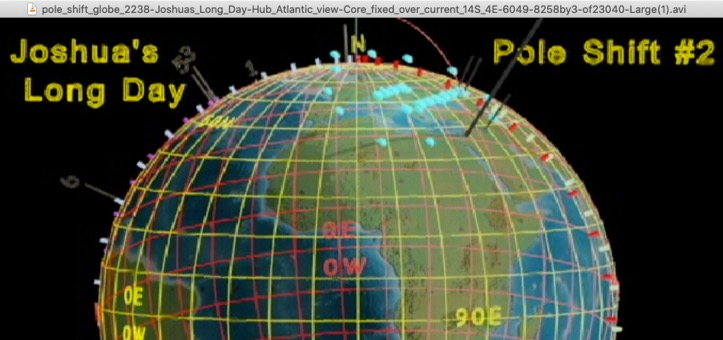
Re “the eastern edge/corner of Jericho”: The current location of
current Gilgal relative to Jericho is NNE (cf. red coordinate system above),
but the PJ location of Gilgal relative to Jericho was NE (cf. yellow coordinate
system above). In the height of the summer at that latitude the sun rises
between NE and ENE, and on April 15, 1456 BCE the sunrise was a little N of
straight E (cf. below).
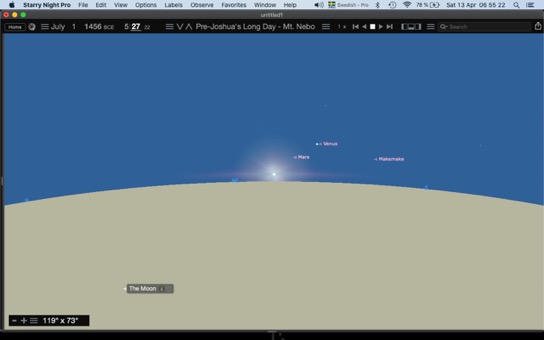
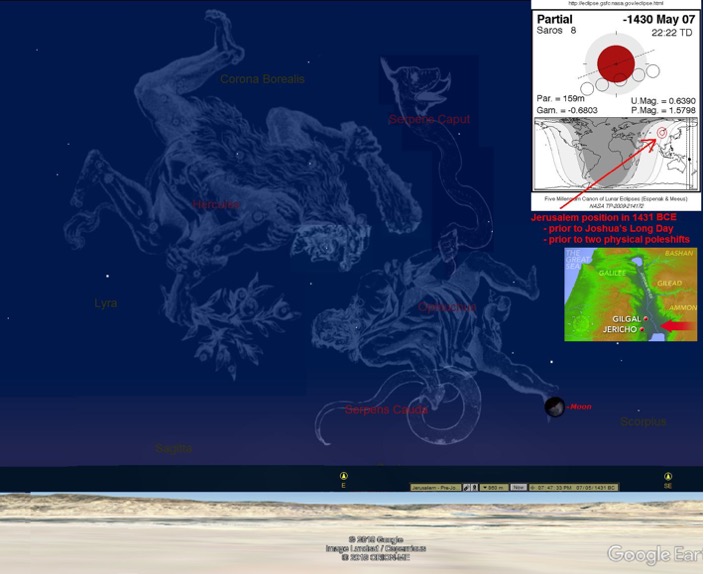
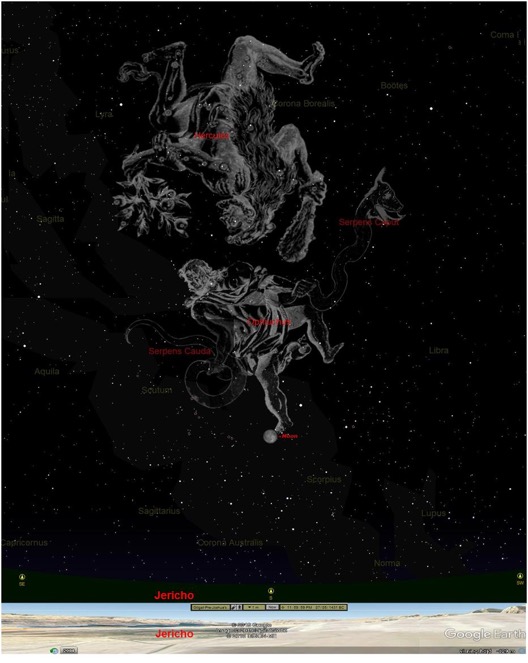
PrintScreen of the heavens on
May 7, 1396 BCE at 7:45 PM above, and at 11:59:59 PM below. Jericho was located
~105° to the right of the easterly view above where the eclipsed Moon was first
visible before passing over Jericho as seen below. (Per Starry Night Backyard
astronomy software, and with the corresponding Google Earth daylight view
inserted at the bottom.)
Joshua 5:13 TLT: “And it came to pass, when Joshua was in the Moon light,[35]
that he lifted up his eyes[36]
and looked, and, behold, there stood a man over against him with his destroyer[37]
in his hand: and Joshua went unto him, and said unto him, Art thou
for us, or for our adversaries?”[38]
That question of Joshua is to
me highly reminiscent of the experiences of several other kings, Caesars, and
others who were likewise facing an eclipse, or other celestial events, which
events were unpredictable in the minds of most people, and thus the fears
therewith associated. That is, associated with any such unexpected solar or
lunar eclipse there were in the minds of people an expectation of a change of
powers upon the throne etc.. Examples being e.g.:
1.
The lunar eclipse described by the woman of Endor at
the time of King Saul’s visit the day before his death in 1028
BCE, which description was grossly misunderstood by King Saul;
2.
Herod at the time of the recent birth of Yeshu in 16-15
BCE re a multitude of celestial events (commonly known as “the star of
Bethlehem”;)
3.
The similar based, as those of Herod, baby killings of
the Roman government at the time of the birth of Caesar Augustus in 68
BCE;
4.
The solar eclipse and the comet associated with the
murder of Caesar Julius in 49
BCE;
5.
The solar eclipse at the time of the death of Caesar
Augustus in 5
CE;
6.
The change of high priests under the command of Herod
in 9
CE re a lunar eclipse;
7.
The solar eclipse visible from one end of the Roman
Empire to the other a few weeks following the crucifixion of Yeshu in 19
CE. For details please carefully consider the details of this
PowerPoint Presentation and of this
article;
8.
The total solar eclipse at the time of the death of
Caesar Caius in 26
CE;
9.
Saul’s meeting with Yeshu at the time of his
conversion experience outside of Damascus at the time of a solar eclipse in 29
CE;
10. The solar eclipse expected at
the time of Caesar Claudius’ birthday sometime in 29-38
CE; and
11. Caesar Vespasian in 65-66
CE re a comet.
Jos 5:14
ויאמר לא
כי
אני
שׂר־צבא־יהוה
עתה
באתי ויפל יהושׁע אל־פניו ארצה וישׁתחו ויאמר לו מה אדני מדבר אל־עבדו׃
Jos 5:14 KJV And he said, Nay; but as captain of the host of the LORD am
I now come. And Joshua fell on his face
to the earth, and did worship, and said unto him, What saith my lord unto his
servant?...
Please compare this last question
of Joshua, “What saith my lord unto his servant?,” with that of Paul in a similar setting, “Lord, what wilt thou have me to do?” Acts
9:6.
. . . . .
Can Jos 5:11 “on the morrows of the Passover” refer to the 14th as well as also to the
15th?
You, the
reader, have now seen some of the evidence re the lunar eclipse tied to Abib 14
of Jos 5:11 [i.e. tied to Fri evening May 7, 1396 BCE.] Accordingly, I am
dating Jos 5:11 as follows:
After sunrise in the morning of Day Seven of the week;
i.e. on the Feast of Firstfruits, the morning of Passover Preparation Day, the
morning of Passover Eve, Abib 14, 1396 BCE [Saturday morning after sunrise, May
8 (the day beginning at sunset Fri May 7,) 1396 BCE,] actual preparations
having had to be as much as possible completed on Abib 13, Day Six, Preparation
Day [the day beginning at sunset Thu May 6, 1396 BCE.]—That is, due to the
Seventh Day Sabbath falling on Abib 14 in that year:
Jos
5:11 ויאכלו מעבור הארץ ממחרת
הפסח
מצות וקלוי בעצם
היום
הזה׃
Jos 5:11 TLT And they did
eat of the produce of the land from the
morrows, i.e. after the sunrise,[39]
of the Passover Preparation Day (and then again after the morrows of the
Passover sacrifice) unleavened cakes,[40] and parched grain in the body[41] of the day.
Jos 5:11 KJV And they did
eat of the old[42] corn of the land on the morrow after the passover, unleavened cakes, and parched corn in the selfsame day.
So how does
this timing of mine agree with Numbers 33:3? That is, that, after the crossing
of Jordan, the people ate of the produce of the land even from the morning of
the 14th. Does it agree? Or does it not? As I see it, yes it
probably could. And yes, I believe it does.
In essence, this
issue may be boiled down to the one question: May the term ‘ממחרת הפסח’ ‘from the
morrows of the Passover’ apply, not only to the morning of Abib 15, but also to
the morning of Abib 14? If so, under what circumstances?
The focus of
the Passover is the Passover sacrifice, which sacrifice is being brought in the
evening twilight hour that is part of the 14th and of the 15th
days of the month. The 14th day is the Day of the Preparation of the
Passover, while the 15th day is the Day of the consummation of the
Passover.
Both days
are intimately tied to the Passover sacrifice, just as they are also intimately
linked with one another as in any two links in a chain. Accordingly, I find
that the Hebrew term ‘ממחרת
הפסח’ may
be properly applied to the 14th as well as to the 15th
day. That is, as apparently done per Jos 5:11 in re to the Shabbat of the 14th,
and per Num 33:3 in re to the 15th (the Sixth Day of the week.)
If that is true,
then why is that so? Well, consider the above situation, when, as best I can
tell, Abib 14 fell out on the Seventh Day Shabbat, which Shabbat coincided with
the Feast of Firstfruits! Is it not true that, whenever that happens, then as
much as possible of the Preparation of the Passover must be completed prior to
the Seventh Day Shabbat, that is, prior to the Feast of Firstfruits and prior
to Abib 14. More below…
But let’s
first look a little more closely at the Exodus event recorded in Num 33:3:
Per my
Excel-file, the Sacred
Calendar of the Creator in Progress, on the tab ‘6000+ years,’ the event recorded
in Num 33:3, occurred in the morning of Abib 15, 1471 BCE [Friday morning May
1, 1471 BCE:][43]
Num 33:3
ויסעו מרעמסס בחדשׁ
הראשׁון
בחמשׁה
עשׂר
יום
לחדשׁ
הראשׁון
ממחרת
הפסח יצאו בני־ישׂראל ביד רמה לעיני כל־מצרים׃
Num
33:3 TLT And they departed from Rameses in the first
month, on the fifteenth day of the first month; after the morrows
of the passover the children of Israel went out with an
high hand in the sight of all the Egyptians.
Num
33:3 KJV And they departed from Rameses in the first
month, on the fifteenth day of the first month; on the morrow after the
passover the children of Israel went out with an high hand in the sight
of all the Egyptians.
It seems
clear enough that, at the Exodus event, everyone was to stay inside through the
first 12 hours of Abib 15 (beginning at sunset Thu Apr 30, 1471 BCE) while the
angel of death bypassed only those doors that were painted with the blood of
the Passover lamb. Then the departure from Rameses followed on the morning of
Abib 15 [Friday morning.] Thus, in this instance I find that clearly the term ‘ממחרת הפסח,’ ‘after the morrows of the Passover’ must apply to Abib 15.
However, upon having seen also that:
1. the evening twilight hour, of the
Passover sacrifice event, belongs both to the 14th and to the 15th
day of the month, I cannot rule out the possibility that the same term ‘ממחרת הפסח,’ ‘after the morrows of the Passover’ could also be correctly applied to the 14th
day;
2.
accordingly, when I read Jos 5:11 and find that “they did eat…
unleavened cakes… from the
morrows of the Passover…” I cannot
rule out the possibility that that language of Jos 5:11 is indeed intended to
tell me that “after sunrise[44]
of the Passover Preparation Day, the 7th Day [of the week,] Abib 14,
[beginning at sunset Fri May 7] 1396 BCE” they did eat, just that which Jos 5:11 says that
they ate.
3. Abib 14 of that year, 1396 BCE,
coincided with the Feast of Firstfruits and the Omer sacrifice, I find nothing
strange in the Jos 5:11 description of what they ate from the morrows of that
day.
I conclude
that yes, the term used in Jos 5:11, “on the morrows of the Passover” is applicable to the 14th as well as also to the 15th, at
least in that year, 1396 BCE.
As always, I
find that the words of the Holy Scriptures, as originally written, are reliable
and exact. When there is an apparent problem, the problem is in the eyes of the
beholder, whether those eyes belongs to a translator, to a transcriber, or to
the end reader. It serves us well to carefully consider and to remember the
reasons for our original problems…
In this case,
I find a cluster of misconceptions at the heart of our past problem with this
Bible passage:
1. Without a true understanding of the
calendar and the reckoning of time as used by the Bible, we have no solid
reference for evaluating our understanding of time related terms used in the
Bible. Accordingly, one of our first priorities ought to be the lifting up of,
and carefully focusing upon, every detail pertaining to time as used by the
Bible! This is possible, but is not a minor undertaking… Finding solid anchors
in time, such as the above discovered lunar eclipse of May 7, 1396 BCE, which
seems to be such a solid anchor stone, is mighty important to each our
understanding of the Holy Scriptures! That is, because this May 7, 1396 BCE
lunar eclipse is in harmony with other such solid anchors, e.g. the lunar
eclipse just prior to King Saul’s death, and because thus far I have found nothing
to the contrary, yes, because of that this lunar eclipse may serve as yet
another such important anchor in time. Recognizing the absolute necessity of
observing the Scripture feasts exactly on the days defined in Leviticus 23 is
key to learning to understand the Biblical calendar and reckoning of time! Thus
also the importance of correctly understanding the exact timing of the Passover
recorded in Joshua!
2.
Discovering the true grammatical meaning of ממחרת הפסח
in terms of ‘after the morrows of the Passover,’ as opposed to “the morrow after
the passover"is key to solving a most pressing problem of this passage.
3. Discovering the true meaning of עצם
היום
in terms of ‘the body of the day,’ ‘the active hours of the day,’ or ‘the hours between sunrise and sunset,’ or, perhaps most importantly, in terms of ‘the remainder of the day…’[45]
That is, as opposed to the KJV translations “the selfsame day" or “that
very day,” is very helpful towards discovering item #2 above.
4. Lastly, recognizing the
importance of a correct understanding of the instructions recorded in Leviticus
23, let’s review more closely the relevant verses, i.e. Lev 23:9-14. That is,
in order that we may more clearly discern each our past problems, and/or
misconceptions, of the instructions given per Lev 23:9-14!:
Lev 23:9
וידבר יהוה
אל־משׁה
לאמר׃
Lev 23:9 TLT And Yehovah spake unto Moses, saying,
Lev 23:9 KJV And the LORD spake unto Moses, saying,
Lev 23:10 דבר
אל־בני
ישׂראל ואמרת
אלהם כי־תבאו
אל־הארץ
אשׁר אני נתן
לכם וקצרתם
את־קצירה והבאתם
את־עמר ראשׁית
קצירכם
אל־הכהן׃
Lev 23:10 TLT Speak unto the children of Israel, and say unto
them, When ye be come into the land which I give unto you,
and shall reap the harvest thereof, then ye shall bring a sheaf
of the firstfruits of your harvest unto the priest:
Lev 23:10 KJV Speak unto the children of Israel, and say unto
them, When ye be come into the land which I give unto you,
and shall reap the harvest thereof, then ye shall bring a sheaf
of the firstfruits of your harvest unto the priest:
Lev 23:11
והניף
את־העמר לפני
יהוה לרצנכם ממחרת השׁבת
יניפנו
הכהן׃
Lev 23:11 TLT And he shall wave the sheaf before Yehovah,
to be accepted for you: after the morrows of the sabbath the priest shall wave
it.
Lev 23:11 KJV And he shall wave the sheaf before the LORD, to
be accepted for you: on the morrow after the sabbath the priest shall
wave it.
Looking at the construction of
the words ממחרת השׁבת, it is quite clear to me that the preposition -מ,
after, pertains to the מחרת, mornings, and not to the word השׁבת,
the Sabbath. That is, the grammatical dual of מחרת, pertaining to the
two points in time:
1)
at the beginning of twilight
at first dawn; and
2)
at sunrise.
That is, corresponding to the parallel
event inherent in:
1)
the sunset;
2)
and the end of evening
twilight.
Which sunset defines the
beginning of the next day, and which end of evening twilight defines the end of
the prior day, thus linking two separate days into one another as in a most
powerful chain.
So also the morrows, מחרת, of one
day powerfully links ערב, the dark and cool
half of the 24+ hour day, unto בקר, the light and hot half of the 24+ hour day, into one unit called יום,
day. Cf. the corresponding definition found in Gen 1:5! As a matter of fact,
the word בקר
may be literally translated as “in the cool” (cf. not only Strong’s #H1242 and
#H1239, but especially #H7119 and #H7120!) That is, because the coldest point
of most 24 hour days is typically at the very time of sunrise. Thus the word בקר may be perceived as
the characteristic sign naming and marking the beginning of the remainder of
the 24+ hour day, יום. That is, עצם
היום (cf. below!) Likewise, the word ערב may be recognized as the characteristic marking the beginning
of the dark and cool half of the 24+ hour day, יום. That
is, as understood from Strong’s #H6150, “rather identical with H6148 through
the idea of covering with a texture); to grow dusky at sundown.”
But notice also Strong’s #H6148, “intermix,” as in the evening twilight
hour that links one 24+ hour יום into the next 24+ hour יום.
Lev 23:12
ועשׂיתם ביום הניפכם
את־העמר
כבשׂ תמים
בן־שׁנתו
לעלה ליהוה׃
Lev 23:12 TLT And ye shall offer that day when ye
wave the sheaf an he lamb without blemish of the first year for a burnt offering unto
Yehovah.
Lev 23:12 KJV And ye shall offer that day when ye
wave the sheaf an he lamb without blemish of the first year for a burnt offering unto
the LORD.
That is, at the midpoint of
the 24+ hour יום, and within the body of the light and hot portion that is
likewise called יום, or עצם
היום, the
latter half of said 24+ hour יום. Cf. Lev 23:14! Indeed, considering the fact that עצם means ‘bone’ and
that the bones are generally the last things left after a meal, the remains
after a meal, one may also understand these instructions as saying that “the
produce of the land may be eaten during the remainder of the day only. That is,
after the offering brought, per vers 12, and regardless of which hour of that
day it is being brought. That is, if for some reason the sheaf arrives to the
priest sometimes later in the Sabbath Day.
Lev 23:13
ומנחתו שׁני
עשׂרנים סלת
בלולה בשׁמן
אשׁה ליהוה
ריח ניחח
ונסכה יין
רביעת ההין׃
Lev 23:13 TLT And the meat offering thereof shall be two
tenth deals of fine flour mingled with oil, an offering made by fire unto Yehovah
for a sweet savour: and the drink offering thereof shall be of wine, the fourth
part of an hin.
Lev 23:13 KJV And the meat offering thereof shall be two
tenth deals of fine flour mingled with oil, an offering made by fire unto the
LORD for a sweet savour: and the drink offering thereof shall be of wine, the
fourth part of an hin.
Lev 23:14 ולחם וקלי
וכרמל לא
תאכלו עד־עצם
היום הזה עד
הביאכם
את־קרבן
אלהיכם
חקת עולם
לדרתיכם בכל
משׁבתיכם׃
Lev 23:14 TLT And ye shall eat neither bread, nor parched
corn, nor green ears, until the remainder
of the day that ye have brought an offering unto your God: it shall be a statute
for ever throughout your generations in all your dwellings.
Lev 23:14 KJV And ye shall eat neither bread, nor parched
corn, nor green ears, until the selfsame day that ye have brought
an offering unto your God: it shall be a statute for ever throughout your
generations in all your dwellings.
It occurs to me that the first “bread” allowed after
the Omer sacrifice, will not have had time to be leavened, unless thus prepared
prior to the statute thus established. That is, מצות, unleavened bread is necessarily
eaten on the Feast of Firstfruits, whether or not it falls out inside or
outside the Feast of Unleavened Bread! But what’s the lesson of that fact, if
not that the Feast of Unleavened Bread serves as a magnifying glass emphasizing
the importance of the Feast of Firstfruits, the Omer sacrifice, and the
Reckoning of Omer towards that Seventh Day which is also the 50th
day, which 50th day of Omer is defined as the seventh Seventh Day
Sabbath within the Reckoning of Omer towards Shavuot, Pentecost!
Indeed, had the original intention been for the Feast
of Firstfruits and for Shavuot to fall out always on the First Day of the week,
which First Day of the new week is always also the 8th day of the
prior week, then it would clearly also have been natural for that First Day to
be somehow emphasized as the Eighth First Day of the Reckoning of Omer, but it
is not! And it is obvious enough that in such a Sunday worship influenced
Reckoning of Omer there cannot possibly exist more than seven Seventh Day
Shabbats. Which fact may serve also as an excellent example of how the built in
lessons and blessings of the Creator’s own perfectly defined feasts cannot
possibly exist, or be experienced, by such people as choose to remain blind to
the extreme importance of learning and heeding the Creator’s instructions
exactly as given and in no other way!
And
reviewing also the instructions for the reckoning of Omer towards Pentecost:
Lev 23:15
וספרתם לכם ממחרת השׁבת
מיום הביאכם
את־עמר
התנופה שׁבע
שׁבתות תמימת
תהיינה׃
Lev 23:15 TLT And ye shall count unto you from the
morrows of the sabbath, from the day
that ye brought the sheaf of the wave offering; seven sabbaths shall be completely
existing within your count of fifty:
Lev 23:15 KJV And ye shall count unto you from the
morrow after the sabbath, from the day that ye brought the sheaf of the wave
offering; seven sabbaths shall be complete:
Consideration
#1 re the Reckoning of the Omer:
Notice that if and when the Omer is
brought on a Seventh Day Sabbath included in the Reckoning of Omer, then the
Counting of Omer will begin with a Seventh Day Sabbath. And, if that first
Seventh Day Sabbath was to be included in the Reckoning of Omer, then the
beginning of the 50th day would mark also the beginning of the 8th
Sabbath within the 50 day count. Thus satisfying, even at the very beginning of
the 50th Day, the requirement “seven sabbaths shall
be completely existing within your count of fifty.”
That is, even at the beginning of that 50th Day, when that 8th
Sabbath is not yet “completely existing within your count of fifty!”
Thus the 8th Sabbath, the 50th day of Omer, would clearly
be signifying something new.
I.
For instance,
as in the birth—‘Birth’ meaning ‘the beginning of the life!’—of a baby on the 6th
day of the 3rd month (as Pentecost is defined by most Jews today) 9
months following a conception at the end of the 6th month. Please
notice the several multiples of the number 3, the type of numbers so highly
honored by the Catholic Church! And, which numbers are also part and parcel of
the numbers 600, 60, 6, and 666, referenced in the book of Revelation as ‘the
Mark of the Beast!’
II.
Or, as in a
fundamentally New Covenant being supposedly taught in the New Testament. That
is, a Covenant such as does away with the laws and principles of the Creator as
given us through Moses and through ‘the Old Testament’—As in the Obsolete
Testament!—That is, in contradistinction to a renewed covenant. A renewed
covenant being purified from the stains, from the guano, from the many defects,
accumulated with time due to the influence of blind leaders of a blind people
ever apostatizing and falling away from the original pure teachings defined and
blessed once and for all forever. That is, in contradistinction to a renewed
Seventh Day Sabbath covenant perfectly in harmony with all of the instructions
built into Leviticus 23! That is, in contradistinction also to the inherent
blessings built into the Creator’s own Feast of Sevens, שָׁבוּעוֹת, השׁבת
השׁביעת! Cf. Lev 23:16 (below!) What an abomination to place such an
annual Seventh Day Sabbath celebration on a Sunday! Compare Isa 1:13 and 66:23 (below!)
However, that
‘if and when’
(pertaining to an inclusive reckoning of Seventh Day Shabbats when the Feast of
Omer is otherwise correctly observed on the Seventh Day of the week) cannot be
because per Lev 23:16, the 50th day is concurrent with the 7th
Sabbath, not with the 8th Sabbath! Furthermore, by the time of “the
morrows of the Sabbath,” not only 7, but 7 ½, “Shabbats are complete!”
And, again,
placing Pentecost on a Sunday morning is certainly not a characteristic of the
pure teachings of our Creator and Redeemer as recorded in Leviticus 23, and it
does absolutely nothing towards emphasizing the importance and the significance
of the Seventh Day Sabbath that is taught and exemplified for us once and for
all per Genesis 2:1-3!
Notice the
verse numbers! What happens when you add all the exactly correct meeting times
with our Creator and Savior, as taught per Lev 23, to the number 66, as in Rev
13:18? See Eze 9:3-4! Or is it not in essence this: 6 + 1 = 7, 60 + 10 = 70,
and 600 + 100 = 700, i.e. a voluntary choice between:
1.
600, 60, and
6 alone: Satisfaction with status quo, imperfection, with the mere beastly dimensions
of man as a being, and with a continual compromise and preparation unto death;
or else
2.
(600, 60, and
6) + (100, 10, and 1:) Preparation towards cleansing in terms of ever greater
harmony with the principles and statutes of “YHWH Elohim who are two becoming
One” unto life eternal at every level of existence!
Notice also
some of the associations tied to the numbers 1, 10, 100, and 1000!:
‘1:’
Deut 6:4 KJV Hear, O Israel: The
LORD our God is one LORD.
Mar 12:29 KJV And Jesus
answered him, The first of all the commandments is, Hear, O Israel; The Lord
our God is one Lord:
A prime word meaning of the
letter aleph is ‘family of YHWH’ as in Genesis 1:26, 27, and the basis of any
one’s existence being one man and one female. Cf. Strong’s #H504!
‘10:’
Ex 20:1-17;
Deut 5:1-21: The Ten Commandments.
A prime word
meaning of the letter ‘yod’ is “hand in motion,” as in a hand of action, a
pro-active mind, and as in learning and heeding:
John 21:6 KJV And [Yeshu] said
unto them, Cast the net on the right side of the ship, and ye shall
find. They cast therefore, and now they were not able to draw it for the
multitude of fishes.
‘100:’
A prime
meaning of the letter kof is ‘eye of a needle,’ cf. Roots of the Bible by
Friedrich Weinberg.
Mar 10:25; Luk
18:25 KJV It is easier for a camel to go through the eye of a needle, than for a rich man
to enter into the kingdom of God.
‘1000:’
Another prime
meaning of the letter aleph is ‘1000,’ cf. Strong’s #H505!
Aleph as in
the word ‘eleph-ant!’
As in 12 x 12
x 1000 = 144,000, cf. Rev 14:1, 4!:
Rev 14:1-3 KJV:
1 And I looked, and, lo,
a Lamb stood on the mount Sion, and with him an hundred forty and four
thousand, having his Father's name written in their foreheads.
2 And I heard a voice
from heaven, as the voice of many waters, and as the voice of a great thunder:
and I heard the voice of harpers harping with their harps:
3 And they sung as it
were a new song before the throne, and before the four beasts, and the elders:
and no man could learn that song but the hundred and forty and four thousand,
which were redeemed from the earth.
Accordingly, please consider
the importance of the message given each and all of us in these passages!:
Isa 1:13 KJV Bring no more vain oblations; incense is an
abomination unto me; the new moons and sabbaths, the calling of assemblies,[46] I cannot away with;
it is iniquity, even the solemn meeting.
Isa 66:23 KJV And it shall come to pass, that from one new
moon to another, and from one sabbath to another, shall all flesh come to
worship before me, saith the LORD.
Please notice carefully the
three key elements in Lev 23:16!:
1.
‘-s of…’
2.
‘the seventh sabbath’
3.
‘fifty days’
Lev 23:16 עד
ממחרת השׁבת
השׁביעת
תספרו חמשׁים
יום
והקרבתם מנחה
חדשׁה ליהוה׃
Lev 23:16 TLT Unto the morrows of the seventh sabbath shall ye number fifty days; and ye shall
offer a new meat offering unto Yehovah.
Lev 23:16 KJV Even unto the morrow after the
seventh sabbath shall ye number fifty days; and ye shall offer a new
meat offering unto the LORD.
Consideration
#2 re the Reckoning of the Omer:
Next, please consider carefully the particulars of the wording within
verse 16 above! According to ancient Hebrew time reckoning, the initiating
event is considered accession time, or time period number zero! If that was not
so, then the 50th day would necessarily coincide with the 8th
Shabbat, not with the 7th Shabbat, as clearly stated in verse 16! If
‘the initiating event’ was the sacrifice of the Omer, aka. the Waving of
the Sheaf ceremony, it would have to have taken place prior to the sunrise on
the Seventh Day Shabbat. That is, the Omer sacrifice would have to be initiated
before or, at the latest, during the morning twilight hour of that Seventh Day
Shabbat and certainly before sunrise. If so, then the Counting of the Omer
morrows would begin Morrow number One of Omer at the sunrise of that Seventh
Day Shabbat. That is, while that same Shabbat is, by itself as a whole and by
the same Hebrew reckoning, the Accession Shabbat, Shabbat number Zero in the
reckoning towards the Seventh Shabbat.
However, per the instructions clearly given per Lev 23:11, the Waving of
the Sheaf is to take place after the morrows of the Shabbat, that
is, after sunrise, not before! And certainly not at the beginning of that
Shabbat at sunset on a Friday evening! Accordingly, the sacrifice of the Omer
cannot be the initiating event at the basis of a perfect understanding of these
Lev 23:16 instructions.
It follows that time itself, invisible and untouchable, as created by
YHWH Elohim, is itself the one and only initiating event prior to ‘the morrows
of the seventh Shabbat.’
Consideration
#3 re the Reckoning of the Omer:
Reading Lev 23:11, 16 more closely, I discover that the Counting of the
Omer is not a matter of counting the 24+ hour days, but is a counting of the
Morrows within that reckoning.
Once we recognize that it is neither the 24+ hour days that are being
reckoned, nor is it the Omer sacrifice that is being reckoned as the initiating
event. On the contrary…:
Lev 23:15 TLT And ye shall count unto you from the
morrows of the sabbath, from the day
that ye brought the sheaf of the wave offering; seven sabbaths shall be completely
existing within your count of fifty:
That is, just as it says, without more! Reckoning only “the morrows” of
those 50 days of Omer… Not the 24+ hour days as defined from even to even!
Well, then it is easy to recognize also that the 50th day of
Omer is concurrent with the 7th Shabbat. That is because, the 1st
morrows of the Omer reckoning is falling at the mid point of the 0th,
or the accession, Shabbat.
And… Notice! The morrows are in the middle of each Shabbat, thus each
Shabbat, except the first and the last, contributes half of a ‘complete
Shabbat’
to each of two separate Sabbaths! Thus, ‘after the morrows of the 7th Shabbat’ we find a total
of exactly 7 complete Sabbaths within our reckoning of 50 days!:
½ + 1 + 1 + 1 + 1 + 1 + 1 + ½ = 7 complete Shabbats!
Exactly as called for by Lev 23:15!
Lessons from Consideration #3:
There must be some valuable lessons hidden within these instructions!
What might some of those lessons be?
First of all, the discovery described under Consideration #3 above makes
me think of how the months of the Scripture calendar year are numbered. That
is, with month number one in the very midst of the calendar year that begins
with the Eighth Day Feast on Tishri 22. That is, the 7th month is
the last month of the Scripture year, which month links into the Scripture New
year through the remainder of that seventh month. And, just like a picture on
the wall is typically hung on one nail in the middle of the picture, so also
month number one is placed in the midst of God’s own calendar year in order for
us to have a calendar year that is constantly balanced correctly relative to
the seasons.
Secondly, the only once or twice in a life time by most people
experienced Sabbatical year is likewise reckoned, in order for God’s people to
remember and correctly observe His seasons! That is, in each and every 49 year
cycle, when the 1st of the 50 year reckoning belongs to the 49th
and last year of the prior 49 year cycle, then the 50th year will
necessarily coincide with the 49th and last year of the most recent 49
year cycle.
(Those who insist in using a
non-ancient Hebrew inclusive reckoning which is a characteristic of Roman and
Greek and modern Western reckoning, most or all of the above discovered are
typically rejected, and the only solution will seem to be continual Sunday
observance, while thus necessarily missing out on all of the valuable lessons
and blessings associated not only with a strict Seventh Day Shabbat observance
in accord with the first instructions within Leviticus 23, but with all of them
in that chapter, placed as it too is, at the very midst of the Torah…)
Lev 23:21
וקראתם בעצם היום
הזה
מקרא־קדשׁ
יהיה לכם
כל־מלאכת עבדה
לא תעשׂו חקת
עולם
בכל־מושׁבתיכם
לדרתיכם׃
Lev 23:21 TLT And ye shall proclaim within the remainder
of that day an holy convocation unto you: ye shall do no servile work therein:
it shall be a statute for ever in all your dwellings throughout your
generations.
Lev 23:21 KJV And ye shall proclaim on the selfsame day,
that it may be an holy convocation unto you: ye shall do no servile work
therein: it shall be a statute for ever in all your dwellings throughout your
generations.
Please notice, once again (cf. above!) that the Hebrew word עצם,
meaning bones, remains (Gen 50:25,) remainder (Ex 12:17,) or body (Strong’s
#H6095-6; 6105-7,) is just that! It is not a simple pronoun pointing to the
complete 24+ hour day as in KJV’s translation ‘selfsame.’ On the contrary, just
like any bone in the body, it is only part of the whole, albeit giving
substance, stability, and ‘mightiness/power’ (Gen 26:16; Ex 1:7, 20) to the
same. It is also a word naturally associated with ‘the active hours of the
day,’ ‘the remaining hours of the day following the darkness and the hours of
rest,’ ‘the hours when one is up and around, using one’s bony extremities in
whichever ways.’ That the word עצם is a word pointing to ‘the hours of the 24+ hour day remaining
after sunrise’ is indicated also by its use in Lev 23:14, 21; Jos 5:11; and Eze
40:1. That is, the time following the sacrifice of Omer (Lev 23:14,) the time
when the holy convocation is assembled (Lev 23:21,) the time the children of
Israel ate of the new grain at Gilgal (Jos 5:11,) and the time of day when
Ezekiel received his vision (Eze 40:1.) Other Scripture passages that use the
word עצם
in a similar manner are Ex 12:17, 41, 51; Gen 7:13; 17:23, 26; Lev 23:28, 29,
30; Deut 32:48; Jos 10:27; Eze 2:3; 24:2. I find no Scripture passage
indicating anything to the contrary!
. . . . . .
.
Re KJV’s
translation “the old corn” in Joshua 5:11:
Seeing Nehemia
Gordon’s reference to
Rabbi Ibn Ezer of the 12th century CE, I realize that the word
“old,” as used in the King James version of Jos 5:11, is nothing but a poorly
thought through addition to the original Hebrew text. That is, an addition
lacking any valid foundation in the Hebrew original. That is, a belated attempt
of one Rabbi to find an excuse for the Pharisees’ traditional placement of the
Omer sacrifice, the Waving of the Sheaf sacrifice, on the 16th day
of Nissan. While recognizing also the strength of Nehemia’s further arguments
re that which was eaten per Jos 5:11, most particularly the “unleavened cakes,”
which are a most characteristic sign of the Feast of Unleavened Bread, I
recognize that Jos 5:11 points, or seems to point, to an event of the 15th
day of Abib. So, is that true or not?
Reminding
myself of, and carefully reviewing (cf. above!,) the original instructions of Lev
23:9-14 re the
Feast of Firstfruits, and re the reckoning of the Omer of Lev
23:15-22, I am
reminded once again of Brian Hoeck’s claims[47] re there being nothing in the Scriptures about the
Omer sacrifice being necessarily brought within the Feast of Unleavened Bread,
that is, on that one only Seventh Day Shabbat within the seven days of the
Feast of Unleavened Bread. Nevertheless, it is clear from Lev 23:11, that this
Waving of the Sheaf offering is being brought at a point in time tied to the
Seventh Day Shabbat. It is likewise clear, per Ex 12:2, that there is a certain
month that is to be identified as month number one of the year. But which month
is that, if there is nothing tying the Passover and the Feast of Unleavened
Bread ordinance to the Omer sacrifice and to the Feast of Firstfruits? Or is
there such a tie? Well, yes! As I understand it, and as explained in Nehemia
Gordon’s article, parched grain is a thing that is intimately tied to the
barely ripened grain harvest, to the aviv stage, and thus to the month Abib,
and is, as such, one of the signs within the definition of the first month of
the year. And seeing also that in order for the first ordinance of the
Passover… (cf. Ex 12:1-3:)
Exo 12:1 ויאמר
יהוה אל־משׁה
ואל־אהרן
בארץ מצרים לאמר׃
Exo 12:2 החדשׁ
הזה לכם ראשׁ
חדשׁים
ראשׁון הוא
לכם לחדשׁי
השׁנה׃
Exo 12:3 דברו
אל־כל־עדת
ישׂראל לאמר בעשׂר
לחדשׁ הזה
ויקחו להם
אישׁ שׂה
לבית־אבת שׂה
לבית׃
Exo 12:5
שׂה
תמים זכר בן־שׁנה
יהיה לכם
מן־הכבשׂים
ומן־העזים
תקחו׃
Exo 12:1-3, 5 TLT:
1 And the LORD spake unto Moses and Aaron in the land of Egypt,
saying,
2 This
month shall be unto you month number one: it shall be the
foremost month of the year to you.
3
Speak ye unto all the congregation of Israel, saying, In the tenth day of
this month they shall take to them every man a lamb, according to the house of
their fathers, a lamb for an house:
5
Your lamb shall be without blemish, a male in his first year of
life:
ye shall take it out from the sheep, or from the goats:
Exo 12:1-3, 5 KJV:
1
And the LORD spake unto Moses and Aaron in the land of Egypt, saying,
2 This
month shall be unto you month number one: it shall be the first month of the
year to you.
3
Speak ye unto all the congregation of Israel, saying, In the tenth day of
this month they shall take to them every man a lamb, according to the house of
their fathers, a lamb for an house:
5
Your lamb shall be without blemish, a male of the first year: ye shall take it
out from the sheep, or from the goats:
…which first ordinance is tied to the 10th
day of Abib, to be observed on the 10th of the month Abib, the
number of the month must necessarily also be firmly determined by the 10th
of Abib. Thus also giving people time enough to travel to Jerusalem, etc..
In this
context, I notice once again, in verse 5, that the lamb is to be a male “of the
first year.” So how is that age of the lamb being defined? Notice how confusing
this would be, providing the age is given in terms of calendar years, if the
turning from being a male ‘of the first year’ to being a male ‘of the second
year’ would take place at the beginning of Abib, month number one! That is, in
this particular setting, when the issue is focused upon whether or not the
present month is either Abib or Adar II! Contrariwise, I would suggest that,
given that most lambs are born in the spring time [February through May]—And I
really doubt that anyone would keep track of the exact date of delivery for
each and every lamb in the flock!—it would only be natural for the age of all
lambs to become a lamb ‘of the first year’ at the time of the Eighth Day Feast
following the Feast of Tabernacles “at the end of the year” (cf. Ex 23:16;
34:22.)
Accordingly
I find that once the produce of the land, e.g. the barley, is ripe enough for
making parched grain somewhere within the boundaries of Israel (typically
beginning first in the Jordan valley or in the Negev desert) then a sheaf of
this will be brought to the priest in Jerusalem post haste and then month
number one is to be proclaimed far and wide by means of the Feast of
Firstfruits, and/or by means of the Passover and Feast of Unleavened Bread
festivities. Thus, the order of the instructions as provided per Leviticus 23.
That is, the Passover instructions are given prior to the Feast of Firstfruits
instructions, whether or not the Feast of Firstfruits occurs prior to the
beginning of the Feast of Unleavened Bread. Remember too, that after the stage
of aviv is determined, and thus also the month of Abib, there may well remain
some uncertainty as to when exactly the grains will be fully ripe, and thus
also which exact Seventh Day Shabbat that will become the Feast of Firstfruits.
I would suggest that the gatherings in Jerusalem during the Feast of Unleavened
Bread will be most helpful in bringing to the surface every last sheaf of truly
ripe sheaf of barley.
Notice too
that there are other signs, associated with the same season of the year, one
such sign being the high water mark of the rivers, a sign that I have
consistently found being tied to the very day when the ice is breaking up on
the lakes upstream from the point of observation, cf. the words “Jordan overfloweth
all his banks all the time of harvest” Jos 3:15!:
Jos
3:15 KJV And as they that bare the ark were come unto
Jordan, and the feet of the priests that bare the ark were dipped in the brim
of the water, (for Jordan overfloweth all his banks all
the time of harvest,)
Having thus
established that…:
1) The Feast of Firstfruits is not necessarily
one of the seven days of the Feast of Unleavened Bread, but is a day tied to
the first Seventh Day Sabbath upon which ripe barley is available;
2) Month number one of the year is
the month when certain signs of spring are recognized, one of which is the aviv
stage of the barley, another one being the time when the barley is ripe enough
for making “parched grain;”and
3) Jos 5:11 is a record of an event
subsequent to the Omer sacrifice,
…it remains
to show clearly whether the Hebrew word ממחרת, commonly
translated “the morrow after the Sabbath;” points to Sunday morning, or else to
the Seventh Day Sabbath morning after sunrise.
Per common
Roman, Latin, Greek, and Western reckoning of time a term such as ‘the morrows of
the Shabbat’ does not make much sense, and the term ‘the morrow after the
Shabbat’ is commonly understood as Sunday morning. These same time concepts
have obviously been inherited by the current post-18th century
restored Roman culture influenced Hebrew language and tradition. That is, the
original ancient Hebrew time concepts have been forgotten, overlooked, and then
mistakenly replaced with non-ancient Hebrew time concepts when the Hebrew
language was being restored after being an almost dead language for around a
thousand years.
However,
using basic Hebrew grammatical rules, and then carefully reading the ancient
Hebrew words exactly as they are written, and after then being able to confirm
such a reading of these words and terms against a comprehensive real time study
of the best available ancient Hebrew Scriptures as projected upon the best
available astronomical data, I find that the literally translated term ‘the
morrows of the Sabbath’ makes excellent and
perfect sense, and none other. That is to say, ‘the morrows of the Sabbath’ points to: 1) the first dawn, and 2) the sunrise
that constitutes one of the first signs at the beginning of the Sabbath.
Thus it is that the morning following a Friday sunset is, per consistent
Scriptural reckoning of time, and per original ancient Hebrew time concepts and
language, that which constitutes ‘the morrows
of the Sabbath.’
That is, I
have discovered that, in the Hebrew culture and language, when referencing any
specific day, month, or year, the focus is always upon the first sign, located
at the beginning, of such a day, month, or year. That is, the focus is not upon
the conclusion of such a day, month, or year, as per the time concepts commonly
used in English and other Western languages.
I have
discovered that this focus upon the very beginning of a time period is a
necessary condition for being able to recognize and to place all the date
stamps provided within the Holy Scriptures in a manner such that all dates
agree with one another. That is, so as to make all the pieces of the puzzle fit
comfortably, easily, and perfectly together into a whole! Yes, that is exactly
what Yehovah has led me to accomplish. This discovery may be equally recognized
and appreciated by whomever is willing to delve into the probably thousands of
particulars constituting this puzzle of ancient chronology.
May I
suggest that you, the reader, if you are really interested in these
particulars, begin tracing your own journey by carefully scrutinizing and
considering these particulars as reflected within my journey of discovery along
these lines? This may be done by carefully studying and considering every
particular provided within this
Bible Study… Alternatively, if you so prefer, begin your pursuit with this
list of astronomy discoveries… Or, to make it just a wee bit more simple,
consider the events and the particulars of the remainder of Joshua, chapters 5
and 6…
Is it
reasonable to believe that there was time enough for Joshua—after his meeting
(presumably on a Sunday morning associated with the Waving of the Sheaf
offering) with the “man over
against him with his sword drawn in his hand” (Jos 5:13)—to organize first his own
thoughts and plans and commands, and then to carry out the first of six
consecutive days of marching around Jericho, all within just the few hours left
prior to nightfall of that very same day? That is, if his meeting with the man
with the sword was indeed an event that occurred no earlier than after sunrise
on Sunday, the First Day of Unleavened Bread, and if that day was also the
first day of marching around Jericho? I think that No, it is not reasonable!
Accordingly
I do find that Joshua 5:11 is
the record of an event that began on the morning of the Seventh Day Shabbat of
Abib 14, 1396 BCE. That is, as above
indicated. And that Joshua 5:12 (cf. below) is the record of an event that
began, as stated per Joshua 5:12, on the morning following the events described
and recorded in Joshua 5:11:
An event
pertaining both to the Seventh Day and to the First Day. That is, seeing that
on Sabbath manna had never been given (Ex 16:25-30,) the absence of manna on
Day One would have been when this difference would have been first noticeable.
Accordingly, Jos 5:12 is a record of facts pertaining both to sunrise time of
Day Seven and to sunrise time of Day One. Day One being in 1396 BCE also Day
One of Unleavened Bread, Abib 14 and 15, 1396 BCE [Saturday and Sunday after
sunrise in the mornings May 7 and 8, 1396 BCE:]
Jos 5:12
וישׁבת המן ממחרת
באכלם
מעבור
הארץ ולא־היה עוד לבני ישׂראל מן ויאכלו מתבואת
ארץ
כנען
בשׁנה
ההיא׃
Jos 5:12 TLT And the manna
ceased after the morrows of the days
within which they ate of the produce of the land; neither had the children of Israel manna any more;
but they did eat of the fruit of the land of Canaan
of that year.
Jos 5:12 KJV And the manna
ceased on the morrow after they had eaten of the old corn of the land; neither
had the children of Israel manna any more; but they did eat of the fruit of the land of Canaan that year.
Pertaining not only to the evening of the lunar
eclipse at the beginning of Day Seven, Abib 14, 1396
BCE, the 24+ hour day when the Waving of the Sheaf offering was brought in that
year [the day beginning at sunset Fri May 7, 1396 BCE,] but also to subsequent
morning and evening twilight hours as these events on the sky continued to
develop both on the sky and in the mind of Joshua.
Jos 5:13
ויהי בהיות יהושׁע ביריחו וישׂא עיניו וירא והנה־אישׁ עמד לנגדו וחרבו שׁלופה בידו וילך יהושׁע אליו ויאמר לו הלנו אתה אם־לצרינו׃
5:13 TLT And it came to
pass, when Joshua was in the Moon
light,[48] that he lifted up his eyes[49] and looked, and, behold, there stood a man over
against him with his destroyer[50] in his hand: and Joshua went unto him, and said unto
him, Art thou for us, or for our adversaries? [51]
5:13 KJV And it came to
pass, when Joshua was by Jericho, that he lifted up his eyes and looked, and,
behold, there stood a man over against him with his sword drawn in his hand:
and Joshua went unto him, and said unto him, Art thou for us, or for our
adversaries?
Jos 5:14
ויאמר לא
כי
אני
שׂר־צבא־יהוה
עתה
באתי ויפל יהושׁע אל־פניו ארצה וישׁתחו ויאמר לו מה אדני מדבר אל־עבדו׃
Jos 5:14 KJV And he said, Nay; but as captain of the host of the LORD am
I now come. And Joshua fell on his face to
the earth, and did worship, and said unto him, What saith my lord unto his
servant?
Jos 5:15 KJV And the captain of
the LORD'S host said unto Joshua, Loose thy shoe from off thy foot; for the
place whereon thou standest is holy. And Joshua did so.
In the PrtSc above, while
considering Jos 5:15, please notice the position of the foot—touching the
Moon!—of the man holding the serpent underneath Hercules, the man with the
destroyer in his hand! Thus, Joshua
might well have identified himself with the man desperately holding on to the
serpent while under the mighty command and support of Hercules, the captain of
Yehovah’s host.
At the
time of the New Moon that was first visible on Tue(!) Zif 1, 1396 BCE
[beginning at sunset (Julian Day calendar) Sat June 22, 1396 BCE:]
Jasher 88:14 And it was in the
second month, on the first day of the month,[52] that the Lord said to Joshua, Rise up, behold I have
given Jericho into thy hand with all the people thereof; and all your fighting
men shall go round the city, once each day,
thus shall you do for six days.
Jasher 88:15 And the priests shall blow upon trumpets, and when
you shall hear the sound of the trumpet, all the people shall give a great
shouting, that the walls of the city shall fall down; all the people shall go
up every man against his opponent.
Jos 6:2
ויאמר יהוה אל־יהושׁע ראה נתתי בידך את־יריחו ואת־מלכה גבורי החיל׃
Jos 6:2 KJV And the LORD said
unto Joshua, See, I have given into thine hand Jericho, and the king thereof, and the
mighty men of valour.
Jos 6:3
וסבתם את־העיר כל אנשׁי המלחמה הקיף את־העיר פעם אחת כה תעשׂה שׁשׁת
ימים׃
Jos 6:3 TLT And ye shall compass
the city, all ye men of war, and go round about the city once. Thus
shalt thou do the first six of the
seven days.
Jos 6:3 KJV And ye shall
compass the city, all ye men of war, and go round about the city once. Thus
shalt thou do six days.
Jos 6:4
ושׁבעה כהנים ישׂאו שׁבעה שׁופרות היובלים לפני הארון וביום
השׁביעי תסבו את־העיר שׁבע פעמים והכהנים יתקעו בשׁופרות׃
Jos 6:4 TLT And seven priests
shall bear before the ark seven trumpets of rams' horns: and the Seventh Day ye shall compass the city seven times, and the priests shall
blow with the trumpets.
Jos 6:4 KJV And seven priests
shall bear before the ark seven trumpets of rams' horns: and the seventh day ye shall compass the city seven times, and the priests shall
blow with the trumpets.
On Day
One through Day Six [of the week,] Zif 5-10, 1396 BCE [beginning on the morning
of the day beginning at sunset (Julian Day calendar) Wed June 26, 1396 BCE,
through the day beginning at sunset (Julian Day calendar) Mon July 1, 1396
BCE:]
Jasher 88:16 And Joshua did so according to all that the Lord had
commanded him.
Jos 6:6
ויקרא יהושׁע בן־נון אל־הכהנים ויאמר אלהם שׂאו את־ארון הברית ושׁבעה כהנים ישׂאו שׁבעה שׁופרות יובלים לפני ארון יהוה׃
Jos 6:6 KJV And Joshua the
son of Nun called the priests, and said unto them, Take up the ark of the
covenant, and let seven priests bear seven trumpets of rams' horns before the
ark of the LORD.
Jos 6:8
ויהי כאמר יהושׁע אל־העם ושׁבעה הכהנים נשׂאים שׁבעה שׁופרות היובלים לפני יהוה עברו ותקעו בשׁופרות וארון ברית יהוה הלך אחריהם׃
Jos 6:8 KJV And it came to
pass, when Joshua had spoken unto the people, that the seven priests bearing
the seven trumpets of rams' horns passed on before the LORD, and blew with the
trumpets: and the ark of the covenant of the LORD followed them.
Jos 6:14
ויסבו את־העיר ביום
השׁני פעם אחת וישׁבו המחנה כה עשׂו שׁשׁת
ימים׃
Jos 6:14 TLT And the Second Day they compassed the city once, and returned into the camp:
so they did the first six of the seven days.
Jos 6:14 KJV And the second day they compassed the city once, and returned into the camp:
so they did six days.
On the Seventh
Day Shabbat, Zif 11, 1396 BCE [the day beginning at sunset (Julian Day
calendar) Tue July 2, 1396 BCE:]
Jasher 88:17 And on the seventh
day they went round the city seven
times, and the priests blew upon trumpets.
Jasher 88:18 And at the seventh round, Joshua said to the people,
Shout, for the Lord has delivered the whole city into our hands.
Jos 6:15
ויהי ביום
השׁביעי וישׁכמו כעלות השׁחר ויסבו את־העיר כמשׁפט הזה שׁבע
פעמים רק ביום
ההוא סבבו את־העיר שׁבע
פעמים׃
Jos 6:15 TLT And it came to
pass on the Seventh Day, that they got themselves ready at the first rise of dawn, and compassed the city after the same manner seven times:
only on that day they compassed the city seven times.
Jos 6:15 KJV And it came to
pass on the seventh day, that they rose early about the dawning of the day, and compassed the city after the same manner seven times:
only on that day they compassed the city seven times.
Jos 6:20
וירע העם ויתקעו בשׁפרות ויהי כשׁמע העם את־קול השׁופר ויריעו העם תרועה גדולה ותפל החומה תחתיה ויעל העם העירה אישׁ נגדו וילכדו את־העיר׃
Jos 6:20 KJV So the people
shouted when the priests blew with the trumpets: and it came to pass, when the
people heard the sound of the trumpet, and the people shouted with a great shout,
that the wall fell down flat, so that the people went up into the city, every
man straight before him, and they took the city.
A Feast
of Tabernacles event, beginning Tishri 15, 1428 BCE [beginning at sunset Sun(!)
Sep 29, or else Tue(!) Oct 29, 1428 BCE.[53]] At the beginnings of the Sabbatical year,
that is, as evidenced by the reading of the Torah at that time! Cf. Deut
31:10-11! More at the footnote at this link:
Deut 31:10
ויצו משׁה אותם לאמר מקץ
שׁבע
שׁנים
במעד
שׁנת
השׁמטה
בחג
הסכות׃
Deut 31:11
בבוא כל־ישׂראל לראות את־פני יהוה אלהיך במקום אשׁר יבחר תקרא
את־התורה הזאת נגד כל־ישׂראל באזניהם׃
Deut 31:10 KJV And Moses commanded them, saying, At the end
of every seven years, in the solemnity of the year of release, in the feast of
tabernacles,
Deut 31:11 KJV When all Israel is come to appear before the LORD thy
God in the place which he shall choose, thou shalt read this
law
before all Israel in their hearing.
Jos 8:34
ואחרי־כן
קרא
את־כל־דברי
התורה הברכה והקללה ככל־הכתוב בספר התורה׃
Jos 8:34 And afterward he read all the words of the law, the blessings and cursings, according to all that is
written in the book of the law.
Jos 8:35
לא־היה
דבר
מכל
אשׁר־צוה
משׁה
אשׁר
לא־קרא
יהושׁע
נגד
כל־קהל
ישׂראל
והנשׁים והטף והגר ההלך בקרבם׃
Jos 8:35 There was not a word of all that Moses commanded, which Joshua
read not before all the congregation of Israel, with the women, and the little ones, and the
strangers that were conversant among them.
The Long Day of Joshua, [A physical poleshift ~150
degrees pole to pole tilt:
(Local times (at locations ~9 time zone hours apart:) duration of poleshift
(military time:) ~57 hrs; (Iyar)/Sivan 13, Day Five[54] and Thu(!) (throughout the duration of the
poleshift!) [(Julian Day calendar date:) ~8AM Mon June 11 - ~8AM Wed June 13,[55] 1426[56] BCE:] More at the footnote at this link:
Jos 10:11
ויהי בנסם מפני ישׂראל הם במורד בית־חורן ויהוה השׁליך עליהם אבנים
גדלות
מן־השׁמים עד־עזקה וימתו רבים אשׁר־מתו באבני הברד מאשׁר הרגו בני ישׂראל בחרב׃
Jos 10:11 And it came to
pass, as they fled from before Israel, and were in the going down to
Bethhoron, that the LORD cast down great
stones from heaven upon them unto Azekah, and
they died: they were more which died with hailstones than they whom
the children of Israel slew with the sword.
Jos 10:12
אז ידבר יהושׁע ליהוה ביום תת יהוה את־האמרי לפני בני ישׂראל ויאמר לעיני ישׂראל שׁמשׁ
בגבעון
דום
וירח
בעמק
אילון׃
Jos 10:12 Then spake
Joshua to the LORD in the day when the LORD delivered up the Amorites[57] before
the children of Israel, and he said in the sight of Israel, Sun, stand thou still upon Gibeon; and thou, Moon, in
the valley of Ajalon.
Jos 10:13
וידם
השׁמשׁ
וירח
עמד עד־יקם גוי איביו הלא־היא כתובה
על־ספר
הישׁר
ויעמד
השׁמשׁ
בחצי
השׁמים
ולא־אץ
לבוא
כיום
תמים׃
Jos 10:13 And the sun stood still, and the moon stayed, until the people had avenged themselves upon their
enemies. Is not this written
in the book of Jasher?[58] So the sun stood
still in the midst of heaven, and hasted not to go down about a whole day.
Jos 10:14
ולא היה
כיום
ההוא
לפניו
ואחריו
לשׁמע
יהוה בקול אישׁ כי יהוה נלחם לישׂראל׃
Jos 10:14 And there was no day like that before it or after it, that the LORD hearkened unto the voice of a man: for
the LORD fought for Israel.
The fifth year after[59] the crossing of Jordan began Tishri 22, 1427 BCE [If[60] pre-Joshua’s
Long Day (location at 47.16º N 99.7º E:) Sunset Wed(!) Oct 14, 1426 BCE; (else if[61] post-Joshua’s Long Day (location at 14º11’ S 37º13’ W:) Sunset Thu(!) Oct 13, 1426 BCE[62].)] Last day of the year: Tishri 21, 1426 BCE
[Beginning at sunset Mon(!) Oct 1, 1425 BCE[63]:]
Jasher 89:54 For five years did Joshua carry on the war with these kings, and he gave their cities
to the Israelites, and the land became tranquil from battle throughout the
cities of the Amorites and the Canaanites.
Jasher 90:1 At that time in the fifth year
after the children of Israel had passed over Jordan, after the children of
Israel had rested from their war with the Canaanites, at that time great and
severe battles arose between Edom and the children of Chittim, and the children
of Chittim fought against Edom.
Jos 11:18
ימים
רבים עשׂה יהושׁע את־כל־המלכים האלה מלחמה׃
Jos 11:18 Joshua made
war a long time[64] with all those kings.
Jos 11:23
ויקח יהושׁע את־כל־הארץ ככל אשׁר דבר יהוה אל־משׁה ויתנה יהושׁע לנחלה לישׂראל כמחלקתם לשׁבטיהם והארץ שׁקטה ממלחמה׃
Jos 11:23 So Joshua took
the whole land, according to all that the LORD said unto Moses; and Joshua gave
it for an inheritance unto Israel according to their divisions by their tribes.
And the land rested from war.
Jos 1:1 KJV Now after the
death of Moses the servant of the LORD it came to pass, that the LORD spake
unto Joshua the son of Nun, Moses' minister, saying…
When are the special days of communion between Yahweh Elohim, our
Creator, and His People? Are they not the Seventh Day Sabbaths and as further
defined per Leviticus 23, and such days as are further defined as special by
the Creator Himself?! Furthermore, when nothing else is being specified in the
text re the origin of any given time period, is it not a given that the day(s)
specified is/are in reference to the only Hebrew names ever used for the days
of the week?! Thus…
Jos 1:11 עברו
בקרב המחנה
וצוו את־העם
לאמר הכינו
לכם צידה כי בעוד
שׁלשׁת ימים אתם
עברים
את־הירדן הזה
לבוא לרשׁת
את־הארץ אשׁר
יהוה אלהיכם
נתן לכם
לרשׁתה׃
Jos 1:11 TLT Pass through
the host, and command the people, saying, Prepare you victuals; for within the Third Day beyond the next Third Day ye shall
pass over this Jordan, to go in to possess the land, which Yehovah your God
giveth you to possess it.
Jos 1:11 KJV Pass through
the host, and command the people, saying, Prepare you victuals; for within three days ye shall pass over this
Jordan, to go in to possess the land, which the LORD your God giveth you to
possess it.
Based upon the English of
the KJV it might thus appear as though Joshua is saying that the people were to
pass over the Jordan within the upcoming Third Day of the week. However, upon considering
more closely the Hebrew behind that text I find a slightly different meaning.
The word “עוד” or “עד” (Strong’s H5703-08; H5750) is typically used in
the Scriptures when pointing to a specific time, e.g. “until.” The prefix “-ב” typically means “within.” But what would be the
meaning of “בעוד,”
that is, “within until…?” Especially when considering also the following
passages…:
Jos 2:2
ויאמר
למלך יריחו
לאמר הנה
אנשׁים באו
הנה הלילה מבני
ישׂראל לחפר
את־הארץ׃
Jos 2:2 KJV And it was told
the king of Jericho, saying, Behold, there came men in hither to night of the children of Israel to search out the country.
Jos 2:16
ותאמר
להם ההרה לכו
פן־יפגעו בכם
הרדפים ונחבתם
שׁמה שׁלשׁת
ימים עד
שׁוב הרדפים
ואחר תלכו
לדרככם׃
Jos 2:16 TLT And she said
unto them, Get you to the mountain, lest the pursuers meet you; and hide
yourselves there these first three days of this week, until the pursuers be returned: and afterward may ye go
your way.
Jos 2:16 KJV And she said unto
them, Get you to the mountain, lest the pursuers meet you; and hide yourselves
there three days, until the pursuers be returned: and afterward may ye
go your way.
Jos 2:22 וילכו
ויבאו ההרה
וישׁבו שׁם שׁלשׁת
ימים עד־שׁבו
הרדפים
ויבקשׁו
הרדפים
בכל־הדרך ולא
מצאו׃
Jos 2:22 TLT And they went,
and came unto the mountain, and abode there the first three days of the week, until the pursuers were returned: and the pursuers
sought them throughout all the way, but found them not.
Jos 2:22 KJV And they went,
and came unto the mountain, and abode there three days, until
the pursuers were returned: and the pursuers sought them throughout all the way, but
found them not.
Jos 2:23 KJV So the two men
returned, and descended from the mountain, and passed over, and
came to Joshua the son of Nun, and told him all things that befell them:
Thus,
I find these passages indicating that Joshua sent out the spies after the end
of the Sabbath, in the evening, such that they were able to enter Jericho on
the eve of the First Day of the week [Saturday night,] and that the lady of the
house referenced the three first 24 hour days of the week. Thus, based on the
Bible alone, it might appear as though the spies returned to Joshua on the east
side of Jordan as early as after the end of the Third Day, i.e. during the eve
of the Fourth Day [Tuesday evening.] However, based upon the Bible’s own
reference, the Book of Jasher, we find that the spies did not return to Joshua
until the beginning of the Seventh Day (cf. Jasher 88:8!)
Accordingly, it may appear as though the spies used those three days for
traveling, and such that their return would take an additional equal time.
Furthermore…
Jos 3:1
וישׁכם
יהושׁע בבקר ויסעו
מהשׁטים ויבאו
עד־הירדן הוא
וכל־בני
ישׂראל וילנו
שׁם
טרם יעברו׃
Jos 3:1 TLT And Joshua rose early in the morning; and they removed from the Acacia trees, and came to Jordan, he and all the children of Israel, and lodged there before they passed over.
Jos 3:1 KJV And Joshua
rose early in the morning; and
they removed from Shittim, and came to
Jordan, he and all the children of Israel, and lodged there before they passed over.
Jos 3:2 ויהי מקצה
שׁלשׁת ימים ויעברו
השׁטרים בקרב
המחנה׃
Jos 3:2 TLT And it came to
pass after the beginning of Day
Three of seven days, that
the officers went through the host;
Jos 3:2 KJV And it came to
pass after three days, that the officers went through the host;
Having
recently discovered that the only correct way, per ancient Hebrew and
Scriptural time concepts, of expressing duration of time generally, is by means
of using the format “x days and x nights,” and that all other formats are
necessarily applying to specific points in time of one type or another. Based
upon the above outlined dating of the Book of Joshua, I realize that formats
such as “שׁלשׁת
ימים,” which is grammatically known as the “construct
format,” do apply do a specific “duration of time,” which “duration of time” is
pointing to a specific portion of the week, that is, as here, to “the first x
days of the [weekly] seven day cycle,” and as such with most or all of the
emphasis being upon the xth day. That is, comparable to the
difference between “Day Three” and “the Third Day.” That is, as in “Day
Three of seven days” or “Number Three of seven days,”
those last two quotations being a literal translation of the corresponding
Hebrew construct format.
Looking
more closely upon the time related words of verse 2, while considering 1) the true meaning of the Hebrew word
“מקצה,”
meaning “after the beginning of,” and 2) the fact that the text here, שׁלשׁת
ימים, is using the construct format, I find that a
more correct translation of Jos 3:2 is (cf. above!:)
Jos 3:2 TLT And it came to pass, after the beginning of Day Three of seven days, that the officers went through the host;
Thus,
our understanding of Joshua 3:2, as a reference to the beginning, the eve, of
the Third Day, is consistent also with Joshua 1:11 (cf. this link!) That is, while still
using all these time references of Joshua as specific date stamps
naming specific days of the seven day cycle.
Although
it may seem unwarranted for the author of Joshua to indicate the specific
portions of the day and other details as follows:
1.
in
Joshua 2:2 (“to night;”)
2.
verse
5 (“about the time of the shutting of the gate;”)
3.
verse
22 (“three days;”)
4.
3:1
(“early in the morning;”)
5.
verse
5 (“to morrow;”)
6.
4:19
(“the tenth day;”) and
7.
all
the details re places and times specified in 5:10 (“encamped in Gilgal, and kept the passover on the fourteenth day of the month at even in the plains of Jericho”…)
That
is, while then indicating the Third Day of two different weeks (Joshua 1:11 vs.
3:2,) and although it would seem as though the events of Joshua 1 and 3
occurred within one and the same week, it may yet be wise to consider also the
particulars of Joshua 2 and the true meaning of the Hebrew word עוד
within Jos 1:11, which word, when associated with a point in time, clearly
indicates a point in time beyond the immediate. That is, as in the English term
“the day after tomorrow,” or in “the week after next.”
The
10th day of the month vs. a Third Day crossing of the Jordan River
requires an Abib New Moon at the beginning of the First Day of the week
(Saturday evening.) Accordingly, this results in the placement of the year of
the crossing of the Jordan as reflected by the within article (cf. the list of years below, but more importantly all of the details behind this reference!) This results in Hag HaOmer, in the
year of the crossing of the Jordan, falling on the Seventh Day Sabbath, Abib
14, 1396 BCE [Beginning at sunset Fri(!) May 7, 1396 BCE.]
Indeed, upon carefully
rereading Joshua Chapters 1-6, I find what I believe is the reality. Indeed,
this scenario is consistent with the seven days of marching around Jericho
coinciding not only with the seven days of the regular week, but also with the
seven days of the Feast of Unleavened Bread! Furthermore, it is consistent with
the Lord speaking to Joshua (Joshua 1:1 & 5:9) on the Seventh Day Sabbath.
Likewise, Joshua’s encounter with the Captain of the host of the Lord, per
Joshua 5:13-6:5, turns out to fall upon the Seventh Day Sabbath.
Accordingly, I find that, the
crossing of the Jordan took place on the Third Day of the week, Aviv 10, 1396
BCE.
Based
upon the NASA Lunar Phase tables and my Starry Night software, I find the
following potential first visibility of the New Moons:
New Moons first visibility (6/13 potential Abib 1 Sat years:)
Julian Day calendar dates:
True week day
Thu Apr 5, 1432 BCE -
4 days = Sun
Sat May 5, 1432 BCE -
4 days = Tue
Mon Mar 25, 1396 BCE - 4
days = Thu
Wed Apr 24, 1396 BCE - 4
days = Sat
Fri Mar 14, 1430 BCE -
4 days = Mon
Sun Apr 13, 1430 BCE -
4 days = Wed
Thu Apr 1, 1429 BCE -
4 days = Sun
Sat May 1, 1429 BCE -
4 days = Tue
Tue Mar 22, 1428 BCE - 4
days = Fri
Wed Apr 20, 1428 BCE -
4 days = Sat
Mon Apr 10, 1427 BCE -
4 days = Thu
Fri Mar
30, 1426 BCE - 4 days = Mon
Sun Apr 29, 1426 BCE -
4 days = Wed
Wed Mar 19, 1425 BCE - 4
days = Sat
Thu Apr 17, 1425 BCE - 4
days = Sun
Tue Apr 7, 1424 BCE -
4 days = Fri
Wed May 6, 1424 BCE - 4
days = Sat
Sat Mar 27, 1423 BCE[65] - 4 days = Tue
Mon Apr 26, 1423 BCE - 4
days = Thu
Wed Mar 16, 1422 BCE - 4
days = Sat
Fri Apr 15, 1422 BCE -
4 days = Mon
Tue Apr 3, 1421 BCE -
4 days = Fri
Wed May 2, 1421 BCE - 4
days = Sat
Sat Mar 23, 1420 BCE -
4 days = Tue
Mon Apr 22, 1420 BCE - 4
days = Thu
The above interpretation of
the text in the Book of Joshua also has implications on the interpretations of
the passages touching on the time for the observance of the Omer Sacrifice,
e.g. the interpretation of Joshua 5:11. Accordingly, the Sacrifice of Omer,
the Waving of the Sheaf, was being brought on the morning of the Seventh Day
Sabbath of the week. On the Seventh Day Sabbath, Aviv 14, 1396 BCE, the day
prior to the First Day of the Feast of Unleavened Bread.
Finally, unless 1396 BCE is
not truly the correct year of the crossing of Jordan, it seems necessary also
to conclude that the Passover sacrifice, when Passover Preparation Day falls
out on a Seventh Day Shabbat, is to be brought at the beginning evening of the
14th day of the first month, and not at the joint evening at the end
of the 14th day and at the beginning of the 15th day as
per the instructions generally. That is to say, the Preparation of the Seventh
Day Sabbath takes over the chores and the preparation of the Passover
Preparation Day. Or, at the very least, that seems to be, based on the within
findings, how it was done in the year of the crossing of the Jordan!
Summary of Lessons Learnt
Through this Study:
1.
The crossing of the Jordan
took place on the Third Day of the week, Aviv 10, 1396 BCE.
2.
The lunar eclipse at
the beginning of Fri(!) Aviv 14, 1396 BCE [Julian Day
Calendar date: Beginning at sunset Tue May 7, 1396 BCE,] which is associated
with a number of specific details, makes that lunar eclipse a powerful anchor
point in ancient history, which as such is tying into the exactly dated
genealogies of Genesis and of the Old Testament, and which anchor point becomes
a most powerful verification of the lunar eclipse that occurred on
Thu(!) March 23, 1028 BCE that was closely associated with the
death of King Saul and of his son Jonathan. And which thereby enables
us to recognize the exact date in the here and now relative to the beginning of
the creation of the universe as recorded per Genesis Chapter One!
3.
On the
morning of the Seventh Day Shabbat, Aviv 14, 1396 BCE, the Feast of Firstfruits
was observed and the sacrifice of the Omer was given, thus verifying that the
instructions given in Leviticus 23 is consistent also with the inescapable
meaning of the Hebrew words ממחרת
השׁבת, translated per KJV as “the morrow after the Sabbath,” but more
correctly translated “after the morrows of the Sabbath,” or “after the first
dawn and after the sunset of the Sabbath.” That is, those Hebrew words, ממחרת
השׁבת, point to the morning hours following most closely upon the
beginning of the Shabbat, not to Sunday morning after the
end of the Seventh Day Shabbat (as commonly understood per Roman, Greek, and
common Western concepts of time… and modern Hebrew after the revival, in the 19th
century, of that, at that point, largely forgotten language!) Thus making the
understanding of ממחרת
השׁבת
in Lev 23:11, 15, 16 consistent with the exact same Hebrew words as
first used in the Torah, that is, as used in Gen 19:34. A consistency which is
required by one of the foremost Bible Study rules!
4.
Given this
example from the Book of Joshua, and from the very first Seventh Day of the
children of Israel, after their entry into the Promised Land, I find Scripture confirmation
of the Scripture truth—pointed out to me first on a Seventh Day Sabbath, by
means of an email from Brian Hoeck—that there exists no Scripture instruction to the effect that the Feast of
Firstfruits is necessarily one of the seven days within the Feast of Unleavened
Bread!
5.
Which fact
(item #4 above) exemplifies
to me, in my very own life, the significance of the
“holy convocations,” designed, defined, and proclaimed by our Creator per
Leviticus Chapter 23. That is, by means of a dialog, between two parties, and
with a focus upon the Laws of our Creator, as typified for us by means of the
two cherubs on either side of the Ark of the Covenant (Ex 25:18-22; Num 7:89,)
our Savior brings us together for purposes of sharing the unleavened lessons of
truths, the manna, showed each one of us along each our path of discovery in
life! And as further exemplified by means of the people in Berea in response to
the apostle Paul (Acts 17:10-11.) A
principle I find beautifully taught also in a book entitled Counsels On
Sabbath School Work by Ellen White, as well as also by means of this
brief paragraph of hers. Some of the rules for Bible Study, as shared with
us by William Miller, are listed under this
link… A more complete listing of the same, and closer to the source, is
found under this
link…
6.
Per the
Hebrew words of Jos 5:11 it is clear that, in 1396 BCE, the
Passover was observed (including also the Passover sacrifice?) already at the
end of the Preparation of the Shabbat, at the beginning—not at the end!—of Aviv
14, 1396 BCE, showing that when the Preparation Day of the
Passover falls out on a Seventh Day Shabbat, then the Preparation Day of the
Passover is transferred so as to coincide with the Preparation of the Shabbat.
That is, such that the holy convocation and the rest of the Seventh Day Shabbat
is always given precedence. And, apparently, per the Book of Joshua, so as to
make the First Day of Unleavened Bread include both the Seventh Day Shabbat of
Abib 14, and the 15th day of the first month as one day! And indeed,
isn’t that also a thing inherent in the very word Passover?!!!
7.
My recent
discovery re the only ancient Hebrew used for expressing duration
being on the format “x days and x nights,” or correspondingly as in the Book of
Daniel “evenings and mornings,” is consistent also with the Book of Joshua’s
use of words translated “three days,” “thirty days,” etc., which corresponding
Hebrew words are consistently found to point to the first three days of the
seven day weekly cycle, beginning at sunset on Saturdays; to the first thirty days of the month; etc..
8.
Comments and donations freely
accepted at:
Tree of Life©
c/o General
Delivery
Nora [near SE-713
01]
Sweden Republic©
in Adamah Republic©
eMail: TreeOfLifeTime@gmail.com
The GateWays into
Tree of Life Chronology Forums©
The GateWays into
Tree of Life Chronology©
The GateWays of
Entry into the Tree of Life Time Chronology Touching upon the Book of Daniel©
Pearls & Mannah
– “I found it!”
Feel free to use,
and for sharing freely with others, any of the truth and blessings belonging to
God alone. I retain all the copyrights to the within, such that no one may
lawfully restrain my use and my sharing of it with others. Including also all
the errors that remain. Please let only me know about those. I need to know in
order to correct them. Others don’t need to be focused upon the errors that
belong to me alone. Please respect that, and please do not hesitate to let me
know of any certain error that you find!
Without recourse.
All Rights Reserved. Tree of Life©
