Without recourse.
All Rights Reserved. Tree of Life©
Statement
of belief: “Sanctify them through thy truth: thy word
is truth.” (John 17:17 KJV)
Created
5968[v2023-12-04] 12
16 – 01
15 2040 [Mon 2025-03-17 – Mon 2025-04-14] – initial meandering work
Edited 5968[v2023-12-04] 01
15 2040 [Mon 2025-04-14] – Cleansed version for brevity and
clarity.
Edited 5968[v2023-12-04]
01
22 2040 [Mon 2025-04-21] – Adding the astronomical observations
to the list of 19..
An Analysis of
Discovering, and/or
Confirming, the Exact Regnal Years
of Esarhaddon, Šamaš-šumu-ukīn, Kandalanu, and Nabopolassar
By Means of 19
Precise Astronomical Recorded Observations
Abstract:
The Babylonian clay tablet known as British Museum 41222 is a very exact
record of a number of events tied primarily to Mercury and Mars. After first
working my way through the other clay tablets in the list of eight clay tablets
under References below, I was able to unequivocally correlate almost all the
events recorded on BM 41222 with their equivalent celestial events as rendered
in Starry Night Pro 8 (SN8).
The following correlations were identified and confirmed. Very precise
observations recorded on the BM 41222 clay tablet.:
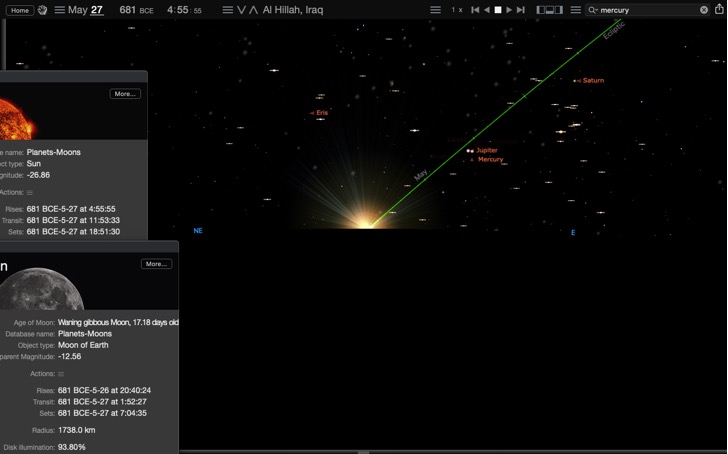
1. A II’ 2’ Esarhaddon’s 2nd
year, month III, the 16th [Mercury’s descent while very close to
Jupiter] May 27, 681
BCE
2. 3’
Šamaš-šumu-ukīn’s 14th year, month XII, the 4th Mercury’s 1st appearance near the Swallow Feb 6, 653 BCE
3. 4’
Šamaš-šumu-ukīn’s 14th year, month XII, the 22nd Mercury at its apex while close to Mars Feb 24, 653 BCE
4. 5’ Šamaš-šumu-ukīn’s 17th year, month II, the 19th Mars adjacent to Mercury while in The Old Man Apr 28, 651 BCE
5. 6’ Šamaš-šumu-ukīn’s 19th year, month VII, the 4th Mercury at its apex while above Mars Sep 15, 649 BCE
6. 7’
Kandalanu’s 1st year, month III, the 28th Mercury trailing Mars Jun
21, 647 BCE
7. 8’
Kandalanu’s 1st year, month III, the 29th Mercury ½° above Mars Jun
22, 647 BCE
8. 9’
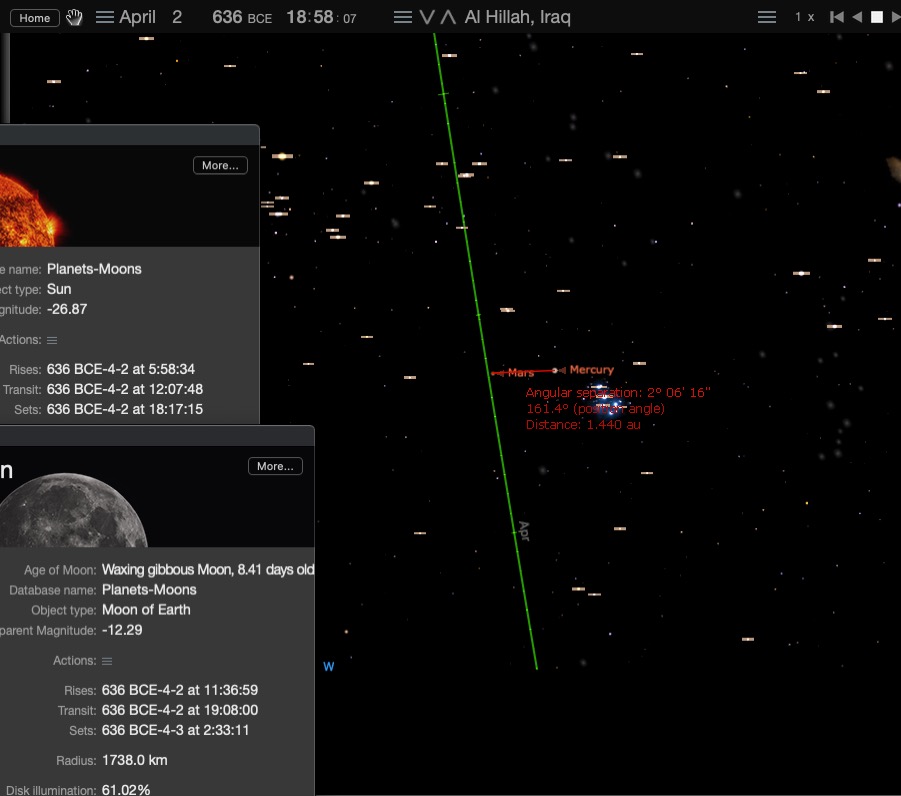
Kandalanu’s 12th year, month I, night of the 8th Mercury 2° from Mars and 2° from
Pleiades Apr 2, 636 BCE
9. 10’
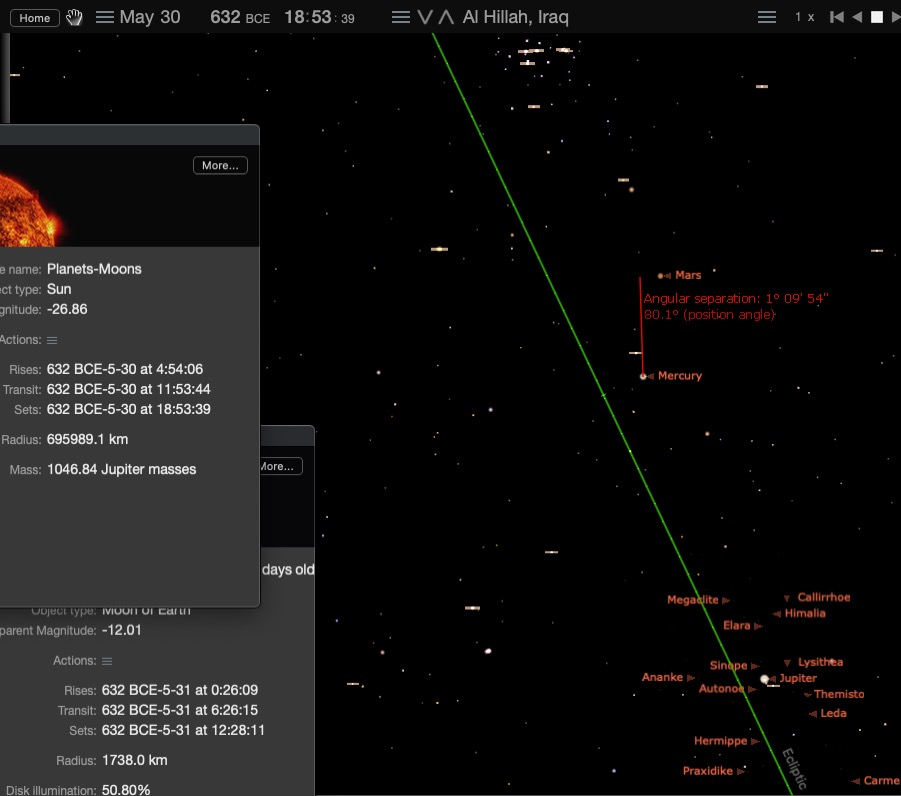
Kandalanu’s 16th year, month III, night of the 20th Mercury at its apex while 1° from Mars May
30, 632 BCE
10. 11’
Nabopolassar’s 7th year, month ….. Mercury
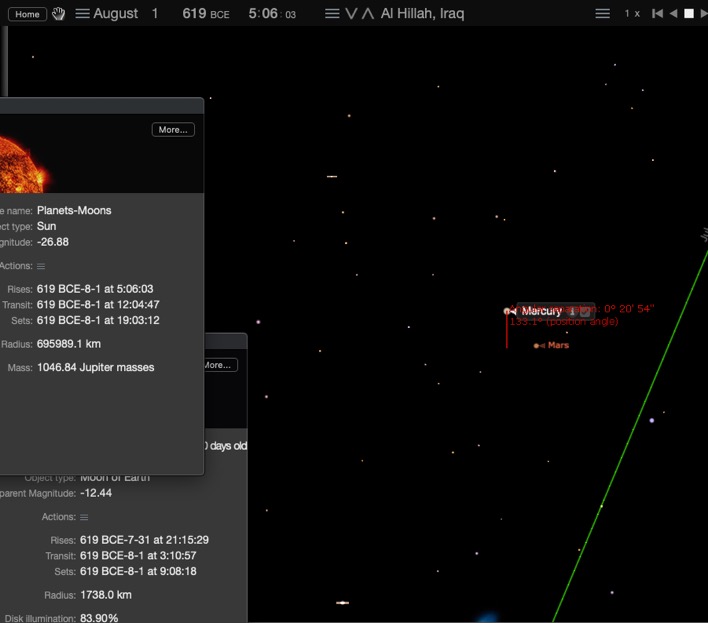
1/3° above Mars Aug 1, 619 BCE
11. B II’ 3
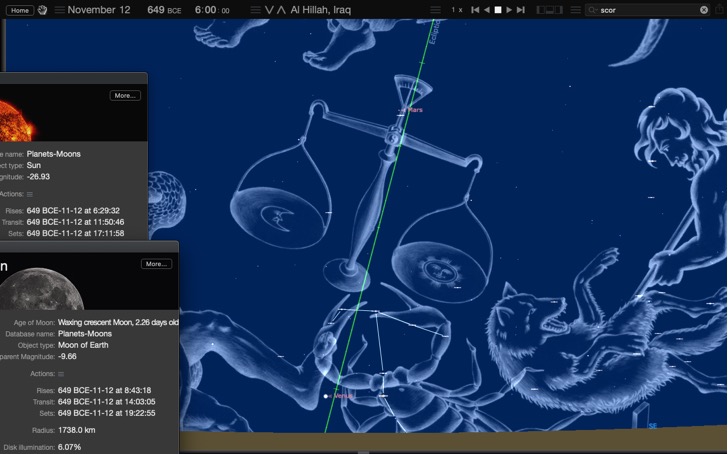
Šamaš-šuma-ukin’s 19th year, month IX, the 2nd Mars at [α Librae (The
Scales)] Nov
12, 649 BCE
12. 4 Šamaš-šuma-ukin’s 19th year, month IX, the 28th Mars in front of 2 small stars in the
Scorpion Dec 8, 649 BCE
13. 5-6 Šamaš-šuma-ukin’s 19th year, month IX, the 29th Mars passes between 2 small stars in the
Scorpion Dec 9, 649 BCE
14. 7
Nabopolassar’s 12th year, month V, the 15th Mars 4°
above α [Tauri] Aug
2, 614 BCE
15. 9
Nabopolassar’s 12th year, month IV, the 18th Mars 7° from Pleiades Jul
7, 614 BCE
16. 10
Nabopolassar’s 12th year, month VI, the 13th Mars adjacent to the Chariot Aug 30,
614 BCE
17. 11
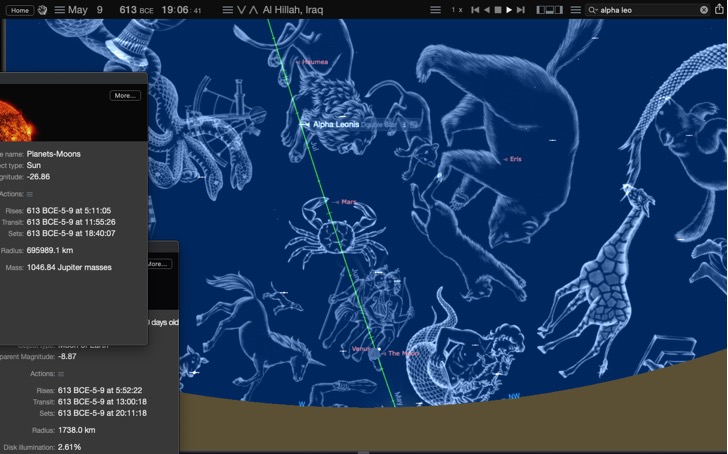
Nabopolassar’s 13th year, month III, the 1st New Moon visible while Mars in
front of α
Leonis May
9, 613 BCE
18. 12
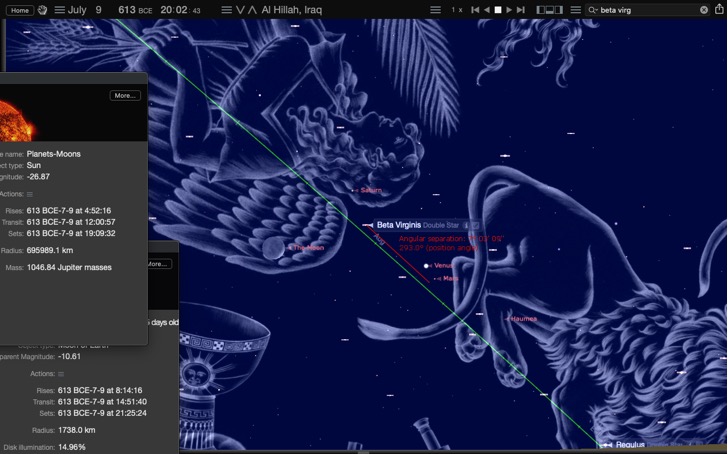
Nabopolassar’s 13th year, month V, the 3rd Mars 7° from β Virginis
Jul 9, 613 BCE
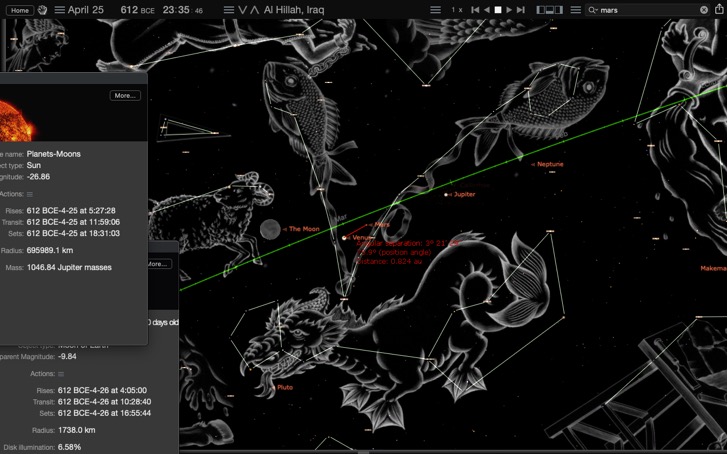
19. 13-14 Nabopolassar’s 14th
year, month I, the 1st Mars
3° from [Venus] Apr 25,
612 BCE
References:
From https://github.com/jacob-pro/astro-tablets
:
Support
for these texts:
·
BM
35115... (LBAT 1415-7, ADT V No.3)
·
BM
32234 (LBAT 1419, ADT V No.4)
·
BM
38462 (LBAT 1420, ADT V No.6)
·
BM
33066 (LBAT 1477, Strm. Kambys. 400)
BM 41222 at British
Museum
From: https://dokumen.pub/the-epoch-of-the-nabonassarian-era-and-the-chronology-of-ancient-persia.html
:
The
Saturn Tablet: BM 76738 + 76813 C.B.F. Walker translated BM 76738 + 76813 in
1999.7 This tablet contains 28 records of first and last appearances of Saturn
observed in Babylon. According to Walker, these observations of Saturn were
made during the first 14 years of the reign of Kandalanu. He also stated that
out of 28 records, 7 records are incomplete because of textual damage, 6
records are unreliable and the remaining 15 records are reliable.
From: https://www.ebl.uni-muenchen.de/library/BM.41222
:
BM 41222:
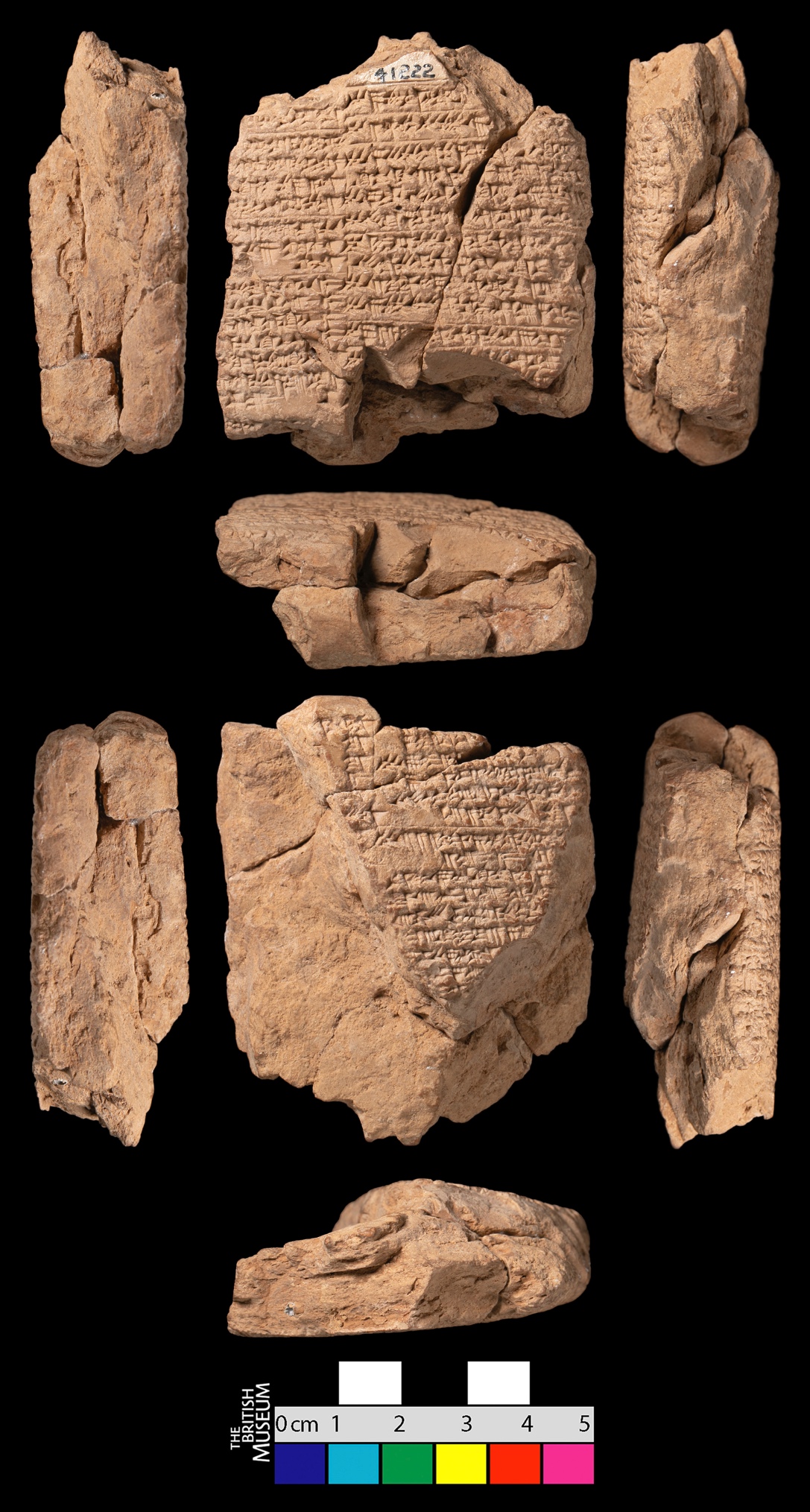
Side A
I'
1' [....] ....
2' [....] stood ½ cubit below α Leonis.
3' [....] above? the rear twin star which is in
front of the True Shepherd.
4' [....] .... Saturn was below the rear twin
star
5' [....] .... moved back?. Month XII. the 8th.
to
6' [....] .... turned into one star.
7' [.... Sa]turn to the rear lower star of ....
8' [....] .... the 26th, Saturn
9' [....] came out.
10' [....] it was balance 8
fingers .... above α Leonis
11' [....] it was balanced ½
cubit behind α Leonis.
12' [....] Saturn was
balanced 2 cubits above Virgo.
13' [....] balanced above
Virgo.
14' [....] the small star
which is between Virgo ....
15' [.... Sat]urn was
balanced 1 ½ cubits above α Librae.
16' [....] 1? ½ cubits
[....] last appearance.
17' [....] star ....
II'
1' Year 8 of Ḫumbaḫaldašu ....
[....]
2' Year 2 of Esarhaddon, month III, the 16th,
.... [....] ....
3' Year 14 of Šamaš-šumu-ukīn, month XII,
the 4th, Mercury's first appearance in the west in the area of the Swallow.
4' when it became high?, it was balanced 6
cubits above [Mar]s?, Mercury .... [....]
5' Year 17, month II, the 19th, mars was in [the
area?] of the Old Man to the right of Mercury 2 cu[bits? ....]
6' Year 19, month VII, the 4th, Mercury stood
for ⅔ cubit above? Mars, Mercury [....]
7' Year 1 of Kandalanu, month III, the 28th,
Mercury was in the back of Mars? .... [....]
8' the 29th, it was 14 fingers above Mercury in
the area of the Lion [....]
9' Year 12, month I, night of the 8th, Mercury,
in the area of Pleiades was 2 ⅔ cubits above? Mars? [....]
10' Year 16, month III,
night of the 20th, Mercury stood 1 cubit 4 fingers behind Mars.
11' Year 7 of Nabopolassar,
month ...., [....] Mercury was balanced 6 fingers above Mars.
12' Year [....] 1 ½ cubits
above Mars
13' [....] .... [....]
Side B
I'
1 [....] stood to the east
2 [....] passed
3 [....] passed
4 [....] balanced
5 [....] ....
6 [....] came close to the moon
7 [....] ....
II'
1 Year .... [....]
2 .... [....]
3 Year 19, month IX, the 2nd. Mars was ....
4 The 28th, Mars was .... to the front of the 2
small stars of the ears of the Scorpion.
5 The 29th, it rose in between these stars.
....
6 they entered each other.
7 Year 12 of Nabopolassar, month V, the 15th.
Mars was balanced 2 cubits above α [Tauri]
8 .... [....]
9 Month IV, night of the 18th, Mars was with
Pleiades 4 cub[its ....]
10 Month VI, the 13th, Mars
was ⅔ cubit above the Chariot [....]
11 [Year] 13, month III,
(when) the moon became visible. Mars was [....] above α Leonis.
12 [Month] V?, the 3rd, it
was with β Virginis 5 cubits [....]
13 [Year 1]4?, month I, the
27th, Mars [....] from [....]
14 [....] .... 4 cubits
[....]
15 [....] above? [....]
Considerations
and astronomical correlations:
From :
Side A
I'
1' [....] ....
2' [....] stood ½ cubit below α Leonis.
3' [....] above? the rear twin star which is in
front of the True Shepherd.
4' [....] .... Saturn was below the rear twin
star
5' [....] .... moved back?. Month XII. the 8th.
to
6' [....] .... turned into one star.
7' [.... Sa]turn to the rear lower star of ....
8' [....] .... the 26th, Saturn
9' [....] came out.
10' [....] it was balance 8
fingers .... above α Leonis
11' [....] it was balanced ½
cubit behind α Leonis.
12' [....] Saturn was
balanced 2 cubits above Virgo.
13' [....] balanced above
Virgo.
14' [....] the small star
which is between Virgo ....
15' [.... Sat]urn was
balanced 1 ½ cubits above α Librae.
16' [....] 1? ½ cubits
[....] last appearance.
17' [....] star ....
II'
1' Year 8 of Ḫumbaḫaldašu[1] .... [....]
2' Year 2 of Esarhaddon, month III, the 16th,
.... [....] ....
Perfect fit re line A
II’ 2’: The date on line 2’ agrees well with this
May 27, 681 BCE event, at which time Mercury passed very close[2] to Jupiter[3] while descending from its apex altitude above the
horizon, while close to its last evening visibility.
3' Year 14 of Šamaš-šumu-ukīn, month XII,
the 4th, Mercury's first appearance in the west in the area of the Swallow.
Confirmed correct fit to line 3’:
The perfect fit to the record in line 3’
occurred on Feb 6, 653 BCE:
Mercury’s first appearance (apparent
magnitude -1.45) at an altitude of 7° (at the time of sunset).
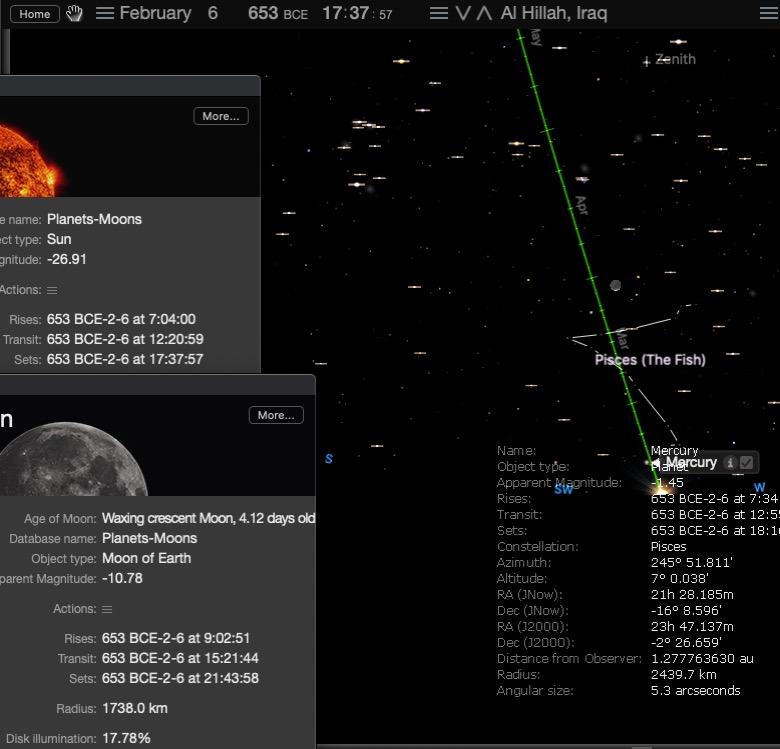
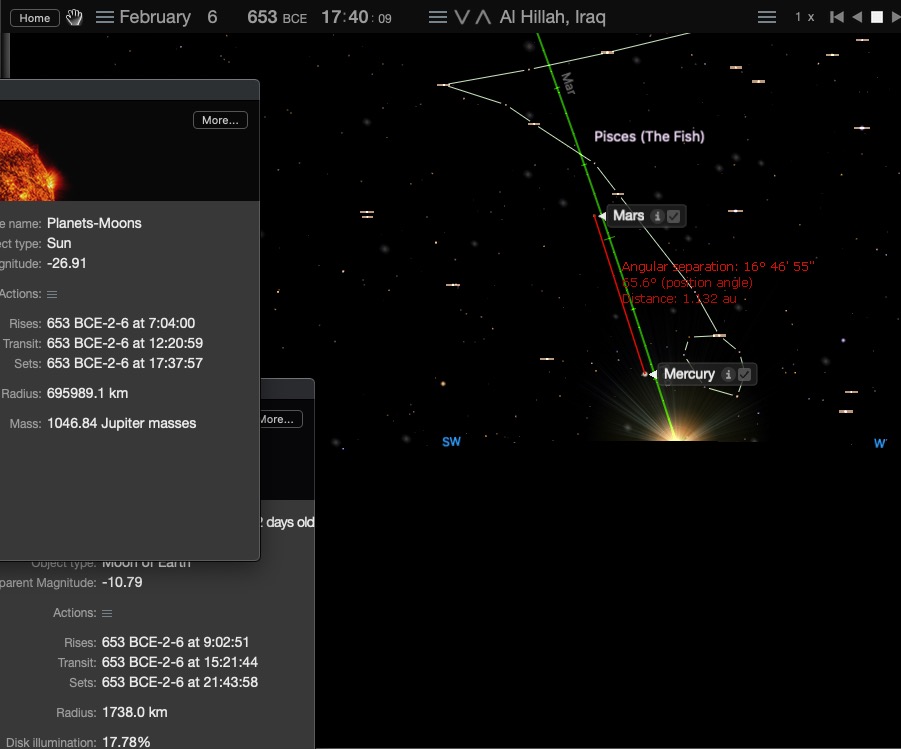
Mercury’s first appearance (apparent
magnitude -1.45) at an altitude of 7° (at the time of sunset), while located
16° 46’ (≈12 cubits) below Mars:
4' when it became high?, it was balanced 6
cubits above [Mar]s?, Mercury .... [....]
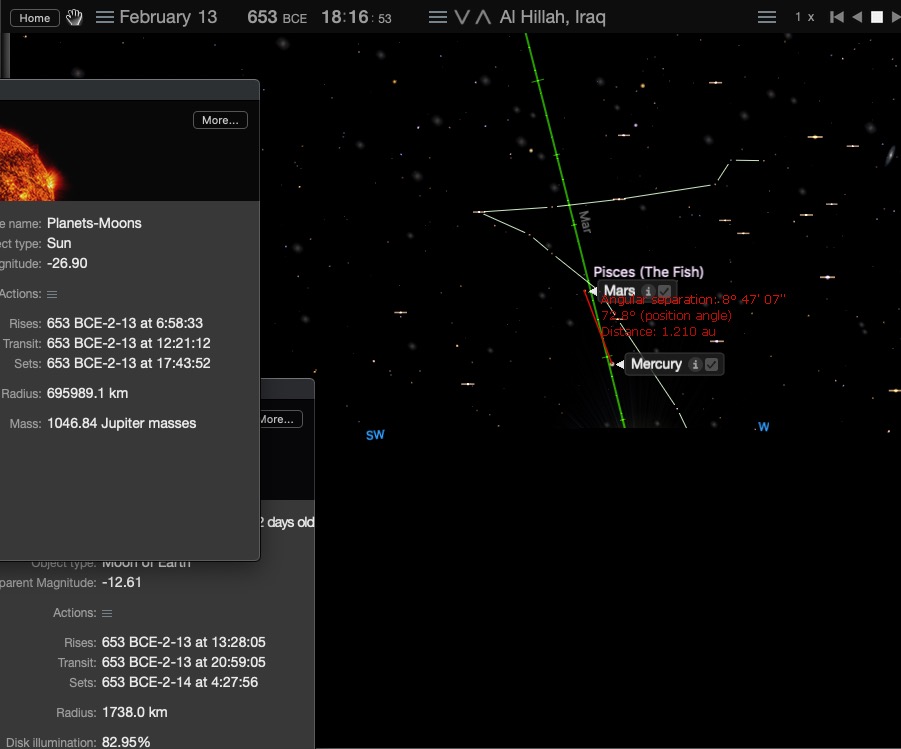
Acceptable fit[4] to line 4’: Mercury ascending… On Feb 13, 653 BCE
Mercury (apparent magnitude -1.09) was located 8° 47’ (≈6
cubits) below (not above!) Mars (apparent magnitude 1.39)
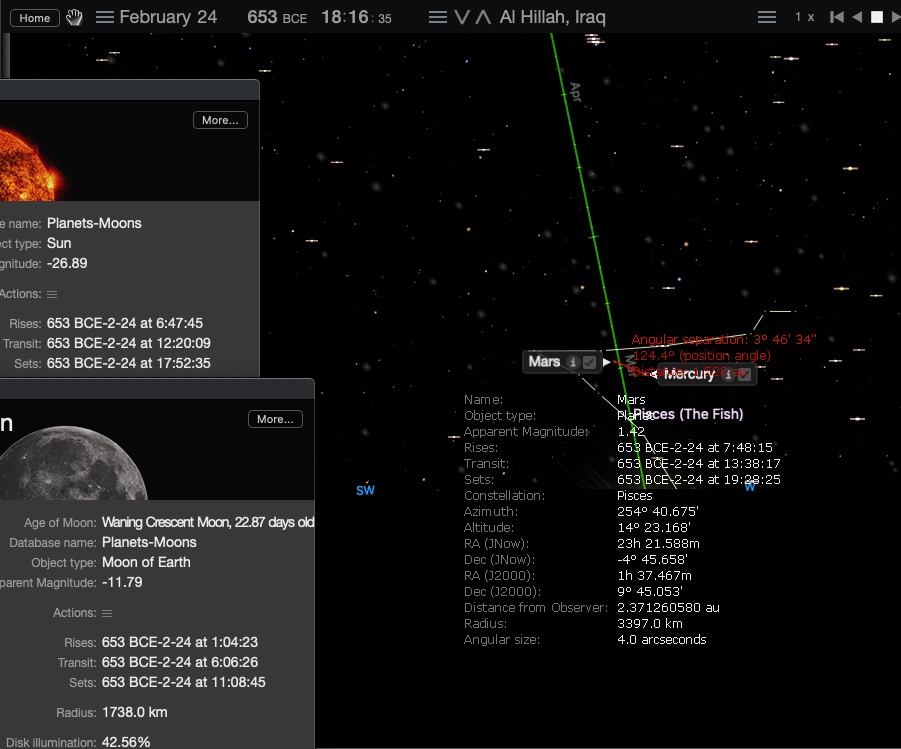
Ok fit to line 4’: Mercury at the time of its highest position above the western horizon
before descending again. Here Mercury (apparent magnitude 0.20) is located slightly
below Mars at a distance of 3° 47’ (≈3 cubits). Not quite the cubit length I
had expected. But seeing the variable length of the cubit even within this clay
tablet alone, I find this one perfectly acceptable…
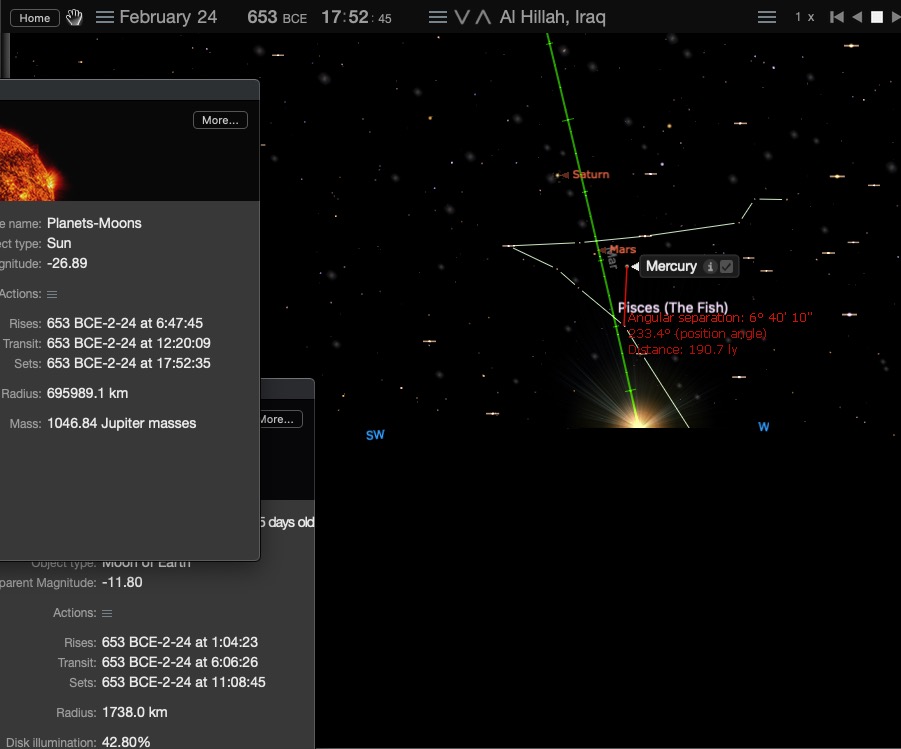
Good fit to line 4’: Mercury at the time of its highest position above the
western horizon before descending again. Here Mercury (apparent magnitude 0.20)
is located 6° 40’ (5-6 cubits) above Epsilon Piscium
(apparent magnitude 4.25). This may seem to be the best fit to the line
4’ clay tablet record…
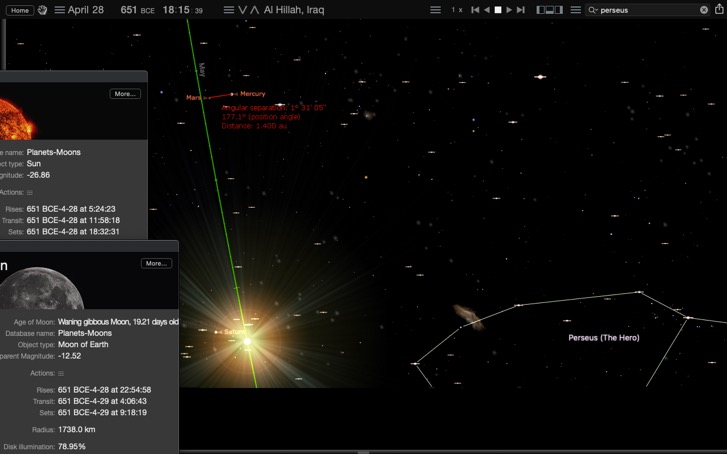
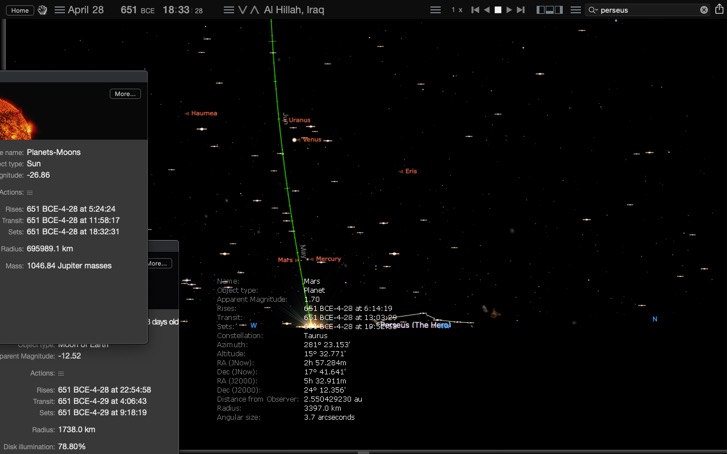
5' Year 17, month II, the 19th, mars was in [the
area?] of the Old Man to the right of Mercury 2 cu[bits? ....]
Good fit to line 5’: On Apr 28, 651 BCE we find the Sun and Perseus (The
Old Man) setting, while Mars and Mercury[5] become
visible over the western horizon in Babylon.
6' Year 19, month VII, the 4th, Mercury stood
for ⅔ cubit above? Mars, Mercury
[....]
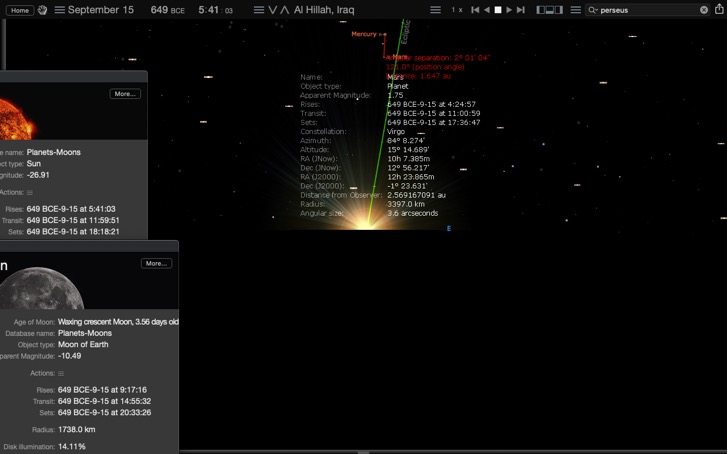
Perfectly acceptable fit to line
6’: On Sep 15, 649 BCE ”month
VII, the 4th, Mercury stood…” (at the apex of its ascension) 2° 01’ (≈1 2/3 cubit)[6] “above Mars”:
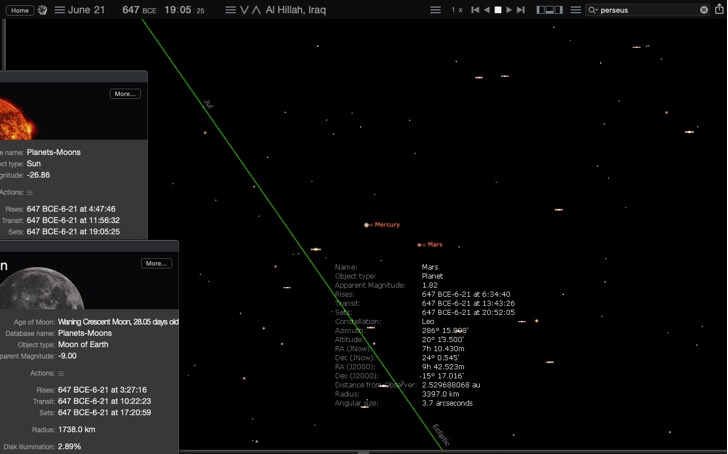
7' Year 1 of Kandalanu, month III, the 28th,
Mercury was in the back of Mars? .... [....]
Perfect fit to line 7’: While approaching its apex position (at 21° 11’
altitude on June 21, 647 BCE), on June 21 Mercury was first seen (at 20° 28’
altitude) behind Mars on its path towards the western horizon:
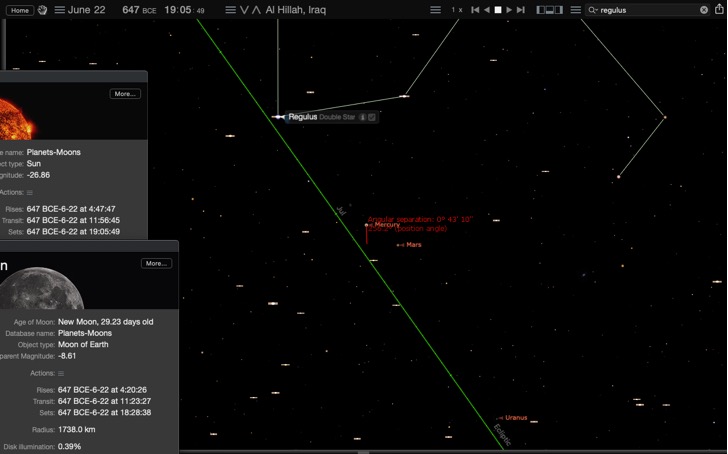
8' the 29th, it was 14 fingers above Mercury in
the area of the Lion [....]
Perfect fit to line 8’: While approaching Leo on its path to its apex
altitude, on Jun 22, 647 BCE (= “month III, the 29th it [Mercury]
rose to 14 fingers [(= ½ cubit) above Mars at an altitude of 20° 38’]”)
9' Year 12, month I, night of the 8th, Mercury,
in the area of Pleiades was 2 ⅔ cubits
above? Mars? [....]
Perfectly acceptable fit to line 9’: While rising towards its apex position (20° 46’ altitude),
on April 2, 636 BCE (=”month I, night of the 8th”)
Mercury (at altitude 18° 14’) passed Mars
at a distance of 2° 6’ 16” [≈ 2 cubits] [7], while at about the same distance from the Pleiades.
10' Year 16, month III,
night of the 20th, Mercury stood 1 cubit 4 fingers behind Mars.
Perfectly acceptable fit to line 10’: On the evening past reaching its apex altitude Mercury
[=”stood”] on May 30, 632 BCE (=”month III, night of
the 20th”). Mercury was at that time located 1° 10’ (≈1 cubit)[8] below Mars.
[I.e. “behind” Mars in the sense
of not reaching quite the same altitude as did Mars]
11' Year 7 of Nabopolassar,
month ...., [....] Mercury was balanced 6 fingers above Mars.
Perfect fit to line 11’: While descending from its apex altitude (16° 48’)
above the horizon, on Aug 1, 619 BCE (“month [V, 19th day]”) Mercury
passed Mars.
At that time we find Mercury
0° 20’ 54” (≈ ¼ cubit = “6 fingers”) above Mars, which was at that time
8° 58’ altitude above the eastern horizon.
12' Year [....] 1 ½ cubits
above Mars
13' [....] .... [....]
Side B
I'
1 [....] stood to the east
2 [....] passed
3 [....] passed
4 [....] balanced
5 [....] ....
6 [....] came close to the moon
7 [....] ....
II'
1 Year .
... [....]
2 .... [....]
3 Year 19, month IX, the 2nd. Mars was ....
Exact correlation to line 3: On Nov 12, 649 BCE, “Year 19 [of Šamaš-šuma-ukin/TLT©], month IX, the 2nd. Mars was ....” seen at α Librae (The Scales).
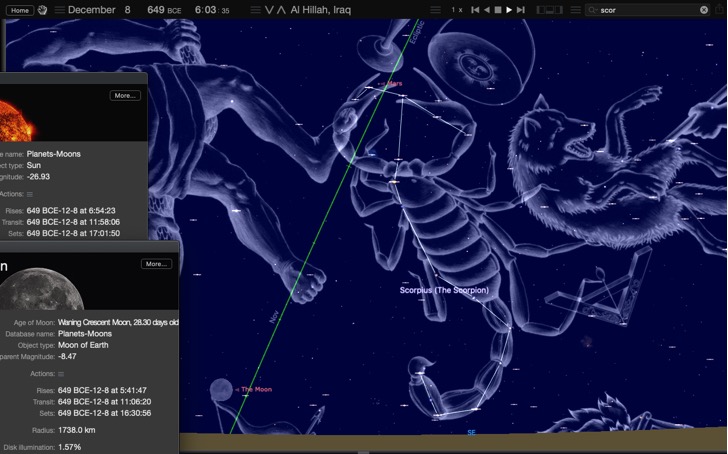
4 The 28th, Mars was .... to the front of the 2
small stars of the ears of the Scorpion.
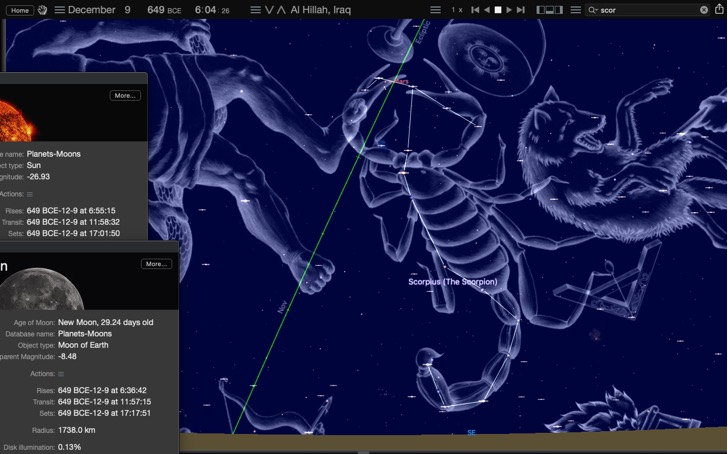
5 The 29th, it rose in between these stars.
....
6 they entered each other.
Powerfully exact confirmation; lines 4-6: In
Šamaš-šuma-ukin‘s 19th year, on Dec 8
and 9, 649 BCE, I find an exact fit to lines 4-6 above.
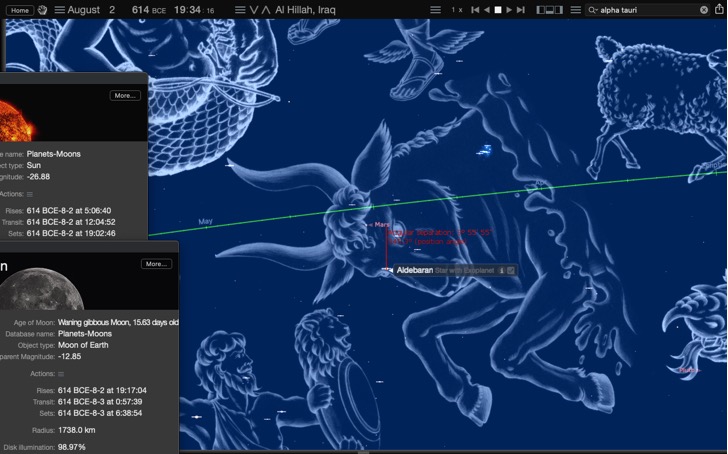
7 Year 12 of Nabopolassar, month V, the 15th.
Mars was balanced 2 cubits above α [Tauri]
8 .... [....]
Exact correlation with line 7: On Aug 2, 614 BCE, “Year 12 of Nabopolassar, month V,
the 15th. Mars was balanced 2 cubits above α [Tauri]” at 3° 56’ (≈ 2 or 3 cubits)
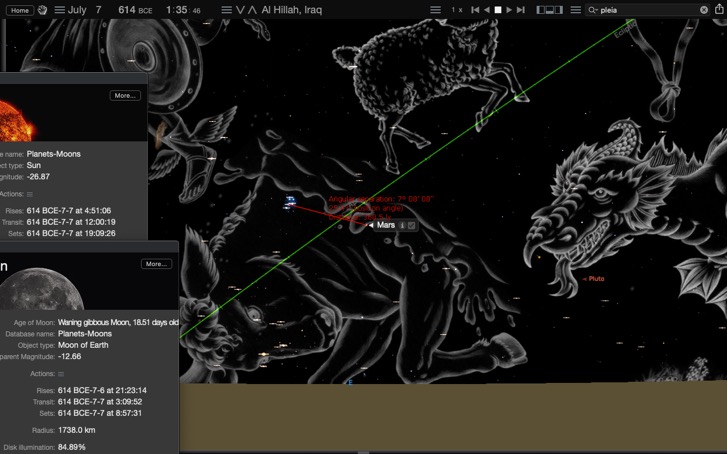
9 Month IV, night of the 18th, Mars was with
Pleiades 4 cub[its ....]
Exact correlation with line 9: On Jul 7, 614 BCE ”Month IV, night of
the 18th, Mars was with Pleiades 4 cub[its ....]”, i.e. at an angular distance of 7° 8’ 6”.
10 Month VI, the 13th, Mars
was ⅔ cubit above the Chariot
[....]
Exact correlation with line 10: On Aug 30, 614 BCE ”Month VI, the 13th, Mars was ⅔ cubit above the Chariot [....]” Probably a reference to 132 Tauri.
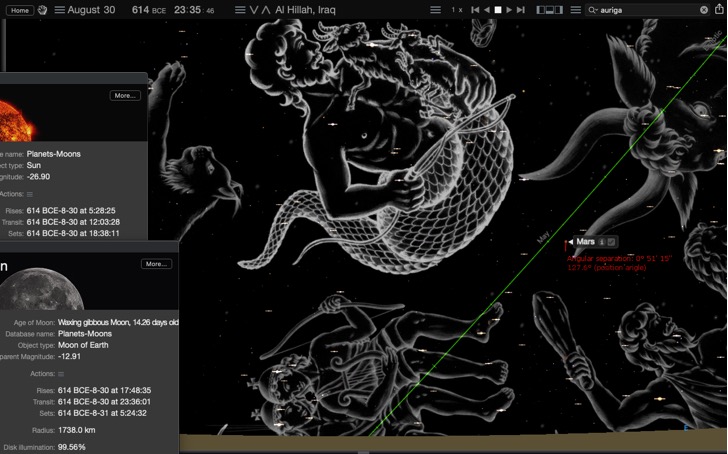
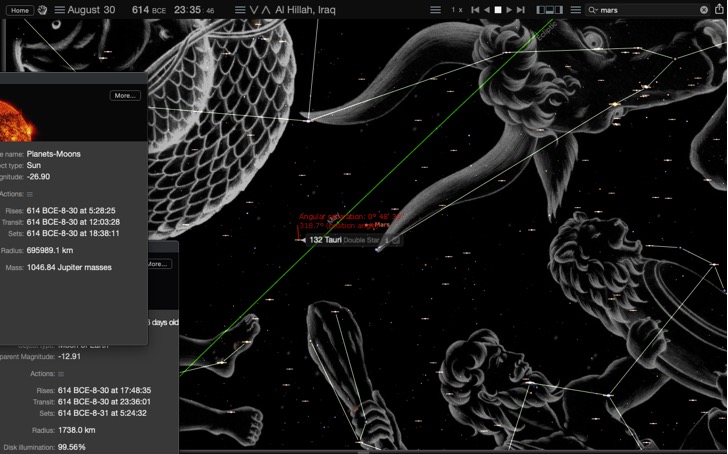
The
Chariot vs Auriga – same stars, different artistry
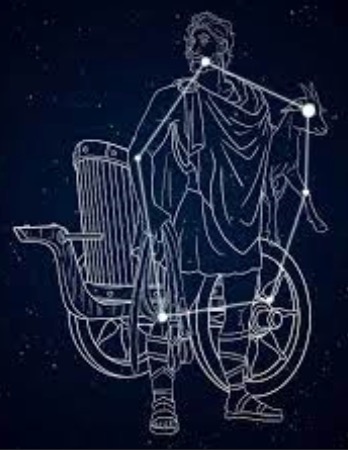
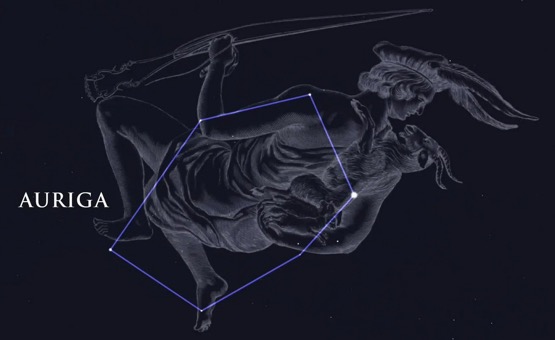
What
is the constellation of the chariot?:
“Auriga is a lesser-known constellation neighboring
Gemini and Taurus that is visible in the northern hemisphere during the winter
months. The mythological character Auriga is based on is often depicted holding
a female goat and her kids, along with the reins of a chariot.”
11 [Year] 13, month III,
(when) the moon became visible. Mars was [....] above α Leonis.
Exact correlation to line 11: On May 9, 613 BCE, “[Year] 13, month III, (when) the moon
became visible. Mars was [....] above α Leonis.” I.e. not ”above”, but ≈17° ≈ 12
cubits ‘in front of’.
12 [Month] V?, the 3rd, it
was with β Virginis 5 cubits [....]
Exact correlation to line 12: On July 9, 613 BCE “[Month] V?,
the 3rd, it [Mars/TLT©] was with β Virginis 5 cubits
[....]”. I.e. 7° ≈
5 cubits.
13 [Year 1]4?, month I, the
27th, Mars [....] from [....]
14 [....] .... 4 cubits
[....]
15 [....] above? [....]
Exact correlation line 13-14: On Apr 25, 612 BCE “[Year 1]4?,
month I, the 27th, Mars [....] from [....]” “ [....] .... 4 cubits [....]”. I.e. 3° 16’ 59” (= 3-4
cubits) angular distance from Venus.
Comments and donations freely
accepted at:
Tree of Life©
eMail: TreeOfLifeTime@gmail.com
A Sampling of God’s
Wonderful Free Gifts
The GateWays into Tree of Life
Chronology Forums©
Without recourse.
All Rights Reserved. Tree of Life©