Without recourse.
All Rights Reserved. Tree of Life©
Statement
of belief: “Sanctify them through thy truth: thy word
is truth.” (John 17:17 KJV)
Created
5968[v2023-12-04] 12
16 – 01
15 2040 [Mon 2025-03-17 – Mon 2025-04-14]
An Analysis of
Abstract:
The Babylonian clay tablet known as British Museum 41222 is a very exact
record of a number of events tied primarily to Mercury and Mars. After first
working my way through the other clay tablets in the list of eight clay tablets
under References below, I was able to unequivocally correlate almost all the
events recorded on BM 41222 with their equivalent celestial events as rendered
in Starry Night Pro 8 (SN8).
The following correlations were identified and confirmed. Very precise
observations recorded on the BM 41222 clay tablet.:
1. A II’ 2’ Esarhaddon’s 2nd
year, month III, the 16th May
27, 681 BCE
2. 3’
Šamaš-šumu-ukīn’s 14th year, month XII, the 4th Feb
6, 653 BCE
3. 4’
Šamaš-šumu-ukīn’s 14th year, month XII, the 22nd Feb
24, 653 BCE
4. 5’ Šamaš-šumu-ukīn’s 17th year, month II, the 19th Apr
28, 651 BCE
5. 6’ Šamaš-šumu-ukīn’s 19th year, month VII, the 4th Sep
15, 649 BCE
6. 7’
Kandalanu’s 1st year, month III, the 28th Jun 21,
647 BCE
7. 8’
Kandalanu’s 1st year, month III, the 29th Jun 22,
647 BCE
8. 9’
Kandalanu’s 12th year, month I, night of the 8th Apr 2, 636 BCE
9. 10’
Kandalanu’s 16th year, month III, night of the 20th May
30, 632 BCE
10. 11’
Nabopolassar’s 7th year, month ….. Aug
1, 619 BCE
11. B II’ 3
Šamaš-šuma-ukin’s 19th year, month IX, the 2nd Nov 12, 649 BCE
12. 4 Šamaš-šuma-ukin’s 19th year, month IX, the 28th Dec
8, 649 BCE
13. 5-6 Šamaš-šuma-ukin’s 19th year, month IX, the 29th Dec
9, 649 BCE
14. 7
Nabopolassar’s 12th year, month V, the 15th Aug 2, 614 BCE
15. 9
Nabopolassar’s 12th year, month IV, the 18th Jul 7, 614 BCE
16. 10
Nabopolassar’s 12th year, month VI, the 13th Aug 30, 614 BCE
17. 11
Nabopolassar’s 13th year, month III, the 1st May
9, 613 BCE
18. 12
Nabopolassar’s 13th year, month V, the 3rd Jul
9, 613 BCE
19. 13-14 Nabopolassar’s 14th
year, month I, the 1st Apr
25, 612 BCE
References:
From https://github.com/jacob-pro/astro-tablets
:
Support
for these texts:
·
BM
35115... (LBAT 1415-7, ADT V No.3)
·
BM
32234 (LBAT 1419, ADT V No.4)
·
BM
38462 (LBAT 1420, ADT V No.6)
·
BM
33066 (LBAT 1477, Strm. Kambys. 400)
BM 41222 at British
Museum
From: https://dokumen.pub/the-epoch-of-the-nabonassarian-era-and-the-chronology-of-ancient-persia.html
:
The
Saturn Tablet: BM 76738 + 76813 C.B.F. Walker translated BM 76738 + 76813 in
1999.7 This tablet contains 28 records of first and last appearances of Saturn
observed in Babylon. According to Walker, these observations of Saturn were
made during the first 14 years of the reign of Kandalanu. He also stated that
out of 28 records, 7 records are incomplete because of textual damage, 6
records are unreliable and the remaining 15 records are reliable.
From: https://www.ebl.uni-muenchen.de/library/BM.41222
:
BM 41222:
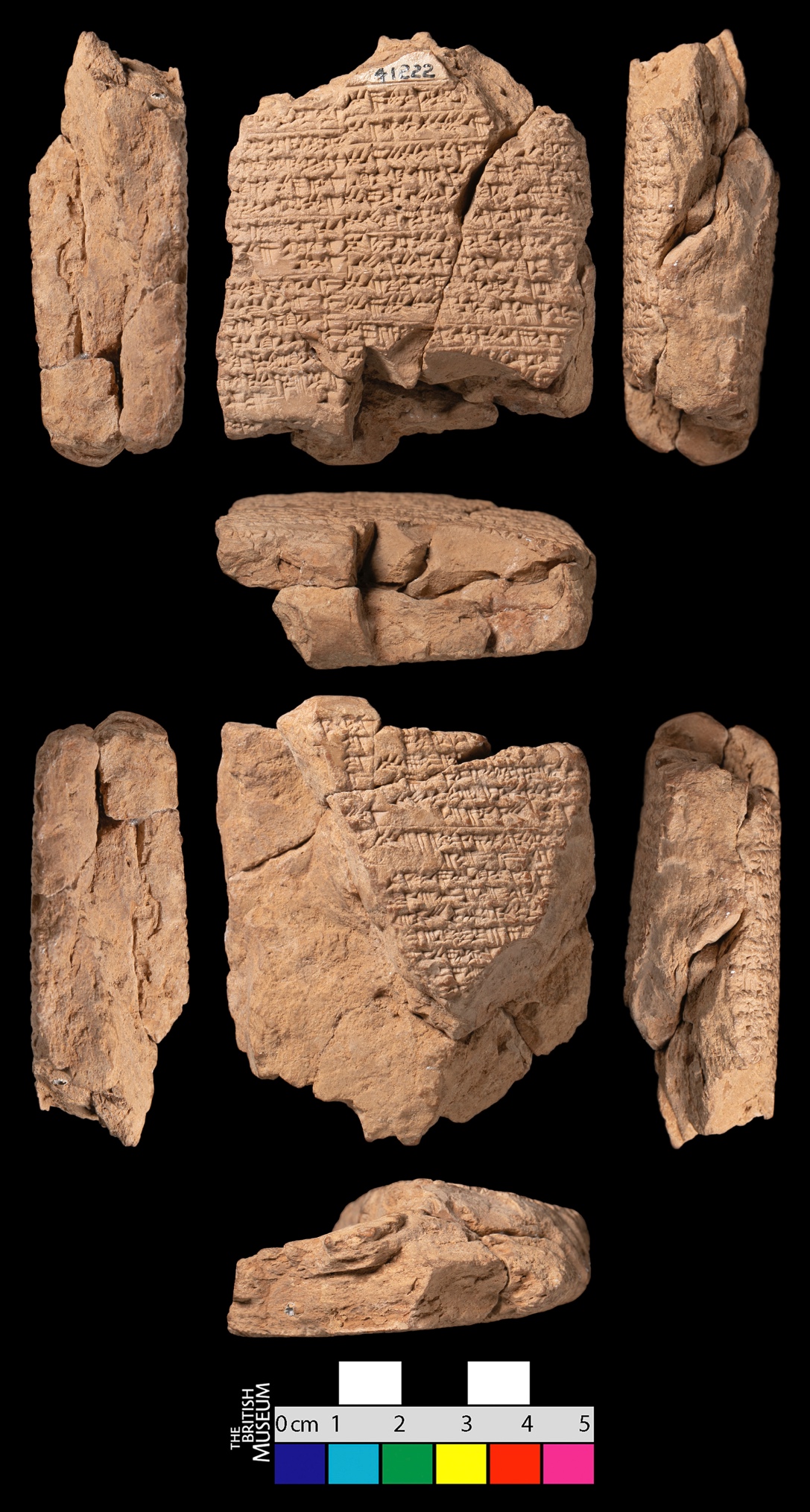
Side A
I'
1' [....] ....
2' [....] stood ½ cubit below α Leonis.
3' [....] above? the rear twin star which is in
front of the True Shepherd.
4' [....] .... Saturn was below the rear twin
star
5' [....] .... moved back?. Month XII. the 8th.
to
6' [....] .... turned into one star.
7' [.... Sa]turn to the rear lower star of ....
8' [....] .... the 26th, Saturn
9' [....] came out.
10' [....] it was balance 8
fingers .... above α Leonis
11' [....] it was balanced ½
cubit behind α Leonis.
12' [....] Saturn was
balanced 2 cubits above Virgo.
13' [....] balanced above
Virgo.
14' [....] the small star
which is between Virgo ....
15' [.... Sat]urn was balanced
1 ½ cubits above α Librae.
16' [....] 1? ½ cubits
[....] last appearance.
17' [....] star ....
II'
1' Year 8 of Ḫumbaḫaldašu ....
[....]
2' Year 2 of Esarhaddon, month III, the 16th,
.... [....] ....
3' Year 14 of Šamaš-šumu-ukīn, month XII,
the 4th, Mercury's first appearance in the west in the area of the Swallow.
4' when it became high?, it was balanced 6
cubits above [Mar]s?, Mercury .... [....]
5' Year 17, month II, the 19th, mars was in [the
area?] of the Old Man to the right of Mercury 2 cu[bits? ....]
6' Year 19, month VII, the 4th, Mercury stood
for ⅔ cubit above? Mars, Mercury [....]
7' Year 1 of Kandalanu, month III, the 28th,
Mercury was in the back of Mars? .... [....]
8' the 29th, it was 14 fingers above Mercury in
the area of the Lion [....]
9' Year 12, month I, night of the 8th, Mercury,
in the area of Pleiades was 2 ⅔ cubits above? Mars? [....]
10' Year 16, month III,
night of the 20th, Mercury stood 1 cubit 4 fingers behind Mars.
11' Year 7 of Nabopolassar,
month ...., [....] Mercury was balanced 6 fingers above Mars.
12' Year [....] 1 ½ cubits
above Mars
13' [....] .... [....]
Side B
I'
1 [....] stood to the east
2 [....] passed
3 [....] passed
4 [....] balanced
5 [....] ....
6 [....] came close to the moon
7 [....] ....
II'
1 Year .... [....]
2 .... [....]
3 Year 19, month IX, the 2nd. Mars was ....
4 The 28th, Mars was .... to the front of the 2
small stars of the ears of the Scorpion.
5 The 29th, it rose in between these stars.
....
6 they entered each other.
7 Year 12 of Nabopolassar, month V, the 15th.
Mars was balanced 2 cubits above α [Tauri]
8 .... [....]
9 Month IV, night of the 18th, Mars was with
Pleiades 4 cub[its ....]
10 Month VI, the 13th, Mars
was ⅔ cubit above the Chariot [....]
11 [Year] 13, month III,
(when) the moon became visible. Mars was [....] above α Leonis.
12 [Month] V?, the 3rd, it
was with β Virginis 5 cubits [....]
13 [Year 1]4?, month I, the
27th, Mars [....] from [....]
14 [....] .... 4 cubits
[....]
15 [....] above? [....]
Considerations
and astronomical correlations:
From :
Side A
I'
1' [....] ....
2' [....] stood ½ cubit below α Leonis.
3' [....] above? the rear twin star which is in
front of the True Shepherd.
4' [....] .... Saturn was below the rear twin
star
5' [....] .... moved back?. Month XII. the 8th.
to
6' [....] .... turned into one star.
7' [.... Sa]turn to the rear lower star of ....
8' [....] .... the 26th, Saturn
9' [....] came out.
10' [....] it was balance 8
fingers .... above α Leonis
11' [....] it was balanced ½
cubit behind α Leonis.
12' [....] Saturn was
balanced 2 cubits above Virgo.
13' [....] balanced above
Virgo.
14' [....] the small star
which is between Virgo ....
15' [.... Sat]urn was
balanced 1 ½ cubits above α Librae.
16' [....] 1? ½ cubits
[....] last appearance.
17' [....] star ....
II'
1' Year 8 of Ḫumbaḫaldašu[1] .... [....]
2' Year 2 of Esarhaddon, month III, the 16th,
.... [....] ....
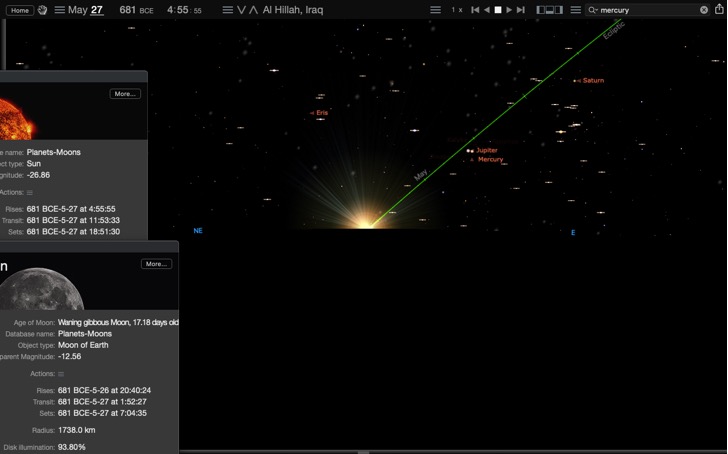
Perfect fit re line A 2’: The date on line 2’ agrees well with this May 27, 681
BCE event, at which time Mercury passed very close (0° 27’ 14” at sunrise time;
the closest encounter occurred 4 hrs past sunrise at 0° 19’ 27”) to Jupiter
while descending from its apex altitude above the horizon, while close to its
last evening visibility.
(If, in 681 BCE, the above date would have
fallen one lunar month later, then no significant event occurred on that
particular day, though, on the evening sky, Mercury was in the midst of rising
towards its apex after having passed Mars a number of days before. Seeing that
Mars, and no other planet besides Mercury, is elsewhere on this clay table
referenced with almost every recorded legible event, I find it worth making
this observation.)
3' Year 14 of Šamaš-šumu-ukīn, month XII,
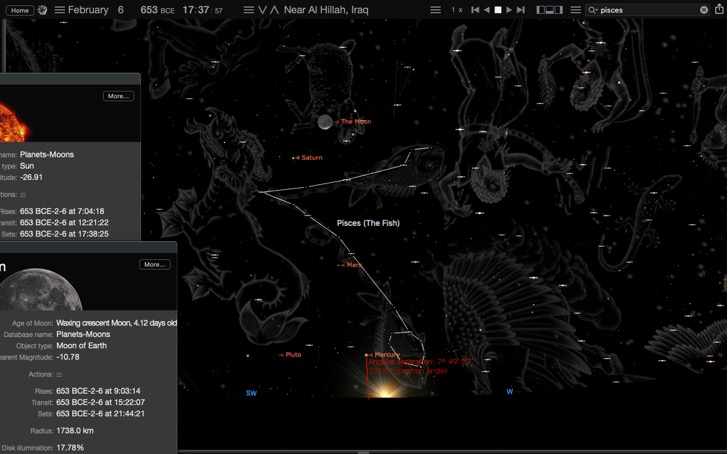
the 4th, Mercury's first appearance in the west in the area of the Swallow.
4' when it became high?, it was balanced 6
cubits above [Mar]s?, Mercury .... [....]
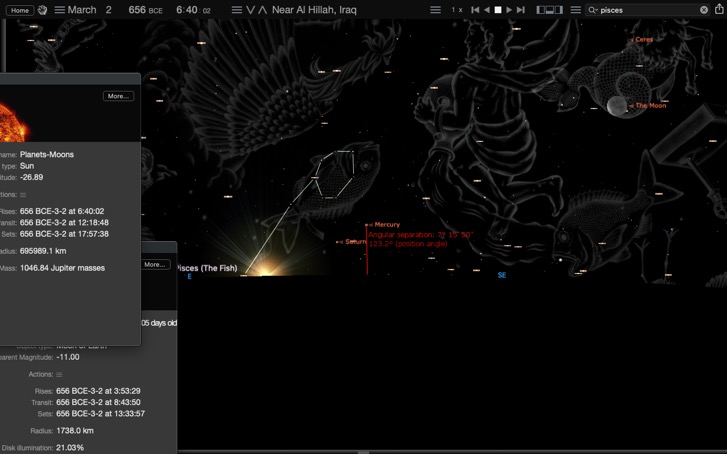
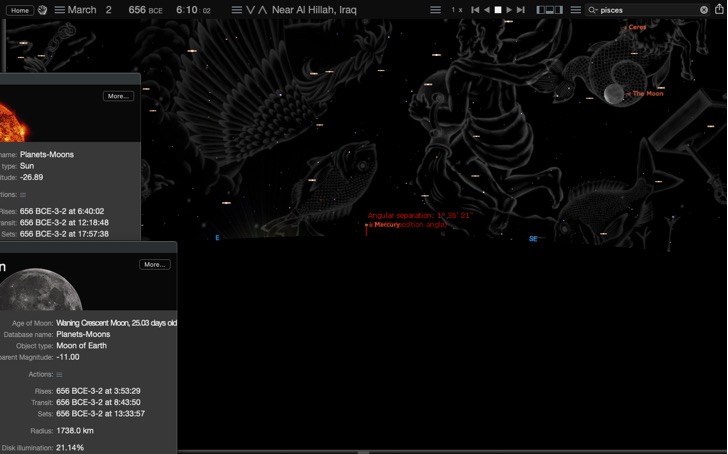
A deceptive apparent perfect fit to the
record in lines 3’ and 4’…:
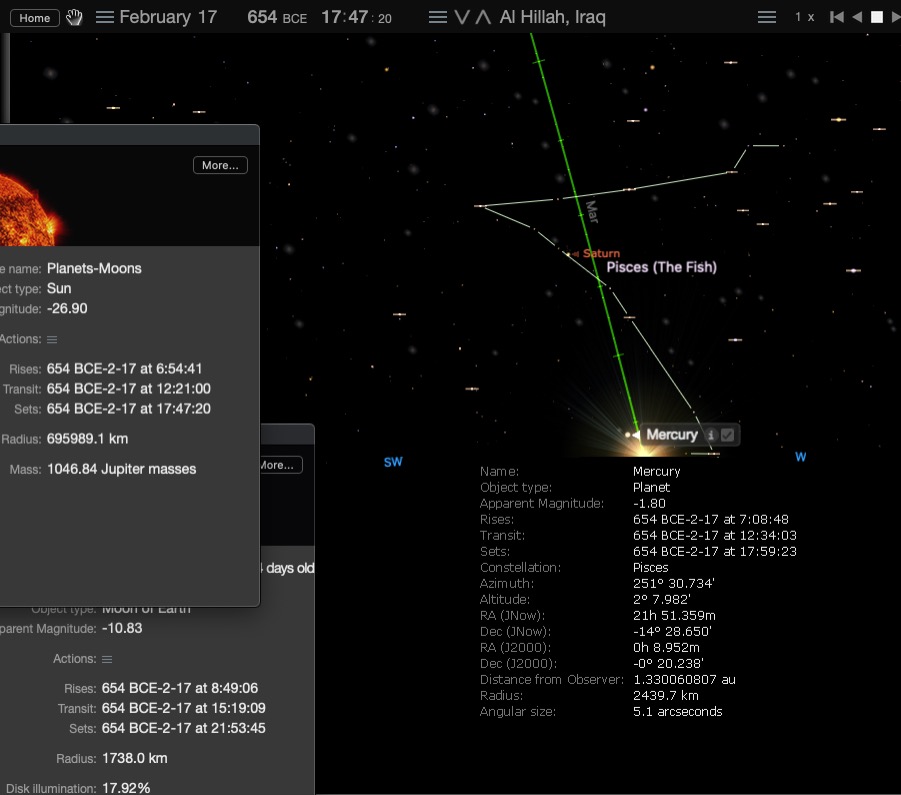
Mercury’s first appearance (apparent magnitude -1.80)
at an altitude of 2° 8’ (at the time of sunset), while located in the Swallow
(in the area of the northern fish of Pisces).
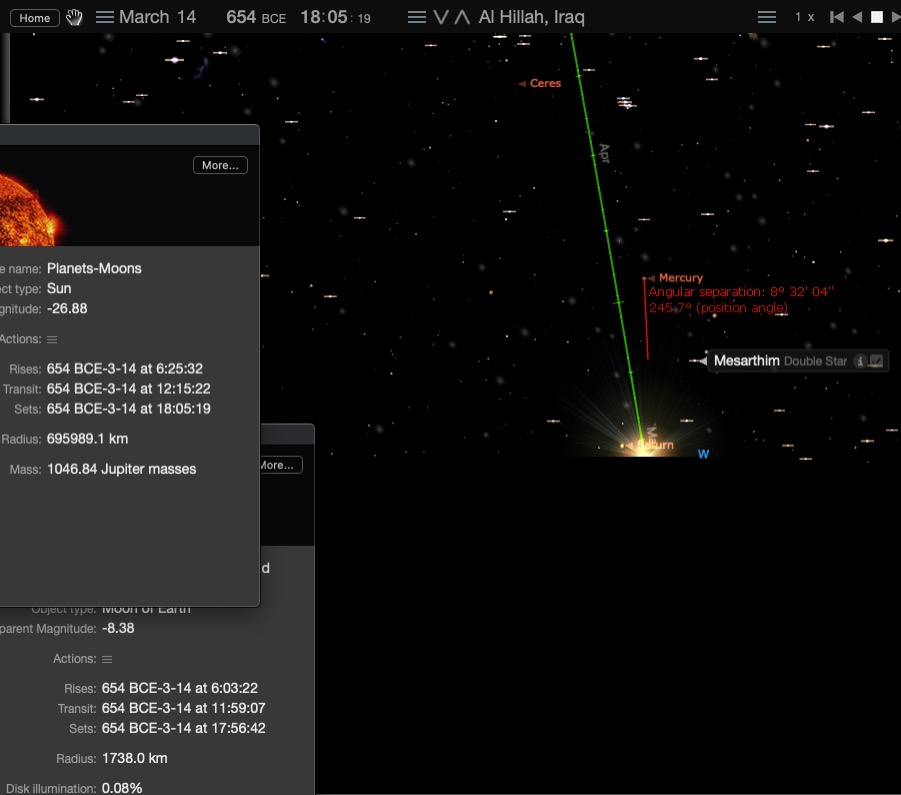
Mercury at the time of its highest position (18° 38’
at sunset) above the western horizon before descending again. Here Mercury
(apparent magnitude 0.56) is located 8° 37’ (≈6 cubits) above Mesarthim (apparent
magnitude 3.87).
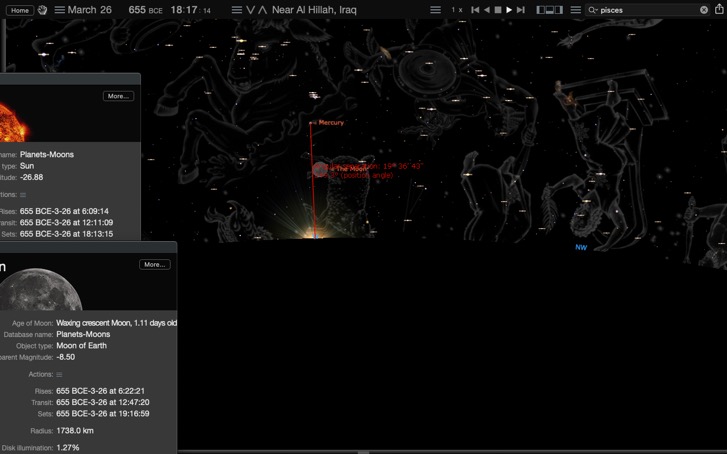
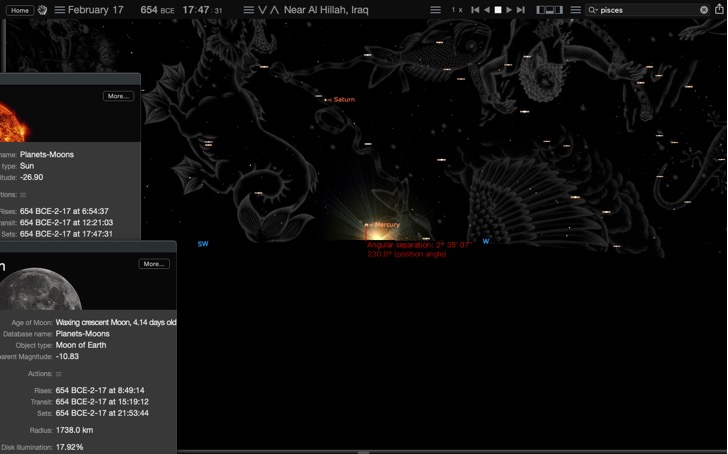
Confirmed correct fit: Initially considered merely as another
seemingly perfect fit to the record in lines 3’ and 4’ (except for the year?... or so I thought):
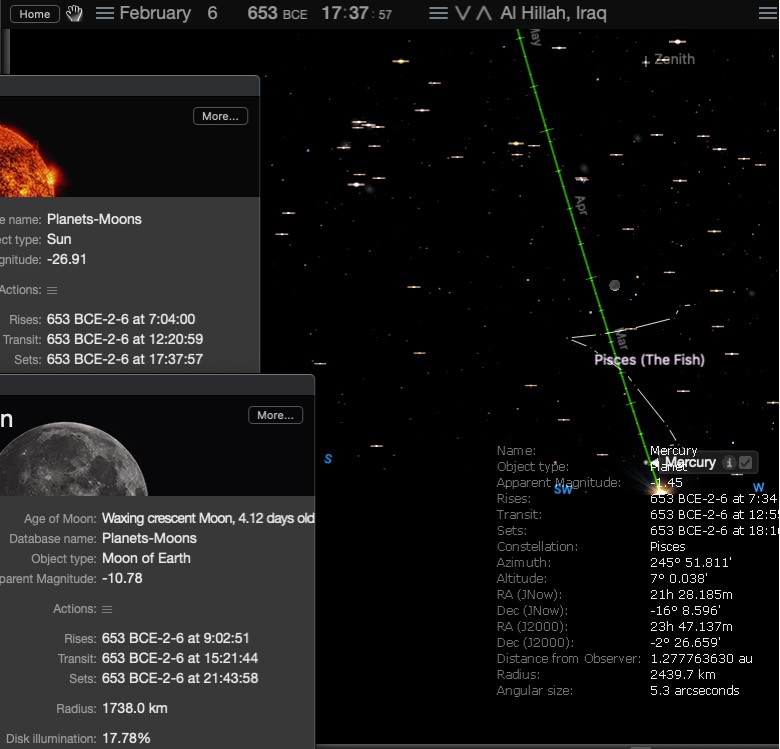
Mercury’s first appearance (apparent magnitude -1.45)
at an altitude of 7° (at the time of sunset).
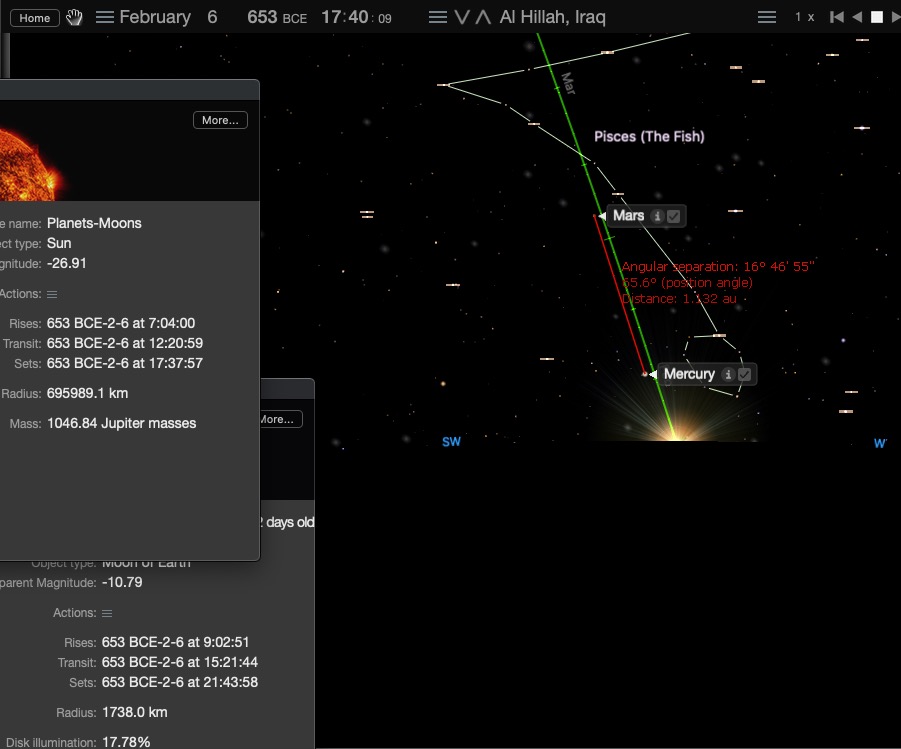
Mercury’s first appearance (apparent magnitude -1.45)
at an altitude of 7° (at the time of sunset), while located 16° 46’ (≈12
cubits) below Mars.
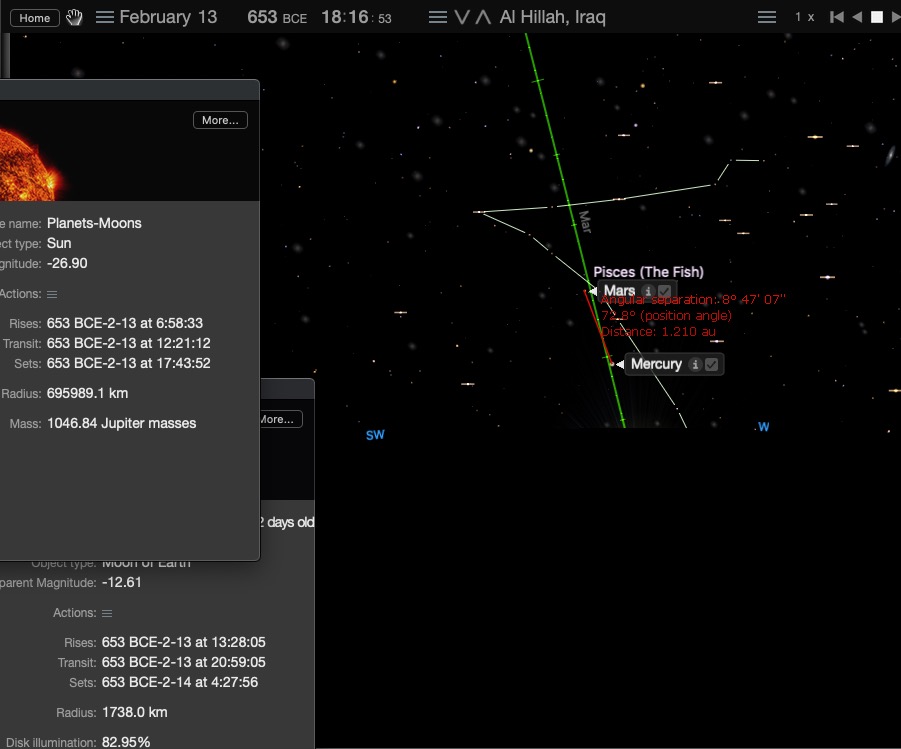
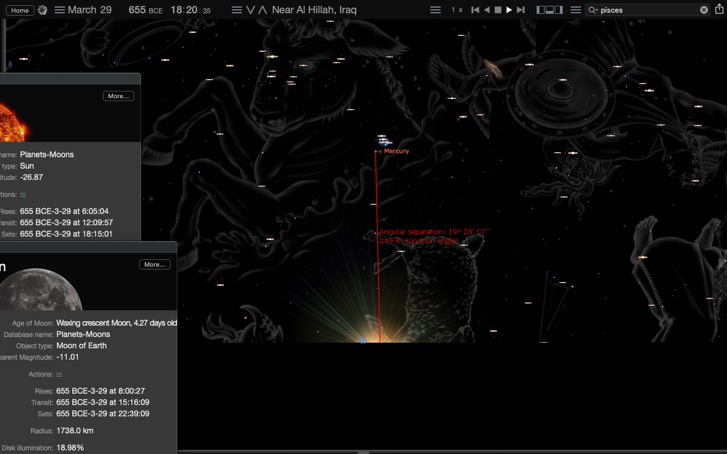
Mercury ascending… Here Mercury (apparent
magnitude -1.09) is located 8° 47’ (≈6 cubits) below (not above!) Mars (apparent magnitude 1.39)
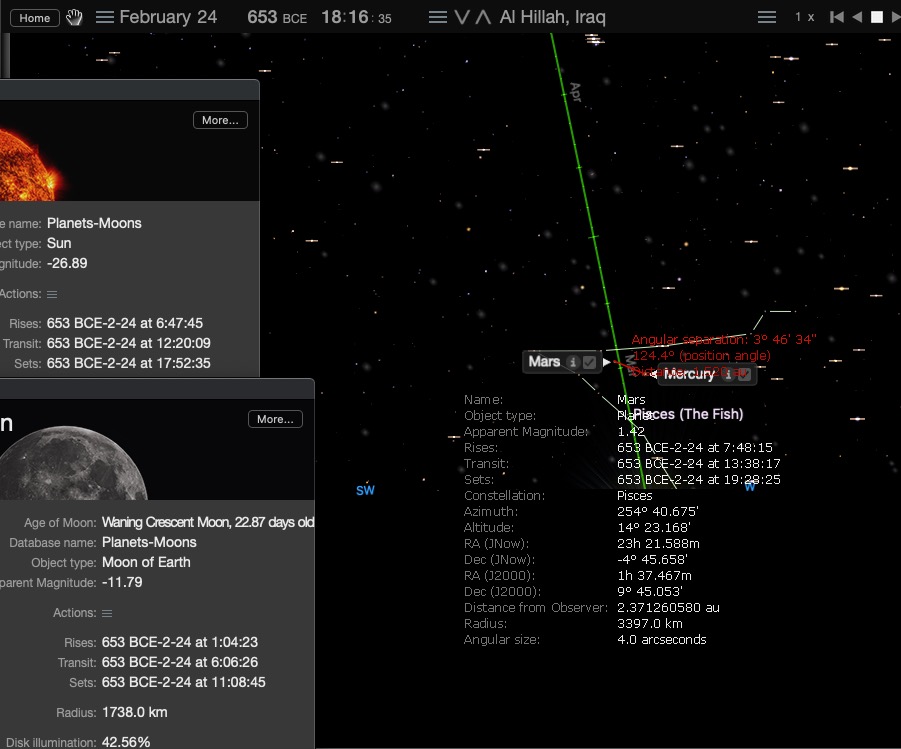
Ok fit: Mercury at the time of its highest position above the western horizon
before descending again. Here Mercury (apparent magnitude 0.20) is located
slightly below Mars at a distance of 3° 47’ (≈3 cubits). Not quite the cubit length I
had expected. But seeing the variable length of the cubit even within this clay
tablet alone, I find this one perfectly acceptable…
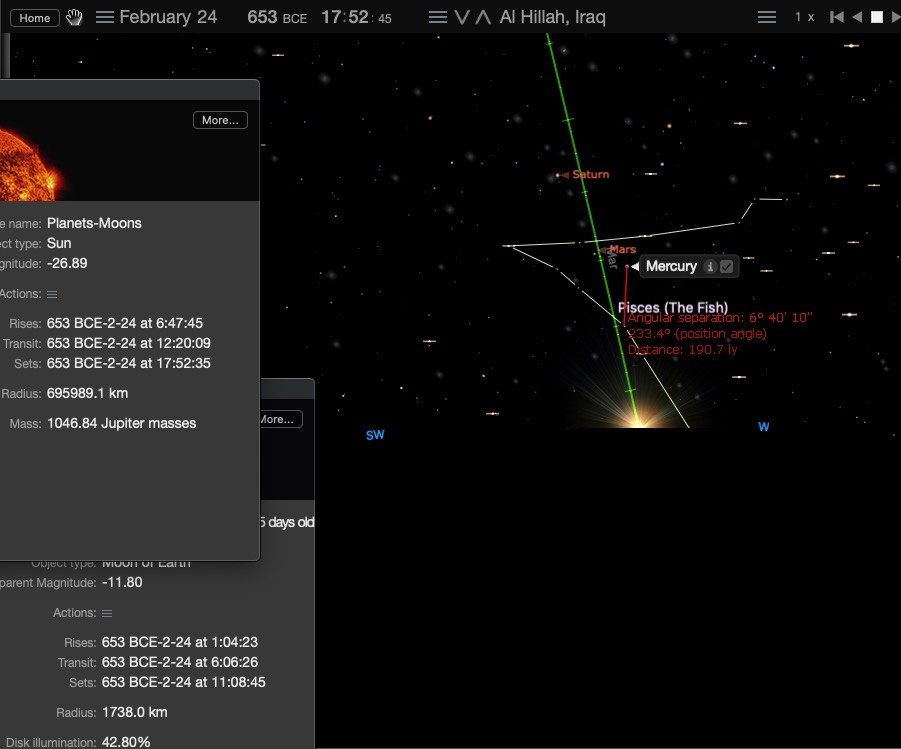
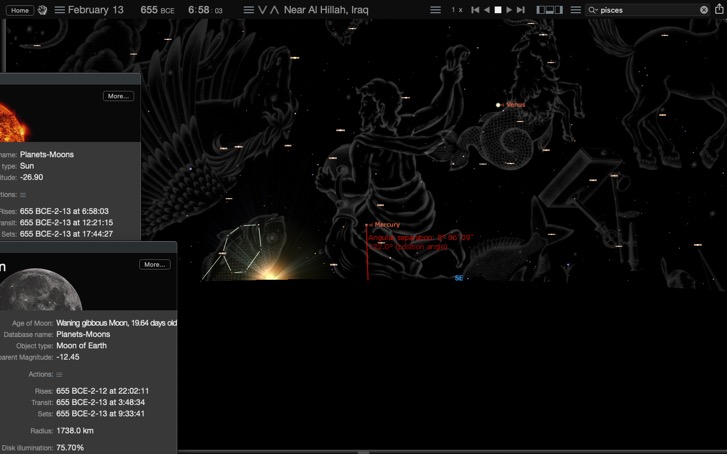
Good fit: Mercury at the time of its highest position above the western horizon
before descending again. Here Mercury (apparent magnitude 0.20) is located 6° 40’ (5-6 cubits) above Epsilon Piscium
(apparent magnitude 4.25). This may seem to be the best fit to the line
4’ clay tablet record… Except that it seems to be the wrong year!
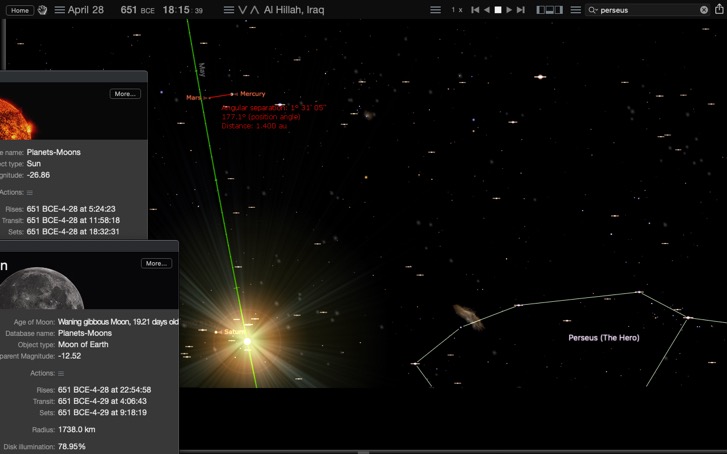
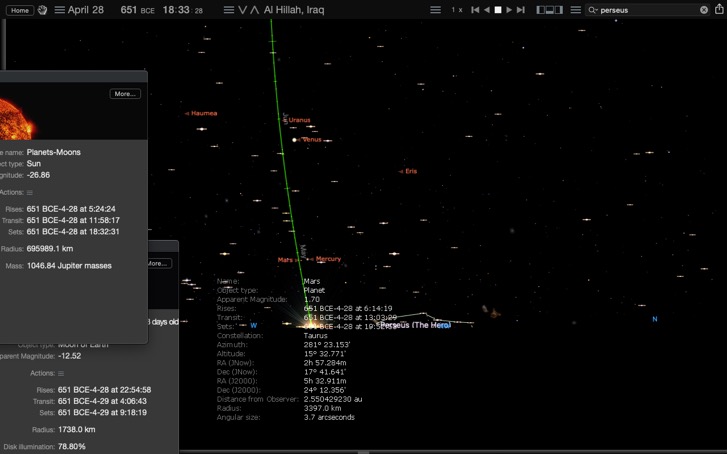
5' Year 17, month II, the 19th, mars was in [the
area?] of the Old Man to the right of Mercury 2 cu[bits? ....]
Good fit: Wrong year? In the spring/summer of 652 BCE, Mars was no where close to Perseus (The Old Man), but in 651 BCE we
find the Sun and Perseus (The Old Man) setting, while Mars and Mercury, albeit
with Mercury 1° 31’ (=1+ cubit) on the right of Mars, become visible over the western horizon in
Babylon.
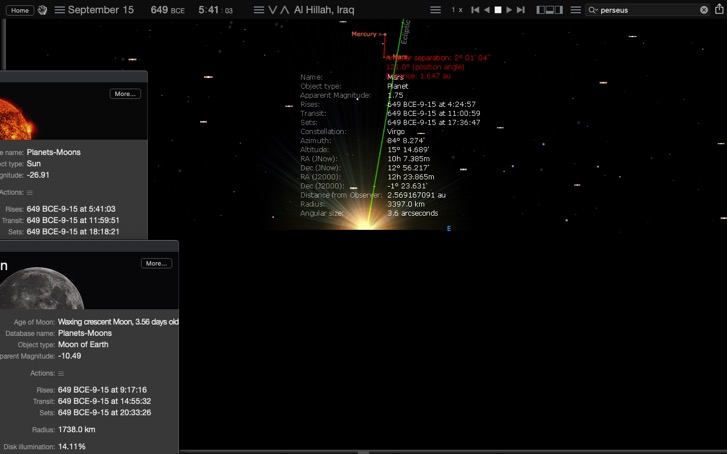
6' Year 19, month VII, the 4th, Mercury stood
for ⅔ cubit above? Mars, Mercury
[....]
Wrong year? (Initially I expected 650 BCE,
but then I discovered that Mars was nowhere close to Perseus in that year):
Perfect fit: On Sep 15, 649 BCE ”month
VII, the 4th, Mercury stood…” (at the apex of its ascension) 2° 01’
(≈1 2/3 cubit) “above Mars”:
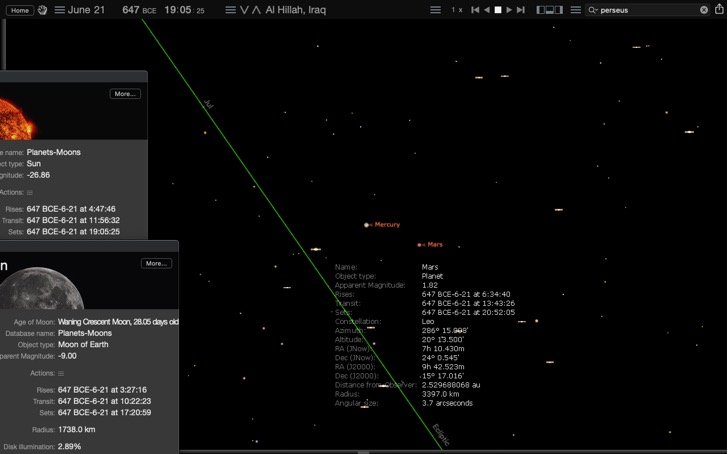
7' Year 1 of Kandalanu, month III, the 28th,
Mercury was in the back of Mars? .... [....]
Perfect fit: While approaching its apex position (at 21° 11’ altitude on June 27, 647
BCE), on June 21 Mercury was first seen (at 20° 28’ altitude) behind Mars on
its path towards the western horizon:
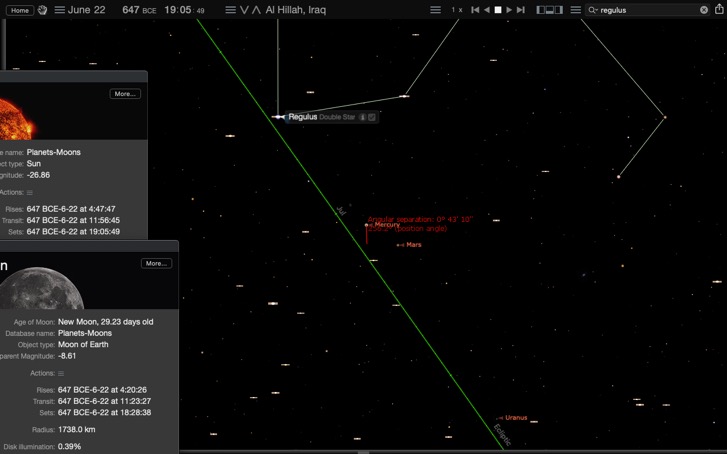
8' the 29th, it was 14 fingers above Mercury in
the area of the Lion [....]
Perfect fit: While approaching Leo on its path to its apex altitude, on Jun 22, 647
BCE (= “month III, the 29th it [Mercury] rose to 14 fingers [(= ½
cubit) above Mars at an altitude of 20° 38’]”)
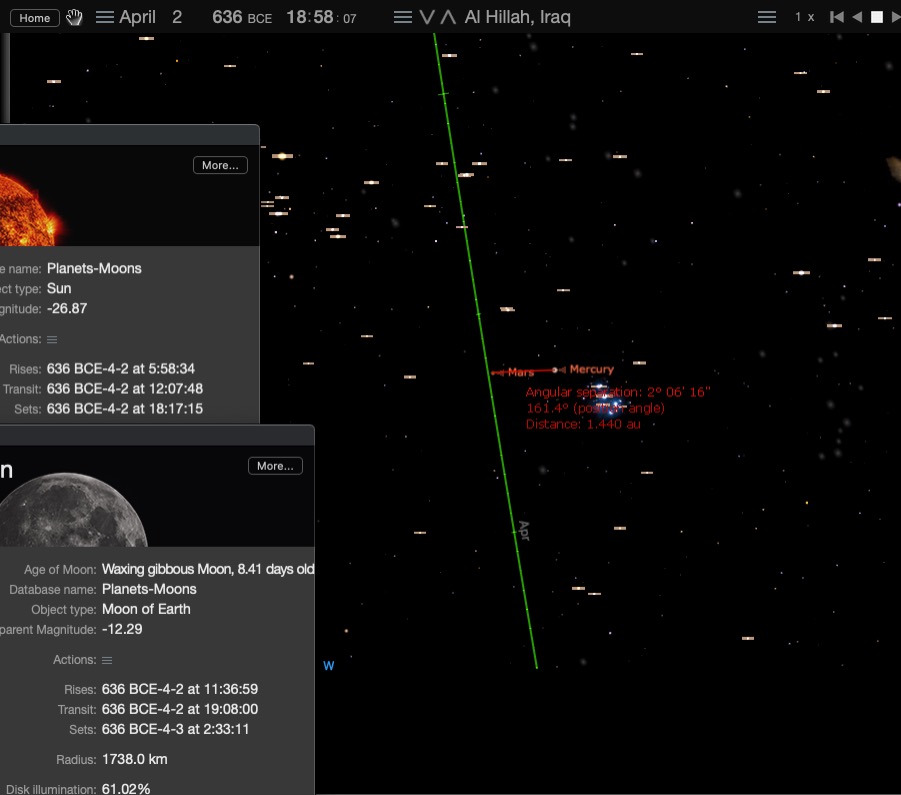
9' Year 12, month I, night of the 8th, Mercury,
in the area of Pleiades was 2 ⅔ cubits
above? Mars? [....]
While rising towards its apex position (20° 46’
altitude), on April 2, 636 BCE (=”month I, night of
the 8th”) Mercury (at altitude 18° 14’) passed Mars
at a distance of 2° 6’ 16” [≈ 2 cubits], while
at about the same distance from the Pleiades.
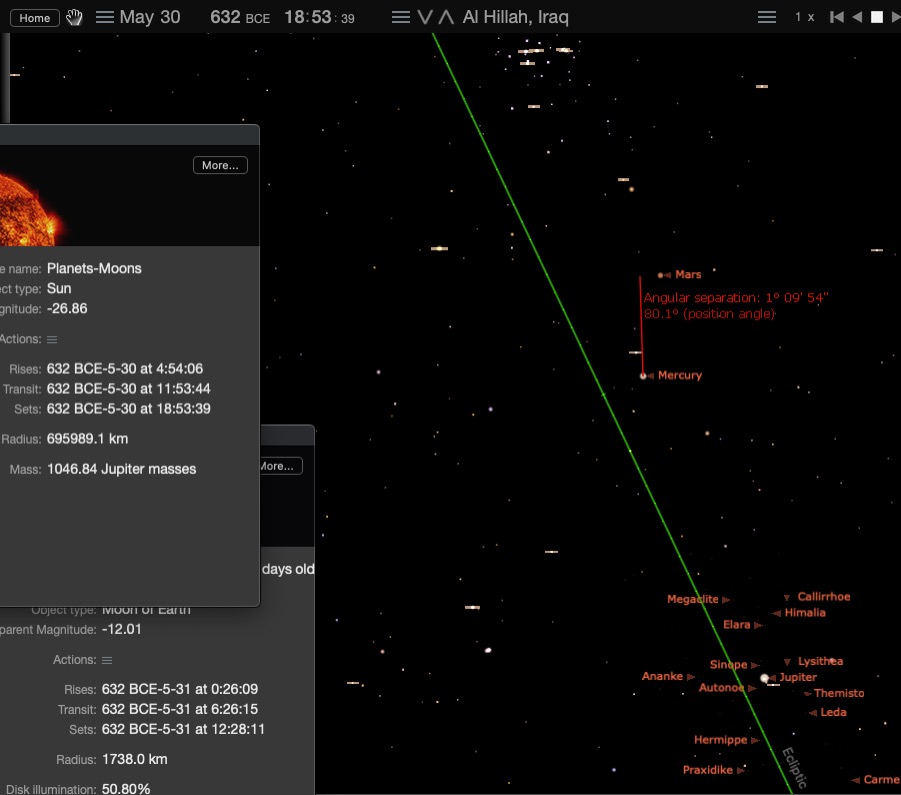
10' Year 16, month III,
night of the 20th, Mercury stood 1 cubit 4 fingers behind Mars.
The evening past reaching its apex altitude [=”stood”], on May 30, 632 BCE (=”month III, night of the 20th”)
Mercury was located 1° 10’ (≈1 cubit) below Mars.
[I.e. “behind” in the sense
of not reaching quite the same altitude as did Mars]
11' Year 7 of Nabopolassar,
month ...., [....] Mercury was balanced 6 fingers above Mars.
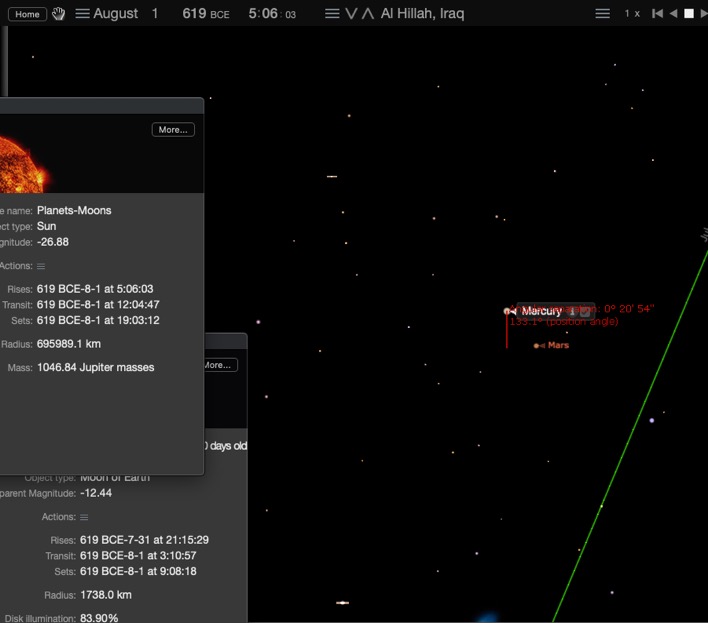
While descending from its apex altitude (16° 48’)
above the horizon, on Aug 1, 619 BCE (“month [V, 19th day]”) Mercury
passed Mars.
At that time we find Mercury
0° 20’ 54” (≈ ¼ cubit = “6 fingers”) above Mars, which was at 8° 58’
altitude above the eastern horizon.
12' Year [....] 1 ½ cubits
above Mars
13' [....] .... [....]
Side B
I'
1 [....] stood to the east
2 [....] passed
3 [....] passed
4 [....] balanced
5 [....] ....
6 [....] came close to the moon
7 [....] ....
II'
1 Year .
... [....]
2 .... [....]
3 Year 19, month IX, the 2nd. Mars was ....
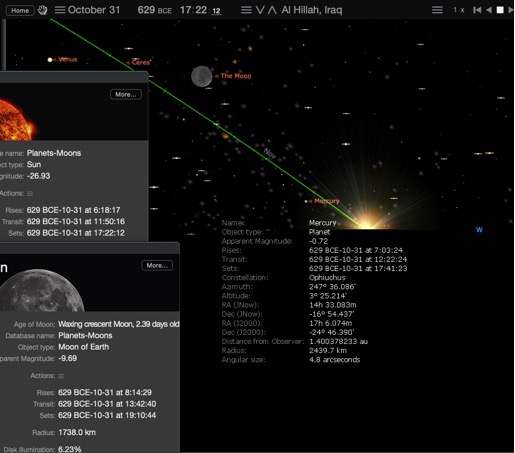
Uncertain correlation: If ”Year 19” of Kandulanu, then “month IX, the 2nd”
may have been (?) Mercury’s first visibility (3° 25’ altitude at sunset). I see
no other possibly significant event touching on Mars or Mercury on Oct 31, 629
BCE, nor one lunar month later, Mars was nowhere close to Mercury on these two
dates in 629 BCE…
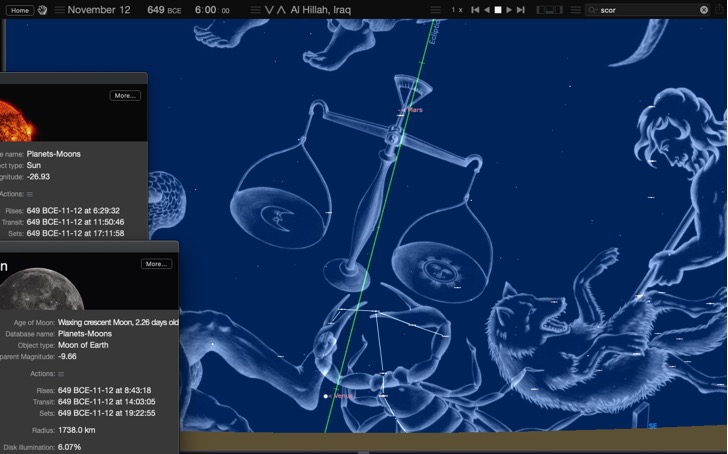
Exact correlation: On Nov 12, 649 BCE, “Year 19 [of Šamaš-šuma-ukin/TLT©], month IX, the
2nd. Mars was ....” seen at alpha Librae (The Scales).
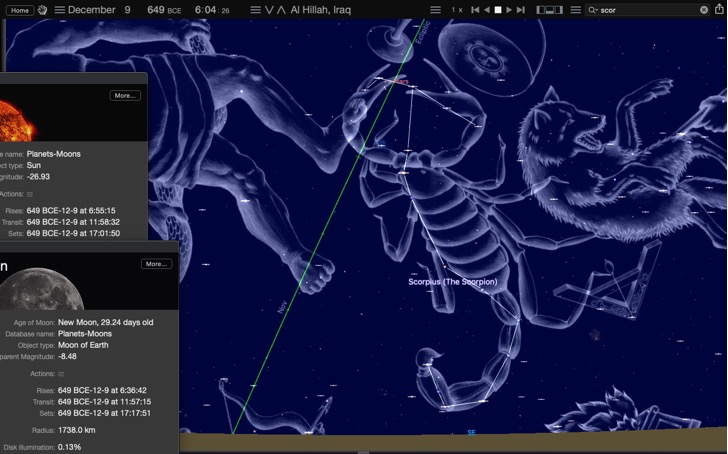
4 The 28th, Mars was .... to the front of the 2
small stars of the ears of the Scorpion.
5 The 29th, it rose in between these stars.
....
6 they entered each other.
(I see no Kandalanu/629 BCE correlation to the above
lines.)
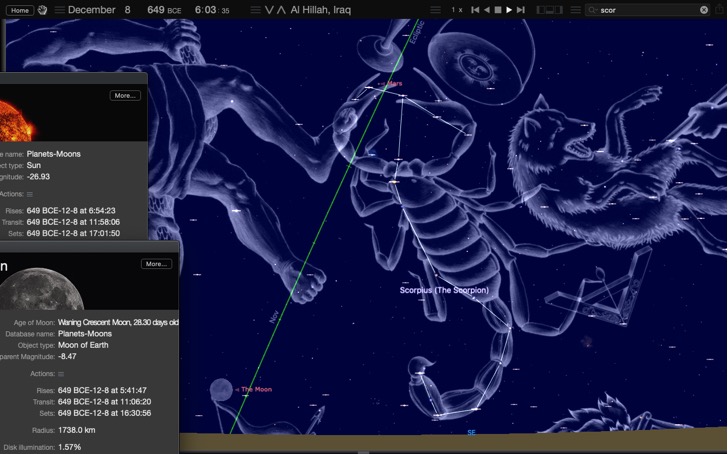
Powerfully exact confirmation: In
Šamaš-šuma-ukin‘s 19th year, on Dec 8
and 9, 649 BCE, I find an exact fit to lines 4-6 above.
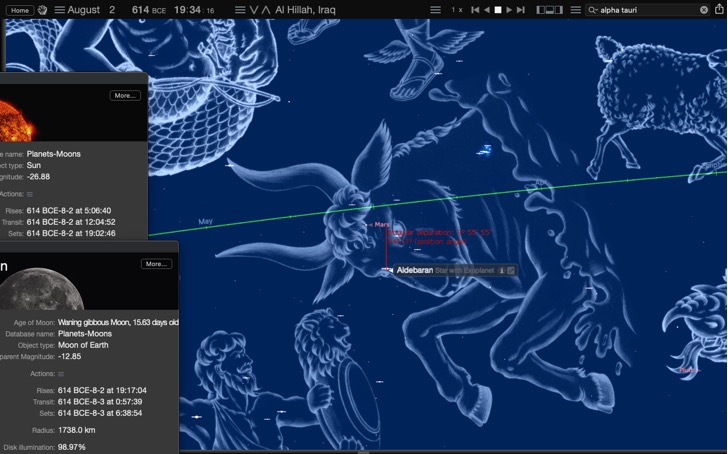
7 Year 12 of Nabopolassar, month V, the 15th.
Mars was balanced 2 cubits above α [Tauri]
8 .... [....]
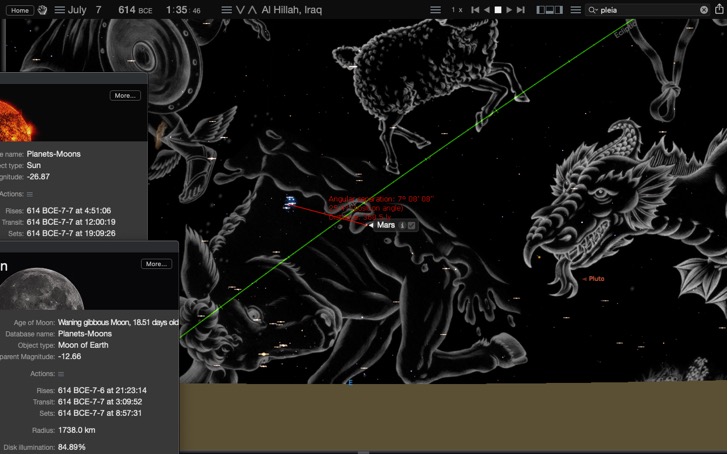
9 Month IV, night of the 18th, Mars was with
Pleiades 4 cub[its ....]
10 Month VI, the 13th, Mars
was ⅔ cubit above the Chariot
[....]
Exact correlation with line 7: On Aug 2, 614 BCE, “Year 12 of Nabopolassar, month V,
the 15th. Mars was balanced 2 cubits above α [Tauri]” at 3° 56’ (≈ 2 or 3 cubits)
Exact correlation with line 9: On Jul 7, 614 BCE ”Month IV, night of
the 18th, Mars was with Pleiades 4 cub[its ....]”, i.e. at an angular distance of 7° 8’ 6”.
Exact correlation with line 10: On Aug 30, 614 BCE ”Month VI, the 13th, Mars was ⅔ cubit above the Chariot [....]”
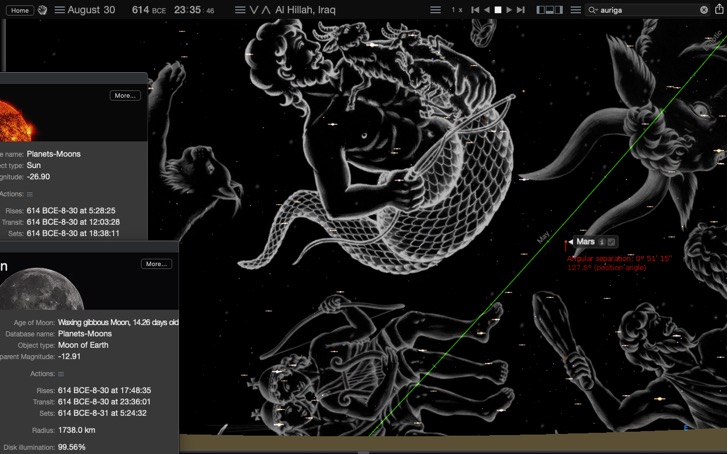
The
Chariot vs Auriga – same stars, different artistry
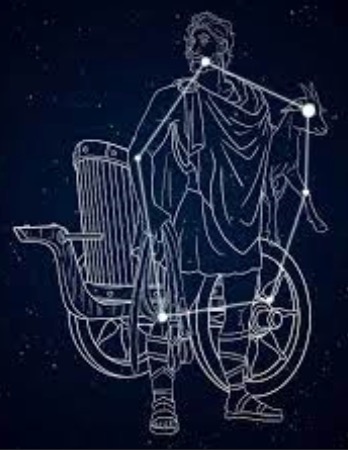
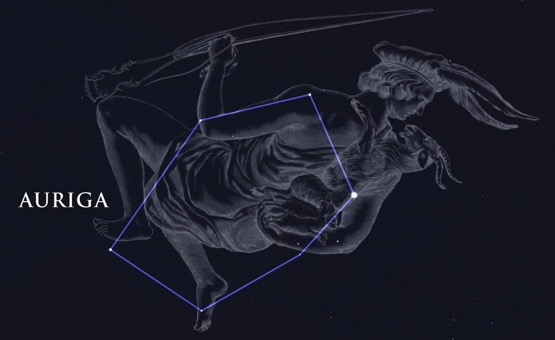
What
is the constellation of the chariot?
Auriga is a lesser-known constellation neighboring Gemini and
Taurus that is visible in the northern hemisphere during the winter months. The
mythological character Auriga is based on is often depicted holding a female
goat and her kids, along with the reins of a chariot.
11 [Year] 13, month III,
(when) the moon became visible. Mars was [....] above α Leonis.
12 [Month] V?, the 3rd, it
was with β Virginis 5 cubits [....]
13 [Year 1]4?, month I, the
27th, Mars [....] from [....]
14 [....] .... 4 cubits
[....]
15 [....] above? [....]
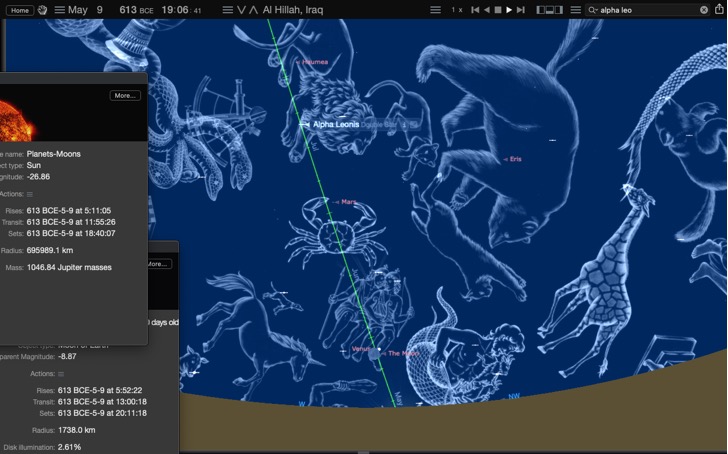
Exact correlation line 11: On May 9, 613 BCE, “[Year] 13, month III, (when) the moon
became visible. Mars was [....] above α Leonis.” I.e. not ”above”, but ≈17° ≈ 12
cubits ‘in front of’.
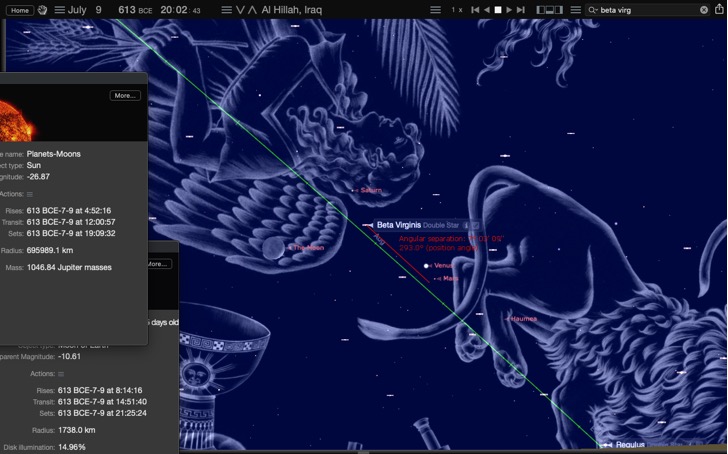
Exact correlation line 12: On July 9, 613 BCE “[Month] V?,
the 3rd, it [Mars/TLT©] was with β Virginis 5 cubits
[....]”. I.e. 7° ≈
5 cubits.
Exact correlation line 13-14: On Apr 25, 612 BCE “[Year 1]4?,
month I, the 27th, Mars [....] from [....]” “ [....] .... 4 cubits [....]”. I.e. 3° 16’ 59” (= 3-4
cubits) angular distance from Venus.
xxxxxxxxxxxx
https://www.youtube.com/watch?v=VQAlGSKbnes&t=159s
:
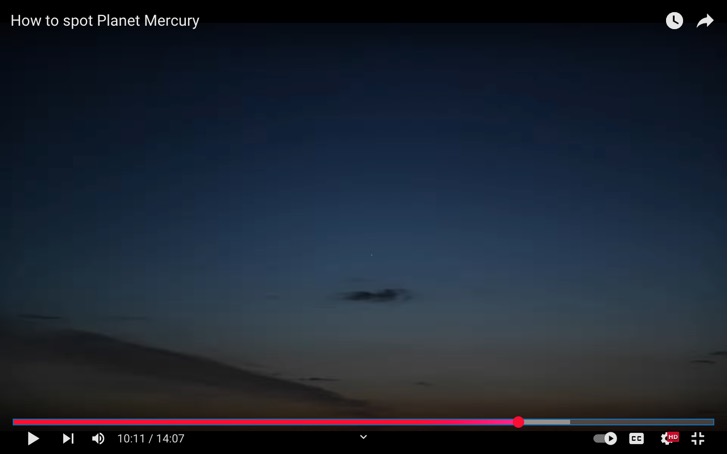
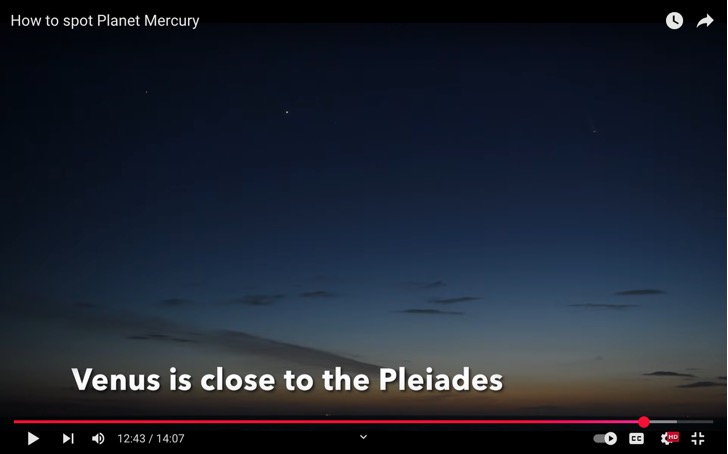
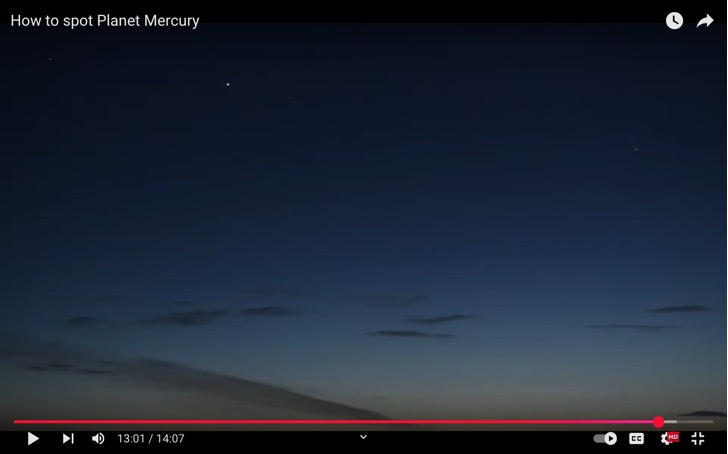
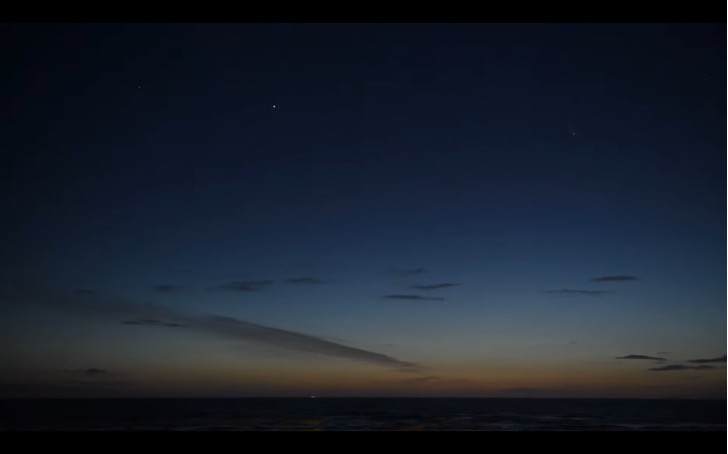
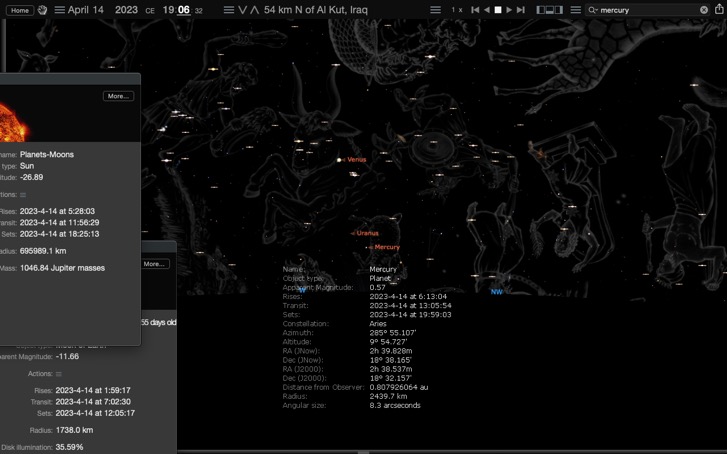
The
altitude of Mercury is 0.19 x the altitude of Venus. The date is April 14, 2023
in Blackpool, UK. The sky could be more clear… As seen
below, this is 95+ min past sunset.
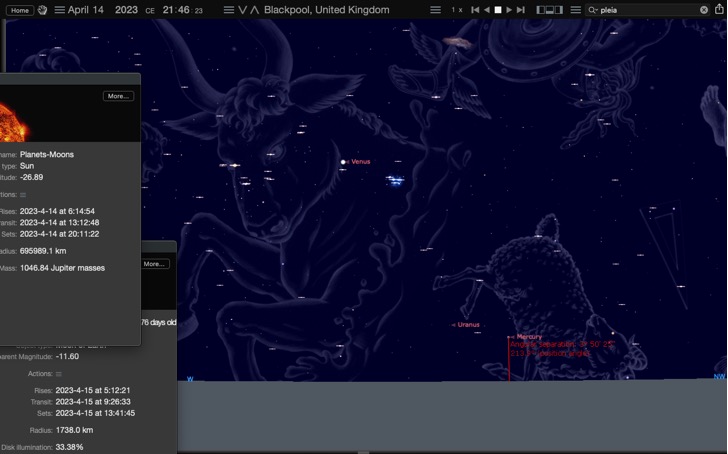
Here Mercury is shown at 0.20084 of the Venus
altitude. That is 95 minutes past sunset. At
that time Mercury was only 3 deg 50’ above the horizon!
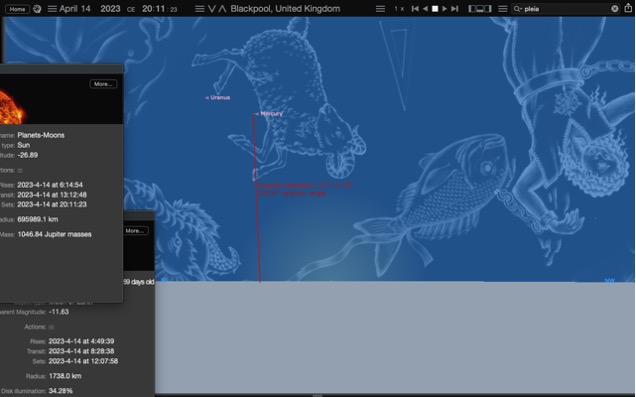
At sunset, however it was as much as 17 deg 11’
50” above the horizon, yet not visible, at least from the Blackpool, UK
location. No doubt, the light pollution, and the atmospheric pollution, was
much less of a problem in ancient times and from a dedicated astronomy
observatory location. Accordingly…
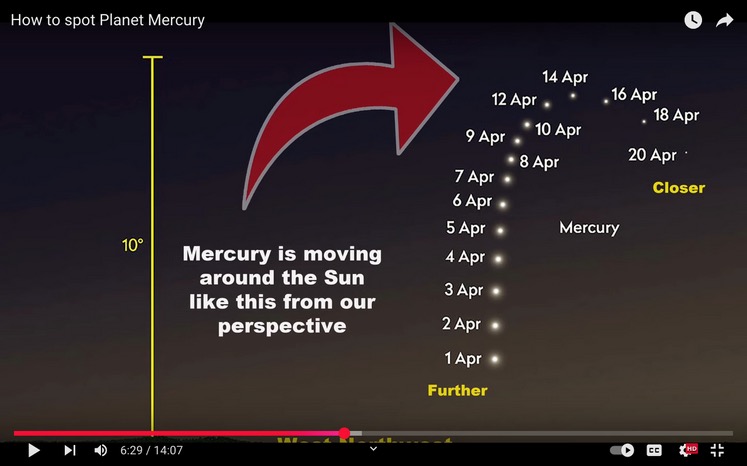
This one should be understood in terms of potential Mercury observations
about 50 min past sunset from a location at 53.8167° N, 3.0370° W…
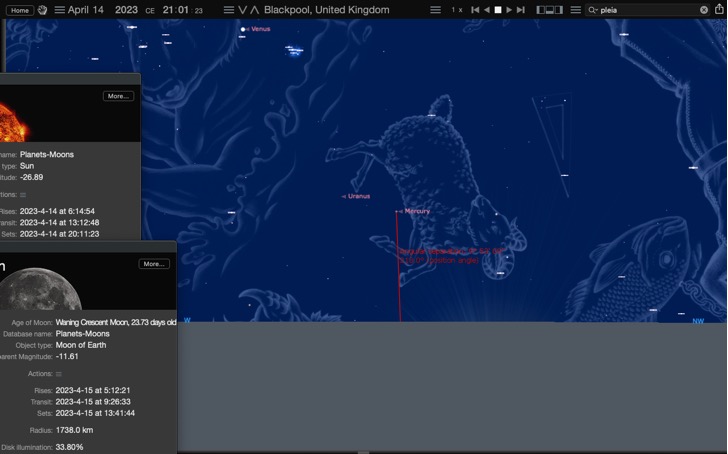
Which would correspond to about 40 min past sunset at Babylon’s closest
real tall mountain (33° 41.4605’ N 46° 27.3728’ E).
Considering also the rapidly diminishing magnitude of Mercury as it
moves away from the Sun and as the % illumination diminishes, I imagine that
when all parameters are optimized, Mercury may be visible perhaps even a few
minutes past sunset, and a very few degrees away from the Sun?
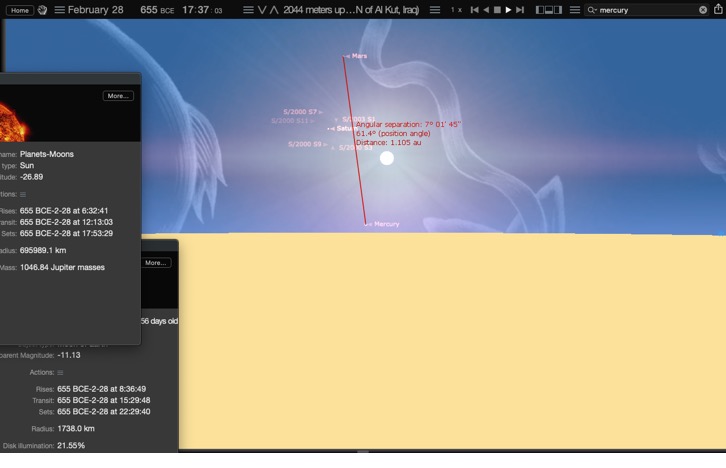
Here Mercury is “balanced 6 cubits [6x1.3=7.8 deg]…”
below “Mars”. But, isn’t it impossible to see Mercury so near the Sun during
day time?
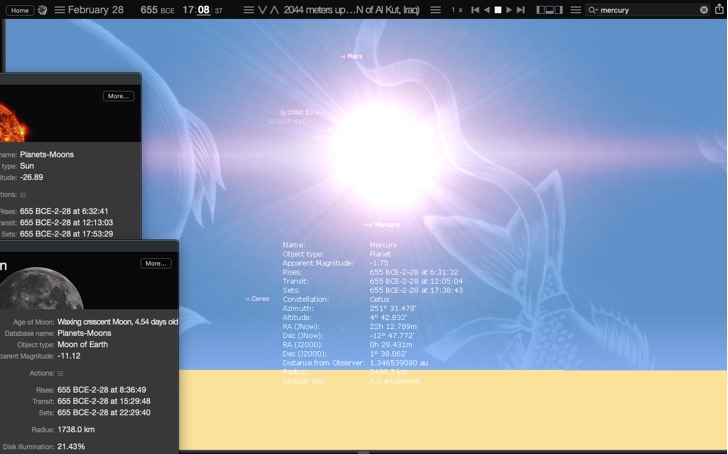
Apparent magnitude of Mercury at that time was -1.75.
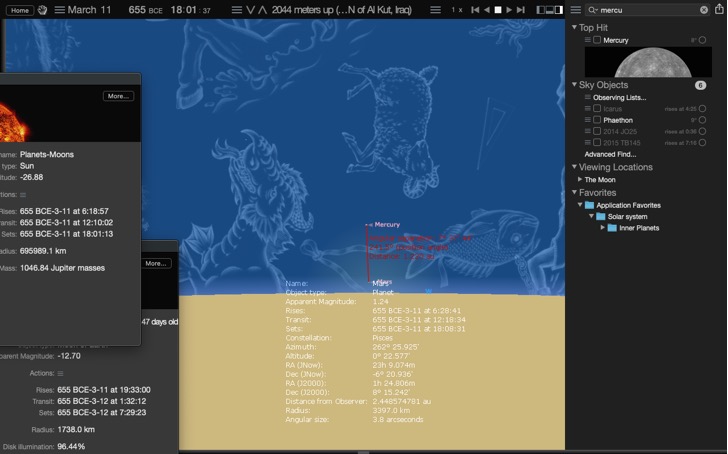
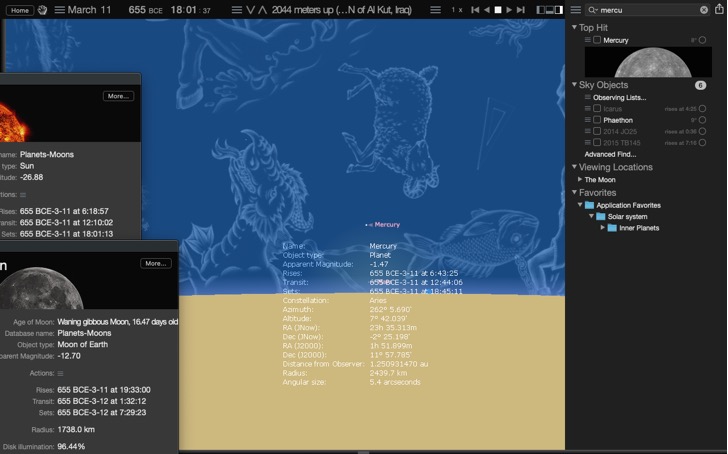
At this
point in time (6 cubits above Mars) Mercury was beginning to fade while still
rising.
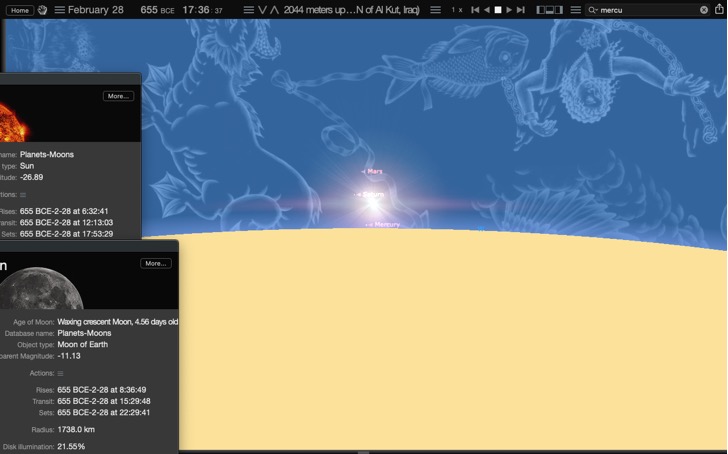
Would this
scenario have been visible?
Soyuz

·

topic starter
· Posts: 3,733
- Joined: 12 Jun 2018
- Loc: Cumberland, Maryland, USA
Posted 11 August 2022 - 12:01 AM
Is there a way to calculate or estimate limiting
magnitude in the daytime?
I specifically am trying to figure out whether
Mercury is too dim for this month's greatest Solar elongation to be viewable in
the daytime.
I figure daytime limiting magnitude might work the same as limiting magnitude for light pollution (with the Sun being a massive source of light pollution that makes it difficult to find faint objects in the daytime). For nighttime light pollution, you typically subtract a number of magnitudes from your limiting magnitude without light pollution. So if you have a limiting magnitude of +12 under dark skies, maybe you only have a limiting magnitude of +11 in the suburbs or +10 in the city.
Is there a rule of thumb of how many magnitudes to subtract from the limiting magnitude for daytime versus nighttime observing?
Might it be possible to predict the limiting magnitude for an object based on its Solar elongation and the Sun's apparent magnitude?
The dimmest object I've seen in the daytime so far is Saturn at magnitude +0.90, but this was in the late afternoon with a Solar altitude of +3.04 degrees (Solar apparent magnitude of -24.8) and a Solar elongation of 92.4 degrees.
The dimmest object I've seen around midday is Vega at magnitude +0.14 with a Solar elongation of 61.7 degrees and a Solar altitude of +22.5 degrees (Solar apparent magnitude of -26.4). This was actually on 2022-01-04, only about 8 hours after Terran perihelion (Solar perigee).
Mercury should be brighter than Vega, but has a smaller Solar elongation. So I think I need a way to figure out limiting magnitude by Solar elongation maybe.
My understanding is that I might just need to figure out how to calculate the brightness of the sky background in something like candelas or magnitudes per square arcsecond. If the object is dimmer than the sky background, it simply won't show. This would be the same as nighttime light pollution or Moonglow (by Lunar elongation instead of Solar elongation).
Edited by Nicole Sharp, 11 August 2022 - 12:09 AM.
#2 
Soyuz
·
topic starter
· Posts: 3,733
- Joined: 12 Jun 2018
- Loc: Cumberland, Maryland, USA
Posted 11 August 2022 - 12:49 AM
I might have something. If assuming that the sky brightness decreases with the square of the angular distance from the bright object, then I already know that the sky background is:
dimmer than magnitude +0.14 when at least 61.7 degrees from the Sun at magnitude -26.4 and
dimmer than magnitude +0.90 when at least 92.4 degrees from the Sun at magnitude -24.8.
This could allow to estimate an empirical constant of proportionality based on the two data points.
LimitingMagnitude = -5*log(Constant*SolarIntensity/SolidElongation)/log(100) /* units of magnitude */ $
SolarIntensity = 100^(-SolarApparentMagnitude/5) /* dimensionless ratio (brightness compared to exoatmospheric Vega) */ $
SolidElongation = %pi*SolarElongation^2 /* units of steradian or square degree */ $
Constant = 100^(-0.90/5)/(100^(24.8/5)/(%pi*(92.4*Degree)^2)) /* units of steradian or square degree */ $
Constant = 1.40765E-7*Degree^2 $
It
seems like a good idea but otherwise doesn't appear to work. It predicts
that if Mercury has a Solar elongation of 22.8 degrees with the Sun at
magnitude -26.6, the limiting magnitude should be +1.41. So the
relationship between limiting magnitude and Solar elongation might not be by
the square of the angular distance.
I forgot to include the minus sign (-5 times the logarithm). Now corrected above. That gives the limiting magnitude for Mercury as -1.41 when at 22.8 degrees of Solar elongation (when the Sun has an apparent magnitude of -26.6). That actually sounds realistic and would explain why I can see Venus but I can't see Mercury. Anyone else having this same problem? A limiting magnitude of -1.41 though will make it extremely difficult if not impossible to see Mercury in the daytime. This is for 90 mm of aperture at f/11.
Right now I just don't have enough empirical experience with daytime astronomy. Hopefully someone else has already figured out a better way to estimate limiting magnitude or already has the empirical experience to make a rule of thumb on the limiting magnitude for daytime observations of Mercury.
Edited by Nicole Sharp, 11 August 2022 - 01:16 AM.
#3 
James Webb Space Telescope
·

· Posts: 18,049
- Joined: 05 Oct 2008
- Loc: Bornholm, Denmark
Posted 11 August 2022 - 01:44 AM
In my 63mm Zeiss, I can easily see Mercury in daylight (if I can find it...) and I've seen and resolved Castor and Izar several times as well, so stars as faint as mag. 4.8 are visible with just a 63mm in daytime.
Mercury through my 63mm Zeiss, 140x, May 19th, 2020, 1700UT (approx.).
Castor, 63mm Zeiss, 140x, May 19th, 2020, 1700UT (approx.)
Clear skies!
Thomas, Denmark
#4
Soyuz
·
topic starter
· Posts: 3,733
- Joined: 12 Jun 2018
- Loc: Cumberland, Maryland, USA
Posted 12 August 2022 - 06:52 PM
The
Sun is below the horizon already with completely clear skies but I still can't
find Mercury with the 7X50 binocular, 9X50 finderscope, or 39X90 telescope. I
think the sky background is just too bright so I don't think I would be able to
see it in the daytime if I can't see it at Sunset.
I need to find a way to predict the limiting magnitude based on the Solar
altitude angle and Solar elongation to find the best times to view Mercury.
Edited by Nicole Sharp, 12 August 2022 - 06:53 PM.
#5
Soyuz
·
topic starter
· Posts: 3,733
- Joined: 12 Jun 2018
- Loc: Cumberland, Maryland, USA
Posted 12 August 2022 - 07:18 PM
I can see Vega in the 9X50 finderscope but cannot see Mercury. Mercury is brighter than Vega right now, so I think the limiting magnitude is proportional to the Solar elongation.
Edited by Nicole Sharp, 12 August 2022 - 07:19 PM.
#6
Soyuz
·
topic starter
· Posts: 3,733
- Joined: 12 Jun 2018
- Loc: Cumberland, Maryland, USA
Posted 12 August 2022 - 07:21 PM
I just saw Mercury. 8:20 PM EDT in Flintstone, Maryland. It was not visible before that.
#7
Apollo
·
· Posts: 1,245
- Joined: 01 Aug 2017
- Loc: Massachusetts
Posted 12 August 2022 - 08:35 PM
I will add to Astrojensen comment. As long as it is not too close to the Sun (<5 Deg), Mercury is always visible in day time with small telescope. You just have to find it. Some times I am looking at it and I cannot see it, until I see it. Reason why I cannot see it could be that the telescope is out of focus or my eyes are out of focus. I usually focus the telescope on Sun (with front glass solar filter), then I move the telescope, then I remove the solar filter. Then I look for it. GL.
#8
James Webb Space Telescope
·
· Posts: 18,049
- Joined: 05 Oct 2008
- Loc: Bornholm, Denmark
Posted 13 August 2022 - 12:20 PM
Please
also remember, that transparency, humidity and amount of particles in the air
(pollen, dust, smoke...) play a major role in how faint you can see during the
day. In exceptionally clear air, Mercury has been
observed within less than half a degree from the Sun!
It's not easy to set up a mathematical model, that can take it all into consideration. Here, observer experience is much better at predicting one's chances of a successful observation, simply from looking at the sky.
A simple, but very reliable test, is to block out the Sun
with your thumb, held out at arm's length. If the sky is blue, almost up to the
Sun, the air is very clear, and your chances good. If the sky is blindingly
bright in a radius many degrees from the Sun, conditions are poor.
And, as always, observer experience plays a huge role.
Clear skies!
Thomas, Denmark
Comments and donations freely
accepted at:
Tree of Life©
eMail: TreeOfLifeTime@gmail.com
A Sampling of God’s
Wonderful Free Gifts
The GateWays into Tree of Life
Chronology Forums©
Without recourse.
All Rights Reserved. Tree of Life©