Without recourse.
All Rights Reserved. Tree
of Life©
 Tryck här för den svenska versionen!
Statement
of belief: “Sanctify them through thy truth: thy word
is truth.” (John
Edited 5941(?) 07 26 2027 [2010-10-05]
Edited 5927[(*??*)] 10 12 2031 [2015-01-04] – Additional references in item #1.
Edited 5927[(*??*)] 13 16 2031 [2015-04-06] – Adding a new
item #1 re the date stamps of Matthew
and Mark vs. John re the Last Supper.
Addition
5928[(*??*)] 08 09 2032 [2015-11-21] – Adding item #17.
Addition
5936[v2016-12-14-21:32] 03 02 2033 [2017-05-28] – Adding hoverlinks
to all Bible references, and removing old counters that have been infested by
troublesome ads.
Addition
5936[v2016-12-14-21:32] 04 02 2033 [2017-06-27] – Adding item #18, and a reference to the same in item
#3.
Addition
5937[v2016-12-14-21:32] 07 30 2034 [2017-10-21] – Adding the “Bible
Study… Chronology -” section of the below title of this page.
Addition
5937[v2016-12-14-21:32] 08 04 2034 [2017-10-25] – While working on
the Swedish translation of this page: Additions to items #10, and #13, plus minor corrections elsewhere.
Addition
5938[v2016-12-14-21:32] 06 28 2035
[2019-08-30] – Adding a reference to Hosea
6:1-3 re the Third Day!
Bible Study
Focusing Upon the
Crucifixion Event Specifically, and,
More Generally,
upon New Testament Chronology
-
Helpful Questions
for a Quicker Understanding of the
“Preview of the
Friday Aviv 17 Crucifixion”
Focusing upon the red font items under “Preview of the Friday Aviv
17 Crucifixion:”
1.
Re the 14th
vs.
the 15th day of the month: When did the Last Supper take place?
And the crucifixion?
Leviticus 23:6 defines the First Day of the Feast of Unleavened Bread as
the 15th day of the first month:
“6 And
on the fifteenth day of the same month is the feast of unleavened
bread unto the LORD: seven days ye must eat unleavened bread.” Leviticus 23:6
Matthew and Mark both identify the Last Supper as being prepared and
eaten on the Feast of Unleavened Bread, which begins with Abib 15:
“12 And the first day of unleavened bread,
when they killed the passover, his disciples said unto him, Where wilt thou
that we go and prepare that thou mayest eat the passover?” Mark 14:12.
“17 Now the first
day of the feast of unleavened bread the
disciples came to Jesus, saying unto him, Where wilt thou that we prepare for
thee to eat the passover? 18 And he said… My time is at hand;
I will keep the passover at thy house with my disciples. 19 And the disciples did as Jesus had appointed
them; and they made ready the passover.” Matthew 26:17-19.
Yet, John identifies the same Last Supper as occurring prior to
said 15th day of the month:
“1 Now before
the feast of the passover… 2 And supper being ended, the devil having now
put into the heart of Judas Iscariot, Simon's son,
to betray him… 3
Jesus… 4…
riseth from supper, and laid aside his garments; and took a towel, and
girded himself.” John 13:1-4.
Accordingly, 1) Is either
Matthew and Mark, or else John, in error re the correct timing of this event,
or 2) is the Scripture record reliable, such that all three of them are
correct? That is, as in Matthew and Mark using the same Scripture calendar as
Yeshu is using, while John is using, as he does consistently throughout his
gospel, the calendar and the time reckoning “of the Jews?” 3) But if the Last
Supper occurred on the 15th day of the month, how is it that almost
all are teaching that the crucifixion took place on the 14th day of
the month?!!!
2. Is
it at all possible for Yeshua to have been, (1) first crucified at the 3rd
hour
of the day, and then, later in the same day, at the 6th
hour
stand trial before Pilate? Please compare Mark 15:25, 33, (Matt 27:45, Luke
23:44, Acts 2:15) with John 19:13-14 (cf. John 4:6)! (2) It is commonly
believed that Yeshua stood before Pilate on the very same Friday when he was
crucified, isn’t it? Alternatively, (3) are we to assume that the inspired word
of the New Testament is in error, even in the original Greek version of the
Textus Receptus? If your answers to the above questions are “1) No, 2) Yes, 3)
No,” respectively, then perhaps it is time to reconsider our traditional way of
thinking and thoroughly consider all the facts while looking for an option that is consistent within itself, isn’t it?
3.
What’s the point of giving a
time reference such as ”after two days,” as used for instance in the KJV of Matt. 26:2 and
Mark 14:1 (cf. #18 below!,) when no
beginning of such a time period is identified in the text? Isn’t it much more likely and reasonable
that, provided such a translation of the original text is permissible by the
Greek language, such words are being used for specifying the day of the week,
as in ”after [the first] two days [of the
week?]” After all, the Hebrew and
Aramaic languages are using no other names for any of the first six days of the
week than Day One, Day Two, Day Three, etc., are they? And isn’t Hebrew or
Aramaic the language used by the people in Israel and Judea in New Testament
times? Cf. Acts 21:40; 22:2; 26:14, John 5:2; 19:17 and Rev. 16:16.
4.
Why was Yeshua (later
confirmed by Peter and Paul) repeatedly emphasizing to his followers that he
was going to arise on “the third day” if
in fact he did arise on the first day of the week and not on “the third day” [of the week?] Cf. Hosea 6:1-3; Matt. 16:21;
17:23; 20:19; 27:64; Mark 9:31; 10:34; Luke 9:22; 13:10, 13-14, 32-33; 18:33;
24:7, 21, 46; John 2:1; Acts 10:40; and
1 Cor. 15:4.
5. Why
would Yeshua say, according to Matt. 12:40, “For as Jonas was three days and
three nights in the whale's belly; so shall the Son of man be three
days and three nights in the heart of the earth,” if in fact he was dead
and buried no more than one day and two nights?
6. Why
would Yeshua teach, according to Mark 8:31, that he was going to “be killed,
and after three days rise again,” if in fact he did rise, not after, but
before two days (9 hours (3PM-mid night) + 24 hours + 6 hours = 39 hours?)
a. Does
the bible ever use inclusive reckoning? Or is it the reader of the bible that
is superimposing his or her own traditional thinking – as taught by his or her
society and culture - upon a bible text? Isn’t it Roman tradition and the Latin
language that is using inclusive reckoning? Consider for instance the word
“quinquennial" as applied upon the Olympic games: Do those events occur
every four years or every five years if they are celebrated in say year 2001
and year 2005?
7. Considering
the last three questions, isn’t it much more likely that Yeshua said what he
meant and meant what he said? Or else,
are we to consider the Holy Scriptures, or at least the New Testament, a book
lacking precise meaning as to detail? And what about the words of Yeshua? How
far exactly are we to extend our lack of trust as to the precision expressed
within the word of God?
8.
Referencing
the words found in Acts 1:12: “…which is from Jerusalem a Sabbath day’s journey.” What’s the
point of referencing a distance in such a unique and unusual way, i.e. in a way
not used any other time in the Scriptures, unless the event tied to this
passage did occur on a Sabbath? Cf. John 11:18, which text, as far as I am
aware, is referencing much the same distance as Acts 1:12!
9.
If Acts 1:3
is not lying, and if Yeshua was
indeed “being seen of them forty days,” before the
conclusion of the events relayed in Acts 1:3-12, and if indeed the events
relayed in Acts 1:3-12 took place on a Sabbath, i.e. on the Seventh Day of the
week, then on what day of the week must the first day of the forty days have
occurred? Am I in error when I count backwards and find that the first of the
forty days occurred upon the Third Day of the week, i.e. beginning at sunset
Monday night? Or wasn’t Yeshua seen on the day the tomb was opened early on the
first of those forty days, actually at the beginning of the first of those
forty days?
|
1st Day
Sunday |
2nd Day
Monday |
3rd Day
Tuesday |
4th Day
Wednesday |
5th Day
Thursday |
6th Day
Friday |
7th Day
Sabbath |
|
|
|
1 Resurrection |
2 |
3 |
4 |
5 |
|
6 |
7 |
8 |
9 |
10 |
11 |
12 |
|
13 |
14 |
15 |
16 |
17 |
18 |
19 |
|
20 |
21 |
22 |
23 |
24 |
25 |
26 |
|
27 |
28 |
29 |
30 |
31 |
32 |
33 |
|
34 |
35 |
36 |
37 |
38 |
39 |
40 Ascension |
|
|
|
|
|
|
|
Pentecost Acts 2:1 |
10.
Consider carefully Luke 22:66:
“And as soon as it was day, the elders of the
people and the chief priests and the scribes came together, and led him into
their council…” How does this affect the time available for all the events
specified in the question #11 below? What
exactly is the meaning behind the words “as soon
as it was day?” A search (using Davar 3) of the Syriac Peshitta provides that the
Aramaic word thus translated (via the Greek) into our modern Bible
translations, is found only twice in the New Testament. However, the other
text, Luke 6:13, given the context, Luke 6:12-13, gives us a pretty clear
picture of the meaning behind this word. That is, sunrise, the beginning of the
light and hot portion of the day. A search of the Hebrew OT text, using the
root of said Aramaic word ‘DBP’ gives me 38 hits,
most of which texts are using this word to indicate a very bright light, such
as the sunrise: Cf. 2 Sam 22:13; 23:4; Job 22:28; Ps 18:12; Prov 4:18; Isaiah
4:5; 9:2; 59:9; 60:3; 62:1; Eze 1:4, 13, 27, 28; 10:4; Joel 2:10; 3:15; Amos
5:20; Habbakuk 3:4! A search of Shem Tov’s Hebrew Matthew gives two hits for
the same Hebrew root: Matt 4:16; 28:1.
What are the odds that three bureaucracies - interacting one with
another and without prior preparation, planning, or arrangement - could and
would have carried out all of the extensive proceedings against Yeshua within
the nine hours between midnight and mid-morning of the very same Friday, and
proceedings #2-8 below within 3 hours, i.e. from daybreak through the 3rd
hour, that is, from 6 AM until 9 AM? Remember each of these proceedings:
1. First the mob taking Yeshua prisoner in Gethsemane, then
2. a court trial before the High Priest, then
3. another court trial before Pilate and the Roman authorities, then
4. a third court trial before Herod, then
5. a fourth court trial, the second one, before Pilate and the Roman
authorities, and in addition, do not forget!,
6. first the flogging, then
7. the actual walk to Golgatha, and finally
8. the crucifixion procedure itself?
Remember, Pilate and Herod were at odds with one another, and the Jewish
Court can hardly be perceived as being in the habit of working in close
cooperation with either Pilate or Herod, or can it? Or does the New Testament paint a picture of
those three courts, as if they were a tightly knit unit working smoothly hand
in hand with one another? Without even
taking into consideration the transportation time between each of these eight
numbered scenes, which of these eight events, if any, is likely to have taken
less than 3/7th of one hour (3 hours / 7 events,) i.e. less than 26
minutes, to conclude from beginning to end?
How likely, or even possible, is a nine hour scenario, such as is
commonly perceived as having taken place all within one and the same Friday
morning? Is such a nine hour scenario consistent with the Bible?
12. How
has it been possible for Anyone or Anything to fool so many Christians for so
many years about any one of the above issues, which issues are supposedly of
such focal interest to everyone within Christendom? Who is Anyone? What is
Anything? What part of the responsibility for this do I, and each and everyone
among us, carry upon each our shoulders for such tomfoolery?
14.
Re John 19:14, 31: What exactly is
meant by the words “14… it was the preparation of the passover”
and “31… for that
sabbath day was a high day?” Are those two days necessarily and always
consecutive, i.e. one following immediately after the other? That is to say: Is
it true that the weekly 7th Day Sabbath within the seven day Feast
of Unleavened Bread always follows immediately upon the 14th day of
the First Moon, Aviv? Is the Bible teaching that the 7th Day Shabbat
of the Waving of
the Sheaf is to
follow immediately upon the day when preparation for the evening of the
sacrifice of the Passover lamb is to be made? What does Leviticus 23:5-8 and
Deuteronomy 16:4 teach re the timing for “the Lord’s passover?” What does Leviticus 23:15-16 teach re the timing of the Waving of the Sheaf and
the beginning of the count of fifty days (cf. #15 below?)
15.
Re #14 above: What point in time exactly is pinpointed by
the words “the morrow after the Sabbath” (Leviticus 23:15, 16?) Sunday morning
or the morning of the 7th Day Shabbat? When exactly does the 7th
Day Shabbat begin? What does Genesis 1:5 and Leviticus 23:32 teach re the
beginning of the Shabbat as well as the beginning of each and every 24 hour day
period? When you are at that point of a Sabbath Day, i.e. at the sunset at the
very beginning of the Sabbath: What point are you talking about when you say
words such as “Tomorrow morning?” What is the relationship between the “night”
referenced in Genesis 19:33 and “the morrow” referenced in Genesis 19:34?
16. To understand the true
meaning of the Greek words translated, in the KJV, “the first day of the week”
you need to use your Strong’s Concordance and Dictionary! Or at least you need
to look at some Greek version of the NT! Consider carefully the meaning of each
of the three Greek words thus translated! Next, look up the Greek words in the
NT that actually means “the First Day” or “Day One” [of the week!] You’ll find these texts in Luke 5:17; 8:22;
Acts 21:7; 28:13! What differences do
you see between the Greek words used in these last four passages in comparison
to the Greek words used in the passages translated in KJV as “the first day of
the week?” Next, do you find any passages in the NT translated “the second day
of the week,” “the third day of the week,” “the fourth day of the week,” etc.?
Why not? On the other hand, if you look for the other days of the week in the
Greek NT, using the same format as in Luke 5:17; 8:22; Acts 21:7; 28:13, isn’t
it true that you’ll find passages where each and every one of the week days are
being specified?!:
·
1st Day: Luke 5:17; 8:22; Acts 21:7; 28:13;
·
2nd Day: Matthew 26:2; Mark 14:1; John 4:40, 43; 11:6; Acts
28:13;
·
3rd Day: Luke 2:46; Acts 25:1; 28:7, 12, 17; plus all the
passages listed in item #4 above;
·
4th Day: John 11:17; Acts 10:30;
·
5th Day: Acts 20:6; 24:1;
·
6th Day: Matthew 17:1; Mark 9:2; John 12:1;
·
7th Day: Acts 20:6; 21:4, 5; 21:27; 28:14; Hebrews 11:40; 4:4;
·
8th day: Luke 1:59; 2:21; 6:6; 9:28; John 20:26; Acts 7:8;
27:3; Philippians 3:5;
·
10th day [of the month:] Acts 25:6.
Don’t you suppose the Roman
Catholic Church would have an incentive not to translate (for instance) Luke
5:17 correctly? If Luke 5:17 was translated such that it was clear that this
passage describes events happening on Sunday, the First Day of the week, don’t
you think that would be quite a strong waker upper for quite a few Sunday
keeping Bible believers? For why is Jesus not being criticized (in Luke 5:17)
for healing people on Sabbath if indeed Jesus intended for Christians to keep
Sunday as a day of Sabbath rest? Indeed, if any of those four passages re Day
One of the week was correctly translated, don’t you think that would be a waker
upper for such as could distinguish between the Greek words in those four
passages and the Greek words used in the passages translated “the first day of
the week” in KJV?
Next: If you carefully study
the context of each of the NT passages translated “the first day of the week,”
isn’t it true that all but one of them is associated with the Feast of
Unleavened Bread? And is there any evidence whatsoever that the one exception
is not also referencing the very same day within the Feast of Unleavened bread
as each of the other like passages?
17.
Considering especially John’s consistent use of the
Jew’s calendar and reckoning, can you find any more sensible, or better,
meaning for the Greek words (μεθ ημερας οκτω) behind the common translation “after eight days”
(John 20:26, KJV?) That is, other than as portrayed under this link?
18. Re Mark 14:1 and KJV’s
translation
Mark 14:1 KJV “After two days was the feast of the
passover, and of unleavened bread.”
This is a most valuable passage, and the KJV translation, albeit being a
mistranslation, is quite valuable because of it being powerful evidence re the
chain of translation from an original Hebrew text. As you can easily recognize
– even if you do not know Greek! – KJV’s translation “, and” is
supported by the Greek word “και” of the Greek Textus Receptus:
Mark 14:1 GNT-TR
“ην δε
το πασχα και τα αζυμα
μετα δυο
ημερας…”
Accordingly, if the Greek Textus Receptus had been a
transcript based on a text originally written in the Greek language, then the
above translation would have been correct. If so, then this text would not have
been a perfectly fitting piece of the puzzle showing us the correct chronology
of the New Testament events as it was in real time there and then. My
chronology thus far discovered would not be correct, and I would then have had
to reconsider large portions of my chronology work thus far. However, God
always has a remedy! Remember, truth is always one with itself. Real events are
what they are. There is no two ways about it! Isn’t this ever so good to know!
No reason ever to doubt reality and real truth! No reason ever to doubt the
Creator of the Universe. That is, the real Universe. Virtual reality is quite
another matter, isn’t it? Accordingly, let’s now take a look at the Aramaic NT
text that is available to us in the form of the Peshitta. Please click the link to read the
Peshitta passage for yourself under Interlinear NT!:
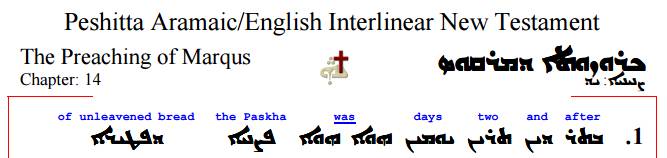
The same Aramaic text as written in Hebrew font and as
rendered by means of my now obsolete Davar 3 software looks as follows. Please
find and download the totally free
Davar 4 software, which will provide you with a vast library of ancient
Bible versions, Dictionaries, and other most valuable Bible related books:
 Mark 14:1
What difference do you perceive upon comparing the
Aramaic text with the above English and Greek texts? All you need to do is to
read the English translation of the Aramaic text! No need for you to know or
recognize the Aramaic of Hebrew original words! Now, notice that, in the
English translation of the Aramaic text there is nothing to support the English
‘and’ of KJV or the Greek ‘και’ of Textus Receptus. On the
contrary, you will notice that the word translated “of unleavened bread” is
simply written in the genitive form while thus tying to itself the word translated
“the Paskha.” That is, “the Paskha of Unleavened Bread” or, to make the Aramaic
text even more clear, “the Paskha Preparation Day of [and before] the
Feast of Unleavened Bread.” Apparently, the Greek translator was not entirely
clear upon the exact differences the Feast of Unleavened Bread and between
‘Passover Day,’ that is, the day for Preparation of the Passover sacrifice,
within which day the Passover lamb was killed during the twilight hour between
Abib 14 and 15. Accordingly, we find that Abib 14 is the Preparation Day of the
Abib 15-21 Feast of Unleavened Bread.
These things considered, we now find perfect agreement
between Mark 14:1, between Matthew 26:2, and between the within represented
chronology. Please compare also Shem Tov’s Hebrew Matthew, which is probably
the best available transcription of the original Hebrew Matthew text. You will
find Shem
Tov’s Hebrew Matthew under this link!:
אחר
שני ימים יהיה
הפסח :Shem Tov’s Hebrew Matthew 26:2
Comments and donations freely accepted at:
Tree of Life©
c/o General Delivery
Nora [near SE-713 01]
Sweden Republic© in
Adamah Republic©
eMail: TreeOfLifeTime@gmail.com
The
GateWays into Tree of Life Chronology Forums©
The
GateWays of Entry into the Tree of Life Time Chronology Touching upon the Book
of Daniel©
Pearls & Mannah – “I found it!”
Feel free to use, and for
sharing freely with others, any of the truth and blessings belonging to God
alone. I retain all the copyrights to the within, such that no one may lawfully
restrain my use and my sharing of it with others. Including also all the errors
that remain. Please let only me know about those. I need to know in order to
correct them. Others don’t need to be focused upon the errors that belong to me
alone. Please respect that, and please do not hesitate to let me know of any
certain error that you find!
Without recourse. All
Rights Reserved. Tree of Life©