Re Tiberius:
Re the death of Tiberius: “Detained,
however, by bad weather and the increasing violence of his illness, he died a
little later in the villa of Lucullus, in the seventy-eighth year of his age and the twenty-third of his reign, on the seventeenth day before the Kalends of April, in the consulship of Gnaeus Acerronius Proculus and
Gaius Pontius Nigrinus.” (Suetonius,
The Lives of the Caesars, The Life of Tiberius, 73.)
- Tiberius was
appointed the heir of Augustus on June 26, 1 BCE [Tammuz 4 or 5, 1 BCE].
- Tiberius died on 4
Adar I/Adar II, 23 CE [March 16, 23 CE.]
Considerations:
23rd = 22+
years of reign
78th = ?
years of age
In my considerations re
NT chronology thus far I have not used the above quote of Suetonius for the
purpose of determining Tiberius years of age or years of reign. Nevertheless, I
see no conflict with this statement of Suetonius and my findings until this
point in time.
Re Caius:
“58 On the ninth day before the Kalends of February at about the seventh hour
he hesitated whether or not to get up for luncheon… the others dispatched him with thirty
wounds; for the general signal was "Strike
again." Some even thrust their swords through his privates…”
(Suetonius,
The Lives of the Caesars, The Life of Caligula, 58)
Considerations:
7th = ? hour
of day
Re Claudius:
He died on the third day before the Ides of
October in the consulship of Asinius Marcellus and Acilius
Aviola, in the sixty-fourth year of
his age and the fourteenth of his reign. (Suetonius,
The Lives of the Caesars, The Life of Claudius, 45.)
10 ![[Legamen ad paginam Latinam]](SuetoniusUseOfOrdinalNumbers_files/image002.gif) Having spent
the greater part of his life under these and like circumstances, he became
emperor in his fiftieth year by a remarkable
freak of fortune.
Having spent
the greater part of his life under these and like circumstances, he became
emperor in his fiftieth year by a remarkable
freak of fortune.
(Suetonius,
The Lives of the Caesars, The Life of Claudius, 7 & 10.)
§
Claudius was born August 1, 24 BCE [Tammuz or
Av 26, 24 BCE.]
§
Claudius’ de jure reign began in his 50th
year of life when Caius died: In
the afternoon on January
24, 27 CE [Tevet (or Shevat) [10th
(or 11th) Moon] 21, 27 CE.]
§
Claudius’
son Britannicus
was born, most likely, on January 20, 26
CE [Tevet or Shevat (10th or 11 Moon) 11 or 12, 26 CE,] (or less
likely in January or February, 27 CE) and he died before the end of extended
festivities attributed to the feast of Saturn in (December, 40 CE or) January
41 CE [Tevet or Shevat, (40/) 41 CE.]
§
Claudius’
daughter Octavia was born between mid May, 28 CE and mid June, 29 CE.
§
Claudius’
wife Messalina, the mother of Britannicus and Octavia, was killed in 32 CE
after she married another man behind Claudius’ back and conspired to have
Claudius killed. Narcissus took the initiative for this and was nominated as
emperor of
§
The marriage of Claudius and Agrippina, the
Agrippina’s killing of Octavia’s former fiancé Lucius Silanus, Octavia’s
espousal to Domitian (Nero,) and the adoption of Domitian as Claudius’ son all
took place in 33 CE – at a time when Domitian was 9 years old and Octavia was
only 3 or 4 years old.
§
Octavia
was married to Nero (between December 15 and 31, 39 CE) at an age of only 10 or
11, Nero being then 16 years old.
§
Josephus is making no statement as to the length of Claudius’
“reign” per se, but is making instead a statement re the length of time that
Claudius was “administering the government.” Considering the apparent fact that
Claudius was a consul, and thus a part of the government, prior to becoming
emperor of Rome, I find that Josephus’ statement “But Claudius himself, when he
had administered the government thirteen years, eight months, and twenty days,
died” is referencing a time period beginning with Tishri 22, 26 CE, and ending,
when Claudius died, on either Zif 21 or Sivan 21, 40 CE [May 22 or else June 20
or 21, 40 CE.]
§
Claudius’ death was concealed for
almost 4 or 5
month until October 13, 40 CE when his death was finally made public.
Considerations:
o
64th = 23 + 40 = 63+
years of age
o
50th = 23 + 26 = 49+ years of age
o
14th = 40 - 27 = 13+ years
of reign
Re Britannicus:
Re Nero:
“In the eleventh year of his age, he was adopted by Claudius, and placed under the tuition of Anneus Seneca” (C.
Suetonius Tranquillus, The Lives of the Caesars [6, 7] (ed. Alexander
Thomson))
“He [Nero] died in the thirty-second year of his age, upon the same day on which he had formerly put Octavia to death” (C.
Suetonius Tranquillus, THE LIVES OF THE TWELVE CAESARS, NERO CLAUDIUS CAESAR:LVII.)
§
Nero was born December 15, 23 CE.
§
Nero
began his de facto reign after a period
of co-regency with Claudius, which, based upon Josephus’ reckoning of Nero’s
years of reign, began between Aviv 1, 39 CE [March 14 or 15 or April 14, 39
CE] and
Tishri 1, 39 CE [September 9 or
October 8 or 9, 39 CE.]
§
Nero’s
1st civil year of de jure
reign began Tishri 1, 39 CE, [September 9, or October 8 (or 9,) 39 CE,] which
year is concurrent with his 16th civil year of life. He was not yet
17 years old, by Roman reckoning when Claudius died.
§
Josephus
counts Nero’s 1st sacred year of reign from the beginning of Aviv 1, 40 CE [April 2 or May 2, 40 CE.] Josephus is
using sacred years of reign when referencing certain time periods within the
war of the Jews in his work The War of
the Jews.
§
Nero’s
reign, as recognized by Josephus,
ended on Aviv 9, 53 CE [March 19, 53 CE,] when he first “heard of the insurrection
in
§
Nero
died some time within a very few
days prior to the time when Galba, sometime between June 1 and June 6, 53 CE
[between Sivan 24 and 30, 53 CE,] received the “advice… from
§
Other events during Nero’s reign:
1. Nero’s poisoning of his
step-brother Britannicus ((14 or) 15 years old) before the end of extended
festivities attributed to the feast of Saturn in (December, 40 CE or) January,
41 CE [Tevet or Shevat, (40/) 41 CE.]
2. Paul, the apostle, arrives to Rome [Monday night July 19, or Tuesday July 20, 45 CE;]
3. Paul’s
release from bondage in
4. Nero’s first
Quinquennial games [October 3 or 5 through 12, 46 CE;]
5. Nero’s comet
[first seen in the lunar month
between December 17, 46 CE and January 15, 47 CE;]
6.
Nero’s
matricide [March 19, 47 CE;]
7.
The great
earthquake in
8. Nero “dearly
loved Poppaea, whom he married twelve days after his divorce from Octavia;”
9. Octavia was divorced and later, “in her
twentieth year,” killed, i.e. 19 years old [in the first half
of 48 CE;]
10. Nero’s daughter’s, Claudia Augusta, birth and death [March(?) and June(?), 48 CE;]
11.
Nero’s
burning of
12.
Seneca’s
first letter to Paul (Chapter XII)
re Nero’s fire of
13. The apostle Paul’s last
letter to Seneca [August 1, 50 CE;]
14. Nero’s second
Quinquennial games [October 3 or 5 through 12, 50 CE;]
15.
Seneca’s
death [October, 50 CE;] and
16. The death of Nero’s
wife Poppaea [October, 50 CE.]
17.
The beginning of the War of the Jews: Artemisius [Jyar,] 51 CE [between May 30 and June 28, 51 CE;]
Considerations:
·
11th = ? year of age
·
32nd = 52 – 23 = 29+ years of age
Re Galba:
Unfavourable omens, and Seleucus’s warnings, delayed
matters another five days. However, on the morning of the sixth, Otho posted his fellow-conspirators in the Forum at the gilt milestone
near the Temple
of Saturn
§
Galba
began his reign as Caesar of Rome when, sometime between June 1 and June 6, 53
CE [between Sivan 24 and 30, 53 CE,] he received the “advice… from
§
Galba
died after sunset on January 15, 54 CE [Day 15 in the 11th Moon,
Shevat 15, 54 CE,] but Josephus counts Galba’s reign as ending on January 8, 54
CE [Shevat 8, 54 CE] when…
Piso:
§
Piso
was adopted as Galba’s son on January 8, 54 CE [Shevat 8, 54 CE.]
§
Piso
was killed before sunset January 15, 54 CE [Day 14 in the 11th Moon,
Shevat 14, 54 CE.]
Considerations:
1.
6th
= 5+ days of delay (verifiable by immediate context.)
Re Otho:
“XI… His
funeral was hastily performed, according to his own order, in the thirty-eighth
year of his age, and ninety-fifth day of his reign.
XII… It is said likewise that he celebrated publicly the sacred rites
of
“He then gave orders that no
violence should be offered to any one; and keeping his chamber-door open until
late at night, he allowed all who pleased the liberty to come and see him. At
last, after quenching his thirst with a draught of cold water, he took up two
poniards, and having examined the points of both, put one of them under his
pillow, and shutting his chamber-door, slept very soundly, until, awaking
about break of day, he stabbed himself under the left pap. Some persons
bursting into the room upon his first groan, he at one time covered, and at
another exposed his wound to the view of the bystanders, and thus life
soon ebbed away. His funeral was hastily
performed, according to his own order, in the thirty-eighth year of his
age, and ninety-fifth day of his reign.” (C.
Suetonius Tranquillus, THE LIVES OF THE TWELVE CAESARS, A. SALVIUS OTHO:XI)
§
“II. The emperor Otho
was born upon the fourth of the calends of May [“IIII. Kal. Mai;” 28th April], in the consulship of Camillus
Aruntius and Domitius Aenobarbus…” [According to my consulship list this may have
been 18 CE.]
§
Otho’s
de facto reign began when Galba died after sunset on January 15, 54 CE [Day 15
in the 11th Moon, Shevat 15, 54 CE.]
§
This
allows for Otho’s accession period to be reckoned, alternatively, all the way
from the beginning of the Civil War Aviv
9, 53 CE [March 19, 53 CE.]
§
Otho
died on Adar III 22, the 22nd Day of the Fourteenth Moon, 54 CE
[April 19, 54 CE.] Otho’s funeral was performed on April 19, 54 CE.
Considerations:
38th = 53 –
18? = 35+? years of age (? Based on consulship list uncertainty)
95th = (31-15)
+ 28 + 31 + 19 = 94– (94+ if counting all of the first day (Jan 15, 54,) i.e.
Roman inclusive reckoning) day of reign
Re Vitellius:
“XV. In the eighth
month of his [Vitellius] reign, the troops both in
Moesia and
“XVIII. He [Vitellius] perished with his brother
and son, in the fifty-seventh year of his age…”
(C.
Suetonius Tranquillus, The Lives of the Caesars (ed. Alexander Thomson;)
Vitellius XV-XVIII.)
“In the eighth month of Vitellius’s reign… When Vespasian’s forces converged on
“In the eighth month of
Vitellius’s reign the Moesian and Pannonian legions repudiated him and swore
allegiance to Vespasian…” (Gaius
Suetonius Tranquillus, The Twelve Caesars, translated by Robert Graves, London,
The Folio Society, MCMLXIV, p. 276.)
§
“The
emperor Aulus Vitellius, son of Lucius, was born on the eighth day before the
Kalends of October, or according to some, on the seventh day before the Ides of
September, in the consulship of Drusus Caesar and Norbanus Flaccus.” (Suetonius, The Lives of the Caesars, The
Life of Vitellius: 3, p. 255.)
§
Vitellius
reign is recognized by Josephus as having begun with the beginning of the Civil
War on Aviv 9, 53 CE [March 19, 53 CE] on the anniversary of Nero’s matricide.
§
Vitellius
died on Kislev 6 [December (24 or) 25,] 54 CE.
§
Upon
Vitellius’ death Domitian, the son of Vespasian, was first [briefly] celebrated
as the new Emperor of Rome.
Astronomical correlations to Vitellius’ reign:
Dio is giving reference to a comet during the reign of
Vitellius as well as of a lunar eclipse in the middle of the summer. The following
event satisfies all criteria provided in
his record:
1.
The comet observation is confirmed by recordings of the
ancient Chinese astronomers who states: “This
comet had a tail measuring about 5 degrees and was seen between June 9 and July
9 of that year.” In 54
CE June 9 and July 9 are the days for the astronomical full moons, not
necessarily the duration of the observation of the comet.
2.
There was a total lunar
eclipse lasting 1 hour 46 minutes on Wednesday August 7, 54 CE at 04:36 UT, the
first visible part of the eclipse beginning at 02:38 UT (i.e. beginning at
04:59
3.
From the language of Dio’s record, which could represent an
indirect quote from a first hand observer, it appears as though the above
referenced comet may have been (?) eclipsed by the moon on the very same day as
the lunar eclipse, possibly (?) even concurrent with the lunar eclipse. –
However, I am not proposing that such a two-fold event can be proven from Dio’s
original Greek words alone!
Considerations:
1.
8th = 8+ month reign (seems confirmed by context,
i.e. by e.g. Dispater sacrifice/founding of Rome/April 21 vs.
December/Kislev/Tacitus/Josephus.)
Re Vespasian:
Re Titus:
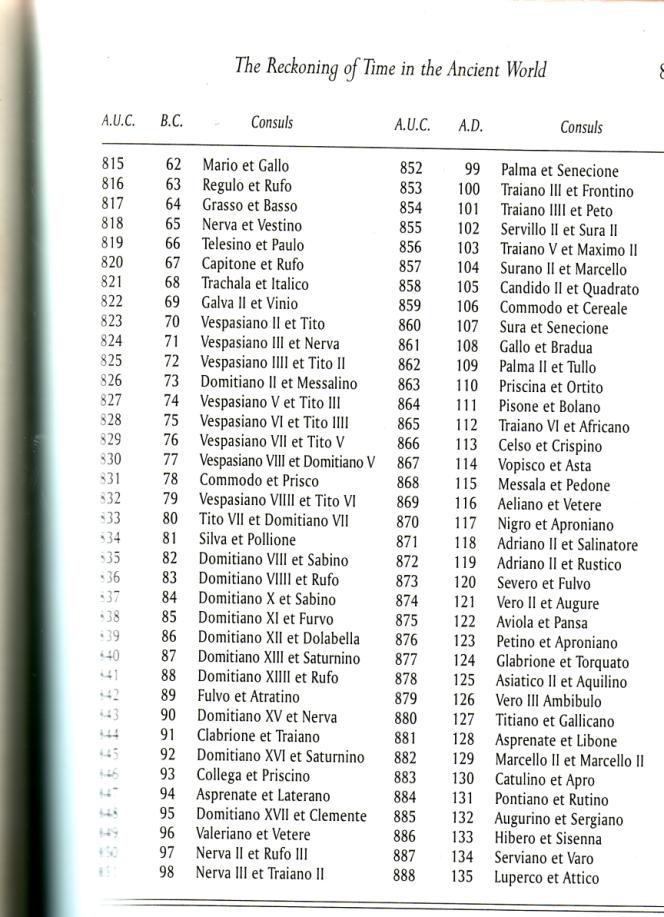
“He
died in the same farmhouse16
as his father, on the Ides of September, two years two months
and twenty days after succeeding Vespasian, in the forty-second year of his
age. When his death was made known, the
whole populace mourned as they would for a loss in their own families, the
senate hastened to the House before it was summoned by proclamation, and with
the doors still shut, and then with them open, rendered such thanks to him and
heaped such praise on him after death as they had never done even when he was
alive and present.”
(Suetonius, The Lives of the Caesars, The Life of Titus, 11, p. 339.)
§
Titus was born December 30, 27 CE [Tebeth (the 10th
Moon) 12 or 13, 27 CE.]
§
Titus began his reign on June 24, 68 CE [Tammuz 5, 68
CE] after his father Vespasian died.
§
Titus died on “the Ides of
September,” September
13, 70 CE [Elul or (or Tishri) (i.e. the 6th (or 7th)
Moon) 18 or 19, 70 CE] “in the forty-second year of his age” as
reckoned by Suetonius.
Considerations:
o
42nd: 69 – 27 = by conception: April 19, 70 - April
19, 27 = 43+, OR by delivery: December 30, 69 – December 30, 27 = 42+, OR by delivery less 3 months: September 30, 69
– September 30, 27 = 42+
Re Domitian:
“16. .. Then he asked the time,
and by pre-arrangement the sixth hour was announced to him, instead of the
fifth, which he feared. Filled with joy at this, and believing
all danger now past, he was hastening to the bath, when his chamberlain
Parthenius changed his purpose by announcing that someone had called about a
matter of great moment p377and would not be
put off. Then he dismissed all his attendants and went to his
bedroom, where he was slain.”
“17:3 He was slain
on the fourteenth day before the Kalends of October in the forty-fifth year of
his age and the fifteenth of his reign…”
(C. Suetonius Tranquillus, The Lives of the Twelve Caesars, The Life of Domitian)
o
“Domitian was born on the ninth day before the Kalends of November…” [October 24, 39 CE (The Seventh or
Eighth Moon (Tishri or Hesvan) 16 or 17, 39 CE.)]
o
Domitian’s
reign began “on the Ides of September…”
[September 13] of “the fifteenth [year as reckoned by Suetonius] of his reign”
[70 CE (the 6th (or 7th) Moon (Elul or (or Tishri)) 18 or
19, 70 CE.)]
o
Domitian died on “the fifth hour…” [between 11 AM and 12 AM
(considering Suetonius’ use of ordinals)] on “the fourteenth day before the
Kalends of October…” [September
18, 85 CE (Elul or Tishri 9 (or 10,) 85 CE)] “in the forty-fifth year of his age and the
fifteenth of his reign.”
o
Suetonius, Dio, and Tacitus are all using a Julian calendar and a Roman
way of reckoning. Suetonius’ ordinal numbers are usually referencing the year
following the corresponding birthday etc. rather than the year preceding it.
Considerations:
o
6th = ? hour of day
o
5th = ? hour of day
o
45th = 84 – 39? = 45 Years of age, OR
by conception: Jan 85 - Jan 40? = 45, OR by delivery less 3 months: July
24, 85 – July 24, 40? = 45
o
15th = 15+ years of reign
Old considerations transferred
from TheRegnalYears…EmperorsII:
:
3. Re Titus:
(Suetonius,
The Lives of the Caesars, The Life of Titus, 11, p. 339.)
In my prior research re Titus I came to the
following conclusion:
4. Re Domitian:
Occisus est XIIII. Kal. Octb. anno aetatis
quadragensimo quinto, imperii quinto decimo.
(C. Suetonii
Tranquilli, De Vita XII Caesarum, Domitianus.)
(C. Suetonius
Tranquillus, The Lives of the Twelve Caesars, The Life of Domitian)
(C. Suetonius Tranquillus,
The Lives of the Twelve Caesars, The Life of Domitian)
“4 In the reign of Claudius he was sent in command of a legion to
Germany, through the influence of Narcissus; from there he was transferred to
Britain,9
where he fought thirty battles with the enemy. He reduced to subjection two
powerful nations, more than twenty towns, and the island of Vectis,10
near Britain, partly under the leadership of Aulus Plautius, the consular governor, and partly under that of Claudius
himself. 2 For this he received the triumphal regalia, and
shortly after two priesthoods, besides the
consulship, which he held for the last two months of the year. The rest of the time up to his proconsulate he spent in rest and
retirement, through fear of Agrippina, who still had a strong influence over
her son and hated any friend of Narcissus, even after the latter's death.
“8 Returning to Rome under such auspices and attended by so great renown,
after celebrating a triumph over the Jews, he
added eight consulships to his former one; he also assumed the censorship and during the whole period of his rule
he considered nothing more essential than first to strengthen the State, which
was tottering and almost overthrown, and then to embellish it as well.
(C. Suetonius Tranquillus, The Lives of the Twelve
Caesars, The Life of Vespasian)
These passages
makes it clear that: