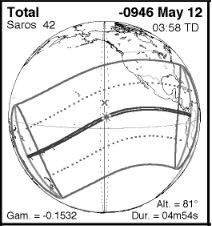
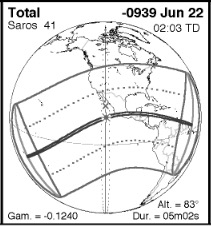
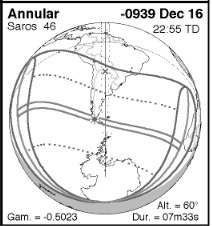
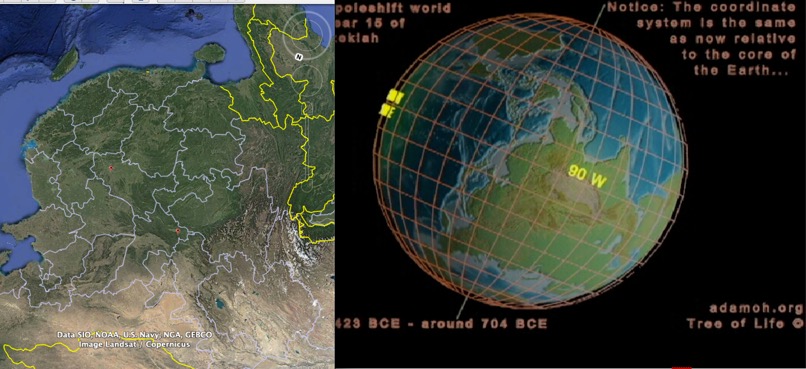
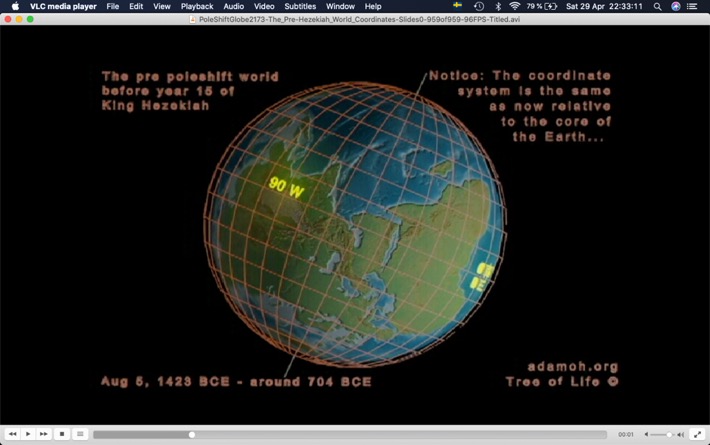
Without recourse. All Rights Reserved. Tree of Life©
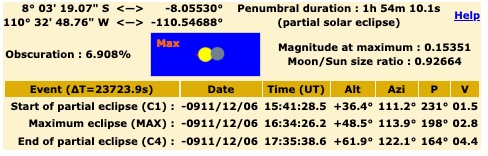
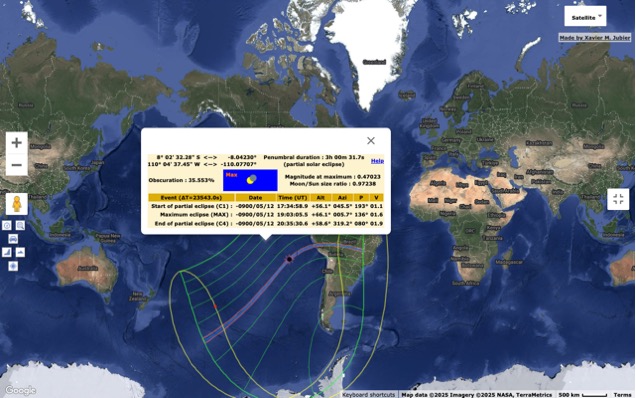
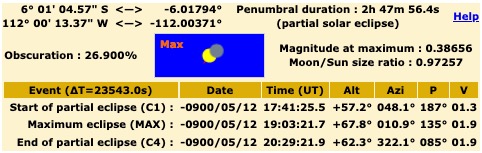
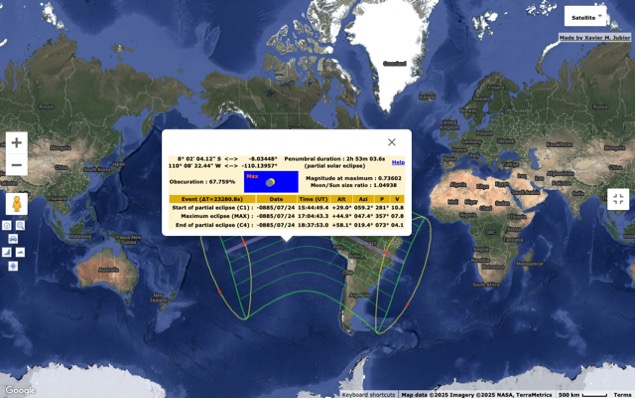
Statement of belief: “Sanctify
them through thy truth: thy word is truth.”
(John 17:17 KJV)
Updated 5925[(*??*)] 08
27 2029 [2012-12-12]
Updated 5926[(*??*)] 04
07 2030 [2014-07-07]
Edit 5927[(*??*)] 13
16 2031 [2015-04-04] – Adding
a link to view the lunar eclipse of King Saul at En-Dor before the last
pole-shift.
Edit 5938[v2016-12-14-21:32]
04 08 2035 [2019-06-13] – Cf. rows #0 -
#2 of the table below!
Addition 5942[v2016-12-14-21:32] 09 23 2039
[2022-12-18 evening] – Modified the page title, and added six quotes to the 1833
Shooting Star Event.
Addition 5942[v2016-12-14-21:32] 09 24 2039
[2022-12-19 evening] – Added an image to the 1833 Shooting Star Event.
Minor edit 5942[v2016-12-14-21:32] 09 28 2039
[2022-12-29] – Starry Night
Download link, and a link to Professor
Silliman’s Journal.
Addition 5942[v2016-12-14-21:32] 01 12 2039
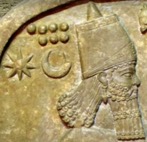
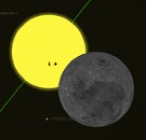
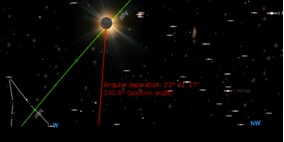
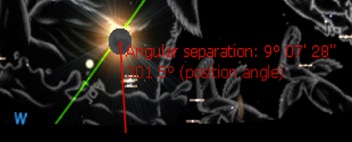
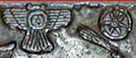
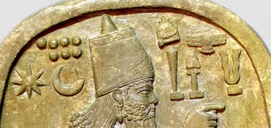
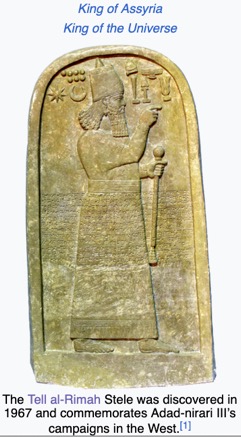
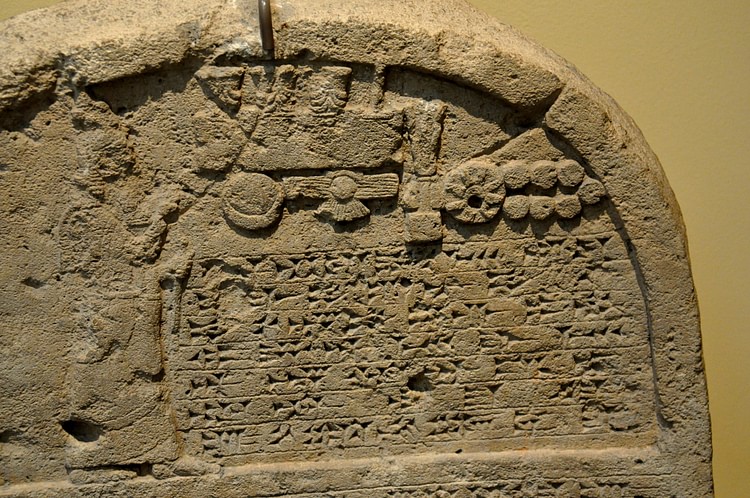
[2023-05-03] – Adding the unidentified solar eclipse suggested by the engraving
on Assurnasirpal II’s stele.
Extensive update 5968[v2023-12-04] 08 08 2040 [Mon 2024-11-11]
– Revising and adding multiple items between 545 BCE - 880 BCE. Cf. last prior
versions: Uploaded,
not
previously uploaded.
Continued extensive update 5968[v2023-12-04] 10
18 2040… [Sun 2025-01-19…] – Revising and adding multiple items between
2128 BCE - 545 BCE. Split this file into 3 parts. Cf. last prior version
Cross Correlating the
Recorded
History
of
Ancient History, including the OT&NT Era vs.
Exactly
Dated Astronomical Events
-
Part
1 of 3
A listing of 109+ celestial and 5 other events (the earliest one dated
potentially to 2128 BCE: one dated to Apr 21, 1494 BCE; one dated May 7, 1431
BCE; one dated most likely to March 23, 1028 BCE that is being matched to the
death of Saul, King of Israel; one dated in 588 BCE, one of two key anchor
points for the Olympic Calendar; eleven in the Greek era; and the remainder
mostly from 222 BCE thru 212 CE.) All matched to historical records tied to the
reigns of various Roman Emperors and other dated historical events.
Abstract:
Below is a table listing two (2)
pole shifts, twelve (12) comets, seventeen (17) solar eclipses, twenty (20)
lunar eclipses, one (1) comet eclipse, five (5) meteor showers, one (1)
unexplained 16 hour long darkness over the New England area, two (2) earth
quakes, one (1) or possibly two volcanic eruptions, and one (1) dated lunar
zodiac constellation, each of which has been matched to key historical events
from 1431 BCE, through 1886 CE. And, in addition to that there are the many and
numerous celestial events recorded on the Babylonian clay tablet VAT4956… Based
upon these matches, plus a large number of matches based upon the New Moons of
the biblical calendar as referenced in the New Testament and by Josephus, I
cannot avoid concluding that…
It is time for a paradigm shift re the dating
of historical events, not only surrounding the beginning of the Christian era,
but re most of ancient history prior to 300± CE!
In order to arrive at a more correct and reliable chronology of history
many dates presently considered well known and well established by conventional
historians - though without matches to celestial events described in historical
records - must be shifted back in time between five and fifteen years relative
to the dates usually provided within conventional historical works. This
applies to all the events in the New Testament as well as to the regnal periods
of the Roman Emperors.
Josephus, Suetonius
and Tacitus constitute three apparently independent witnesses agreeing with one
another perfectly in most instances, while also being more or less concurrent
in time with the events here described.
Josephus is describing a number of exactly dated events which presently
seem to have been nailed down fairly solidly upon the cross of exact
astronomical tables of solar and lunar eclipses and phases of the moon.
Josephus is referencing one important lunar eclipse (9 BCE) and one comet (54
CE) within the period of time here considered.
One historical
fingerprint with many particulars is the period of time surrounding Herod the
Great’s reign.
I gratefully acknowledge the tremendous work done by Ronald L. Conte Jr.
in identifying perhaps half of the within correlations between historical and
celestial events, or most of the 18 or so correlations that I was aware of when
I began this article. One part of the within work consists merely in
consolidating the astronomical events already identified by Ronald L. Conte
Jr., and in further establishing and revising the exact dates based [primarily]
upon Josephus’ works and upon the available quotes from Suetonius and Tacitus. Another most important part of the within
work is based [primarily] upon the most reliable Greek manuscripts of the New
Testament, the Textus Receptus, and the references to time as there specified.
Further verification has been found in Shem Tov’s Hebrew Matthew, which is a
late transcript of an original Hebrew text of the Gospel of Matthew from which
the Greek manuscripts of Matthew are obviously translated (cf. this link!)
For additional
detail of the below table please click here!.
For a listing of
dated New Testament events and the supporting calculations and
references click here.
For a listing of
the starting and ending dates of the twelve Roman Emperors from Julius
Caesar through Domitian, and the supporting calculations and
references, click here.
For an outline of
the events of the War and the Destruction of Jerusalem by Titus,
and the supporting calculations and references, click here.
In contrast to data presented
in the table below, please notice the glaring absence of any significant
correlations between exactly dated celestial events and conventional Roman and
New Testament chronologies.
NOTICE: To see the movies you
may need to download the free Quicktime
6.0 or later software. Or else go get your copy of the Starry Night software and make your own studies of
the starry skies as I did mine.
|
# |
What: |
When: |
References and Quotes: |
||||||||||||||||||||||||||||||||||||||||||||||||||||||||||||||||||||||||||||||||||||||||||||||||||||||||||||||||||||||||||||||||||||||||||||||||||||||||||||||||||||||||||||||||||||||||||||||||||||||||||||||||||||||||||||||||
|
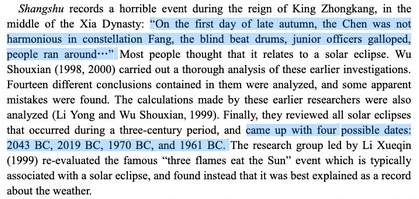
1 |
Considerations re the exact
identification of the first and earliest solar eclipse recorded in the
Chinese literature. |
At the time of the astronomical New
Moon within October or early November, and probably between 2200 – 1800 BCE,
judging from the assessment of other authors. Studying the eclipses within
this time frame, I find two or possibly three possible matches with the
ancient Chinese annals: 1)
The
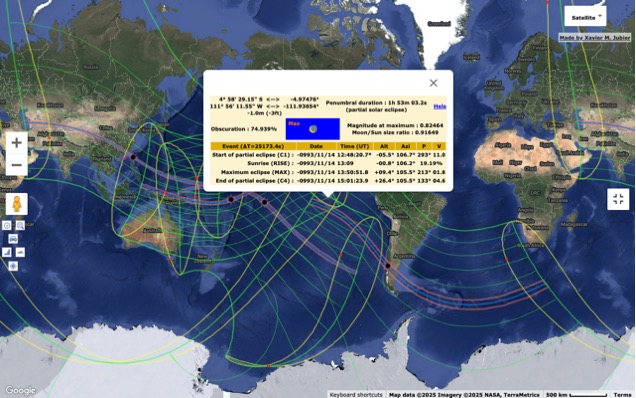
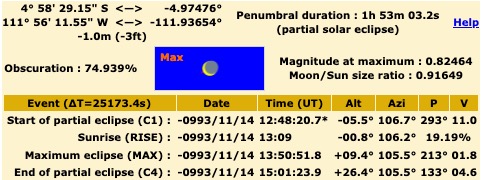
Oct 12, 2128 BCE solar eclipse was not seen from
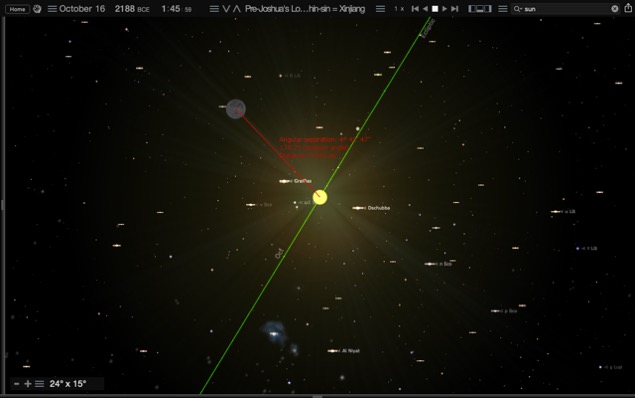
pre-Joshua’s Long Day China, unless SN8 calculations
are off. Alternatively, if the location of the observer was somewhere along the southern coast of current Alaska,
this eclipse would be a perfect match to the Chinese record. Possible, but not likely eclipse. 2)
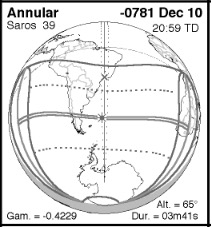
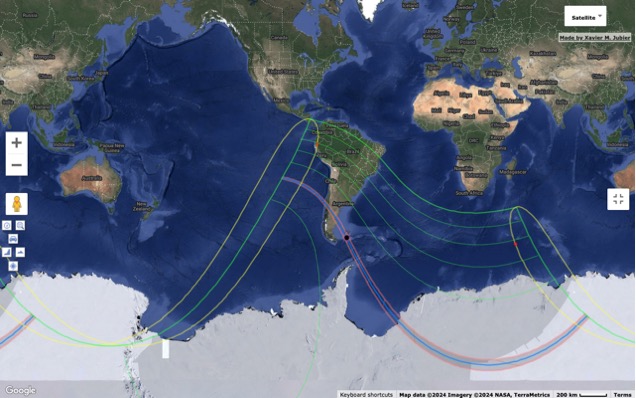
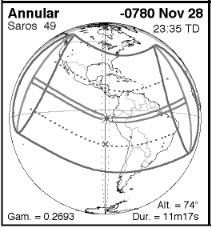
The
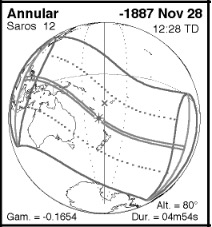
Nov 28, 1888 BCE solar eclipse would have been visible as an annular eclipse
along a narrow path within the (current) boundaries of China, across north
east China as currently located, as viewed from locations along that path in
pre-pole shift #1 China. However, the Sun of this eclipse was in Sagittarius rather than in Scorpii and the
constellation Fang. Astronomical New Moon #1 would
then have been the (pre-pole shift #1 fall) Apr 5, 1888 BCE New Moon if the eclipsing (spring) Nov 28, 1888 BCE New Moon was
reckoned as #9. If the eclipsing moon, Fang, was reckoned as Moon #4 then the
corresponding Moon #1 would have been Aug 30, 1888 BCE. This apparent
discrepancy re the constellation Fang/Scorpii vs the Sagittarius eclipsed Sun
could be understood as an overdue
intercalation month. That is, causing this eclipse
Nov 28, 1888 BCE Moon to be (mis-)labeled Fang rather than being labeled as
one of the constellations associated with the prior month #3. The spring vs fall issue remains unresolved at this time. 3)
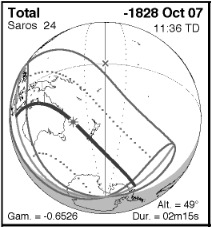
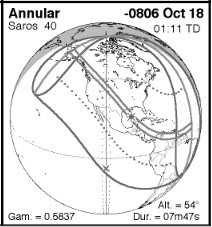
The
Oct 7, 1829 BCE total solar eclipse as visible from pre-pole shift #1 China.
Defines a large portion of the boundary between China and Mongolia (as
presently defined). Good fit provided the
calendar year was at that time reckoned as beginning in the seventh month, as
do the Jewish, Hebrew and Biblical calendar years even to this day. The
eclipse maximum was fairly distant from
Erlitou. Of
the above 1) – 3) alternatives, I find that 1), a pre-Joshua’s Long Day,
pre-pole shift #2, option, is
unlikely, while 2) and 3), both of which are pre-pole shift #1 options,
remain the more likely options, more so # 3). |
Quote from The Present Status of Chinese
Study of Solar Eclipses, by Ma Liping, p. 5 of 9.
Quote from Examination of Early Chinese
Records of Solar Eclipses, by Liu, Liu, and Ma, (June 2003), p. 55:
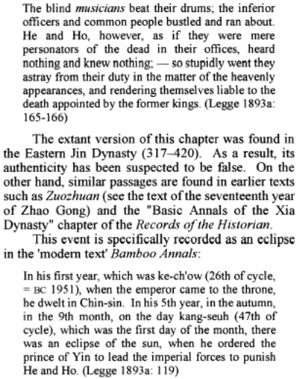
”In his first year, which
was ke-ch’ow (26th of cycle, = BC 1951) when the emperor came to the throne,
he dwelt in Chin-sin. In his 5th year, in the autumn, in the 9th
month, on the day kang-seuh (47th of cycle), which was the first
day of the month, there was an eclipse of the sun, when he ordered the prince
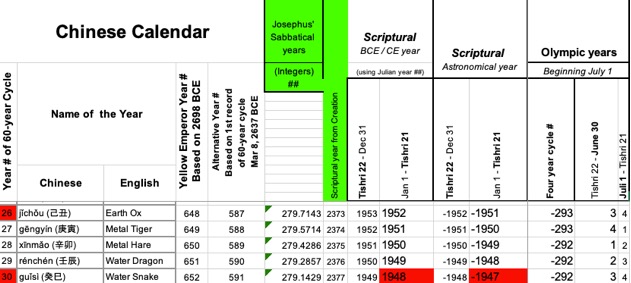
of Yin to lead the imperial forces to punish He and Ho (Legge 1893a 119)” Notice the year recorded
as “In his first year, which was ke-ch’ow (26th of cycle… In his 5th
year… there was an eclipse of the sun…”, indicates that this eclipse occurred
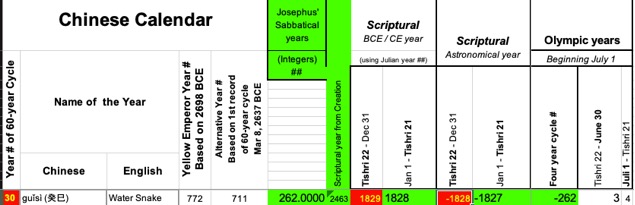
in the 30th year of the 60-year Chinese calendar cycle. If “Chin-sin” = Xinjiang (as
suggested by Google), then the corresponding current coordinates for Chin-sin
are 42±7 N 85±12 E. This would roughly correspond to pre-Joshua’s Long Day
45±7 N 150±12 E. If “Chin-sin” = Zhenxun = Earlitou (?),
which was then at 30N 180E (vs current 35N 113E).
The 30th year within each of eight
consecutive 60-year Chinese calendar cycles:
From NASA’s website
(which does not extend beyond 2000 BCE to “2043 BC, 2019 BC”):
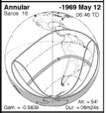
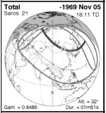
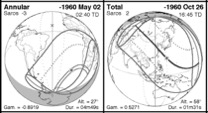
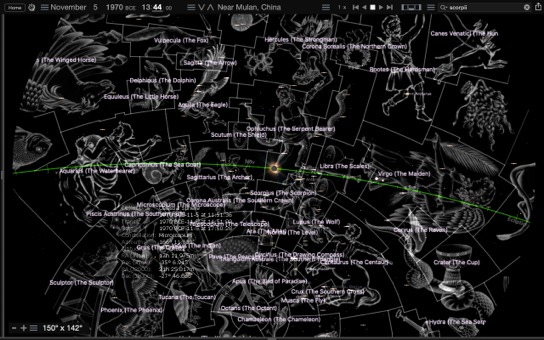
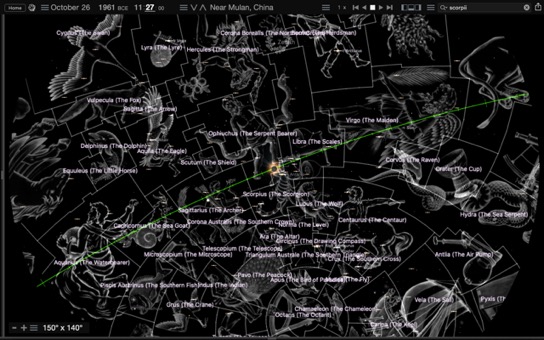
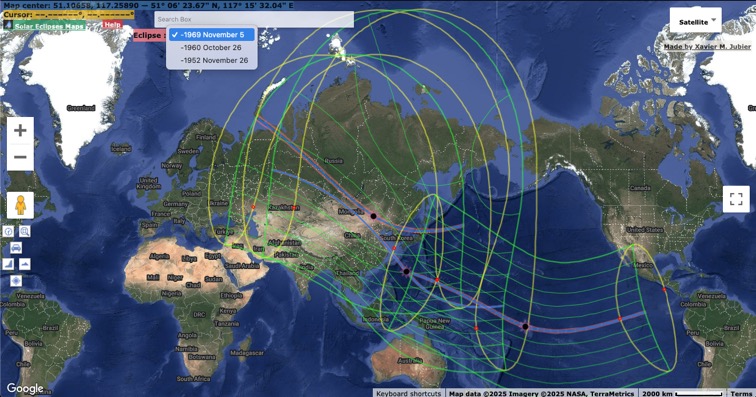
Among the above four
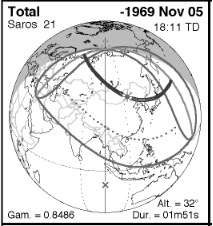
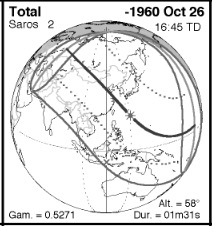
NASA-listed solar eclipses it is obvious that said “1970 BC, 1961 BC” (Wu
Shouxian) eclipses point to the -1969 Nov 5 and -1960 Oct 26 eclipses
respectively, both of which traversed China, as currently located, and both
of which occurred “on the first day of late autumn” as reckoned if China had
then been located on the Northern Hemisphere as it currently is.
And both of which (-1969
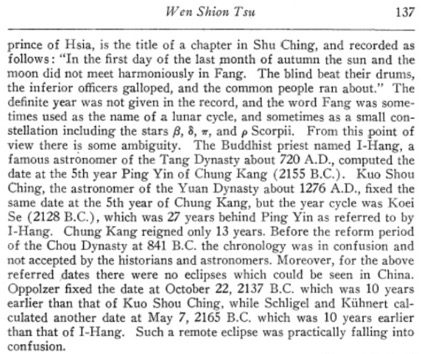
Nov 5 and -1960 Oct 26) occurred when the Sun was in “Scorpii”, as suggested
on page 137 in Wen Shion Tsu (cf. below):
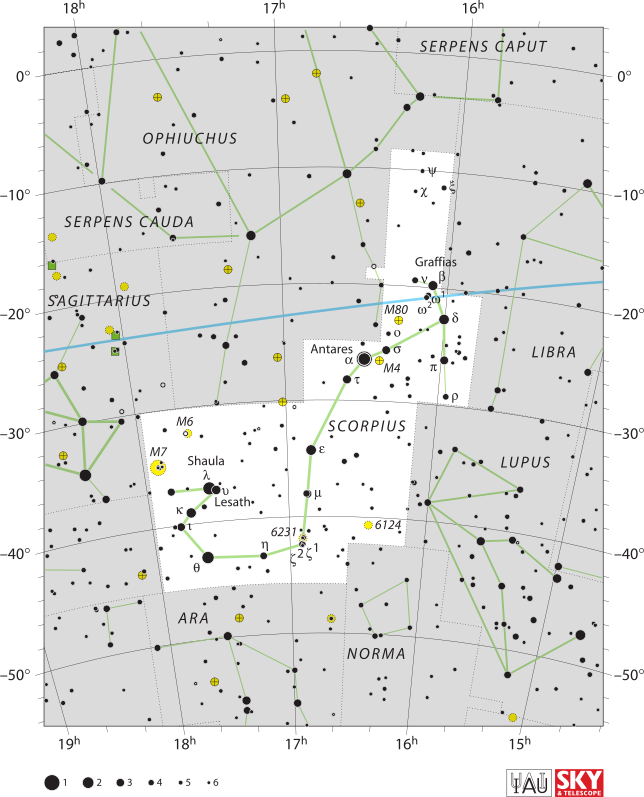
”β, δ, π, and
ρ Scorpii” are the four stars
aligned with one another at the top right of Scorpii. A “small constellation”
indeed. This should be helpful for determining the correct solar eclipse… Unfortunately, the NASA
website is not providing any maps prior to 2000 BCE, i.e. for the above referenced
eclipses in “2155 B.C… 2128 B.C… Oct 22, 2137 B.C… [and] May 7, 2165 B.C.”
However, the needed corresponding data is available using astronomy software
such as SN8, Starry Night Pro 8. Notice that among the
above quoted years 2155, 2128, 2137, 2165, 2073, 2019, 1970, and 1961 BCE,
the one and only year that coincides with the 30th (within the 60
year cycle) is 2128 BCE.
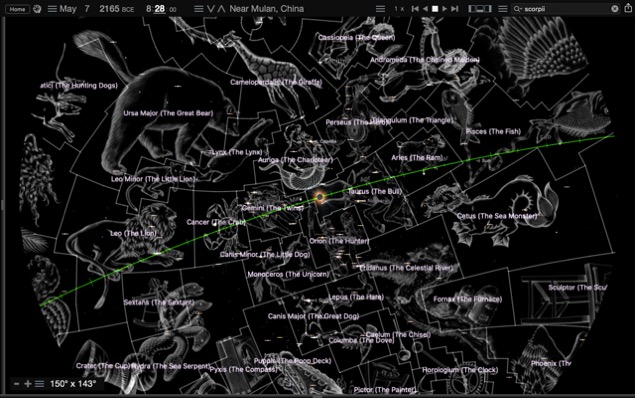
Notice, however, that in May
the Sun is not anywhere near Scorpii, which constellation was at that time,
May 7, 2165 BCE as far from the Sun as can be.
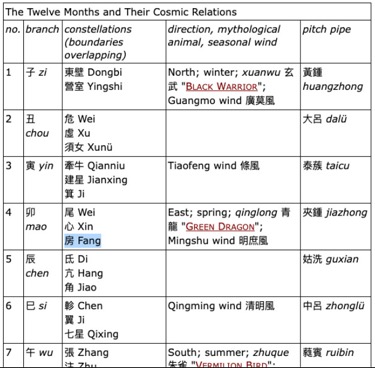
Notice that, according to
the above table, the month named “Fang”, is the 4th month in the
Chinese calendar, and is the month when the Sun is in the Fang constellation,
which occurs in Oct-Nov annually, implying that month #1 would fall in
Jul-Aug, i.e. about the time of the summer solstice as observed from the
Northern Hemisphere. But if the year
is reckoned as beginning at the time of the winter solstice or in January or
February, then Fang could easily be reckoned as the ninth month, as recorded
in the quotes from Bamboo Annals (Legge 1893a: 119), cf. above.
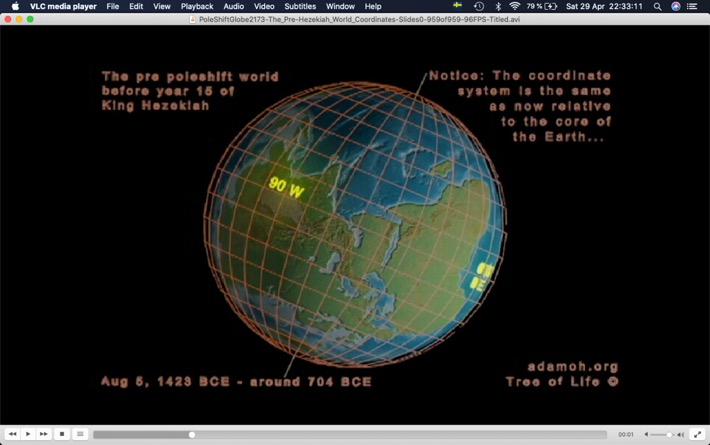
Showing China’s
pre-Joshua’s Long Day location at 25±15 N
180±15 E (yellow grid; vs current 30±15 N 110±15E (red grid)) Zhenxun = Earlitou (?) was at 30N 180E
(vs current 35N 113E).
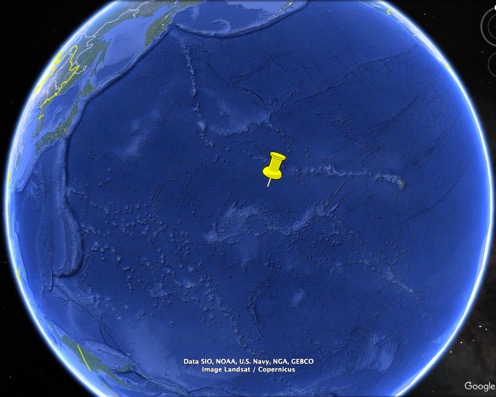
Google Earth map (current).
The pin is marking China’s pre-Joshua’s Long Day location.
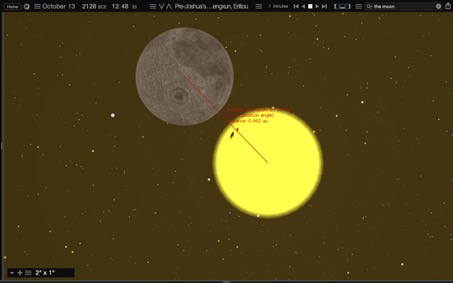
Moon’s closest
conjunction, 0° 41’
21”, on Oct 13, 2128 BCE 12:48 SN8 time, as viewed from the pre-Joshua’s Long
Day location 30°N 180°E of Chin-sin, Zhenxun, Erlitou
in China. The following NASA-listed solar eclipses
between 2000-1947 BCE would have been visible in China as located, at 25°±15° N 180°±15° E, prior to the Joshua’s
Long Day pole shift, pole shift #2:
Adding to the above, the subsequent
eclipse candidates within the 30th year of a few 60-year cycles: 1888 BCE:
1828 BCE ±1 year:
1768 BCE ±1 year:
1708 BCE ±1 year:
Of the above 22+2+3+4+1=32
solar eclipses the following six or seven[1] occurred
in Fang (Oct-Nov), the month when the Sun is in the constellation Scorpii,
i.e. in the constellation Fang.
Map showing the extent of
each of the first four of the last seven solar eclipses above.
Map showing the extent of
each of the last three of the last seven solar eclipses above. Clearly, if we had access
to the corresponding solar eclipses all the way to 2200 BCE, we would find
perhaps 4 x 7 = 28 additional solar eclipses fitting the recorded description
of that first and earliest solar eclipse recorded in Chinese records.
Accordingly, we definitely need more data re the details of said first solar
eclipse, before we can know exactly when that solar eclipse occurred, and
which of perhaps 7 + 28 = 35 possible solar eclipses is the correct one. Notice however, that if
the lunar month Fang was reckoned as the 4th calendar month in
China, then Moon #1 in the year of this first recorded Chinese solar eclipse
would fall in July or early August. As such it would be closely associated
with the summer solstice. Considering the traditions associated with the
Mid-summer celebrations in Sweden, this would make a lot of sense,
particularly when considering the mid-summer pole in terms of a tool for
identifying the shortest shadow and the longest day of the year, and while
considering also the folk dancing around said mid-summer pole, and the
numerous wreaths typically hung on that pole as well as crowning the heads of
the celebrating and dancing girls. All of that ever so reminiscent of the
ever revolving events on the sky! Furthermore, using the mid-summer solstice,
rather than the winter-solstice, as the beginning of the year, would make a
lot of sense because people are naturally much more apt to be outside
enjoying and celebrating in the summer than in the winter. Also, it should be
easier to correctly determine the shortest shadow sharply outlined close to
the mid-summer pole, than for determining the longest shadow furthest away
from any pole, and therefore much less well defined shadow, which shadow may
well be further obscured by a layer of snow on the ground at mid-winter
times! Traditional calendar reckoning across the next following pole shift
would then transfer the New Year from mid-summer to mid-winter, while soon forgetting
the true origins of mid-summer celebrations as well as the original reasons
for defining the beginning of the calendar year a certain way. Conclusion: My findings thus far seem
to exclude all eclipses this side of 2000 BCE. Based on the above quoted
words the year recorded as “In his first year, which was ke-ch’ow (26th
of cycle… In his 5th year… there was an eclipse of the sun…”,” if
this eclipse was a pre-Joshua’s Long Day, pre-pole shift #2 event, then I
suggest that this eclipse occurred in Oct/Nov of one of the years 2008 BCE,
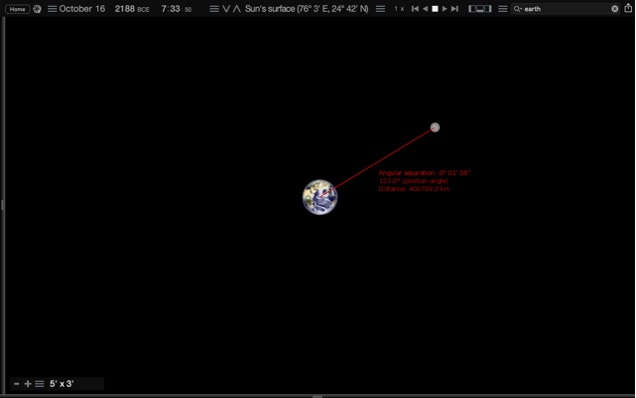
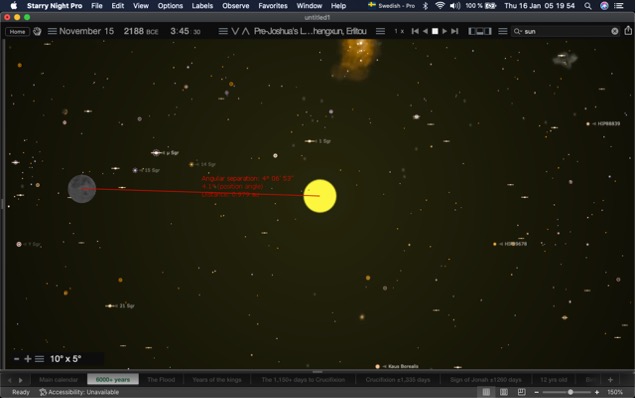
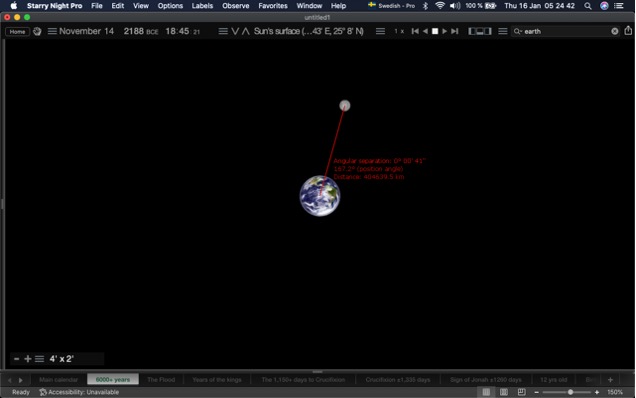
2068 BCE, 2128 BCE, or 2188 BCE. Studying those I find:
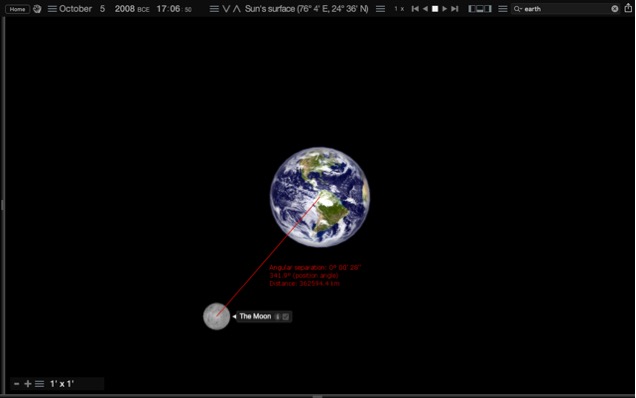
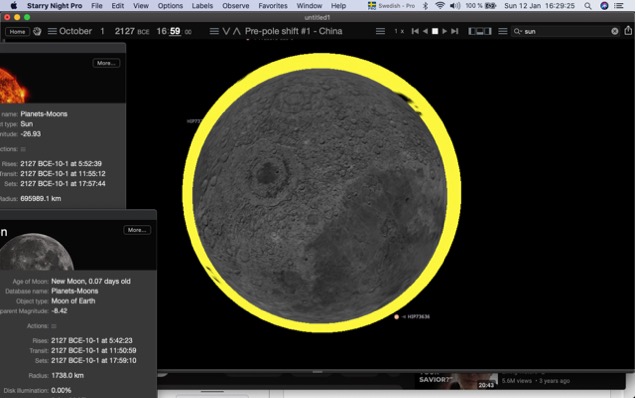
As shown above there was
no solar eclipse in October 2008 BCE…
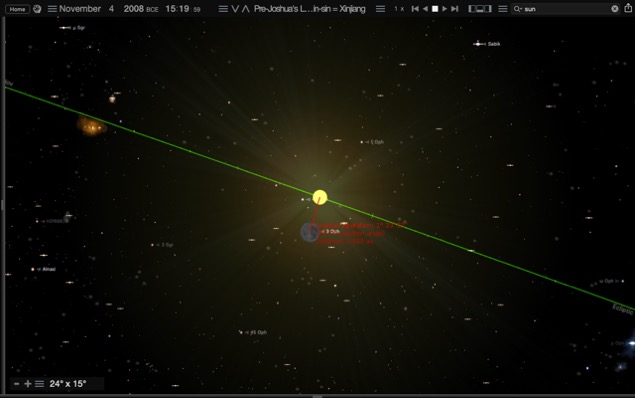
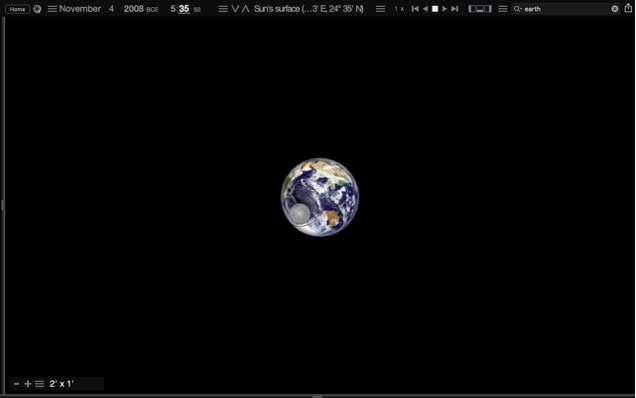
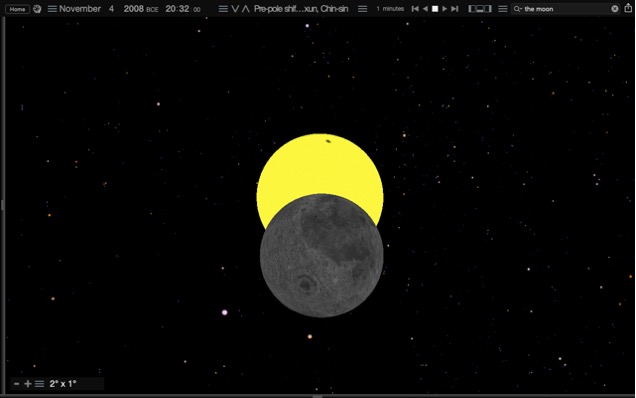
On Nov 4, 2008 BCE there
was a solar eclipse, but the eclipse path did not cross either the current or
the pre-Joshua’s Long Day, pole shift #2 location of China. Furthermore, as
further considered below, by the time the eclipse reached the pre-pole shift
#1 location of China, it was well past sunset, so this Nov 4, 2008 BCE
eclipse was not visible from China.
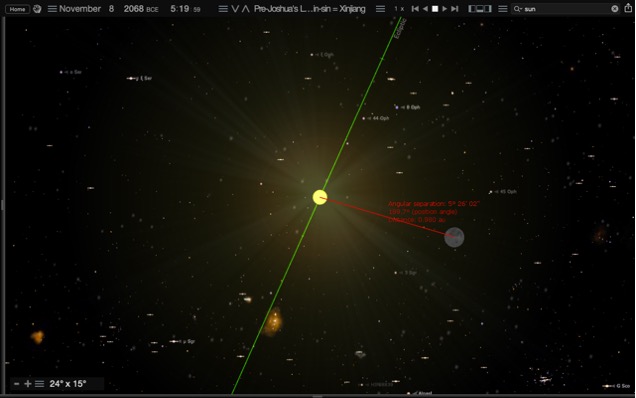
As shown in the above two
SN8 renditions of the closest conjunction between the Sun and the Moon, there
was no Oct or Nov 2068 BCE solar eclipse.
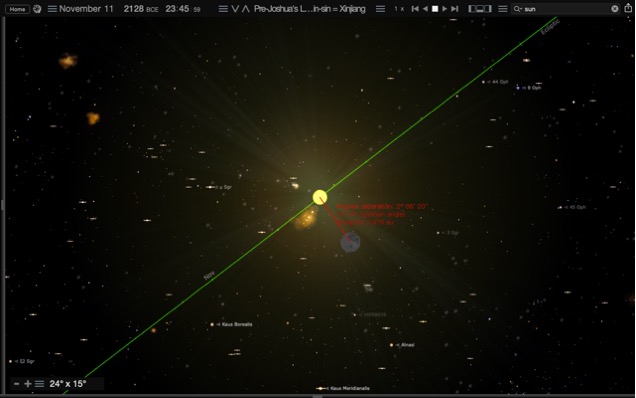
As shown in the above two
SN8 renditions of the closest conjunction between the Sun and the Moon, there
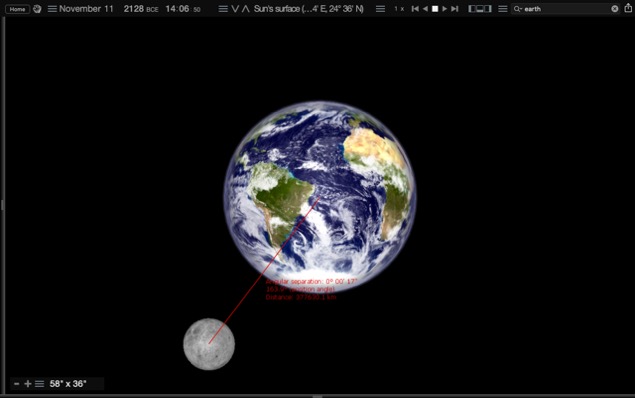
was no Nov 2128 BCE solar eclipse.
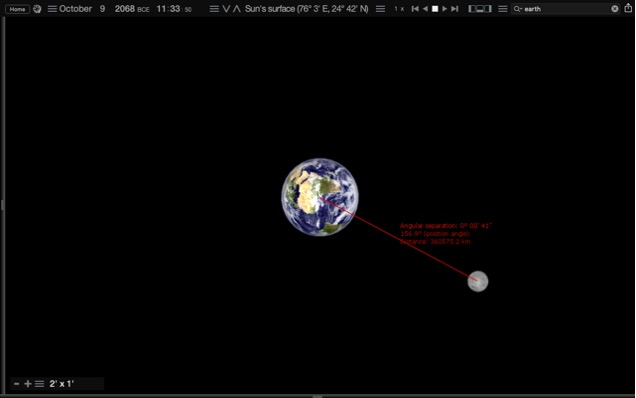
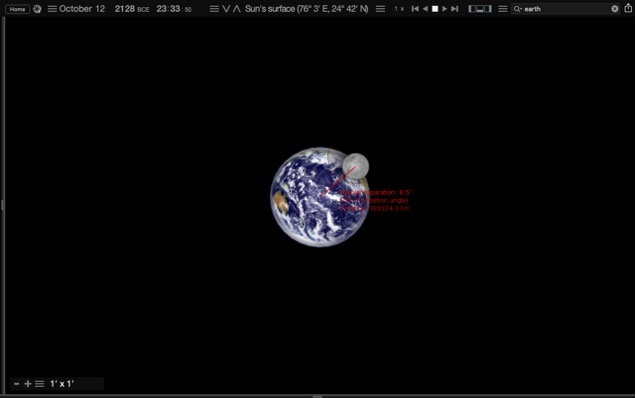
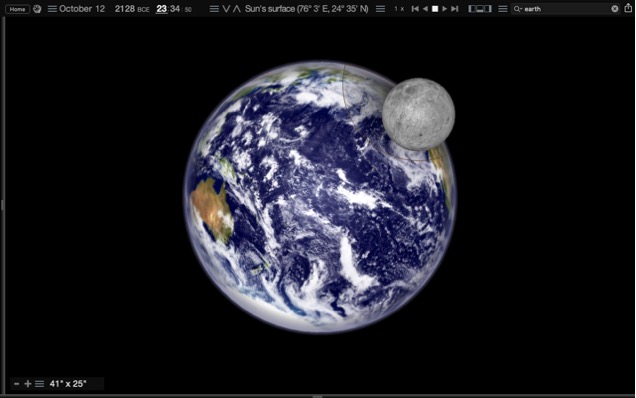
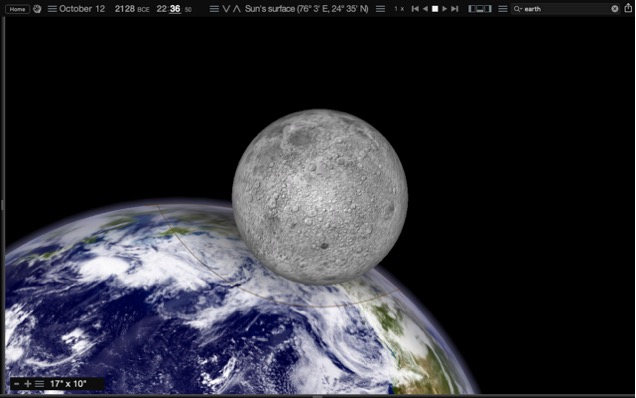
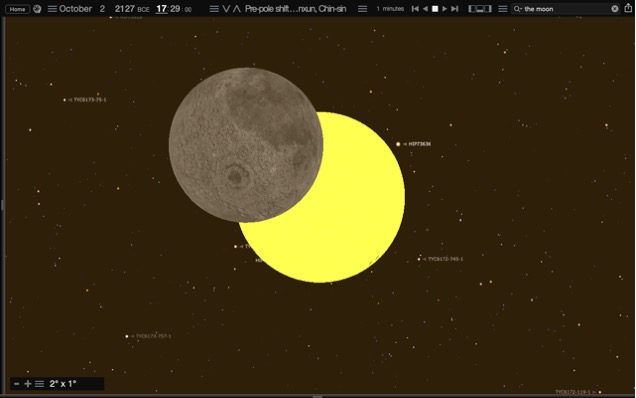
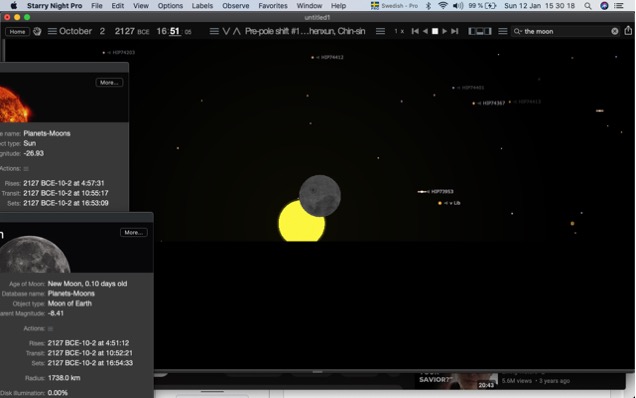
As shown in the above
three SN8 renditions of the closest conjunction between the Sun and the Moon,
there was an Oct 12, 2128 BCE solar eclipse. As rendered in SN8, it did not,
however, quite reach the pre-Joshua’s Long Day, pre-pole shift #2, nor the
pre-pole shift #1, location of China. Accordingly, for this Oct 12, 2128 BCE
eclipse to truly be the eclipse recorded in the Chinese annals, either 1)
Chin-sin, the Chinese Capital, would have to have been then located about as
far to the north east as Bering Strait, that is, somewhere along their path
of migration from Caucasus to China via America. Or else, 2) if the SN8
rendition of this eclipse is not precise enough to correctly render the exact
path of the solar eclipses that early in time. I find both of these options,
1) and 2), possible but perhaps unlikely.
As shown in the above four
SN8 renditions of the closest conjunction between the Sun and the Moon, there
was no Oct or Nov 2188 BCE solar eclipse. Accordingly, the Chin-sin, Xia,
eclipse in Fang did not occur in 2188 BCE, nor in 2068 BCE.
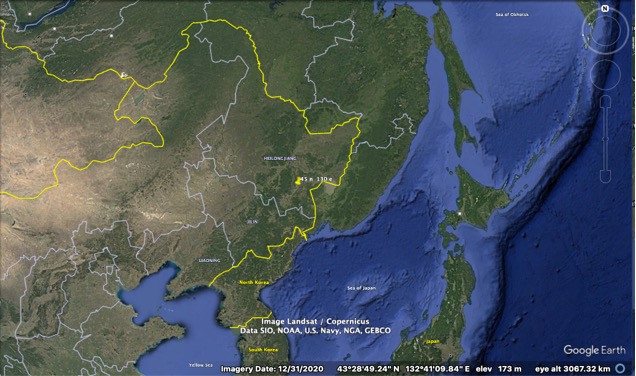
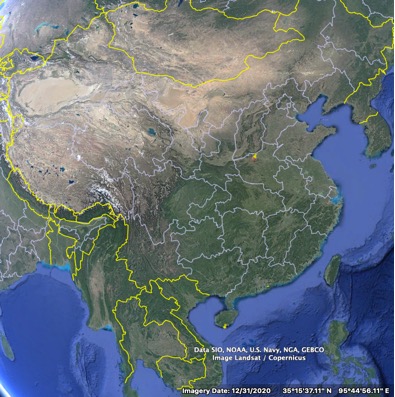
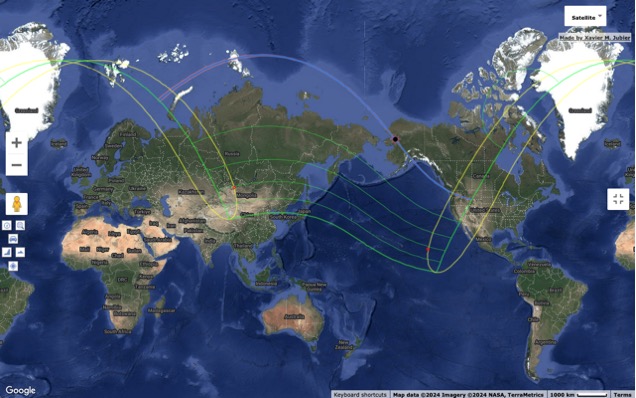
Google Earth Pro map showing the current
boundaries of China as projected upon the current earth coordinate system.
Cf. the Oct 12, 2128 BCE SN8 map above. Earth coordinates prior to the 1st
of 3 post-Diluvial pole shifts:
Seeing that Erlitou’s
current coordinates are 34.7N 112.7E, based on the map above I find the
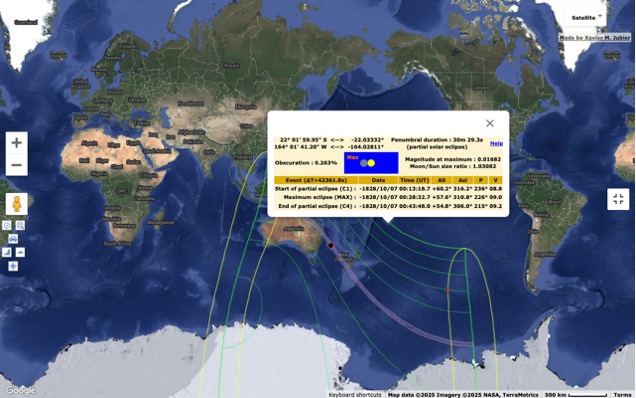
corresponding pre-pole shift #1 coordinates 22S 164W. “In his first year, which
was ke-ch’ow (26th of cycle… In his 5th year… there was
an eclipse of the sun…”. I suggest that this eclipse occurred in Oct/Nov of
one of the years 1828 BCE, 1888BCE, 1948 BCE, 2008 BCE, 2068 BCE, 2128 BCE,
or 2188 BCE. Among those seven years (26th/1st, 30th/5th
±1 year) I find the following being visible from the 22S 164W location
of pre-pole shift #1 “Chin-sin” = Zhenxun = Earlitou (?). Beginning
with the ones available from the NASA solar eclipse pages:
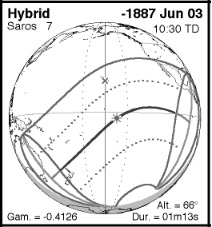
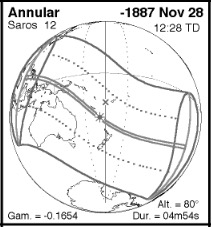
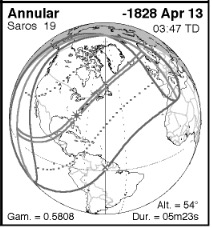
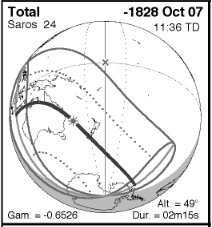
I find that only these five
on this side of 2000 BCE are available from the NASA website of solar
eclipses. Out of these five only two occurred in the Oct-Nov Fang window,
i.e. “-1887 Nov 28” and “-1828 Oct 07”. Looking a little closer at
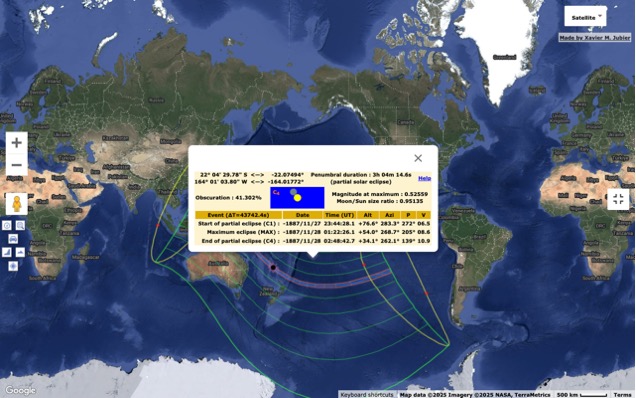
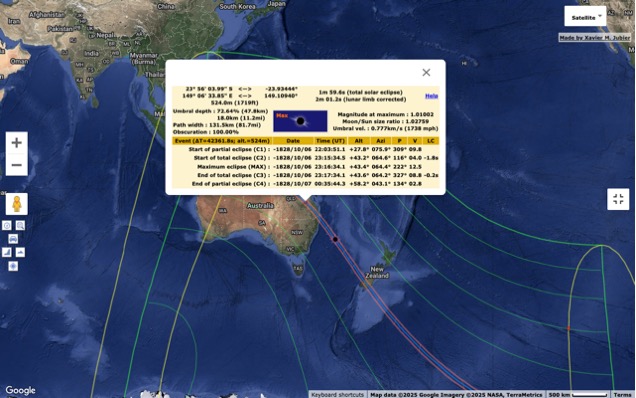
these two++ eclipses I find: Re the 1888 BCE eclipse:
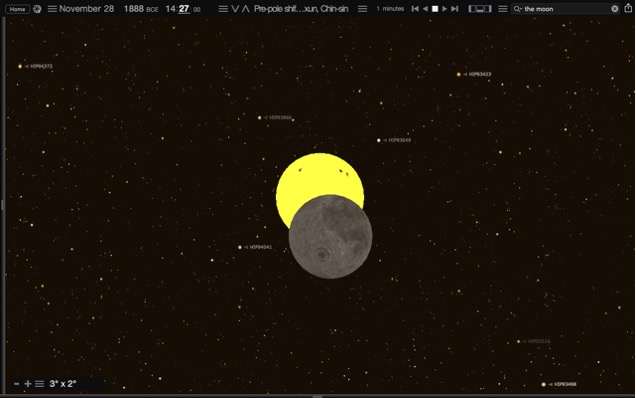
SN8 appearance of the Nov
28, 1888 BCE annular solar eclipse at maximum as viewed from pre-pole shift
#1 “Chin-sin” = Zhenxun = Earlitou
(?) at 22S 164W.
The Nov 28, 1888 BCE
annular solar eclipse path as projected onto a current world map. The tip of
the point at the bottom of the smaller window is at the location of pre-pole
shift #1 “Chin-sin” = Zhenxun = Earlitou (?)… In the two maps below,
you’ll find yellow pins marking points along the Nov 28, 1888 BCE annular
narrow path of totality. (The coordinates of at the yellow pins are derived
from the central path of maximum annularity within the above solar eclipse
map.)
The Nov 28, 1888 BCE solar
eclipse would have been visible as a total eclipse along a path within the
(current) boundaries of China, between the yellow pins in the above two maps,
as viewed from locations along that path in pre-pole shift #1 China. However,
the Sun and this eclipse was in Sagittarius rather than in Scorpii and the
constellation Fang. Astronomical New Moon #1 would then have been the (fall)
Apr 5, 1888 BCE New Moon if the eclipsing (spring) Nov 28, 1888 BCE Moon was reckoned
as #9. If the eclipsing moon, Fang, was reckoned as Moon #4 then the
corresponding Moon #1 would have been Aug 30, 1888 BCE. This apparent
discrepancy re the constellation Fang/Scorpii vs the Sagittarius eclipsed Sun
could be understood as an overdue intercalation month. That is, causing this
eclipse Nov 28, 1888 BCE Moon to be (mis-)labeled Fang rather than being
labeled as one of the constellations associated with the prior month #3 in
this table:
At this point I have not
pursued the spring vs. fall issue occurring in consequence of this being a
Southern Hemisphere pre-pole shift #1 solar eclipse observation. Re the 1829 BCE eclipse:
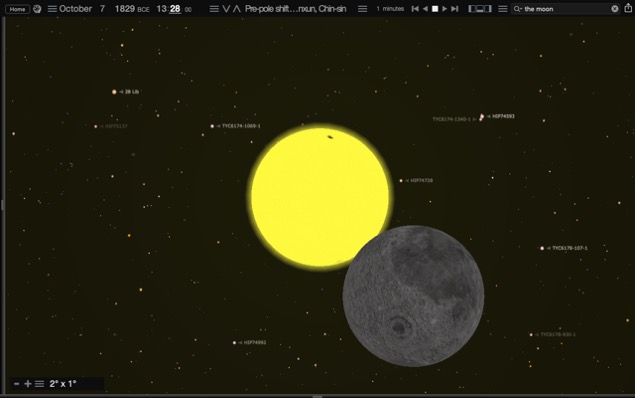
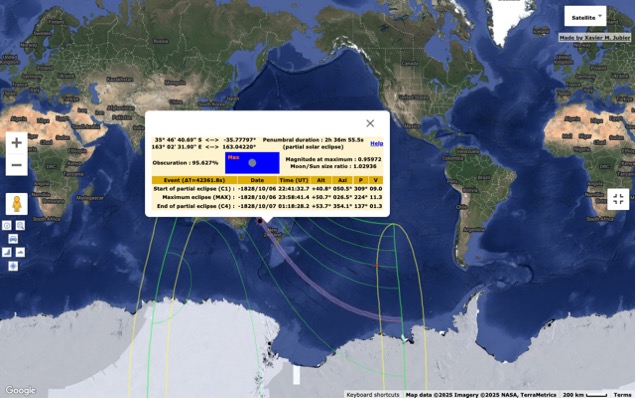
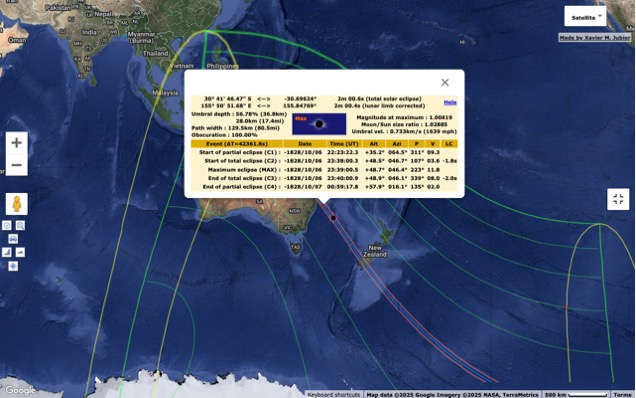
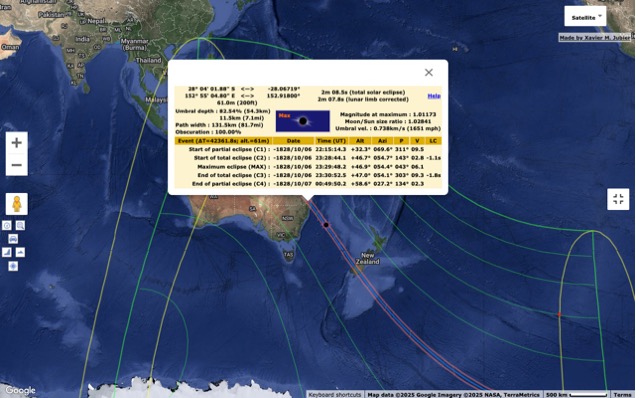
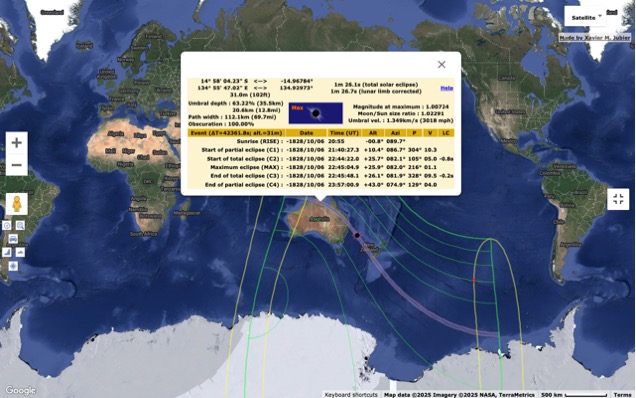
SN8 rendering of the Oct 7,
1829 BCE total solar eclipse (at maximum) as viewed from pre-pole shift #1
“Chin-sin” = Zhenxun = Earlitou
(?) at 22S 164 E.. Barely visible even as a partial eclipse at that location!
Map showing the Oct 7,
1829 BCE total solar eclipse path. Does not look close enough for being
observed as “very dark sky” from anywhere close to the Erlitou location.
However, still visible within China as a “very dark sky” along the border
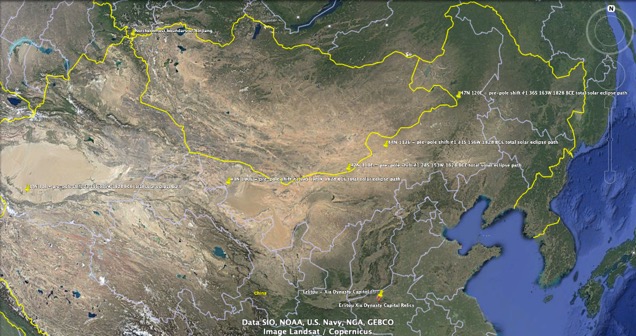
between China and Mongolia… Tracing (in the five maps
below) the totality path of the Oct 7, 1829 BCE total solar eclipse westwards
from pre-pole shift #1 northeast China to Xinjiang in the west. (Or rather…
eastwards… and southwest… China as then viewed from the Southern Hemisphere.)
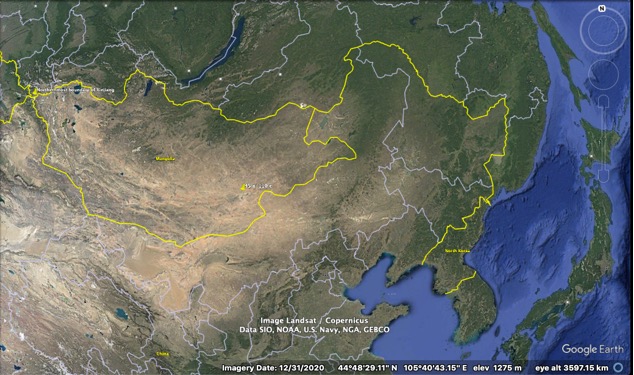
Google Earth Pro map with
yellow pins marking Erlitou and the path of the Oct 7, 1829 BCE total solar
eclipse as visible from pre-pole shift #1 China. Notice how it defines a
large portion of the boundary between China and Mongolia (as presently
defined). Could that solar eclipse path possibly have been used for purposes
of originally defining said boundary and/or for extending the claims of China
westwards to the Xinjiang province? As part of the original westward
(“westward” from our current point of view, “eastward” as viewed then and
there in 1829 BCE) migration of the Chinese people from Caucasus via N.
America and the Bering Strait? That is, as indicated by ancient Chinese maps
of America, and as indicated also by the ancient Chinese characters
identifying the days of the week?
The year matches, yes!
That is, except that the Oct and Nov eclipses in the list of 37 Chinese solar
eclipses were all reckoned as being placed at the end of the year [i.e.
column A, in ScriptureChronoly.xls, matching up with columns I and K rather
than with columns H and J as does this 1829 BCE solar eclipse]. In other
words, provided the calendar year was at
that time reckoned as beginning in the seventh month, as
do the Jewish, Hebrew and Biblical calendar years. Notice, however, that all of
said Oct/Nov eclipses in the 37 list were post-Hezekiah and thus autumn
events on the Northern Hemisphere, while this 1829 BCE eclipse was a spring
event viewed from the Southern Hemisphere. And what about this year being the
year named Water Snake, as in the Chinese dragon? Seems like that symbol
should have something of importance to do with the beginnings of the people
of China and their claims to land and property? Continuing with the pre-2000 BCE eclipses… Re the 2008 BCE eclipse:
SN8 rendering of the Nov
4, 2008 BCE at maximum solar eclipse as viewed (below the horizon!) from pre-pole shift #1
“Chin-sin” = Zhenxun = Earlitou
(?) at 22S 164W… Accordingly, there was no 2008 BCE solar eclipse visible from pre-pole shift #1 China.
Double checking the extent of this solar eclipse, I find that at the time of
this eclipse reaching closest to the pre-pole shift #1 location of China the
(above horizon) visibility reached no further westwards than to about current
167 E, which location was far below the horizon at that time:
Re the 2068 BCE eclipse: No Oct or Nov eclipse was
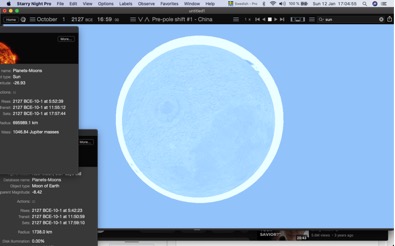
visible in 2068 BCE. Cf. above! Re the 2127 BCE eclipse:
SN8 rendering of the Oct
4, 2127 BCE at maximum solar
eclipse as viewed from pre-pole shift #1 “Chin-sin” = Zhenxun = Earlitou (?) at 22S 164W…
SN8 rendering of the Oct
4, 2127 BCE solar eclipse at sunset as
viewed from pre-pole shift #1 “Chin-sin” = Zhenxun = Earlitou (?) at 22S 164W…
SN8 rendering of the Oct
4, 2127 BCE solar eclipse at sunset as viewed from pre-pole
shift #1 Sun at 1 hour intervals…
SN8 rendering of the Oct
4, 2127 BCE solar eclipse at sunset as viewed from pre-pole
shift #1 China at 3S 164 W…
…corresponding
to current map location 16N 109E…
Yellow
pins marking 1) Erlitou, and 2) the southernmost tip of China that would have
been within the narrow belt of annular totality 1 hour prior to the local
sunset. The annular totality would, however, not totally have darkened the
Sun…
SN8
rendering of the Oct 4, 2127 BCE solar eclipse at sunset as
viewed from pre-pole shift #1 China at 3S 164 W…
Re the 2188 BCE eclipse: No Oct or Nov eclipse was
visible in 2188 BCE. Cf. above! Conclusion thus far: Based on the criteria understood from
the original Chinese records (or transcripts thereof), I’ve found a few
possible contenders to being the one and only solar eclipse behind the
Chinese record: 1)
The
Oct 12, 2128 BCE solar eclipse was not seen from
pre-Joshua’s Long Day China, unless SN8 calculations
are off. Alternatively, if the location of the observer was somewhere along the southern coast of current Alaska,
this eclipse would be a perfect match to the Chinese record. Possible, but not likely eclipse. 2)
The
Oct 4, 2127 BCE solar eclipse at sunset as
viewed from pre-pole shift #1 China at 3S 164 W. Total annular eclipse,
within China, at, or close to, the tip of the peninsula closest to the
equator only. More distant from Erlitou than
the Oct 7, 1829 BCE total solar eclipse. 31st year of 60. Thus, not a good match. One year off from the
record’s 30th of 60. 3)
The
Nov 28, 1888 BCE solar eclipse would have been visible as an annular eclipse
along a narrow path within the (current) boundaries of China, across north
east China as currently located, as viewed from locations along that path in
pre-pole shift #1 China. However, the Sun of this eclipse was in Sagittarius rather than in Scorpii and the
constellation Fang. Astronomical New Moon #1 would
then have been the (pre-pole shift #1 fall) Apr 5, 1888 BCE New Moon if the eclipsing (spring) Nov 28, 1888 BCE New Moon was
reckoned as #9. If the eclipsing moon, Fang, was reckoned as Moon #4 then the
corresponding Moon #1 would have been Aug 30, 1888 BCE. This apparent
discrepancy re the constellation Fang/Scorpii vs the Sagittarius eclipsed Sun
could be understood as an overdue
intercalation month. That is, causing this eclipse
Nov 28, 1888 BCE Moon to be (mis-)labeled Fang rather than being labeled as
one of the constellations associated with the prior month #3. The spring vs fall issue remains unresolved at this time. 4)
The
Oct 7, 1829 BCE total solar eclipse as visible from pre-pole shift #1 China.
Defines a large portion of the boundary between China and Mongolia (as
presently defined). Good fit provided the
calendar year was at that time reckoned as beginning in the seventh month, as
do the Jewish, Hebrew and Biblical calendar years presently. The eclipse
maximum was fairly distant from Erlitou. Of
the above 1) – 4) alternatives, I find that 2) can be ruled out, 1), a
pre-Joshua’s Long Day, pre-pole shift #2, option, is unlikely, while 3) and 4), both of which
are pre-pole shift #1 options, remain the more likely options. Contemporary Bible
correlations: 1)
In my
file The Sacred Calendar of the Creator in Progress (version XXIX.2).xls,
under the tab ‘6000+ years’, at 1888 BCE, I have a note referencing Book of
Jasher 21:22, 38 relating 1888 BCE to a visit of Abram to his son Ishmael in
Ishmael’s 22nd year of life and Isaac’s 8th year of
life. 2)
In my
file The Sacred Calendar of the Creator in Progress (version XXIX.2).xls,
under the tab ‘6000+ years’, at 1835 BCE, I have a note referencing Book of
Jasher 26:16 relating 1835 BCE to the conception of Jacob and Esau. At 1820
BCE, I have a note referencing Jasher 26:17, 29 and the 15th year
of Jacob & Esau, and the death of Abraham, and also a note referencing
Jasher 27:15, 16 and the death of Nimrod. |
||||||||||||||||||||||||||||||||||||||||||||||||||||||||||||||||||||||||||||||||||||||||||||||||||||||||||||||||||||||||||||||||||||||||||||||||||||||||||||||||||||||||||||||||||||||||||||||||||||||||||||||||||||||||||||||||
|
2 |
A Scripture date stamp, based in part on the New Moon as visible from Mt.
Sinai in Saudi Arabia before Joshua’s Long Day, found in
Numbers 10:11, 13 |
Beginning at sunset Julian Day Thu Apr 19, pre-Joshua’s Long Day at
Sinai Sat Apr 21, 1494
BCE. (Cf. the tab ‘Exodus+2years’ in my
file JewishPriestlyCoursesDatedBack.xlsm) |
Numbers 10:11 KJV And
it came to pass on
the twentieth day of the second month, in the second year, that the cloud was taken up from off the tabernacle of
the testimony. Num 10:13 TLT
And within the
First [Day of the week] they took their journey according to the commandment of
the Yehovah by the hand of Moses. |
||||||||||||||||||||||||||||||||||||||||||||||||||||||||||||||||||||||||||||||||||||||||||||||||||||||||||||||||||||||||||||||||||||||||||||||||||||||||||||||||||||||||||||||||||||||||||||||||||||||||||||||||||||||||||||||||
|
3 |
A
partial lunar eclipse |
May
7, 1431 BCE |
Joshua 5:10 – Seventh Day Sabbath / Passover
Preparation / Feast of Firstfruits / Abib 14 Jos 5:10 TLT And the
children of Israel encamped[2] at Gilgal.[3] [4] And they observed the Passover[5] in the fourteenth day of the month during
the twilight hour[6] of both evenings the first one of which
included an eclipse[7] of
the Moon[8] [9] Or, as more fully
expressed, using these [explanatory [bracketed] and/or italic] words… Jos 5:10 TLT And the children
of Israel encamped[10] at Gilgal.[11] [12] And they
observed the Passover [at
the beginning of the Seventh Day Sabbath and at the beginning of the Feast of
Unleavened Bread] in the fourteenth day of the month during the twilight
hour[13] of both evenings the first one of which
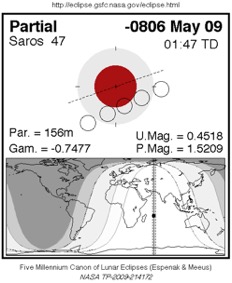
included an eclipse[14] of the Moon[15] [See the pictures below! In fact, at
sunset the eclipsed Moon of May 7, 1431 BCE was rising over the SSE horizon
while moving thence onwards above Jericho in the SSW as viewed from
the hills NNE of Jericho.] [16] Jos 5:10 KJV And the
children of Israel encamped in Gilgal, and kept the passover on the fourteenth day of the month at even in the plains of Jericho. |
||||||||||||||||||||||||||||||||||||||||||||||||||||||||||||||||||||||||||||||||||||||||||||||||||||||||||||||||||||||||||||||||||||||||||||||||||||||||||||||||||||||||||||||||||||||||||||||||||||||||||||||||||||||||||||||||
|
4 |
A pole shift; the second of the three pole
shifts identified by Charles Hapgood. |
Mon(!) June 30, 1425 BCE,
Joshua’s Long Day. |
Joshua 10:12 “Then spake Joshua to the LORD in the day when the
LORD delivered up the Amorites before the children of Israel, and he said in
the sight of Israel, Sun, stand thou still upon Gibeon; and thou, Moon, in
the valley of Ajalon.” |
||||||||||||||||||||||||||||||||||||||||||||||||||||||||||||||||||||||||||||||||||||||||||||||||||||||||||||||||||||||||||||||||||||||||||||||||||||||||||||||||||||||||||||||||||||||||||||||||||||||||||||||||||||||||||||||||
|
5 |
If the
solar event in the 15th year of
Hezekiah, King of Judah, was a pole-shift, then Mt. Tabor, at the time
of King Saul, may have been located at about 13 S; 41 W, and… - Tied (?) in the Holy
Scriptures to the sunrise of a Seventh-day Sabbath further defined by a
certain numbered month of the Scriptural calendar year, which month is
identified by the record found in 1 Samuel 27:7. More… |
Pre-Hezekiah Sat AM Dec 20 = Julian Day Fri AM Dec 19, 1061 BCE |
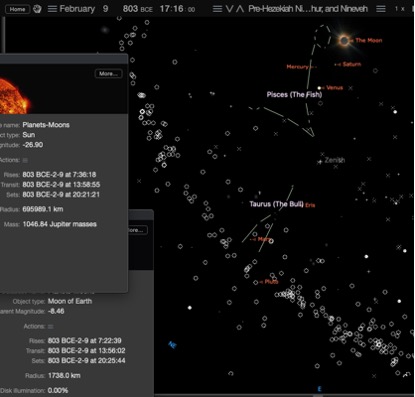
Quoting the Holy Scriptures: Tied to the death of King
Saul of Israel are the familiar words out of 1 Samuel 28:13, 14 (KJV) “I saw gods ascending
out of the earth… An old man cometh up; and he is covered with
a mantle…,” which words are
probably better translated (TLT ©) “I saw gods [the
sun and the moon] being above the
horizon of the earth… A waxing old [mature and/or setting] entity [the
‘old moon’] above [the horizon of the earth]; and it was covered with
a cover[ing shadow, i.e. a lunar eclipse.]” For a detailed study,
please cf. this link
to another article of mine. |
||||||||||||||||||||||||||||||||||||||||||||||||||||||||||||||||||||||||||||||||||||||||||||||||||||||||||||||||||||||||||||||||||||||||||||||||||||||||||||||||||||||||||||||||||||||||||||||||||||||||||||||||||||||||||||||||
|
6 |
A Chinese total (or hybrid) solar
eclipse recorded as “the sky turned very dark… by River Han…”: As
observed from
pre-Hezekiah, pre-pole shift River Han in China. |
1)
Most likely (item #4 in the
column to the right): The
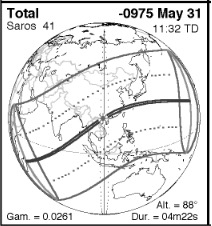
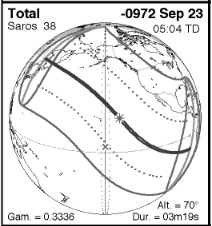
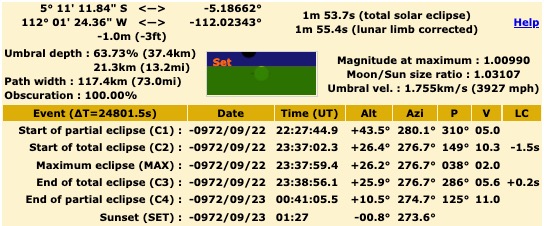
Sept 23, 973 BCE total solar eclipse would indeed result in an event
perfectly described by the words translated “the sky turned very dark… by
River Han…” (100% obscuration lasting 1 min 54 sec as
observed 1 hour 50 min before sunset, from River Han). This eclipse
seems to be a perfect, and the best, fit unto the Chinese record. 2)
Less likely (item #2 in the
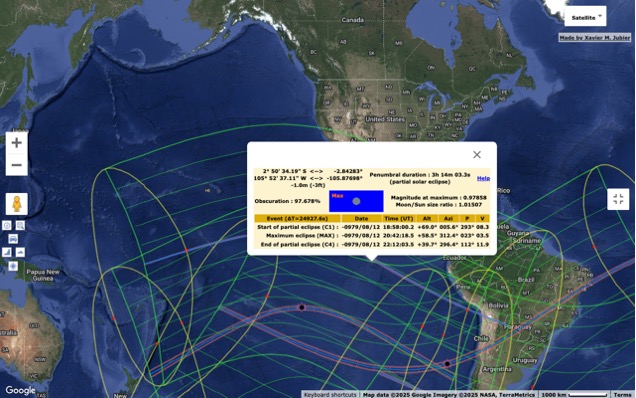
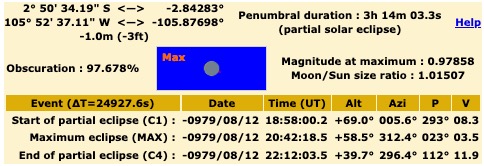
column to the right): The almost 98% hybrid solar eclipse of Aug 13, 980 BCE would result in
a noticeable darkening of the sky, with maximum 1 hour past noon, reasonably
well described by the translation “the sky turned very dark… by River Han…”.
It satisfies the Chinese record fairly well. |
Quote – Further analysis below…:
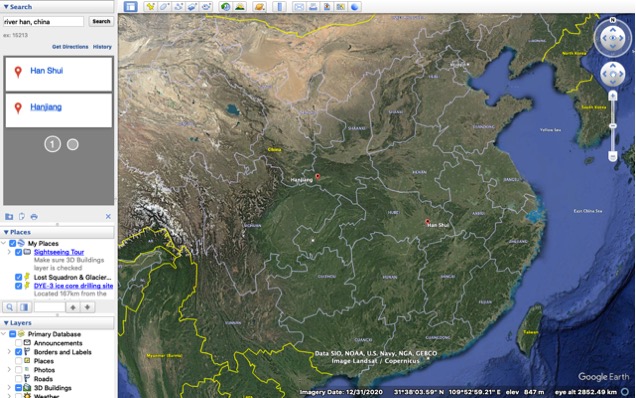
Per Google Earth the Han River is currently located between 30-33N
106-114E (between the two red pins in the map below):
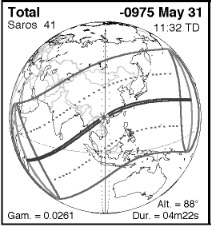
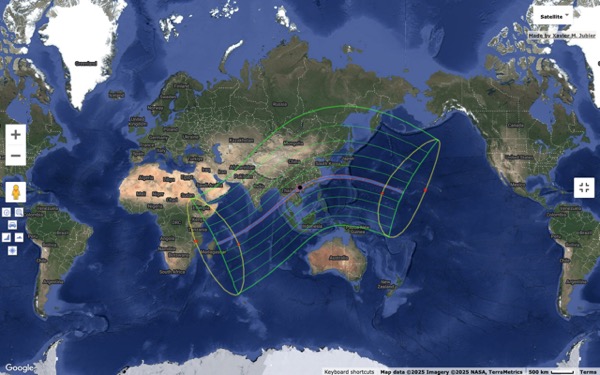
The above referenced Chinese solar eclipse as heretofore identified
while not considering a pole shift between then and now:
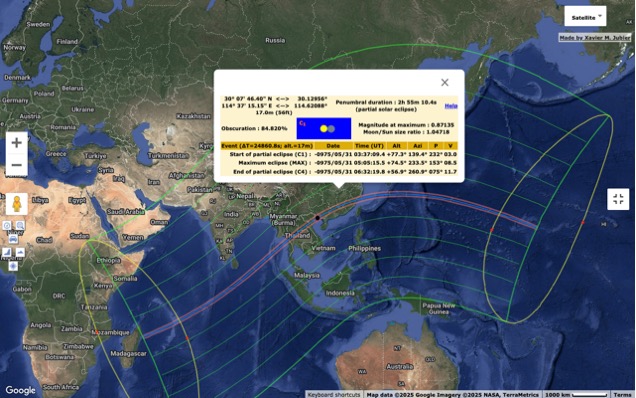
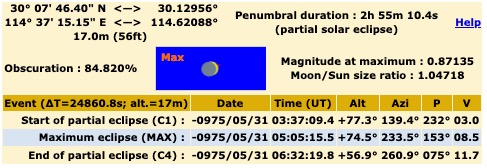
This May 31, 976 BCE solar eclipse as maximally obscured, 84.820%,
from the area of the River Han that runs closest to the path of this eclipse.
But unfortunately, an eclipse that is at maximum 85% obscured does not make
the “sky very dark”… Considerations re the pre-Hezekiah, pre-pole shift, solar eclipse in
“the 19th year of King Zhao… by River Han”:
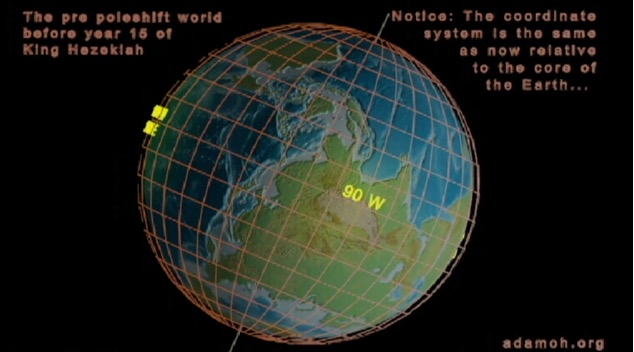
Earth’s coordinate system prior to the 699/698 BCE
pole shift. Including China at 5±15S 96±16W (22S-10N 80-112 W). Selecting all the total, annular, or hybrid solar
eclipses visible from anywhere near the pre-Hezekiah, pre-pole shift location
of China during the 68-year period 1008-940[17] BCE,
a total of 29 eclipses:
Selecting, among the above 29 solar eclipses, only the ones which
would have caused an event described by the words “the sky turned very dark…
by River Han…” along the River Han as located prior to the 699/698 BCE
Hezekiah, pole shift. That is, the maps above where the path of totality or
annularity crosses, or very nearly crosses, the area between 3-5S 106-112W,
as per a comparison of two maps below; Google Earth to the left of my
pre-Hezekiah global map:
In the Google Earth map to the left above, the red pins indicate the
extent of River Han. Superimposing that location upon the global map at the
right, I find the pre-pole shift extent of River Han within 3-5S 106-112W. Selecting from the above 29 eclipses, all the eclipses >51%
obscured at the corner of 3-5S 106-112W closest to the eclipse path, I find
only the following seven (7) eclipses meeting said criteria: 1.
Less than 75% obscuration. Would not result in an event well described
by the words “the sky turned very dark… by River Han”. Thus, not a very
likely contender for satisfying the criteria given per the Chinese record. 2.
This almost 98% total solar eclipse of Aug 13, 980 BCE would result in
a noticeable darkening of the sky, with maximum 1 hour past noon, reasonably
well described by the translation “the sky turned very dark… by River Han…”.
It satisfies the Chinese record fairly well. 3.
Less than 75% obscuration. Would not result in an event well described
by the words “the sky turned very dark… by River Han”. Thus, not a very
likely contender for satisfying the criteria given per the Chinese record. 4.
This Sept 23, 973 BCE eclipse would indeed result in an event
perfectly described by the words translated “the sky turned very dark… by
River Han…” It seems to be a perfect, and the best, fit unto the Chinese record.
100% obscuration beginning 1 hr 50 min prior to sunset and lasting 1 min 54
sec. 5.
Less than 75% obscuration. Would not result in an event well described
by the words “the sky turned very dark… by River Han”. Thus, not a very
likely contender for satisfying the criteria given per the Chinese record. 6.
Less than 80% obscuration. Would not result in an event well described
by the words “the sky turned very dark… by River Han”. Thus, not a very
likely contender for satisfying the criteria given per the Chinese record. 7.
The past maximum eclipsed Sun rising above the River Han, China
horizon. This dawn event would have involved a slightly darker and slower dawn
than usual, but with no intermittent darkening along the way of the ever more
lightening dawn. At sunrise 50% of the solar disc would be covered by the
Moon, as per the above SN8 rendering of that eclipse event. I do not find
this event being well described by the above Chinese record. Conclusion: I find this recorded Chinese eclipse being most likely identifiable
with one of two eclipses: 1)
Less likely (item #2 above):
The almost 98% total solar eclipse of Aug 13, 980 BCE would result in a
noticeable darkening of the sky, reasonably well described by the translation
“the sky turned very dark… by River Han…”. It satisfies the Chinese record
fairly well. 2)
Most likely (item #4 above):
The
Sept 23, 973 BCE eclipse would indeed result in an event perfectly described
by the words translated “the sky turned very dark… by River Han…” It seems to
be a perfect, and the best, fit unto the Chinese record. |
||||||||||||||||||||||||||||||||||||||||||||||||||||||||||||||||||||||||||||||||||||||||||||||||||||||||||||||||||||||||||||||||||||||||||||||||||||||||||||||||||||||||||||||||||||||||||||||||||||||||||||||||||||||||||||||||
|
8 |
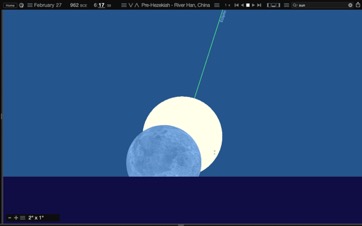
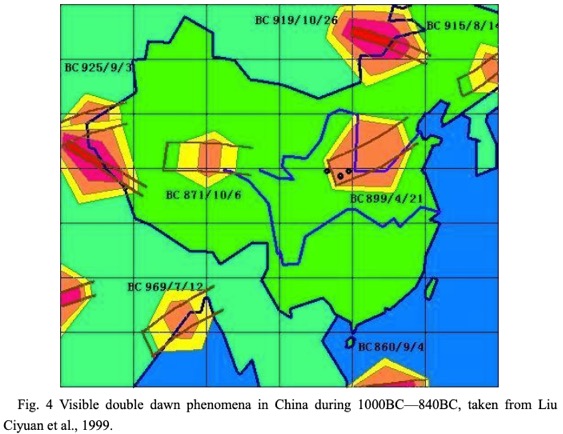
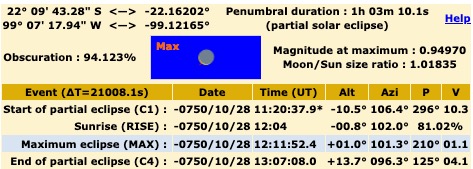
A Chinese annular solar eclipse at
dawn: A solar
eclipse observed from
pre-Hezekiah, pre-pole shift Zheng in
China described in the record as “the day dawned twice at Zheng”. |
April 21, 918 BCE annular solar eclipse |
Quote – Further analysis below…:
. . .
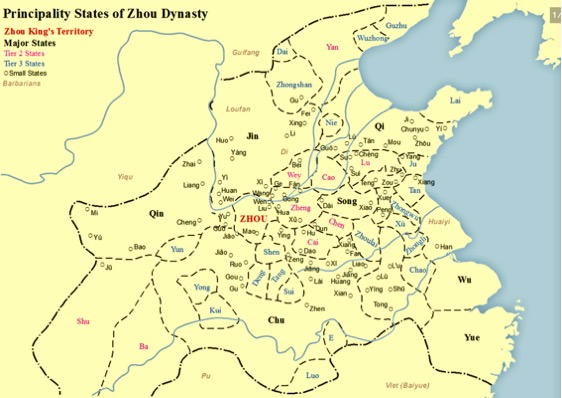
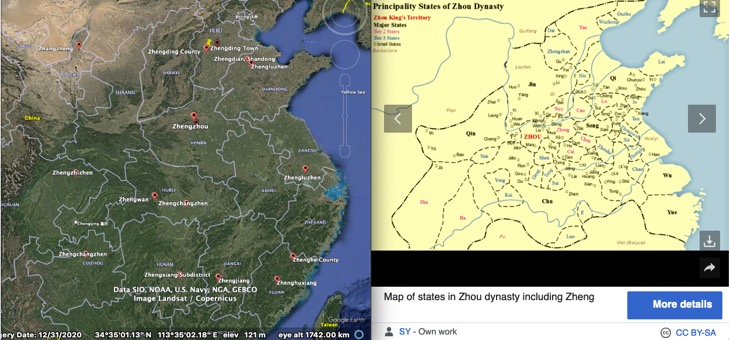
Comparative maps showing current coordinates of the ancient Zheng (at
34°35’N 113°35’E; Google
Earth Pro map to the left, Wikipedia map to the right). The above referenced Chinese solar eclipse as heretofore identified
while not considering a pole shift between then and now:
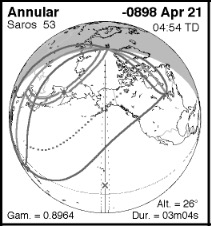
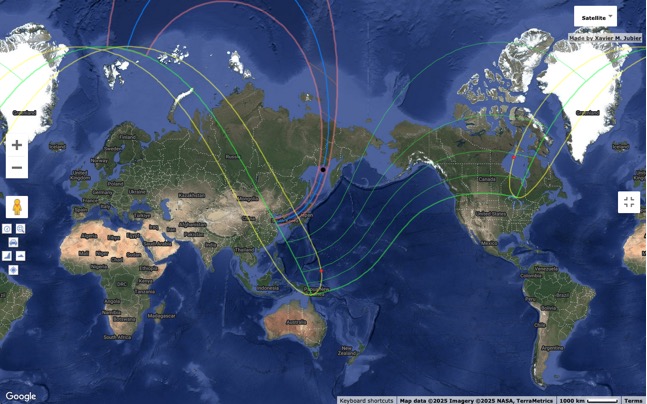
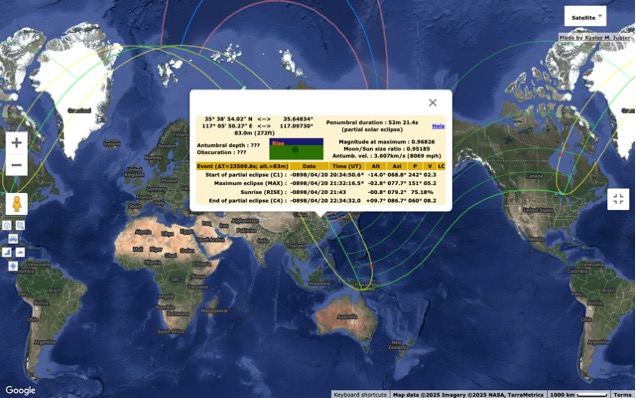
Maps showing the path of the
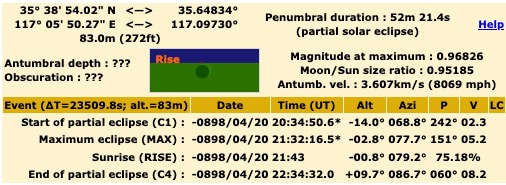
solar eclipse previously associated with the Zheng eclipse. That is, as per
the current location of Zheng. This eclipse began 69 min before sunrise,
Maximum magnitude 0.96826 11 min before sunrise. Would have appeared as a
“double dawn”, but only if Zheng was then located at the same geographical
coordinates as presently. Considerations re the pre-Hezekiah, pre-pole shift, timing of the Zeng
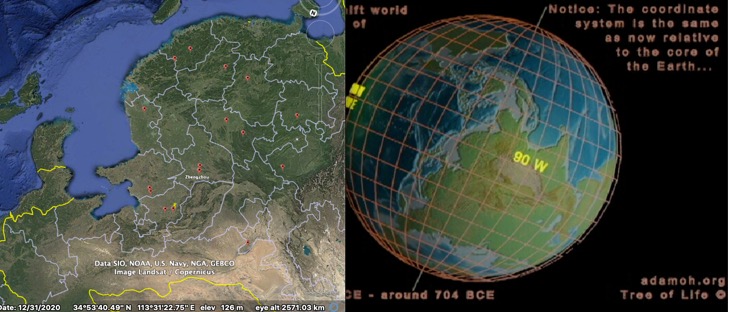
solar eclipse at dawn: Earth’s coordinate system now (Google Earth Pro to
the left) vs prior to the 699/698 BCE pole shift. Including Zheng in China at
8S 110W:
Selecting all the total, annular, or hybrid solar
eclipses visible from anywhere near the pre-Hezekiah, pre-pole shift location
of China during the 80 year period 940-860 BCE, a total of 41 eclipses:
Among all of the above 41 eclipse maps, I
find only 10 eclipses that would have been potentially visible as a “double
dawn”, or as an eclipse in the forenoon, at Zheng, as located at 8S 110E…
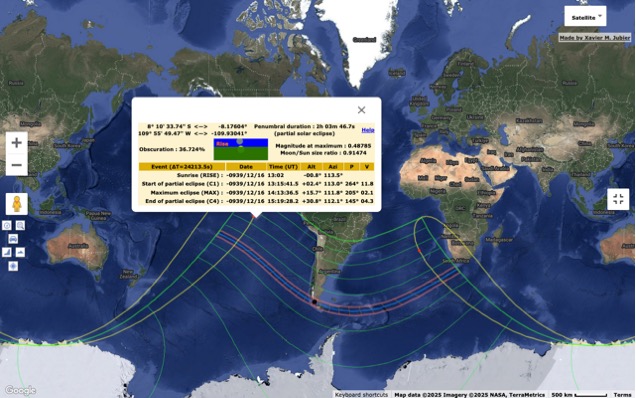
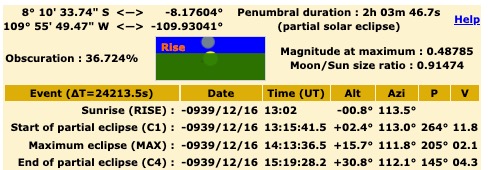
Began 14 min past sunrise. Max 36.724% 72 min past
sunrise. This would have slowed down the dawn experience a tiny bit, but not
really made it appear as a double event.
This solar eclipse began when the Sun was already at
14.8 deg altitude. Not really a “double dawn” event.
This eclipse began 94 min before sunrise and ended
26 min past sunrise. Maximum eclipse 37 minutes before sunrise. A true “double dawn” event at
Zheng.
This eclipse began when the sun was already 12.2 deg
above the horizon. Not a “double dawn” event.
This eclipse began when the sun was already 36.4 deg
above the horizon. Not a “double dawn” event.
This eclipse began when the Sun was already high in
the sky, 57.2 deg. Not a “double dawn” event.
This eclipse began when the Sun was already high in
the sky, 29.0 deg. Not a “double dawn” event.
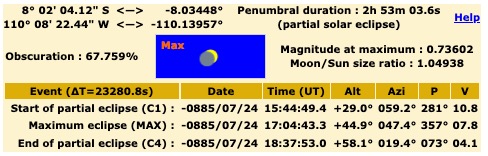
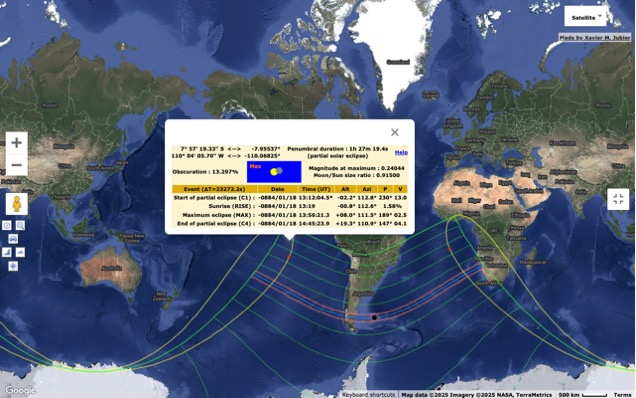
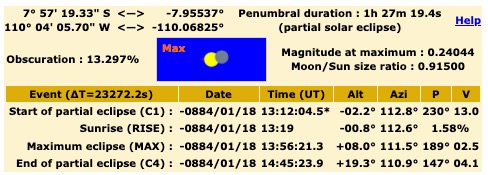
This eclipse began 7 min before sunrise, had its
maximum 37 min past sunrise, but maximum obscuration was only 13.297%. Would
have been visible at sunrise, but wouldn’t have created much, if anything, of
a “double dawn” event.
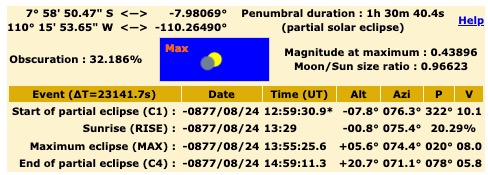
This eclipse began 29 min before sunrise, maximum 26
min past sunrise. Max obscuration 32.186%. Would have appeared as a slowed
down sunrise, but not likely as a “double dawn.”
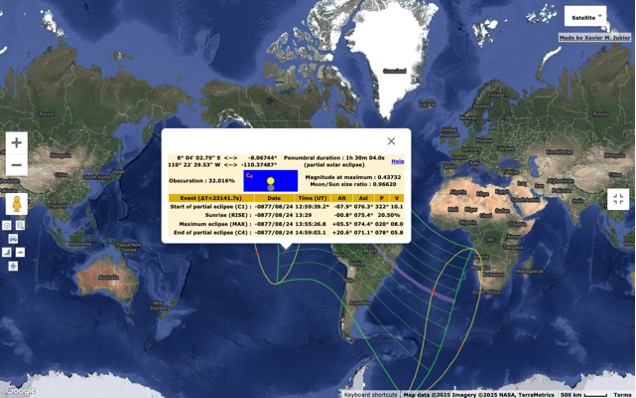
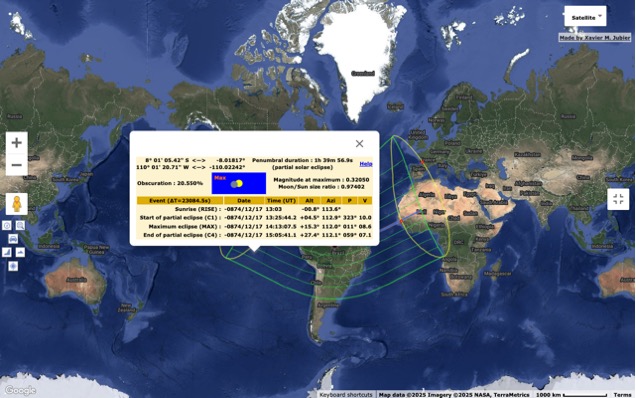
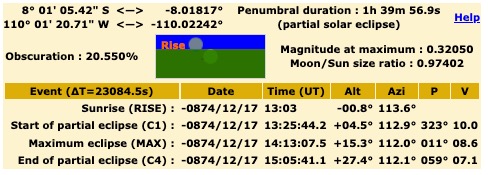
This eclipse began 22 min past sunrise. Had its
maximum obscuration 20.550% 48 min past sunrise. Would not likely have given
the impression of a “double dawn”. Conclusion: The pre-Hezekiah, pre-pole shift eclipse recorded as
observed in Zheng in China as a “double dawn” can be identified as the Apr
21, 918 BCE solar eclipse. The one and only eclipse during the 80-year period
940-860 BCE, among 182 total, annular, or hybrid solar eclipses anywhere near
China, that truly would have appeared as a “double dawn.” |
||||||||||||||||||||||||||||||||||||||||||||||||||||||||||||||||||||||||||||||||||||||||||||||||||||||||||||||||||||||||||||||||||||||||||||||||||||||||||||||||||||||||||||||||||||||||||||||||||||||||||||||||||||||||||||||||
|
9 |
A total lunar eclipse from
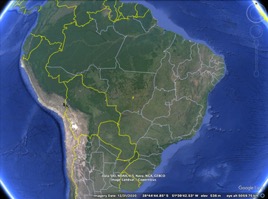
the view point of pre-Hezekiah, pre-pole shift, Ashur, Iraq, at 15S 55W
(Where currently the State of Mato Grosso in Brazil is located, at the very center
of South America). |
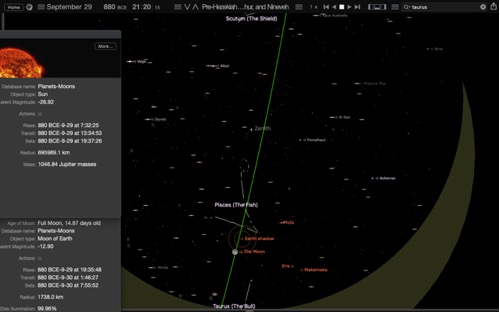
At the
time of the simultaneous moonrise and sunset on Sep 29, 880 BCE. |
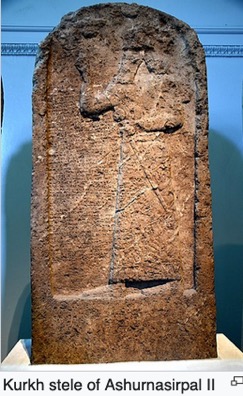
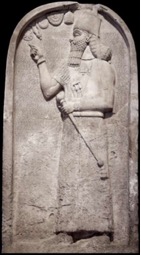
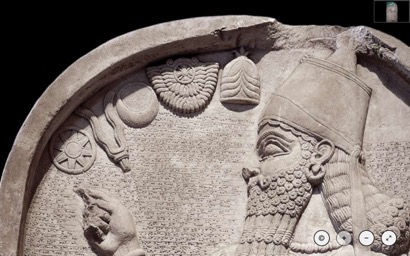
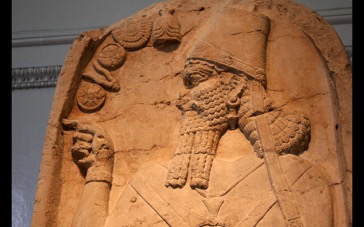
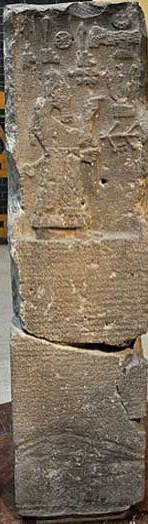
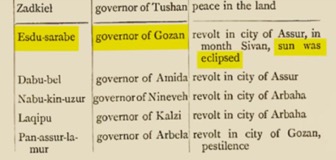
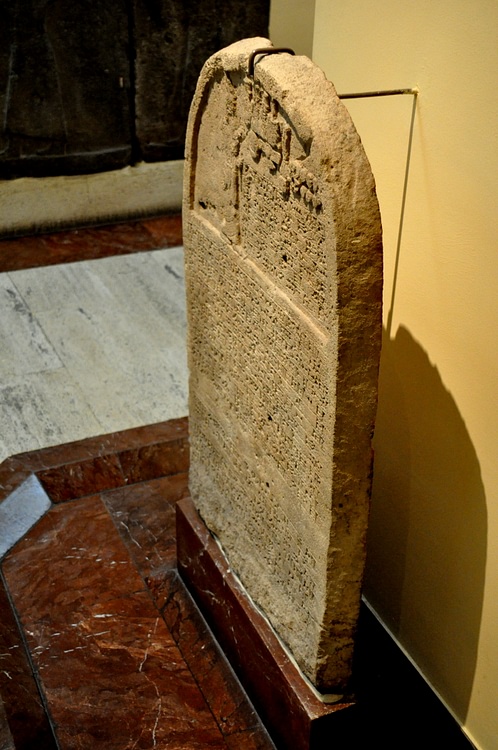
Kurkh stele of
Ashurnasirpal II – The icons at the top of the stele (below right)
correspond the stars on the sky visible from pre-Hezekiah (before the last
poleshift) Nimrud-Kalhu-Ashur (at 15S 55W) during the lunar eclipse of Sep
29, 880 BCE, the year of Ashurnasirpal II’s ascension to the throne:
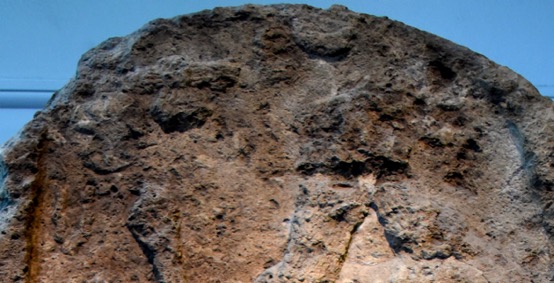
Zoomed in view of the top portion of the
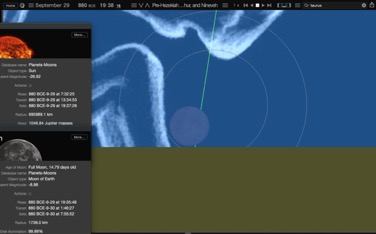
above stele. Starry Night Pro
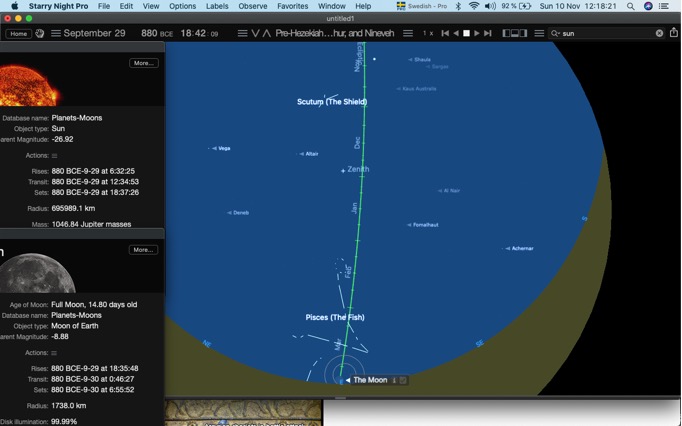
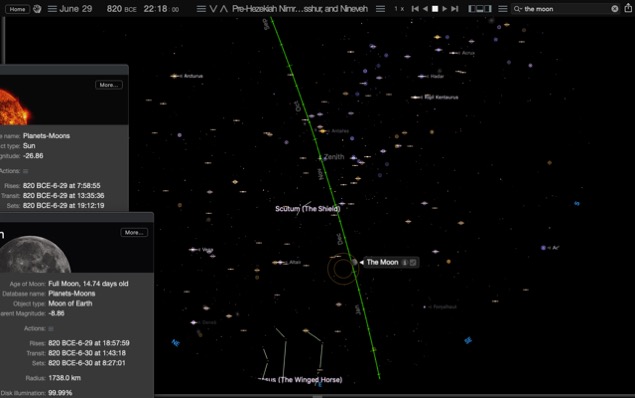
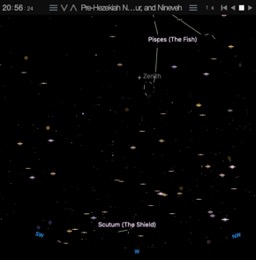
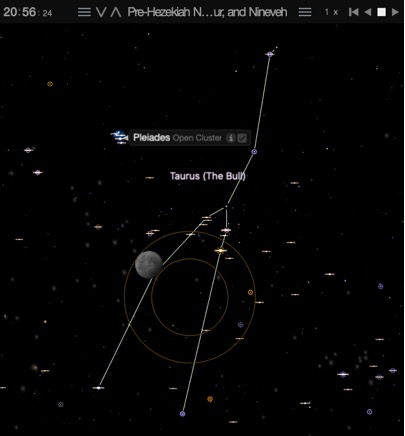
8 astronomy software display of the 29 Sep 880 BCE lunar eclipse, - as viewed
from Pre-Hezekiah, pre pole shift, Nimrud-Kalhu-Asshur at 15S 55W:
The totally
eclipsed full Moon rising above the horizon in the East.
The eclipsed Moon
is close to the constellation Swallow (Pisces). In the waning
twilight the Moon slowly emerges out Earth’s shadow while a growing
number of stars become visible, including those
of the constellations Scutum (The Shield), high in the sky, and Taurus (the
Bull) rising from below the eastern horizon…
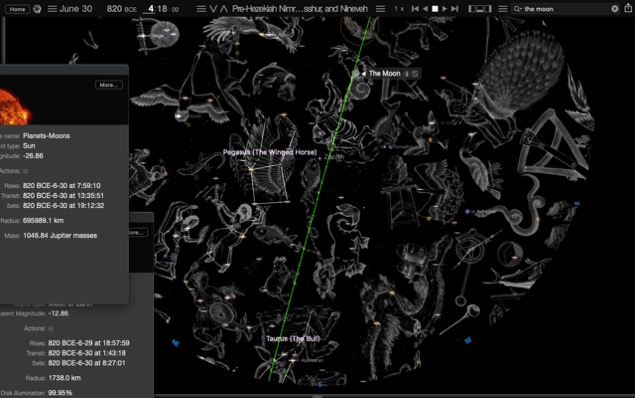
Notice the 5
astronomical objects represented by the five Kurkh stele Ashurnasirpal II
icons: 1) Taurus below
the horizon as also below the king’s finger in the stele,
2) the setting
Sun at the kings finger,
3) the Swallow
(Pisces),
4) Scutum (The
Shield), and 5) the emergence
of the Moon out of the total lunar eclipse.
The emerging Moon
on the Eastern sky compares favorably to the eclipse icon of the stele above. |
||||||||||||||||||||||||||||||||||||||||||||||||||||||||||||||||||||||||||||||||||||||||||||||||||||||||||||||||||||||||||||||||||||||||||||||||||||||||||||||||||||||||||||||||||||||||||||||||||||||||||||||||||||||||||||||||
|
10 |
A partial solar eclipse as
viewed from Pre-Hezekiah, pre pole shift, Ashur-Kalhu-Nimrud in Iraq at 15S
55W |
Mar 11, 879 BCE |
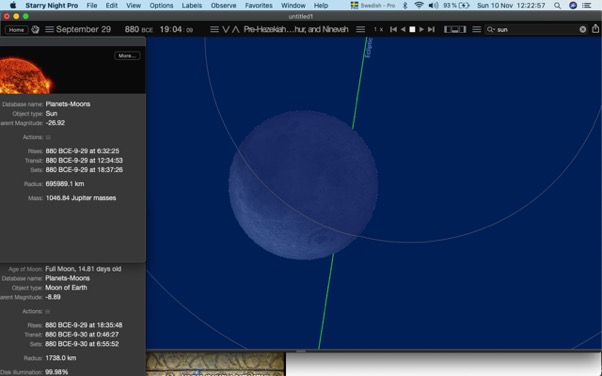
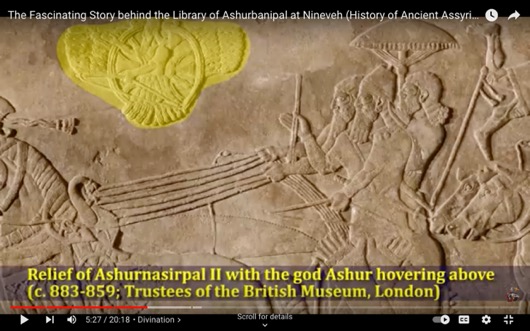
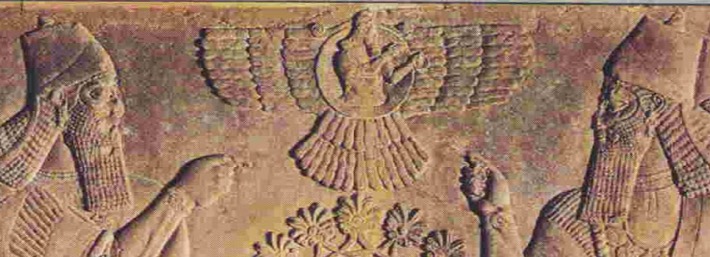
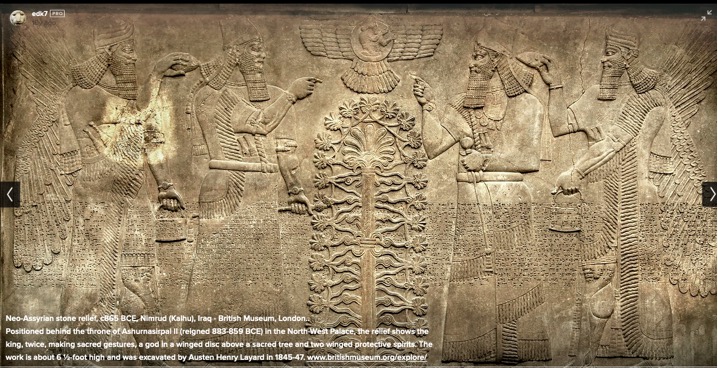
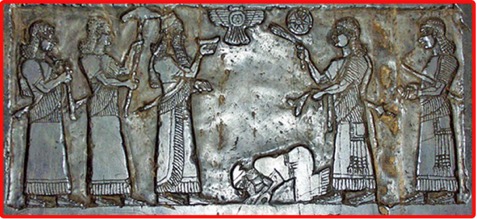
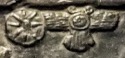
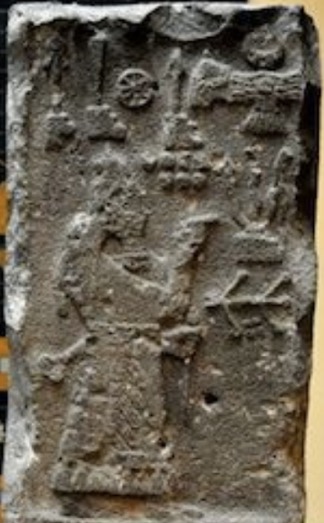
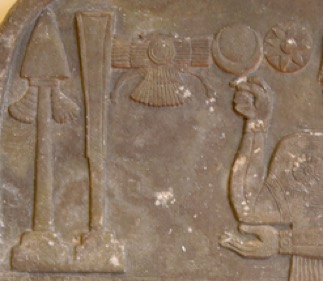
Mar 11, 879 BCE partial solar eclipse. I found the image below on a,
for me thus far unidentified, wall-covering/relief labeled "Relief of
Ashurnasirpal II with the God Ashur hovering above (c. 883-859; Trustees of the
British Museum, London)". Looks like it could be a record of a solar
eclipse in the constellation Swallow (Pisces) within the 1st full
calendar year of Ashurbanipal II’s reign as King of Assyria:
(Source)
Notice the
similarities and differences between the winged disc icons in each of the two
reliefs above! Notice also the
pointing fingers, and likewise the pine cones in the hands of the angels
behind. The ones on the right, while facing and pointing to the left, are
pointing slightly upwards, as in the rising stars in the east. The ones on
the left, while facing and pointing to the right, are pointing slightly
downwards, as in the setting stars in the west. How does that apply to an
eclipse event occurring at sunset (in the west)? What’s the significance of
the men facing and pointing left in the relief above? Could it be intended as
a reminder that the new 24-hour day is beginning with the approaching darkness
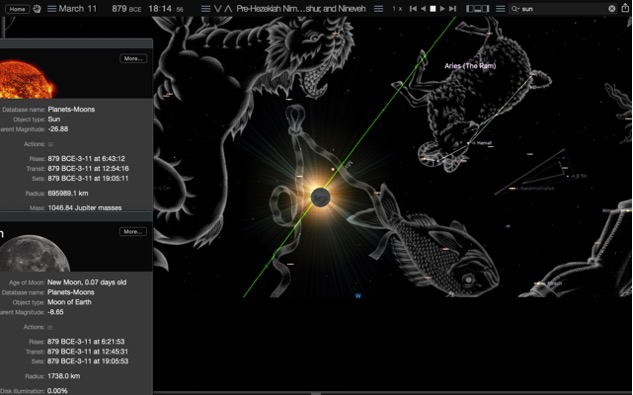
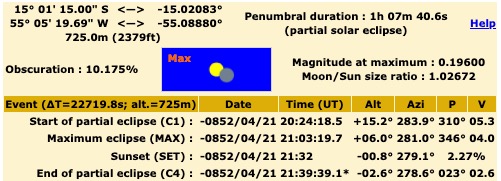
arising in the east at the time of sunset? Both of the above reliefs fit this sunset Mar 11, 879 BCE partial
solar eclipse very well (except as noted in the last paragraph above):
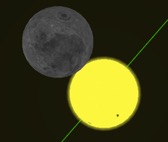
Notice the solar eclipse as located in the middle of Pisces (ancient
Swallow)!
Maximum occlusion as viewed from 15S 55W
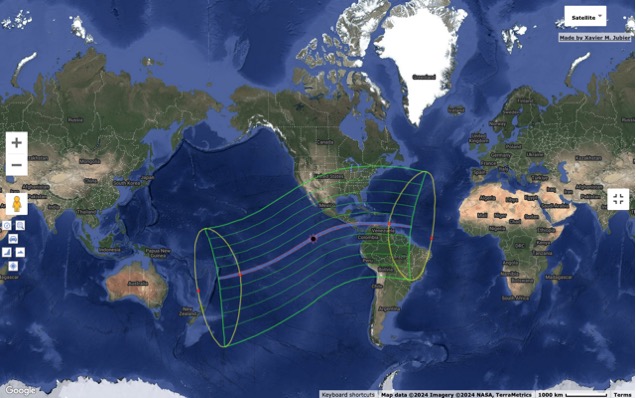
Solar eclipse path March 11, 879 BCE, as superimposed on current,
post-Hezekiah, post-pole shift, geography. |
||||||||||||||||||||||||||||||||||||||||||||||||||||||||||||||||||||||||||||||||||||||||||||||||||||||||||||||||||||||||||||||||||||||||||||||||||||||||||||||||||||||||||||||||||||||||||||||||||||||||||||||||||||||||||||||||
|
11 |
A total
lunar eclipse visible from the
horizon of Pre-Hezekiah, pre pole shift, Nimrud-Kalhu-Asshur at 15S 55W. |
Oct 10, 862 BCE.
The 19th year of reign of Ashurnasirpal II. |
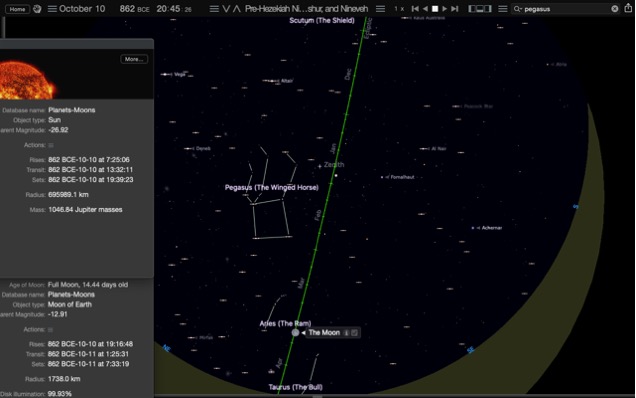
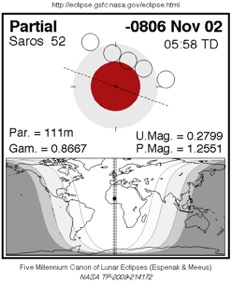
Ashurnasirpal II stele – BM118805 – The Great Stele:
The icons at the top of the stele correspond to the lunar eclipse on Oct 10,
862 BCE, and to the 19th year of Ashurnasirpal II’s reign, which 19th year
corresponds to “Ashurnasirpal II's palace in Kalhu… having been completed after
around 15 years…” of
building (Ref. links: Cf. Gateway to... Sacred Calendar...):
Ashurnasirpal
II stele – BM118805
Sky view facing east.
Sky view facing south at the time the Moon enters
Earth’s umbral shadow. Notice the 5 astronomical objects represented by the five Kurkh stele
Ashurnasirpal II icons: 1)
Sunset,
2)
Taurus (The Bull) rising
over the horizon,
3)
the Moon (subsequent total
eclipse between 1:55/2:55 - 4:22/5:22 AM),
4)
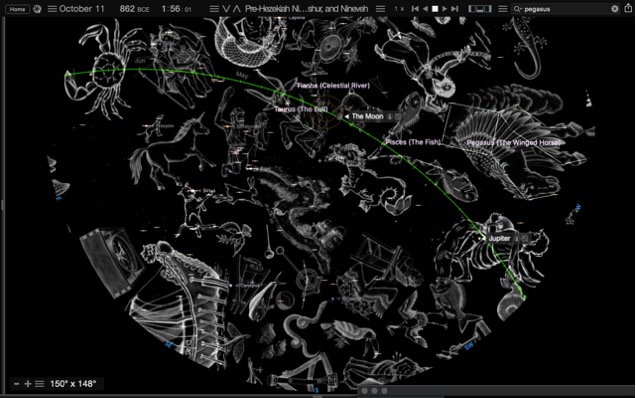
Pegasus (The Winged Horse),
and
5)
Scutum (The Shield).
|
||||||||||||||||||||||||||||||||||||||||||||||||||||||||||||||||||||||||||||||||||||||||||||||||||||||||||||||||||||||||||||||||||||||||||||||||||||||||||||||||||||||||||||||||||||||||||||||||||||||||||||||||||||||||||||||||
|
12 |
A total lunar
eclipse |
Nov 21,
855 BCE. At the beginning of the 1st calendar year of reign of
Shalmaneser III. |
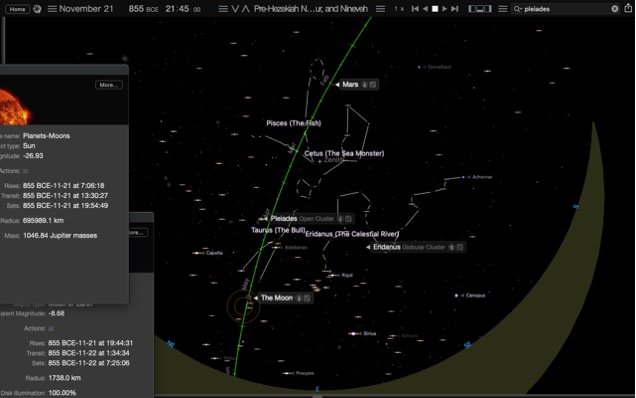
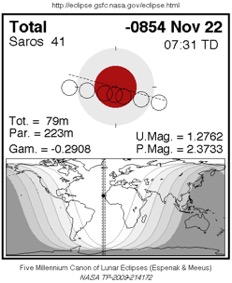
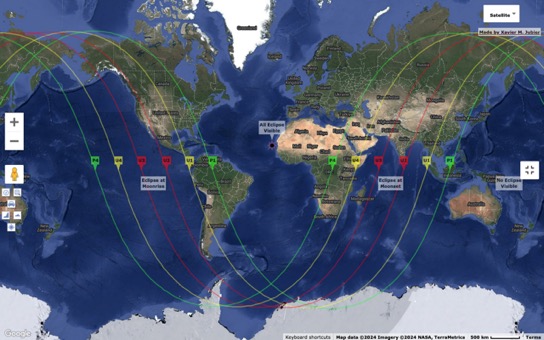
Nov 21, 855 BCE total
lunar eclipse at the beginning of the 1st calendar year of reign of
Shalmaneser III. A not very common
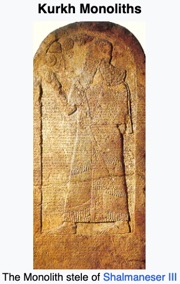
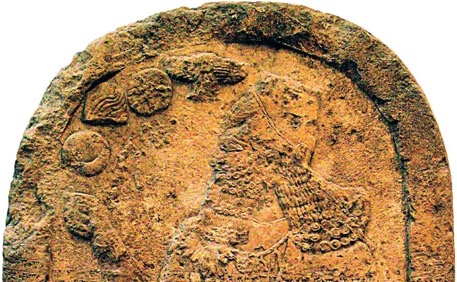
astronomical event recorded in some detail at the top of the Kurk Monolith stele of Shalmaneser III. Indeed,
within the years between 900 BCE – 817
BCE I find only three lunar eclipses that are fairly well described, and are
clearly identifiable, by the stele icons.
Nov 21, 855 BCE is within Shalmaneser III’s 1st year of reign: 1) Nov
21, 855 BCE; 2) Oct
31, 845 BCE; and 3) Nov
1, 826 BCE.
Notice above and below (the
King’s finger indicating the horizon): 1) the eclipsed Moon
The Nov 21, 855 BCE evening
sky as viewed facing east.
The Moon entering Earth’s
Shadow (at 21:45 SN8 time)
|
||||||||||||||||||||||||||||||||||||||||||||||||||||||||||||||||||||||||||||||||||||||||||||||||||||||||||||||||||||||||||||||||||||||||||||||||||||||||||||||||||||||||||||||||||||||||||||||||||||||||||||||||||||||||||||||||
|
13 |
A partial solar eclipse as viewed from pre-Hezekiah, pre pole shift, Nimrud-Kalhu-Asher at 15S
55W. |
Apr
21, 853 BCE. Within the 3rd
calendar year
of reign of Shalmaneser III. |
Apr
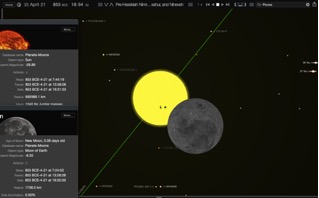
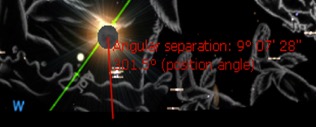
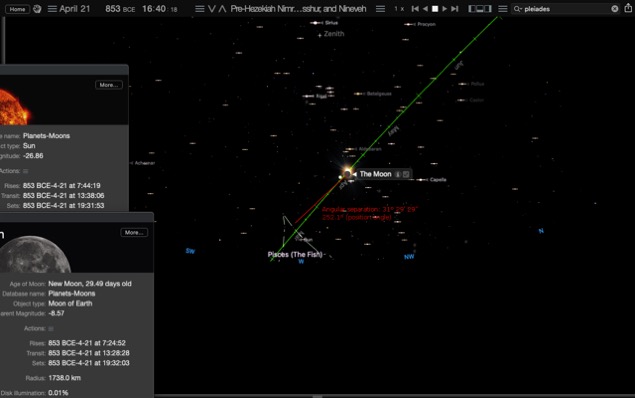
21, 853 BCE solar eclipse maximum while at 9 degrees above the
horizon where the Swallow (Pisces) just set behind the
horizon (30 degrees between the Sun and the Swallow).
The Sun followed the Swallow beyond the horizon. Compares favorably with
the image of the Sun close to, even touching, the image of the Swallow
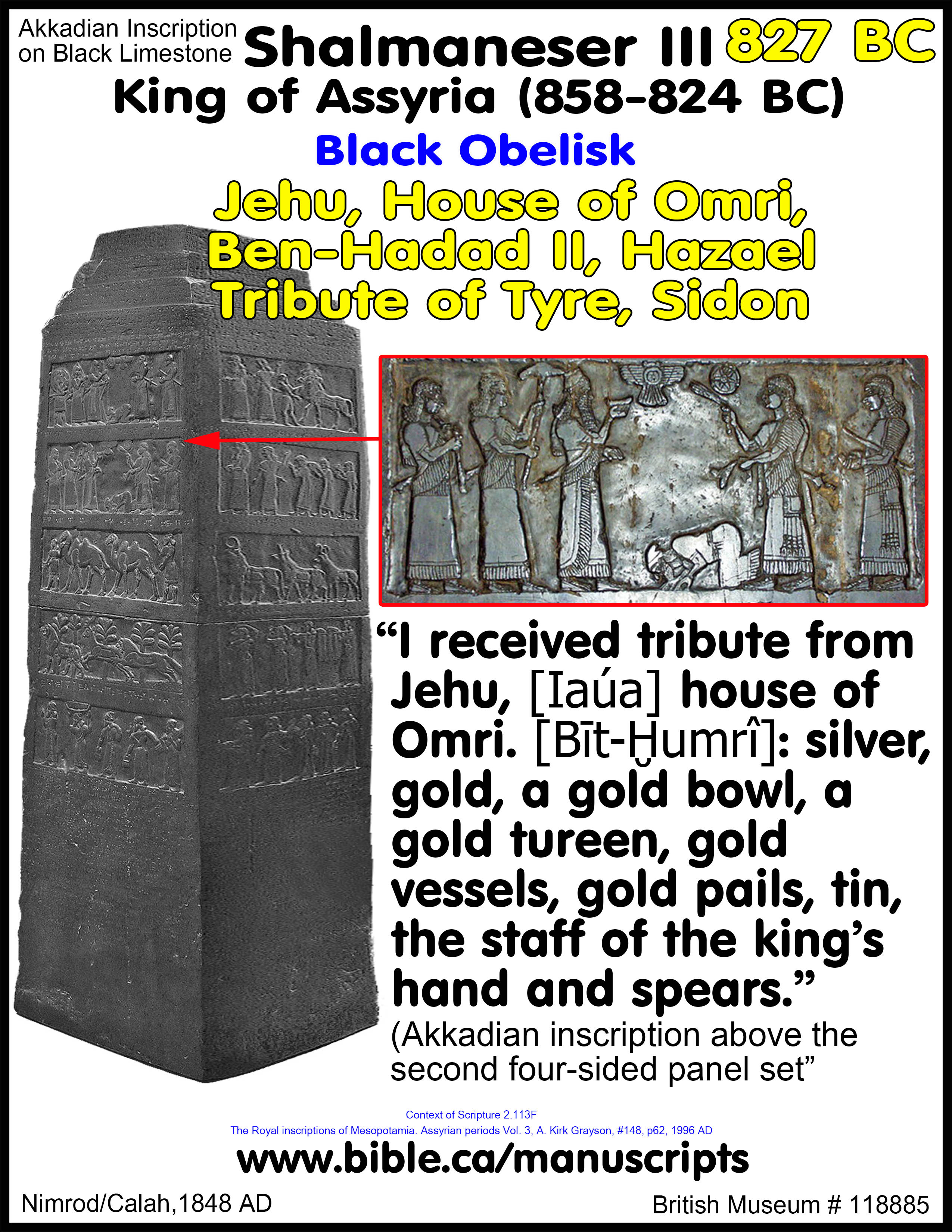
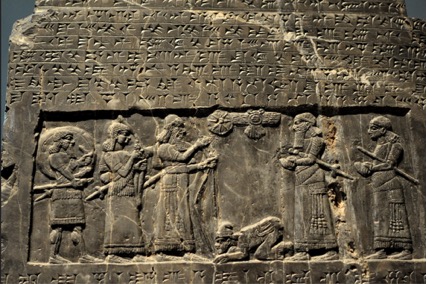
(Pisces) on the 1st row of the Black Obelisk showing Sûa, the Gilzânite, kissing the dirt
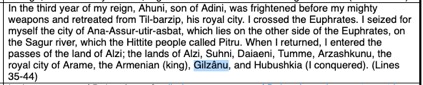
in front of Shalmaneser III, the Assyrian king. Shalmaneser concurred Gilzânu in his 3rd year.
Cf.
the very similar event as described below at Shalmanesers 11th year (compare below!), at which time the maximum eclipse was 17 degrees above the horizon.
Thus also corresponding with the longer distance between the images of the
Sun and the Swallow seen on the 2nd row of same obelisk. Notice, however,
that this eclipse took place on April 21,
853 BCE at
the beginning of the spring to spring calendar year. It being therefore a
road sign in time at the beginning of Shalmaneser's 3rd year.
Side 1, line 1: Notice the symbols of the Sun
Another translation
of the obelisk text. And another. “In the year named after
Assur-bêl-kain, on the 13th of Duzu [Shalmaneser III’s 3rd year of reign/TLT©], I left
Nineveh, crossed the Tigris, went through the lands… I
approached the land of Gilzânu. King Asâu of Gilzânu,
together with his brothers, and his sons, came out to meet me. [I accepted from him tribute and gifts for my royal self—
tamed horses, cattle, sheep, wines, and seven Bactrian camels. I made a
heroic statue of my royal self and inscribed on it the glory of my
lord Assur, the great lord, and the great power which I had displayed in the
land of Nairî. I set it up in his temple in the middle of the city. I left Gilzanu, coming to Shilaia, the fortress of
Kâki, king of Hubushkia.”
(https://jewishchristianlit.com/annalsshalmaneser3/) “[This
inscription mentions the Syrian wars against Hadad, but does not mention
Hazael. He says it is the fourth time they have fought, which is already more
than we know about with Hadad. Presumably that would date this inscription around year 17]: ”I brought in subjection the land of Hatti to its farthest border, the land
of Melidi, the lands of Daiani and Suhme, Arzashkun, the royal city of Arame
of Armenia, the lands of Gilzanu and Hubushkia,
from the source of the Tigris to the source of Euphrates, from Lake
Urmia, to the Persian Gulf. I marched to Babylon, offered
sacrifices there and went down to the land of Chaldea. I captured their
cities and received their tribute. Hadad-ezer of Damascus, Irhulini of
Hama, along with 15 coastal cities, advanced against me, I fought with them
for the fourth time and brought about their overthrow. [I destroyed their
chariots and cavalry, and appropriated their battle equipment. They fled for
their lives… ”I
conquered the entire Hittite-land; I entered into the passes of the
land of Enzite and conquered Suhme, Daiani and Armenia. I accepted tribute of Gilzanu for the second time. For
the third time I marched against the land of Nairî, I enscribed my name at
the source of the Tigris.” (
https://jewishchristianlit.com/annalsshalmaneser3/) In the last quote above, please notice the
very extensive area covered by the Assyrian king! Accordingly, depending on
his whereabouts, the solar eclipse would have appeared more or less total or
partial. I do not know the exact whereabouts of Gilzanu?
3rd year of Shalmaneser III: Apr 21, 853 BCE partial solar eclipse near sunset (9 deg above the horizon at time of maximum AND the Moon passing the Sun
on the right side) while Pisces (The Swallow) is setting behind the horizon.
The two icons touching each other, corresponding to the above 9
degrees – as also to the closer approach between the Sun and the Moon in this
3rd year event. Notice also the relative left vs right positions between the
two icons (the Sun to the left) vs between the Sun on the left and the eclipsing Moon on the right in
the two events (above and below)!
|
||||||||||||||||||||||||||||||||||||||||||||||||||||||||||||||||||||||||||||||||||||||||||||||||||||||||||||||||||||||||||||||||||||||||||||||||||||||||||||||||||||||||||||||||||||||||||||||||||||||||||||||||||||||||||||||||
|
14 |
A partial solar eclipse as viewed from pre-Hezekiah, pre pole shift, Nimrud-Kalhu-Asher at 15S
55W. |
Apr
12, 844 BCE. Within the 11th
calendar year
of reign of Shalmaneser III. |
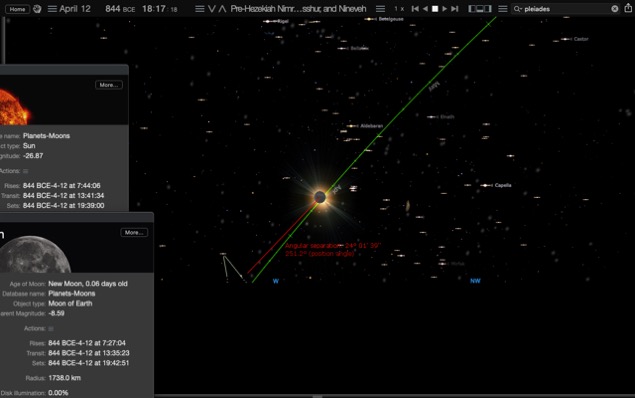
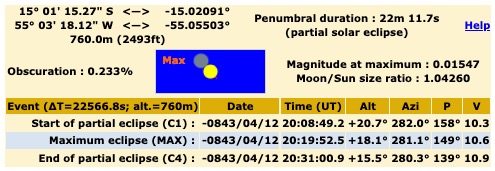
Apr
12, 844 BCE solar eclipse with maximum 17 degrees above the horizon where the
Swallow (Pisces) is setting. On the 2nd row of the Black Obelisk we see Jehu, the Samaritan (King
of Israel), kissing the dirt in front of Shalmaneser III, the Assyrian king
in Shalmaneser's 11th year. Cf. the very similar event as described above at
Shalmanesers 3rd year, at which time the maximum eclipse was only 9 degrees
above the horizon. Thus also corresponding with the shorter distance between
the images of the Sun and the Swallow seen on the 1st row of same obelisk.
Notice, however, that this eclipse took place on April 12 at the beginning of
the spring to spring calendar year. It being therefore a road sign in time at
the beginning of Shalmaneser's 11th or else 12th year. Is this an apparent
disagreement between the 3rd and 11th year of the obelisk vs the timing of
these two solar eclipse events? Or else, was this latter solar eclipse
considered an event at the end of the 11th calendar year?
Side 1, line 2. Notice the symbols of the Sun and of
the Swallow! Notice in particular their position and distance relative to one
another! The second one (above) of the two reliefs on the obelisk showing
celestial objects. Side 1, line 1: Notice the symbols of the Sun “In the eleventh year of my reign, I crossed the euphrates
for the ninth time. I captured countless cities. I descended upon cities of
the land of Hamath. I captured 89 cities. Hadad-ezer
[Ben-Hadad II] of Aram and twelve kings of the land of Hatti stood by each
other. I was successful in overthrowing them. (Lines 87-89)” (From bible.ca) Another translation
of the obelisk text. And another. Please
notice, in the above quote, the phrase “twelve
kings of the land of Hatti”! That is, the twelve tribes of Israel… “[This
inscription mentions the Syrian wars against Hadad, but does not mention
Hazael. He says it is the fourth time they have fought, which is already more
than we know about with Hadad. Presumably that would date this inscription around year 17]: “I brought in subjection the land of Hatti to its farthest border, the land
of Melidi, the lands of Daiani and Suhme, Arzashkun, the royal city of Arame
of Armenia, the lands of Gilzanu and
Hubushkia, from the source of the Tigris to the source of Euphrates,
from Lake Urmia, to the Persian Gulf. I marched to
Babylon, offered sacrifices there and went down to the land of Chaldea. I
captured their cities and received their tribute. Hadad-ezer of
Damascus, Irhulini of Hama, along with 15 coastal cities, advanced against
me, I fought with them for the fourth time and brought about their overthrow.
[I destroyed their chariots and cavalry, and appropriated their battle
equipment. They fled for their lives… ”I
conquered the entire Hittite-land; I entered into the passes of the
land of Enzite and conquered Suhme, Daiani and Armenia. I accepted tribute of Gilzanu for the second time. For
the third time I marched against the land of Nairî, I enscribed my name at
the source of the Tigris.” (
https://jewishchristianlit.com/annalsshalmaneser3/) In the quote above, please notice the very
extensive area covered by the Assyrian king! Accordingly, depending on his
whereabouts, the solar eclipse would have appeared more or less total or
partial.
11th year vs 3rd year
eclipse – Moon to the left vs Moon to the right of the Sun
11th year vs 3rd year
altitude above the horizon of the eclipse – 23 degrees vs 9 degrees 11th year of Shalmaneser III: Apr 12, 844 BCE partial solar eclipse near sunset (23 deg above the horizon at time of maximum AND the Moon passing the Sun
on the left side)
while Pisces (The Swallow) is setting behind the horizon.
11th year vs 3rd year
obelisk appearance – left vs right and greater vs lesser distance between the
two icons. The two icons, in the 11th year, more
distant from one other,
corresponding to the above 23 degrees above the horizon – as also a less
close approach between the Sun and the Moon in this 11th year
event. Notice also the relative left vs right positions between the
two icons (the Sun to the right in the 11th year) vs between the Sun to the left
and the eclipsing Moon on the right in the 3rd year event!
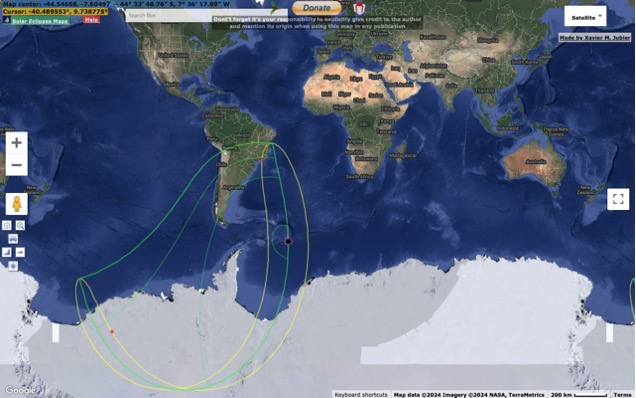
Please notice the tiny geographical area around 15S
55W, shared by both of the eclipses defined on the Black Obelisk, as
identified by the above eclipse maps, for Nimrud-Kalhu-Asshur, in the 3rd
and 11th year of King Shalmaneser III! |
||||||||||||||||||||||||||||||||||||||||||||||||||||||||||||||||||||||||||||||||||||||||||||||||||||||||||||||||||||||||||||||||||||||||||||||||||||||||||||||||||||||||||||||||||||||||||||||||||||||||||||||||||||||||||||||||
|
15 |
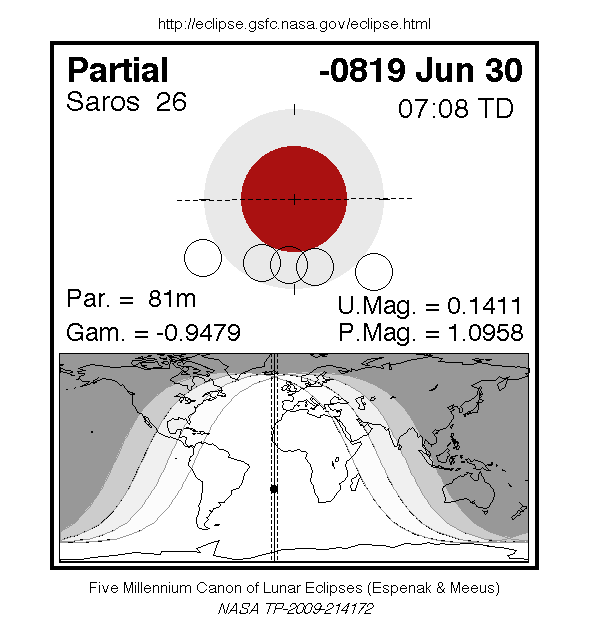
A 0.1411 umbral magnitude partial lunar eclipse as viewed from pre-Hezekiah, pre pole shift, Nimrud-Kalhu-Asher at 15S
55W. |
June 28/29, 820
BCE. Shamsi-Adad V’s accession year. |
Quote: ”Shamshi-Adad V (Akkadian: Šamši-Adad)
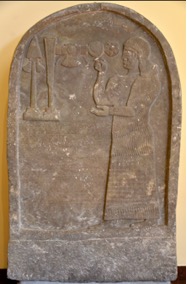
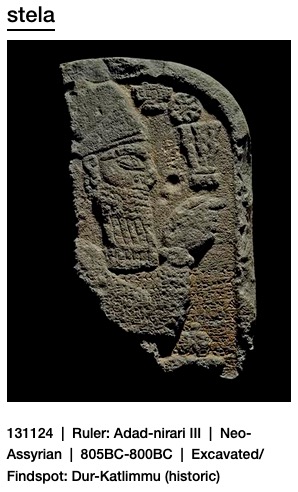
was the King of Assyria from Notice the almost identical celestial icons in
comparison to Assurnasirpal II’s stela above! Shamsi-Adad V’s icons being
only slightly more rotated to the left (counter clockwise). More below…
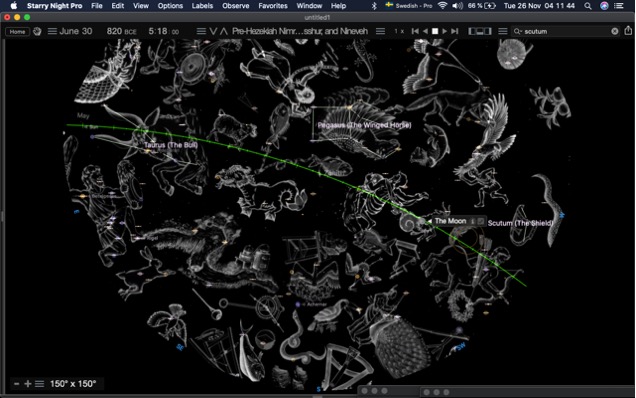
June 29, 820 BCE partial lunar eclipse as
the Moon is entering into Earth’s shadow. 1) Scutum and 2) Pegasus (The
Winged Horse) has already risen above the horizon at the time of 3) the
beginning of the lunar eclipse. Thus also the order indicated on Shamsi-Adad
V’s stele with 1) the Scutum icon at the top, followed by 2) the Pegasus (The
Winged Horse) icon below, and then 3) the lunar eclipse icon…
Followed a few hours later by 4) Taurus
rising above the horizon a few hours before 5) sunrise. As indicated also by
the stele’s Taurus icon, the 4th icon from the top, and lastly by
5) the Sun icon closest to 6) the King’s finger that is pointing out the
horizon. Strangely enough, so far as the rotation of
the icons, it appears as though the King is viewing the celestial objects
while facing south, not east or west? That is, 1)
The sky viewed while facing south. Well,
when located on the southern hemisphere, the darkest portion of the sky is
the southern sky. Accordingly, if the King viewed the sky from a balcony
facing south while having an open view also to the east and to the west, then
this would make sense, wouldn’t it?
|
||||||||||||||||||||||||||||||||||||||||||||||||||||||||||||||||||||||||||||||||||||||||||||||||||||||||||||||||||||||||||||||||||||||||||||||||||||||||||||||||||||||||||||||||||||||||||||||||||||||||||||||||||||||||||||||||
|
16a |
A 0.9676 near total umbral magnitude partial
lunar eclipse as viewed from pre-Hezekiah, pre pole shift, Nimrud-Kalhu-Asher at 15S
55W. |
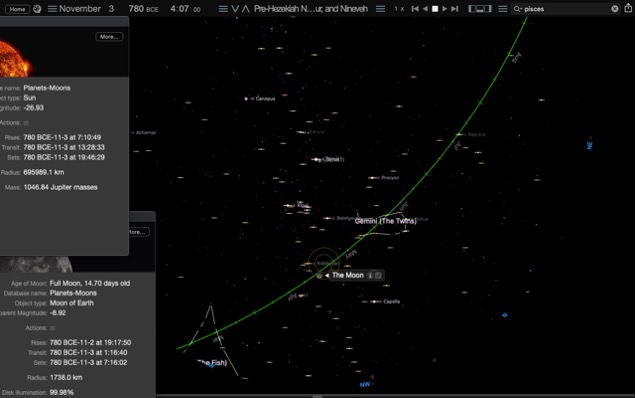
Nov 3, 780 BCE 0.9676 umbral magnitude near total
lunar eclipse in Shalmaneser IV’s accession year. As represented upon the Stele
of Bel-harran-beli-usur, an Assyrian palace herald, made during Shalmaneser
IV's reign. |
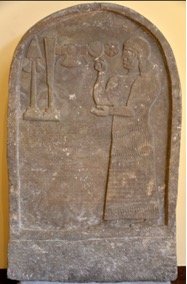
Stele of Bel-harran-beli-usur, an Assyrian palace herald,
made during Shalmaneser IV's reign. “[105]
Šalmaneser [IV], son of Adad-nirari, ruled for 10 years (
Nov 3,
780 BCE near total lunar eclipse. Eight plus hours past 1) sunset Consider this: Gemini (The Twins), as in a
double (hidden) meaning… Notice however, that the man in the stele is facing
and pointing to the left = east, whereas this Nov 3, 780 BCE is an event in
the west. Thus, this Nov 3, 780 BCE can only be a secondary, mirror image
type, correlation with the event referenced on the stele. |
||||||||||||||||||||||||||||||||||||||||||||||||||||||||||||||||||||||||||||||||||||||||||||||||||||||||||||||||||||||||||||||||||||||||||||||||||||||||||||||||||||||||||||||||||||||||||||||||||||||||||||||||||||||||||||||||
|
16b |
A 0.1020 umbral magnitude partial lunar eclipse
as viewed from pre-Hezekiah, pre pole shift,
Nimrud-Kalhu-Asher at 15S 55W. |
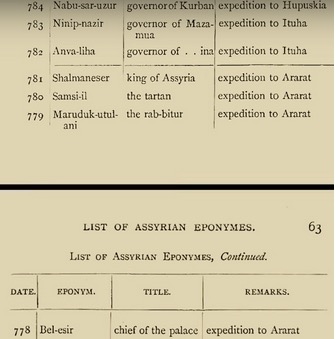
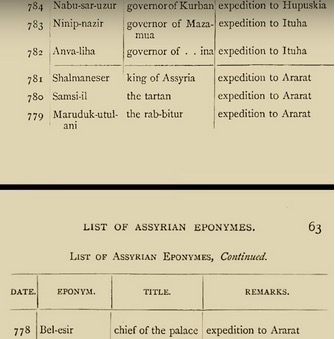
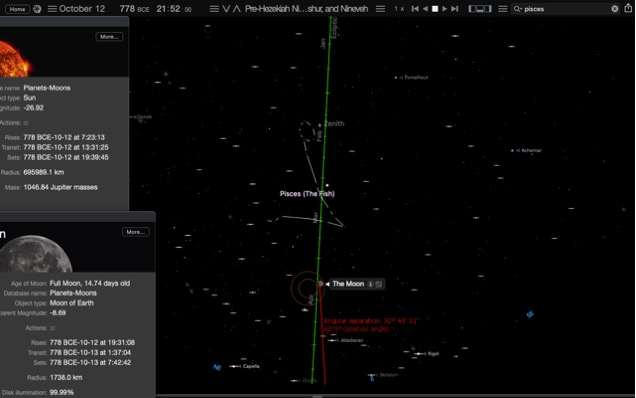
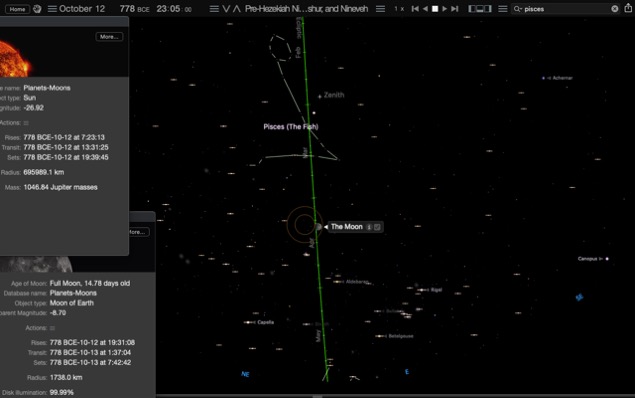
Oct 12, 778 BCE in the 2nd or 3rd
calendar year following Shalmaneser IV’s eponym year, i.e. when Bel-esir
(=Bel-harran-beli-usur?), chief of the palace, held the eponym title. Could
it be that Bel-harran-beli-usur erected his stele not only in honor of King Shalmaneser IV, but also
in honor of himself? That is, by making the five celestial icons on the stele
that could be interpreted to represent either one or both of two different
lunar eclipses while also two different government persons, the King and the
‘chief of the palace’? |
Stele of Bel-harran-beli-usur, an Assyrian palace herald,
made during Shalmaneser IV's reign. “[105]
Šalmaneser [IV], son of Adad-nirari, ruled for 10 years (
Oct 12, 778 BCE.
1) About 2 hours past sunset Consider this: Gemini (The Twins), as in a
double (hidden) meaning… |
||||||||||||||||||||||||||||||||||||||||||||||||||||||||||||||||||||||||||||||||||||||||||||||||||||||||||||||||||||||||||||||||||||||||||||||||||||||||||||||||||||||||||||||||||||||||||||||||||||||||||||||||||||||||||||||||
|
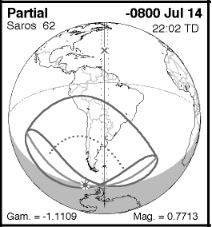
17 |
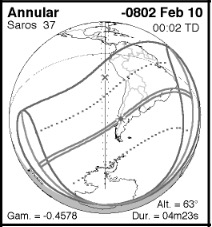
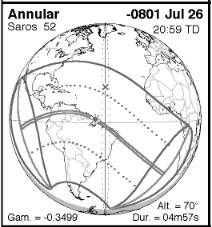
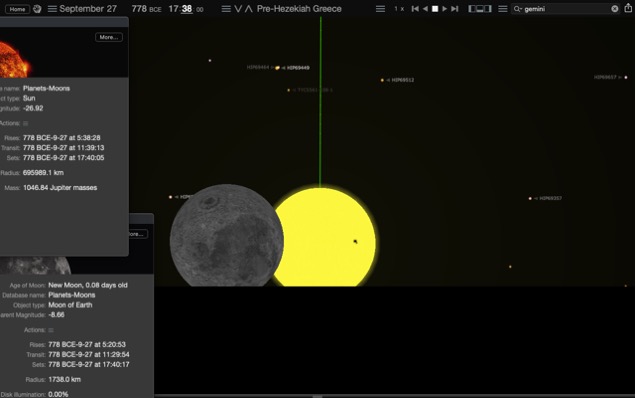
An annular or partial Solar Eclipse as seen from the pre-Hezekiah, pre 699/698 BCE pole shift location of Greece… |
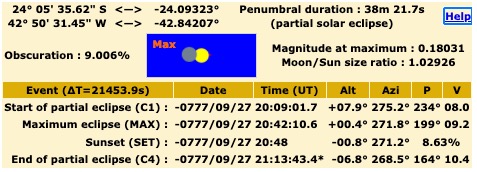
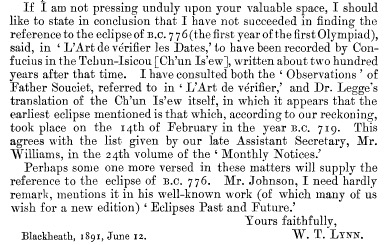
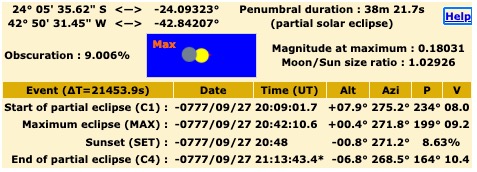
Sep 28, 778 BCE solar eclipse: An eclipse in “the first year of the first Olympiad… written about two
hundred years after that time…”? Question is: If that is true, which solar
eclipse does this represent? |
The corrected
”B.C. 776… first year of the first Olympiad…” was the year 779/778 BCE, not
“B.C 776.” Quote:
Question is: If that is true,
which solar eclipse do these words represent: “B.C. 776 (“the first year of
the first Olympiad)”? Cf. also the Pre-Hezekiah map of Earth’s coordinate
system below! Per my file ScriptureChronology.xls, the first year of the first
Olympiad was the year 779/778 BCE, not “B.C. 776…”. The one and only solar
eclipse that would have been visible in Pre-Hezekiah Greece, or even in the
Middle East and Europe (20-50S 18-70W; Greece at about 24S 41W; cf. map
below) between fall 779 BCE and fall 778 BCE, is the Sep 28, 778 BCE eclipse,
which would have been visible from Pre-Hezekiah Greece at sunset time:
- - - - - - - - - - - - - - - - - - - - - - - - The coordinate
system of Earth prior to the 699/698 pole shift:
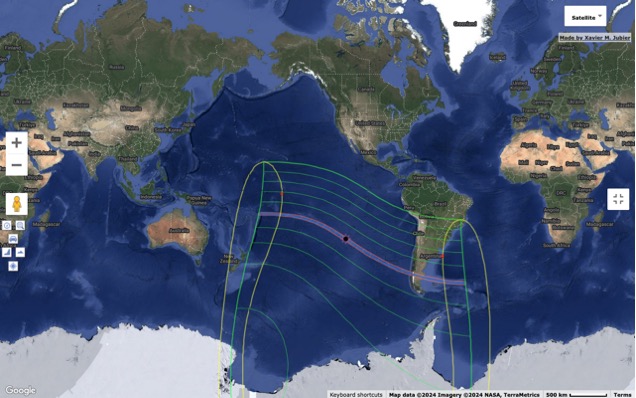
The one and only solar eclipse that covered any part
of Europe and the Middle East was the Sep 27, 778 BCE solar eclipse shown on
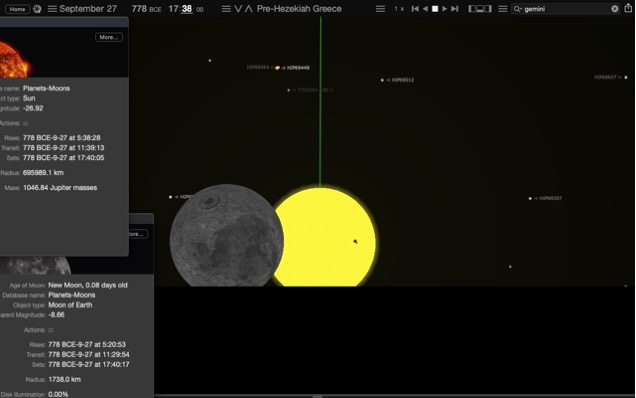
this map of our current globe. Comparing the above two maps, I find that the total
solar eclipse would have been experienced along all of Scandinavia, Great
Britain, and Ireland, while Greece would have experienced a partial solar
eclipsesomething close to this:
Conclusion: The
Sep 28, 778 BCE solar eclipse is more than likely the solar eclipse that
occurred in the 1st year of the 1st Olympiad. As such
it constitutes further confirmation for the 15th year of
Hezekiah’s reign pole shift. However, the dates indicated in W. T. Lynn’s
article are largely in error and uncertain! |
||||||||||||||||||||||||||||||||||||||||||||||||||||||||||||||||||||||||||||||||||||||||||||||||||||||||||||||||||||||||||||||||||||||||||||||||||||||||||||||||||||||||||||||||||||||||||||||||||||||||||||||||||||||||||||||||
|
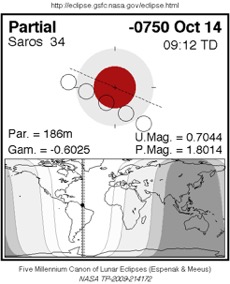
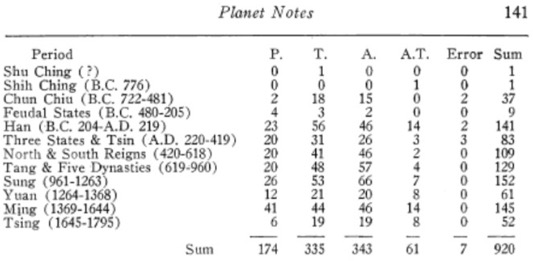
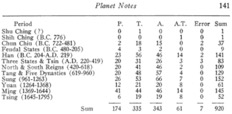
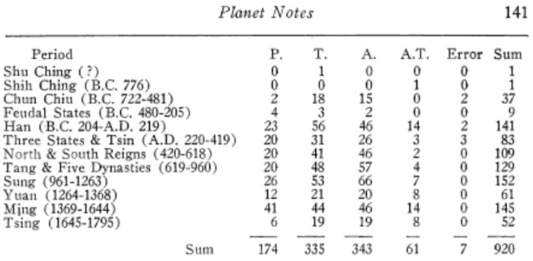
18 |
The 2nd item in a
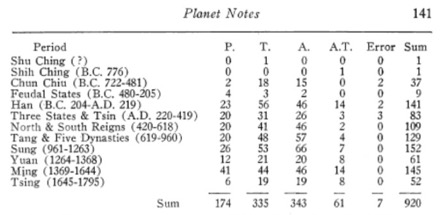
Chinese list of 920 solar eclipses: A lunar
eclipse preceding a total Solar Eclipse as observed from pre-Hezekiah, pre-pole shift China. |
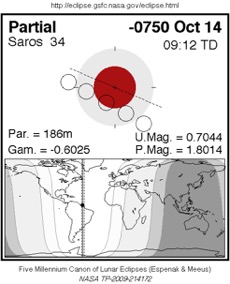
October 14, 751 BCE partial lunar eclipse. This
lunar eclipse is recorded as preceding the Shih Ching solar eclipse
referenced on the 2nd row of the list below:
|
Preceding the Oct 18, 751
BCE total solar eclipse recorded in China: A 70% lunar eclipse on Oct 14, 751
BCE, which was visible throughout pre-Hezekiah, pre-pole shift, China,
beginning 86± min after sunset. For details, please cf. the next item below!:
|
||||||||||||||||||||||||||||||||||||||||||||||||||||||||||||||||||||||||||||||||||||||||||||||||||||||||||||||||||||||||||||||||||||||||||||||||||||||||||||||||||||||||||||||||||||||||||||||||||||||||||||||||||||||||||||||||
|
19 |
The 2nd item in a
Chinese list of 920 solar eclipses: A total
Solar Eclipse as observed
from pre-Hezekiah, pre-pole
shift China. |
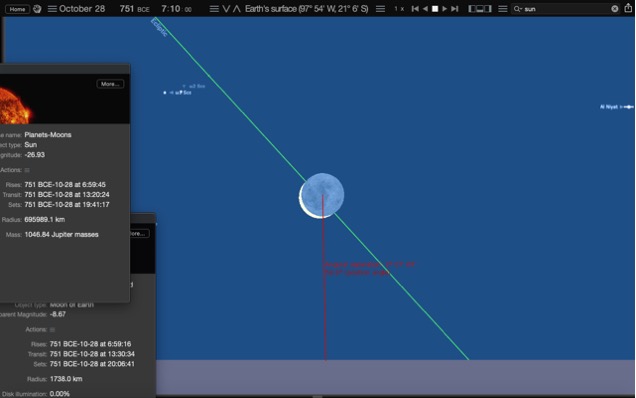
October 28, 751 BCE total solar eclipse. The Shih
Ching eclipse referenced on the 2nd row of the list below:
|
A pre-Hezekiah, pre-pole
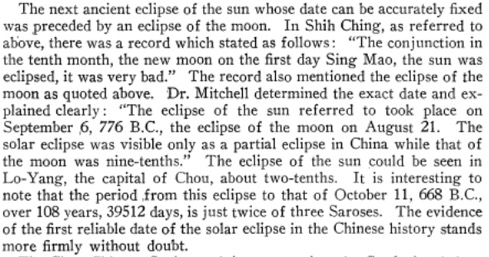
shift, total solar eclipse recorded in China: “In Shih Ching… there was a
record which stated as follows: “The
conjunction in the tenth month, the new moon on the first day Sing Mao, the
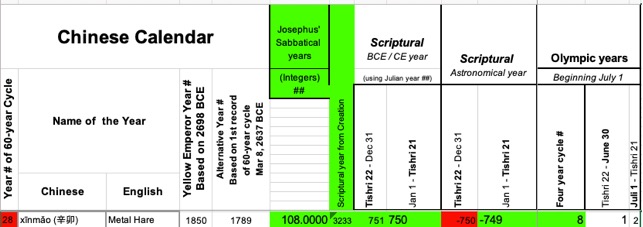
sun was eclipsed, it was very bad.” “Sing Mao” aka “xīnmǎo (辛卯)” or “Metal Hare” is the name of the 28th
year of the Chinese 60-year cycle calendar, which calendar is seasonally
adjusted by intercalated months, month #1 typically beginning in November or
December:
Earth’s coordinate system prior to the 699/698 BCE pole
shift. Including China at 5±15S 96±16W (22S-10N 80-112 W).
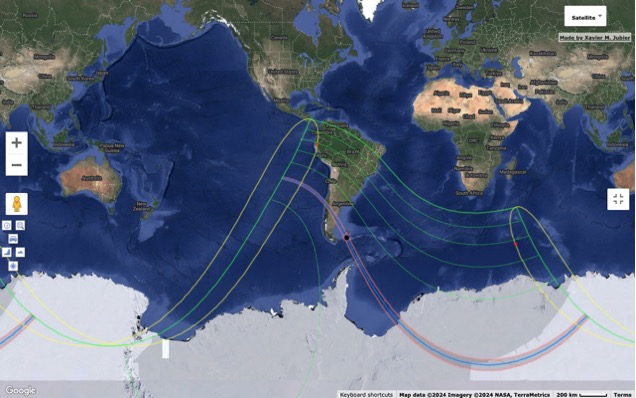
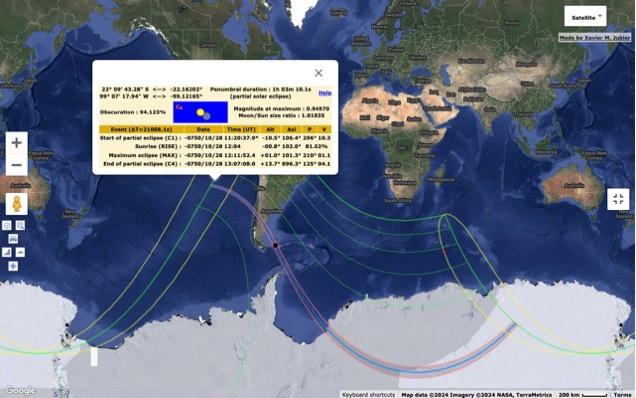
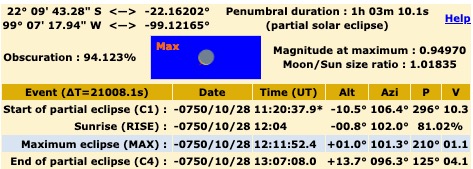
Map showing visibility of the Oct 28, 751 BCE total solar
eclipse. As viewed from a location within pre-Hezekiah, pre-pole shift, China
at 21°
S 97° W. Certainly
satisfying the criteria for a “bad” eclipse:
And this solar eclipse was
preceded by a 70% lunar eclipse on Oct 14, 751 BCE, which was visible
throughout pre-Hezekiah, pre-pole shift, China, beginning 86± min after
sunset:
This solar eclipse has
previously been [mis-]identified as the Sep 6, 776 BCE hybrid solar eclipse.
That is, while unaware of the subsequent 699/698 BCE pole shift that
relocated China from around 5°±15° S 105°±15° W to its current location. And in spite of that Sep
6, 776 BCE eclipse occurring, not in the 28th year, “Sing Mao” aka
“xīnmǎo (辛卯)” or “Metal Hare”, as per the original record, but
in the 3rd year named “bǐngyín
(丙寅); Fire Tiger.”:
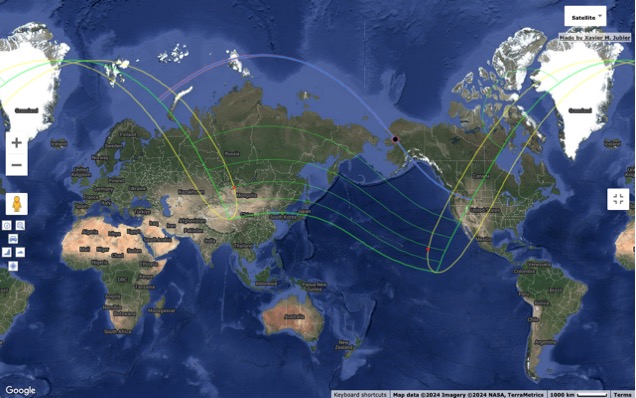
Map showing visibility of the Sep 6, 776 BCE hybrid
solar eclipse. Visible at China’s current location only in the
northernmost parts of China, and with a maximum obscuration of 30 degrees as
viewed from within China. Not very “bad” and not a very good match for the
available recorded data even if there had been no subsequent pole shift:
|
||||||||||||||||||||||||||||||||||||||||||||||||||||||||||||||||||||||||||||||||||||||||||||||||||||||||||||||||||||||||||||||||||||||||||||||||||||||||||||||||||||||||||||||||||||||||||||||||||||||||||||||||||||||||||||||||
|
20a |
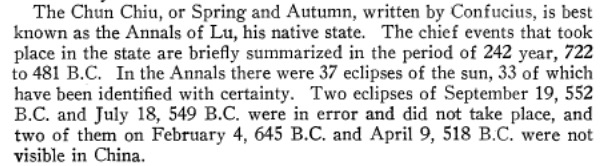
In a Chinese record of 37 solar
eclipses, the Annals of Lu aka Ch’un Ts’ew or Chun Chiu, we find a total Solar Eclipse as observed from China if there has been no pole
shift since the time of this solar eclipse. Cf item 20b below! |
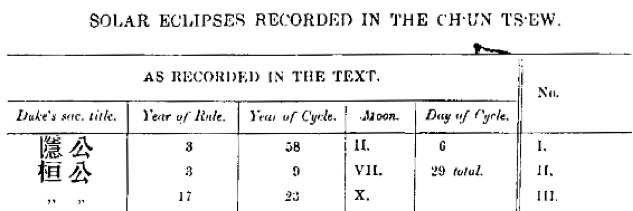
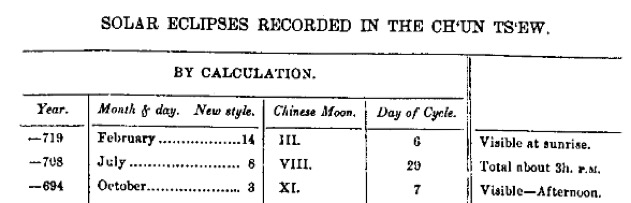
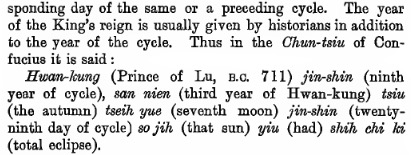
February 22, 720 BCE total solar eclipse. This
eclipse was indeed visible as “No. I… Visible at sunrise” as indicated in Dr Legge’s
list. That is, provided China was then located at the same geographical
coordinates as it is currently. That is, if there was no pole shift since
that time.
|
This item 20a is most
likely the eclipse intended by the editor that compiled the list found in Dr
Legge’s book, and who also computed and generated the list headed “BY
CALCULATION”. However, this eclipse is not necessarily the eclipse indicated
by the original Chinese record, “Ch’un Ts’ew” or “Chun Chiu”, as referenced
also by the “Year of Cycle… 58” in the list headed “AS RECORDED IN THE TEXT”
below. (It is obvious that the data found in the list headed “BY CALCULATION”
did not even exist as such until the Astronomical Calendar and until the
Julian/Gregorian calendar were created, and also that the data provided in
the columns “Chinese Moon” and “Day of Cycle” of the “BY CALCULATION” list
does not consistently agree with the corresponding data in the “AS RECORDED
IN THE TEXT” column.)
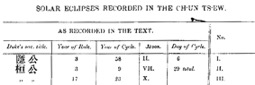
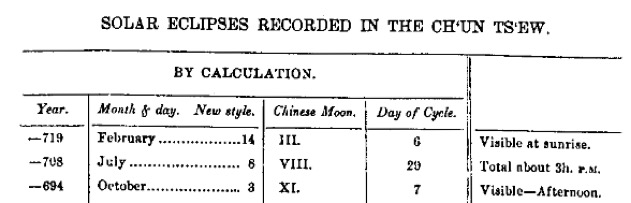
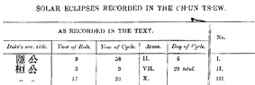
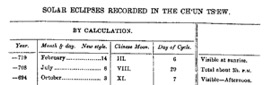
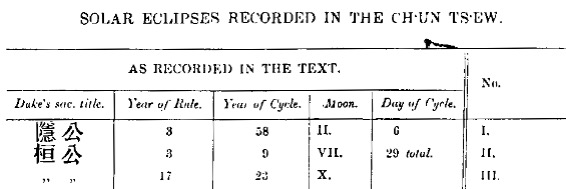
(Solar Eclipses in Chinese History, p. 137) Re “No. I.” in the two
lists below (under the title SOLAR ECLIPSES RECORDED IN THE CH’UN TS’EW) “-719… February… 14…”
“Moon… II” “Year of Cycle… 58” “Chinese Moon… III” “Visible at sunrise.”
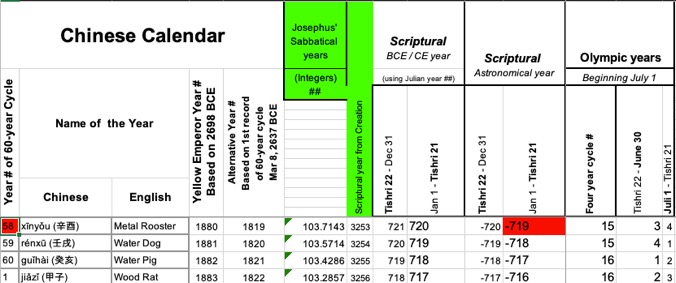
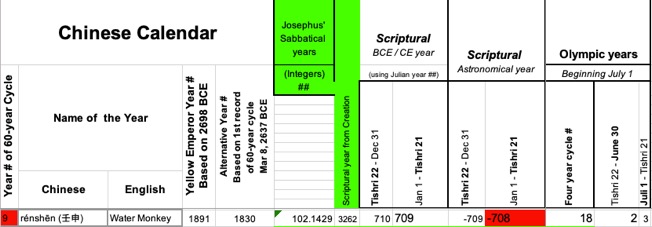
Re “Year of Cycle… 58”:
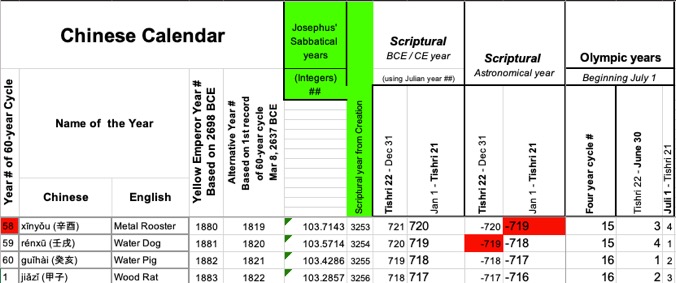
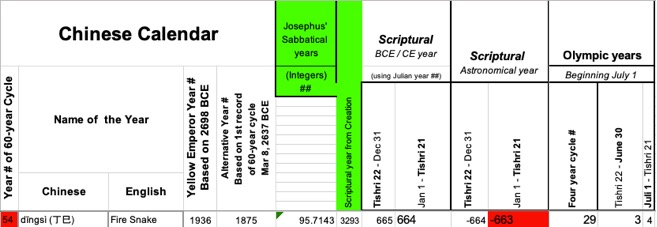
Screen print from my file
ScriptureChronology.xls. Notice that Chinese calendar year
58, as given in Dr Legge’s list of eclipses, agrees perfectly with that year
being the astronomical year -719 BCE. Not so if said “No. I” eclipse was the
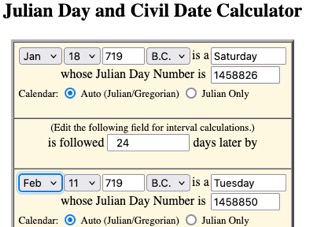
February 11, 719 BCE solar eclipse identified as item 20b below, which item
20b must be the eclipse observed in China if there was a pole shift
subsequent to the “No. I” eclipse recorded in the “AS RECORDED IN THE TEXT”
list..
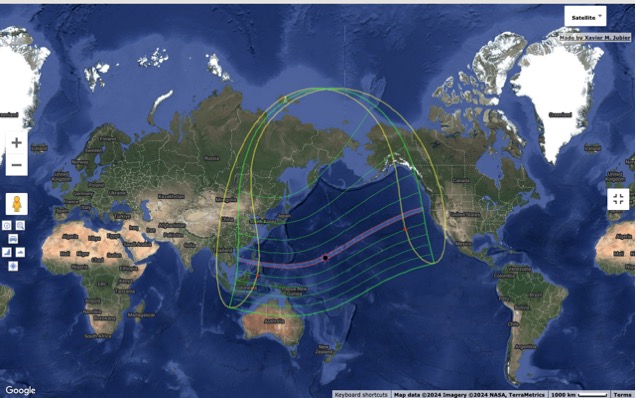
Map showing visibility of the February 22, 720 BCE total
solar eclipse. This eclipse was indeed visible as “Visible at sunrise” as
indicated in Dr Legge’s list. His only remaining apparent error, re this item
“No. 1”, then being “February… 14” rather than the correct “February 22”,
that is, most likely, this error of a few days difference is due to a
systematic error present also in most or all of the listed 37 solar eclipses.
It is obviously due to an incorrect method[18] of
calculating ancient dates. . Re “Moon… II.”: If this February 22, 720 total solar eclipse is
correctly identified as the “No. I” eclipse, then the “Moon… II” in the “AS
RECORDED IN THE TEXT” list above agree perfectly with the Wikipedia words
quoted below. That is, if so, then Moon I began Dec 26, 721 BCE, Moon II
began Jan 25, 720 BCE, and Moon III began Feb 23, as defined by the visible
New Moon crescent observation in China. Astronomical New Moon occurred on
December 25, 721 BCE at 1 PM local time in China, visible New Moon, as viewed
from China, occurred on Dec 26, 721 BCE, and winter solstice occurred on
December 28, 721 BCE at 3 AM.. Accordingly, if the visible New Moon was used
for identifying the Chinese months, then this solar eclipse fell within
“Month… II”, if the astronomical New Moon was used for identifying the
“Chinese Moon”, then this was “Month… III”. “Zhou dynasty
The first lunisolar calendar was the Zhou calendar (周曆; 周历),
introduced under the Zhou dynasty (1046 BCE – 256 BCE). This calendar sets
the beginning of the year at the day of the new moon before the winter
solstice.” For comparison:
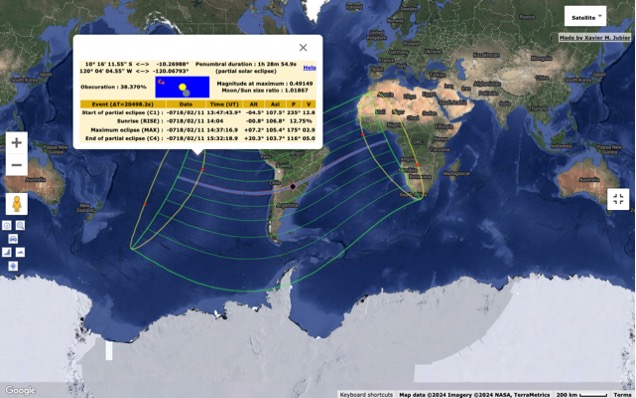
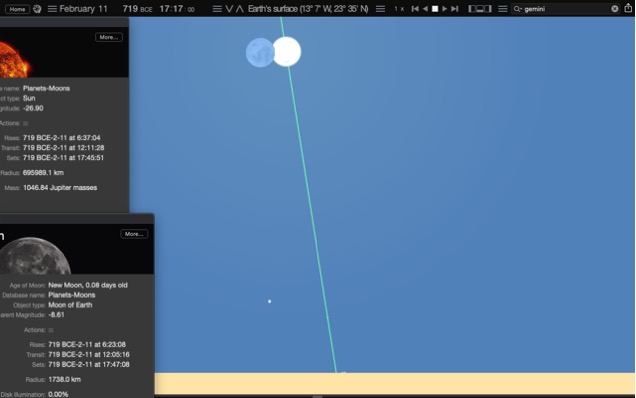
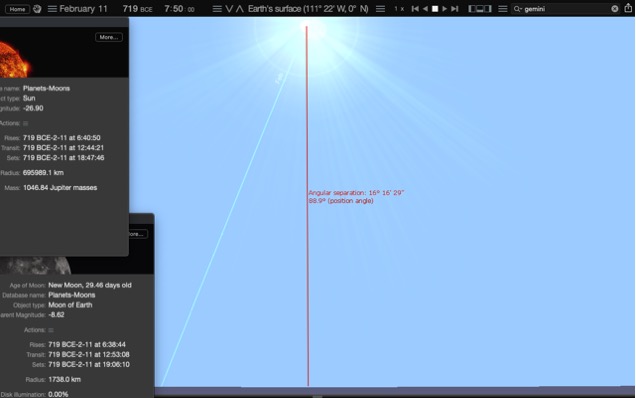
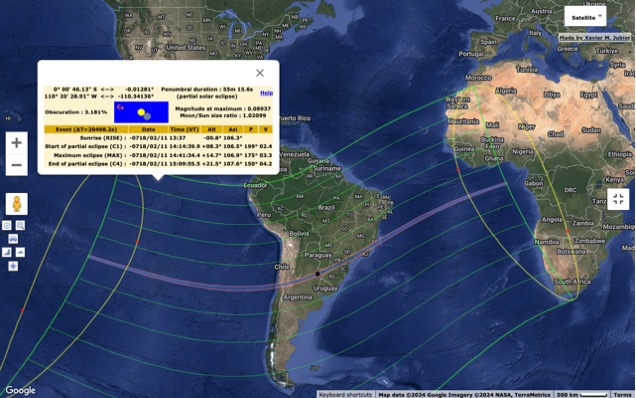
Map showing visibility of the February 11, 719 BCE
total solar eclipse, and, in the window pointing at the ancient location of
China, the particulars of the solar eclipse at the location corresponding to
the Chinese record. It is obvious from this map that if China was located at
the same geographical coordinates as presently, then this Feb 11, 719 BCE
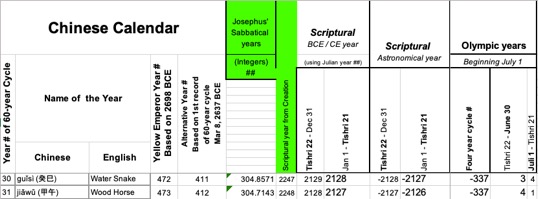
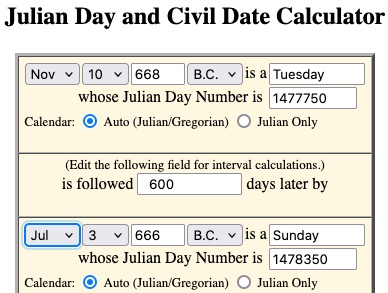
solar eclipse could not possibly have been observed from anywhere near China. Re “Day of Cycle… 6”: “Day of Cycle… 6” should mean the 6th day
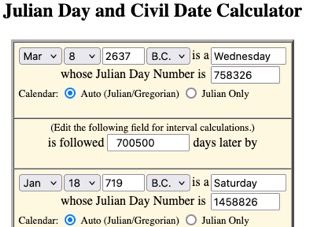
in a recurring cycle of exactly 60 days. Using this
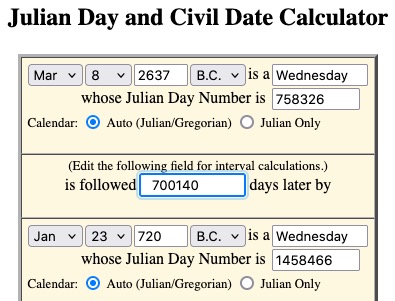
basis: “An
alternative system is to start with the first historical record of the 60-day
cycle from March 8, 2637 B.C.E.” Unfortunately, I find no exact date
associated with “2698 B.C.E.” I get this
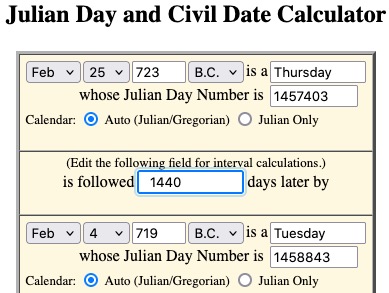
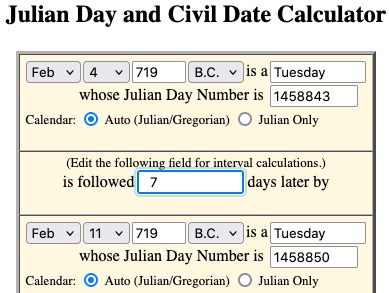
result. But that gives me 30, not “Day of Cycle… 6”. Why? A difference of +24
days (or -36 days)! I don’t yet know!:
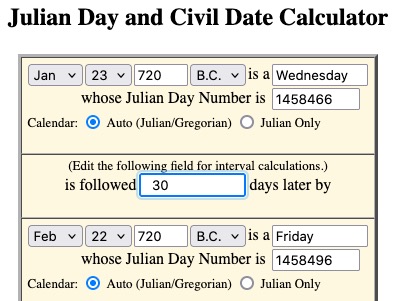
However, if we begin our “Day of
Cycle” count with New Moon #1 of this particular Chinese “Year of Cycle”, we
get: New Moon #1: Jan 23, 720 BCE
results in 57, not “Day of Cycle… 29”. A difference of 28 days
(or -32) for this no pole shift vs this solar eclipse application:
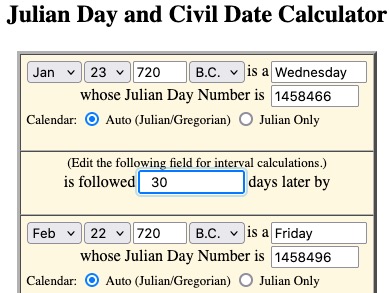
That is, I get 30,
not “Day of Cycle… 6”. A difference of +24 days (or -36 days) for this no
pole shift vs this solar eclipse application. Not a good fit! Why, I don’t yet know!
Likewise, re the “No. I… --719…
February… 14” entry in the list… |
||||||||||||||||||||||||||||||||||||||||||||||||||||||||||||||||||||||||||||||||||||||||||||||||||||||||||||||||||||||||||||||||||||||||||||||||||||||||||||||||||||||||||||||||||||||||||||||||||||||||||||||||||||||||||||||||
|
20b |
In a Chinese record of 37 solar eclipses,
the Annals of Lu aka. Ch’un Ts’ew, Chun-tsiu, or Chun Chiu, of Confucius we
find: A total
Solar Eclipse, observed at
least as partial from
a pre-Hezekiah, pre 699/698 BCE pole shift location in China… |
Feb 11, 719 BCE total solar eclipse, visible in
China only if there has since been a very significant pole shift and if China
was then located at 10±S 110±W. An eclipse referenced by the words “…the earliest eclipse mentioned is
that which, according to our reckoning, took place on the 14th of
February in the year B.C. 719”?
|
”14th of February in the
year B. C. 719”? Really? - Per NASA’s listings there was no
eclipse on that date?! - Yet, pursuing this item to
perfection proves to be exceptionally rewarding… Quote:
Question is: If there is truth
behind the words above quoted, which solar eclipse does this represent? Cf. also the Pre-Hezekiah map of Earth’s coordinate
system above!
Well, Feb 11 is
not ”Feb 14”, but per the Pre-Hezekiah map
above the above -718 Feb 11 solar eclipse was certainly visible in the
pre-Hezekiah location of Middle-East and Europe around noon time (cf.
below…). JD Feb 11, 719 BCE corresponds to PH Feb 12, 719 BCE. “14th
of February” may well be an error based upon a misunderstanding of the
language in the original record, or even a
simple one figure typographical error. As seen above, of
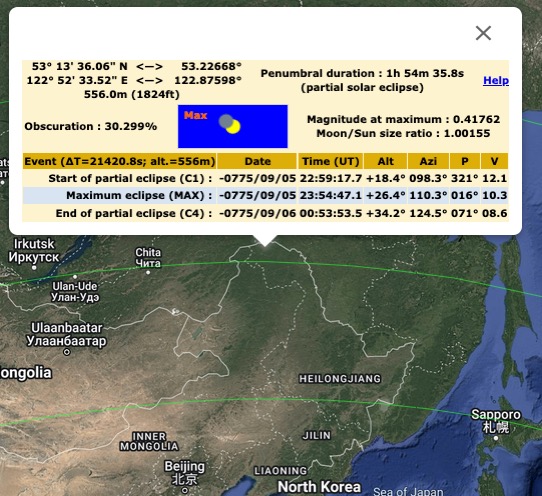
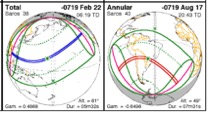
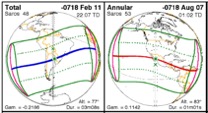
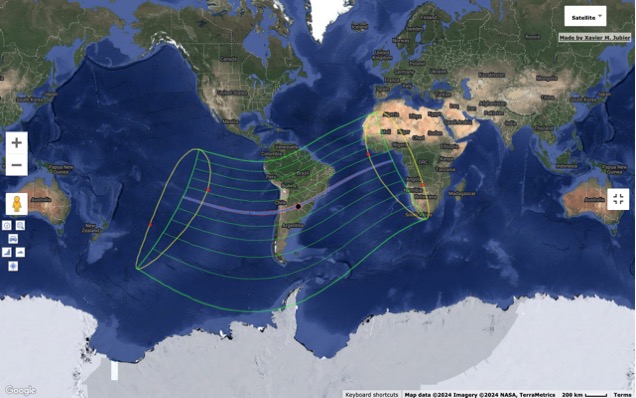
the above solar eclipses, the one and only solar eclipse visible from any one
place within our current, post-Hezekiah, location of Middle East, Europe,
Africa, or Asia, was the -0718 Feb 11 eclipse, which would have been visible
from nowhere within Middle East, Europe, Africa, or Asia, except for the
coast of West Africa, including Marocco, as currently located. More
significantly, this -718 Feb 11 eclipse would also have been visible from
pre-Hezekiah China (at 0±10S 110±10W)!:
The pre-Hezekiah
Feb 12, 719 BCE solar eclipse as viewed from the current location of Marocco.
The Feb 12, 719
BCE solar eclipse as viewed from Pre-Hezekiah China at 0±10S 110±10W. The Feb 12, 719
BCE solar eclipse path. The inserted window showing particulars pertaining to
Pre-Hezekiah China:
Or, if ”14th
of February… B.C. 776” is based upon the current erroneous Olympiad reckoning,
one of these eclipses?
But
there is no February eclipse among these last three eclipses! Conclusion: This ”14th of February in
the year B. C. 719” eclipse is most likely an error for Feb 12, 719 BCE,
based on a less than perfect translation of a Chinese calendar date provided
in a Chinese record written in the Chinese language! As such I find reason
for pursuing the original Chinese record of this eclipse!... Indeed, to begin
with, I found a complete and free pdf version
of Dr Legge’s book, above referenced[19]… and
in it a list with detailed descriptions of 37 solar eclipses observed in
China, the first two prior to the 699/698 BCE pole shift: Feb 14, 719 BCE,
and Jul 5, 708 BCE. Re “No. I.” in the two
lists below (under the title
SOLAR ECLIPSES RECORDED IN THE CH’UN TS’EW) “-719… February… 14…”
“Moon… II” “Year of Cycle… 58” “Chinese Moon… III” “Visible at Sunrise”
Earth’s coordinate system prior to the 699/698 BCE
pole shift. Including China at 5±15S 96±16W (22S-10N 80-112 W).
Map showing the path of the Feb 11, 719 BCE total
solar eclipse. It is obvious from this map that if China was located at the
same geographical coordinates as presently, then this Feb 11, 719 BCE solar
eclipse could not possibly have been observed from anywhere near China, or
isn’t that so?! However… Seeing from the above map of Earth’s Pre-Hezekiah geographical
coordinates that China was at that time [Feb 11, 719 BCE] located around 5°±15°S 96°±16°W, we may now correlate the following info from Dr
Legge’s book with the Feb 11, 719 BCE total solar eclipse:
I find that Re “Year of Cycle… 58”:
Screen print from my file
ScriptureChronology.xls. Notice that Chinese calendar year
58, as given in Dr Legge’s list of eclipses, agrees perfectly with that year
being the astronomical calendar year -719 BCE. Apparently not so if said “No.
I” eclipse was this February 11, 719 BCE solar eclipse, which must be the
eclipse observed in China if there was a pole shift subsequent to (in 699/688
BCE) the “No. I” eclipse recorded in the “AS RECORDED IN THE TEXT” list.
However, if, somehow, “February… 14” was reckoned as being placed within the
last portion of that 58th calendar year, then perhaps it would be
possible? At first I didn’t see how. Perhaps a scribal error carryover from
the prior year? Or, perhaps a post-pole shift editor’s “correction” of the
“Year of Cycle” entry, based upon his blindness for the reality of the pole
shift?… Well, considering China’s
pre-Hezekiah, pre-pole shift, location, a great portion of China being then
located on the southern hemi-sphere, the winter solstice AND the Chinese New
Year, could be reckoned as occurring, not in December, but in June, when the
southern hemi-sphere winter solstices were experienced. Accordingly, the pole
shift year in China would have consisted of either 6 or 18 months, more or
less. That is, a seasonal adjustment in the nature reminiscent of
intercalated days or months. Testing this scenario against the existing solar
eclipses, and against the above Chinese record, I find that the “Year of
Cycle” of the pole shift was a short 6 months long year between two
subsequent winter solstices. (Cf. the table below from my file
Testing3ScenariousForCompatibilityWithChineseSolarEclipses.xlsx). The
sequence of months from I-XII, however, would not have been disrupted.
Instead, the New Year would have simply been moved from fall to spring, from
month #7 to month #1, much like the Hebrew and Biblical calendars:
Re “Moon… II.”: If this February 11, 719 total solar eclipse is correctly
identified as the “No. I” eclipse, then the “Moon… II” in the “AS RECORDED IN
THE TEXT” list above agrees perfectly with the Wikipedia words quoted below.
That is, if so, then Moon I began Dec 15, 720 BCE, Moon II began Jan 14, 720
BCE, and Moon III began Feb 14, as defined by the visible New Moon crescent
observation in Pre-Hezekiah, pre-pole shift, China at 10S, 110W.Winter
solstice occurred on December 27, 720 BCE at noon local time. Accordingly,
this Feb 11, 719 BCE solar eclipse fell within “Month… II”. “Zhou dynasty
The first lunisolar calendar was the Zhou calendar (周曆; 周历),
introduced under the Zhou dynasty (1046 BCE – 256 BCE). This calendar sets
the beginning of the year at the day of the new moon before the winter
solstice.” Re “Day of Cycle… 6”: “Day of Cycle… 6” should mean the 6th day
in a recurring cycle of exactly 60 days. Using this
basis: “An
alternative system is to start with the first historical record of the 60-day
cycle from March 8, 2637 B.C.E.” Unfortunately, I find no exact date
associated with “2698 B.C.E.” I get this
result. But that gives me 24, not “Day of Cycle… 6”. Why? A difference of +18
days (or -42 days)! I don’t yet know!:
However, if we begin our “Day of
Cycle” count with New Moon #1 of this particular Chinese “Year of Cycle”, we
get: New Moon #1: Jan 23, 720 BCE
results in 57, not “Day of Cycle… 29”. A difference of 28 days
(or -32) for this no pole shift vs this solar eclipse application:
That is, I get 29,
not “Day of Cycle… 6”. A difference of +23 days (or -37 days) for this
pre-Hezekiah, pre-pole shift vs this solar eclipse application. Not a good
fit! How about backtracking our 60-day cycles as
beginning on a prior “Moon… VII” or “Moon… I” to the New Moon at the end any
potential last prior intercalated month?... Well, so doing provides:
So doing I get 7, not “Day of Cycle… 6”. A
difference of +1 day (or -59 days) for this pre-Hezekiah, pre-pole shift vs
this solar eclipse application. Close enough perhaps, considering the
International Date Line, and/or the differences due to differences in
reckoning the beginning of each day, sunset vs midnight, etc.? Yet, I find
the close to 4-year reckoning between intercalations a bit long… [Feb 25. 723
BCE – Feb 4. 719 BCE]. And neither does it agree with my results re the “New
Moon #1: Dec 12, 709 BCE” result below, i.e. following an
intercalated month prior to that New Moon #1… Or, why would the intercalated
month precede Feb 25 in this year while preceding Dec 12 in 709 BCE? Makes no
sense! And attempting to apply a similar backtracking method on the 709 or
708 BCE eclipses did not work either! Accordingly, I still don’t know how to
reckon the “Day of Cycle”… Re “Visible at sunrise”: The words “Visible at sunrise” are based, not upon
the original Chinese record “AS RECORDED IN THE TEXT”, but only “BY
CALCULATION” of astronomical data available to the much later compiler and
editor of the lists entitled “SOLAR ECLIPSIS RECORDED IN THE CH’UN TS’EW”.
Most especially so re the list entitled “BY CALCULATION”:
Map showing visibility of the February 11, 719 BCE
total solar eclipse, and, in the window pointing at the ancient location of
China, the particulars of the solar eclipse at the location corresponding to
the Chinese record. Proof positive(?), or at least powerful
evidence, of the 699/698 pole shift: Per the above info re this Feb 11,
719 BCE solar eclipse being “visible at sunrise” from China, we find powerful
evidence that China was indeed located at approximately 0°±10°S 110°±10°W at the time of that eclipse, and
not at the present location (21°-52°N 73°-121°E). That is, powerful evidence, even proof positive when added to
other data, of a major subsequent pole shift! Potential rebuttal of the above said pole shift
proof:
Map showing visibility of the February 22, 720 BCE
total solar eclipse, which solar eclipse is consistent with Dr Legge’s list
of Chinese solar eclipses, the one subtitled “BY CALCULATION”. Likewise, re the “No. II… --708…
July… 8” entry in the list (below)… |
||||||||||||||||||||||||||||||||||||||||||||||||||||||||||||||||||||||||||||||||||||||||||||||||||||||||||||||||||||||||||||||||||||||||||||||||||||||||||||||||||||||||||||||||||||||||||||||||||||||||||||||||||||||||||||||||
|
21a |
In a Chinese record of 37 solar
eclipses, the Annals of Lu aka. Ch’un Ts’ew, Chun-tsiu, or Chun Chiu, of
Confucius we find: A total
Solar Eclipse as observed
from China IF there has been
no pole shift since the time of this solar eclipse. |
July 17, 709 BCE total solar eclipse. This eclipse
is consistent with Dr Legge’s “BY CALCULATION” list of Chinese solar
eclipses. This eclipse was indeed visible as “No. II… Total about 3h. PM” as
indicated in Dr Legge’s list. That is, provided China was at that time (July
17, 709 BCE) located at the same geographical coordinates as it is currently.
That is, if there was no pole shift since that time.
|
This item 21a is most likely
the eclipse intended by the editor that compiled the list found in Dr Legge’s
book. However, this eclipse is not necessarily the eclipse indicated by the
original Chinese record, as referenced also by the “Year of Cycle… 9” in the
list headed “AS RECORDED IN THE TEXT” below. The Chinese words “in the Chun-tsiu
of Confucius” as quoted from page 304 in The Shu King:
Re “No. II.” in the two
lists below (under the title SOLAR ECLIPSES RECORDED IN THE CH’UN TS’EW) “-708… July… 8…” “Moon…
VII” “Year of Cycle… 9” “Chinese Moon… VIII” “Total about 3h. P.M.”:
Map showing visibility of the July 17, 709 BCE total
solar eclipse. This eclipse is consistent with Dr Legge’s “BY CALCULATION”
list of Chinese solar eclipses. This
eclipse was indeed visible as “Total about 3h. PM” as indicated in Dr Legge’s
“BY CALCULATION” list. His reference “July 8”, rather than the correct “July
17”, could be a simple typo, such as dropping the ‘1’ in ‘17’, or, much more
likely, as this discrepancy of a few days is
present also in most of these listed 37 Chinese solar eclipses, is due
to an incorrect method of finding ancient dates. . For comparison:
Map showing visibility of the July 7, 708 BCE total
solar eclipse.
Map showing particulars re the July
7, 708 BCE total solar eclipse at the location of pre-Hezekiah, pre-pole
shift, China.
For comparison with the above map
and with the “No. I” Chinese solar eclipse above: Map showing particulars re
the February 11, 719 BCE total solar eclipse at the approximate location of
the sunrise observation recorded in the Chinese list of eclipses. Notice the quite limited
geographical area shared by the 719 BCE and by the 708 BCE eclipses. This
constitutes powerful evidence of the pre-Hezekiah location of China and of
the observer in China recording these Pre-Hezekiah, pre pole shift solar
eclipse events.
Re “Day of Cycle… 29”: “Day of Cycle… 29” should mean the 29th
day in a recurring cycle of exactly 60 days. Using this
basis: “An
alternative system is to start with the first historical record of the 60-day
cycle from March 8, 2637 B.C.E.” Unfortunately, I find no exact date
associated with “2698 B.C.E.”... But that hypothesis failed when applied to
the above listed 719 BCE and 720 BCE eclipses... Reckoning instead from the
last prior recorded Chinese solar eclipse (above listed): I get the
result shown below. But that gives me 23, not “Day of Cycle… 29”. A
difference of -6 days (or +54)! Why? I don’t yet know!:
However, if we begin our “Day of Cycle”
count with New Moon #1 of this particular Chinese “Year of Cycle”, we get: New Moon #1: Jan 22, 709 BCE
results in 57, not “Day of Cycle… 29”. A difference of 28 days
(or -32) for this no pole shift vs this solar eclipse application:
Tweaking this result by recognizing 1) there may have been
an intercalated month in that Chinese calendar year prior to this eclipse, 2)
that the Chinese New Moon #1 day began at sunset on the day prior to the
above Julian Day; Dec 24, 710, and 3) that, in China, as currently located
just next to the International Date Line, the Chinese date of this eclipse
could be one day later than the UT date referenced by this Julian Day and
Civil Date Calculator, gives me:
That is, I get 28, not
“Day of Cycle… 29”. A difference of -1 day (or +59 days) for this no pole
shift vs this solar eclipse application. Not an acceptable fit, even after
the above tweaking actions! Conclusion: This 2nd recorded solar eclipse
as observed in China constitutes further confirmation of the 699/698 pole
shift and of the pre-Hezekiah location of China. Nevertheless, consider also
the “Potential rebuttal…”
above! |
||||||||||||||||||||||||||||||||||||||||||||||||||||||||||||||||||||||||||||||||||||||||||||||||||||||||||||||||||||||||||||||||||||||||||||||||||||||||||||||||||||||||||||||||||||||||||||||||||||||||||||||||||||||||||||||||
|
21b |
In a Chinese record of 37 solar
eclipses, the Annals of Lu aka. Ch’un Ts’ew, Chun-tsiu, or Chun Chiu, of
Confucius we find: A total
Solar Eclipse as observed
from a pre-Hezekiah,
pre 699/698 BCE pole shift location in China… |
Jul 7, 708 BCE [local time sunset
Jul 6, 708 BCE] pre-Hezekiah, pre-pole shift, total solar eclipse referenced in Dr
Legge’s book, including a list of solar eclipses observed in China”, item #2
in the list below:
|
Re “No. II.” in the two
lists below (under the title SOLAR ECLIPSES RECORDED IN THE CH’UN TS’EW) “-708… July… 8…” “Moon…
VII” “Year of Cycle… 9” “Chinese Moon… VIII” “Total about 3h. P.M.”
Map showing visibility of the Jul
7, 708 BCE total solar eclipse.
Map showing particulars re the July
7, 708 BCE total solar eclipse at the approximate location of the 3 PM
observation recorded in the Chinese list of eclipses.
For comparison with the above map:
Map showing particulars re the February 11, 719 BCE total solar eclipse at
the approximate location of the sunrise observation recorded in the Chinese
list of eclipses. Notice the quite limited
geographical area shared by the 719 BCE and by the 708 BCE eclipses. This
constitutes powerful proof of the pre-Hezekiah location of the observer in
China recording these solar eclipse events.
Re “Day of Cycle… 29”: “Day of Cycle… 29” should mean the 29th day
in a recurring cycle of exactly 60 days. Using this
basis: “An
alternative system is to start with the first historical record of the 60-day
cycle from March 8, 2637 B.C.E.” Unfortunately, I find no exact date
associated with “2698 B.C.E.”... But that hypothesis failed when applied to
the above listed 719 BCE and 720 BCE eclipses... Reckoning instead from the
last prior recorded Chinese solar eclipse (above listed): I get the
result shown below. But that gives me 24, not “Day of Cycle… 29”. A
difference of -5 days (or +55)! Why? I don’t yet know!:
However, if we begin our “Day of
Cycle” count with New Moon #1 of this particular Chinese “Year of Cycle”, we
get: New Moon #1: Jan 11, 708 BCE
results in 57, not “Day of Cycle… 29”. A difference of 28 days
(or -32) for this no pole shift vs this solar eclipse application:
If, within this Chinese year and prior to this eclipse,
there was an intercalated month, we get: New Moon #1:
Dec 12, 709 BCE results in 27, not “Day of Cycle… 29”. A difference of
-2 days (or +58) for this pre-Hezekiah, pre-pole shift vs this solar eclipse
application:
Tweaking this result by recognizing 1) that the Chinese New
Moon #1 day began at sunset on the day prior to the above Julian Day; Dec 11,
709, and 2) that, in China, as currently located just next to the
International Date Line, the Chinese date of this eclipse could be one day
later than the UT date referenced by this Julian Day and Civil Date
Calculator, gives me:
An apparently perfect agreement with the “Day of
Cycle… 29” as indicated by the Chinese record Ch’un Ts’ew! Conclusion: This 2nd recorded solar eclipse
as observed in China constitutes further confirmation of the 699/698 pole
shift and of the pre-Hezekiah location of China. Nevertheless, consider also
the “Potential rebuttal…”
above! |
||||||||||||||||||||||||||||||||||||||||||||||||||||||||||||||||||||||||||||||||||||||||||||||||||||||||||||||||||||||||||||||||||||||||||||||||||||||||||||||||||||||||||||||||||||||||||||||||||||||||||||||||||||||||||||||||
|
22 |
A pole shift; the third of the three
pole shifts identified by Charles Hapgood. |
An
event that took place within the year beginning with Tishri 22, 699 BCE, King
Hezekiah’s 15th year of reign. |
Isa 38:8 8 Behold, I will
bring again the shadow of the degrees, which is gone down in the sun dial of
Ahaz, ten degrees backward. So the sun returned ten degrees, by which degrees
it was gone down. 2 Kings 20:8-11 8 And
Hezekiah said unto Isaiah, What shall be the
sign that the LORD will heal me, and that I shall go up into the house of the
LORD the third day? 9 And Isaiah said, This sign shalt thou have of the
LORD, that the LORD will do the thing that he hath spoken: shall the shadow
go forward ten degrees, or go back ten degrees? 10 And Hezekiah answered, It is a light thing for
the shadow to go down ten degrees: nay, but let the shadow return backward
ten degrees. 11 And
Isaiah the prophet cried unto the LORD: and he brought the shadow ten degrees
backward, by which it had gone down in the dial of Ahaz. Flynn, David, Temple at the Center of Time, p. 2: ”Plato, Timaeus…
Further in this work is the story of Atlantis… that had disappeared ”in a
single day and night of misfortune”. ” (Plato, The Timaeus,
translated by Benjamin Jowett (New York, Liberal Arts Press, 1949).) |
||||||||||||||||||||||||||||||||||||||||||||||||||||||||||||||||||||||||||||||||||||||||||||||||||||||||||||||||||||||||||||||||||||||||||||||||||||||||||||||||||||||||||||||||||||||||||||||||||||||||||||||||||||||||||||||||
|
23 |
In a Chinese record of 37 solar eclipses,
the Annals of Lu aka. Ch’un Ts’ew, Chun-tsiu, or Chun Chiu, of Confucius we
find: A Solar
Eclipse as observed
from a post-Hezekiah, post
699/698 BCE pole shift location in China… |
The Oct 10, 695 BCE annular solar
eclipse: A post-Hezekiah, post-pole shift, solar eclipse referenced in Dr
Legge’s book, including a list of solar eclipses observed in China”, item #3
in the list below:
|
Re “No. III.” in the two
lists below (under the title SOLAR ECLIPSES RECORDED IN THE CH’UN TS’EW) “-694… October… 3…” “Moon…
X” “Year of Cycle… 23” “Chinese Moon… XI” “Visible - Afternoon”
Map showing visibility of the Oct
10, 695 BCE annular solar eclipse, recorded as being “Visible – Afternoon” in
China.
For comparison with the above map:
Map showing particulars re the July 8, 708 BCE total solar eclipse at the
approximate location of the 3 PM observation recorded in the Chinese list of
eclipses. Notice the very different
geographical location of the solar eclipse observer in China in this
pre-Hezekiah eclipse map vs the corresponding location in the above map!
For comparison with the 708 BCE and
695 BCE maps above: Map showing particulars re the February 11, 719 BCE total
solar eclipse at the approximate location of the sunrise observation recorded
in the Chinese list of eclipses. Notice the quite limited
geographical area shared by the 719 BCE and by the 708 BCE eclipses. This
constitutes powerful proof of the pre-Hezekiah location of the observer in
China recording these solar eclipse events. Re “Day of Cycle… 7”: “Day of Cycle… 7” should mean the 7th day
in a recurring cycle of exactly 60 days. Using this
basis: “An
alternative system is to start with the first historical record of the 60-day
cycle from March 8, 2637 B.C.E.” Unfortunately, I find no exact date
associated with “2698 B.C.E.”... But that hypothesis failed when applied to
the above listed 719 BCE and 720 BCE eclipses... Reckoning instead from the
last prior recorded Chinese solar eclipse (above listed): I get the
result shown below. But that gives me 31, 38, or 43, not “Day of Cycle… 7”. A
difference of +24, +31, or +36 days (or -36, -29, or -24 days)! Why? I don’t
yet know!:
Conclusion: This 2nd recorded solar eclipse
as observed in China constitutes further confirmation of the 699/698 pole
shift and of the pre-Hezekiah location of China. |
||||||||||||||||||||||||||||||||||||||||||||||||||||||||||||||||||||||||||||||||||||||||||||||||||||||||||||||||||||||||||||||||||||||||||||||||||||||||||||||||||||||||||||||||||||||||||||||||||||||||||||||||||||||||||||||||
|
24 |
In a Chinese record of 37 solar
eclipses, the Annals of Lu aka. Ch’un Ts’ew, Chun-tsiu, or Chun Chiu, of
Confucius we find: Total
solar eclipse, visible at sunset as total or
partial in all of China. |
Apr 15, 676 BCE total solar
eclipse. Visible at sunset as total or partial in all of China as located
since the pole shift 23+ years prior. |
“No. IV.” in the lists below: “-675…
April… 6…” “Moon… III” “Year of Cycle… 42” “Chinese Moon… V” “Visible –
Sunset”
Map showing the total Apr 5, 675
BCE total solar eclipse visibility path. Visible as partial in all of China
as located since the pole shift 23+ years prior. Visible as partial in early
morning over all of China. Problem:
NOT “Visible - Sunset”
Map showing the total Apr 15, 676
BCE total solar eclipse visibility path. Visible at sunset as total or
partial in all of China as located since the pole shift 23+ years prior. Re “Day of Cycle… 49”: “Day of Cycle… 49” should mean the 49th
day in a recurring cycle of exactly 60 days. Using this
basis: “An
alternative system is to start with the first historical record of the 60-day
cycle from March 8, 2637 B.C.E.” Unfortunately, I find no exact date
associated with “2698 B.C.E.”... But that hypothesis failed when applied to
the above listed 719 BCE and 720 BCE eclipses... Reckoning instead from the
last prior recorded Chinese solar eclipse (above listed): I get the
result shown below. But that gives me 42 not “Day of Cycle… 49”. A difference
of -7 days (or +53)! Why? I don’t yet know!:
Conclusion: Apparently correctly identified
solar eclipse. |
||||||||||||||||||||||||||||||||||||||||||||||||||||||||||||||||||||||||||||||||||||||||||||||||||||||||||||||||||||||||||||||||||||||||||||||||||||||||||||||||||||||||||||||||||||||||||||||||||||||||||||||||||||||||||||||||
|
24 ½ |
A
typographical error: When corrected, pointing, not to any recorded
observation, but only to a calculated post-Hezekiah, post 699/698 BCE pole shift annular
solar eclipse. |
The annular solar eclipse on May 27, 669 BCE erroneously
referenced as May 27, 699 BCE. An eclipse referenced by the words
“…in the reign of Esarhaddon… in the month Tammuz… It is very difficult to
identify this eclipse with any resulting from calculation… it may
have been one which occurred on the 27th of May, B.C. 699, and was annular in
India.”? |
“27th of May, B.C. 699”?
Really? - Per NASA’s listings there was no
eclipse on that date?! Quote:
. . . [Cf. the quote in the last 2 entries
above:]
Question is: If that is true,
which solar eclipse does this represent? Cf. also the Pre-Hezekiah map of Earth’s coordinate
system above!
As seen above, only one of the above solar eclipses in 699
BCE were visible “in India”. Not as depicted in the above four maps, but when
applied to the Pre-Hezekiah pole shift. That is, the Dec 22, 699 BCE annular
eclipse that may have been visible shortly before sunset as an annular solar
eclipse from a Pre-Hezekiah’s 15th year pre-poleshift India, which
at that time was located where Middle-America is currently located (about 10N
80W±). That is, provided said pole shift did occur subsequent to Dec 22, 699
BCE and not before said date! But Dec 22 is not
“the 27th of May”. However, I find
this May 27, 669 BCE annular eclipse that
did indeed cover India:
Accordingly, the
year provided in the quote “it may have been one which occurred on the
27th of May, B.C. 699, and was annular in India” is almost
certainly a simple typo exchanging ‘669’ for ‘699’. Conclusion: W. T.
Lynn’s reference to a solar eclipse “which occurred on
the 27th of May, B.C. 699, and was annular in India” is a simple
typographical error corrected by changing just one figure! That given, this
reference of W. T. Lynn has no further significance to the within findings of
mine. |
||||||||||||||||||||||||||||||||||||||||||||||||||||||||||||||||||||||||||||||||||||||||||||||||||||||||||||||||||||||||||||||||||||||||||||||||||||||||||||||||||||||||||||||||||||||||||||||||||||||||||||||||||||||||||||||||
|
25 |
In a Chinese record of 37 solar
eclipses, the Annals of Lu aka. Ch’un Ts’ew, Chun-tsiu, or Chun Chiu, of
Confucius we find: Annular
solar eclipse, visible in AM as annular or partial
in all of China as located since the pole shift 30+ years prior. |
May 27, 669 BCE annular solar
eclipse. Visible in AM as annular or partial in all of China as located since
the pole shift 30+ years prior. |
“No. V.” in the lists below: “-668…
May… 18…” “Moon… VI” “Year of Cycle… 49” “Chinese Moon… VI” “Visible –
Morning”
Map showing the total May 16, 668
BCE annular solar eclipse visibility path. Visible as partial in south China as
located since the pole shift 30+ years prior. Visible as partial in early PM,
beginning about ½ hour past solar noon, over south China. Problem:
NOT “Visible - Morning”
Map showing the total May 27, 669
BCE annular solar eclipse visibility path. Visible in AM as annular or
partial in all of China as located since the pole shift 30+ years prior. Re “Day of Cycle… 8”: “Day of Cycle… 8” should mean the 8th day
in a recurring cycle of exactly 60 days. Using this
basis: “An
alternative system is to start with the first historical record of the 60-day
cycle from March 8, 2637 B.C.E.” Unfortunately, I find no exact date
associated with “2698 B.C.E.”... But that hypothesis failed when applied to
the above listed 719 BCE and 720 BCE eclipses... Reckoning instead from the
last prior recorded Chinese solar eclipse (above listed): I get the
result shown below. But that gives me 19, not “Day of Cycle… 8”. A difference
of +11 days (or -49)! Why? I don’t yet know!:
Conclusion: Apparently correctly identified
solar eclipse, BUT not “Visible – Morning”
as per the record in the above list. |
||||||||||||||||||||||||||||||||||||||||||||||||||||||||||||||||||||||||||||||||||||||||||||||||||||||||||||||||||||||||||||||||||||||||||||||||||||||||||||||||||||||||||||||||||||||||||||||||||||||||||||||||||||||||||||||||
|
26 |
“a
total eclipse of the moon… beginning
on the eastern quadrant of the moon and-spreading over the whole of the
western quadrant. The planets Jupiter and Venus were visible during the
eclipse…” |
Visible April 21, 667 BCE at Mosul [=Nineveh] as a total lunar eclipse
from sunset until 19:59 PM, then as a partial lunar eclipse over the western
side of the Moon until 21:01 PM (per SN8). Jupiter and Venus were both
visible over the opposing western horizon. Quote: “Nabu-ahi-irba, a senior court official and astronomer, reports
to King Ashurbanipal that a total eclipse of the moon has been observed,
beginning on the eastern quadrant of the moon and-spreading over the whole of
the western quadrant. The planets Jupiter and Venus were visible during the
eclipse…” |
Clay
tablet # 1883,0118.40 at the British Museum: “Nabu-ahi-irba, a senior court
official and astronomer, reports to King Ashurbanipal that a total eclipse of
the moon has been observed, beginning on the eastern quadrant of the moon
and-spreading over the whole of the western quadrant. The planets Jupiter and
Venus were visible during the eclipse. The eclipse forecast evil for
countries to the west of Assyria. The eclipse is datable to 21 April 667 BC.”
|
||||||||||||||||||||||||||||||||||||||||||||||||||||||||||||||||||||||||||||||||||||||||||||||||||||||||||||||||||||||||||||||||||||||||||||||||||||||||||||||||||||||||||||||||||||||||||||||||||||||||||||||||||||||||||||||||
|
27 |
In a Chinese record of 37 solar eclipses,
the Annals of Lu aka. Ch’un Ts’ew, Chun-tsiu, or Chun Chiu, of Confucius we
find: Annular
solar eclipse, visible as annular or partial over all of China. |
Nov 10, 668 BCE annular solar eclipse, visible in China in AM. |
“No. VI.” in the lists below:
“-667… November… 3…” “Year of Cycle… 50” “Moon… XII” “Chinese Moon… XII”
“Visible – Morning”
Map showing the Nov 10, 668 BCE
annular solar eclipse visibility path. Visible as partial or annular all over
China as located since the pole shift 30+ years prior. Visible as partial in
AM. Re “Day of Cycle… 60”: “Day of Cycle… 60” should mean the 60th
day in a recurring cycle of exactly 60 days. Using this
basis: “An
alternative system is to start with the first historical record of the 60-day
cycle from March 8, 2637 B.C.E.” Unfortunately, I find no exact date
associated with “2698 B.C.E.”... But that hypothesis failed when applied to
the above listed 719 BCE and 720 BCE eclipses... Reckoning instead from the
last prior recorded Chinese solar eclipse (above listed): I get the
result shown below. But that gives me 52, not “Day of Cycle… 60”. A
difference of -8 days (or +52)! Why? I don’t yet know!:
Conclusion: Apparently correctly identified
solar eclipse. |
||||||||||||||||||||||||||||||||||||||||||||||||||||||||||||||||||||||||||||||||||||||||||||||||||||||||||||||||||||||||||||||||||||||||||||||||||||||||||||||||||||||||||||||||||||||||||||||||||||||||||||||||||||||||||||||||
|
28 |
In a Chinese record of 37 solar
eclipses, the Annals of Lu aka. Ch’un Ts’ew, Chun-tsiu, or Chun Chiu, of
Confucius we find: Total
solar eclipse, visible as total or partial over all of China. |
Aug 28, 664 BCE total solar eclipse,
visible in China in PM. |
“No. VII.” in the lists below: “-663…
August… 21…” “Year of Cycle… 54” “Moon… IX” “Chinese Moon… IX” “Visible –
Afternoon”
Map showing the Aug 28, 664 BCE total
solar eclipse visibility path. Visible as partial or total all over China as
located since the pole shift 30+ years prior. Visible in PM. Re “Day of Cycle… 7”: “Day of Cycle… 7” should mean the 7th day
in a recurring cycle of exactly 60 days. Using this
basis: “An
alternative system is to start with the first historical record of the 60-day
cycle from March 8, 2637 B.C.E.” Unfortunately, I find no exact date
associated with “2698 B.C.E.”... But that hypothesis failed when applied to
the above listed 719 BCE and 720 BCE eclipses... Reckoning instead from the
last prior recorded Chinese solar eclipse (above listed): I get the
result shown below. But that gives me 56, not “Day of Cycle… 7”. A difference
of -11 days (or +49)! Why? I don’t yet know!:
Conclusion: Apparently correctly identified
solar eclipse. |
||||||||||||||||||||||||||||||||||||||||||||||||||||||||||||||||||||||||||||||||||||||||||||||||||||||||||||||||||||||||||||||||||||||||||||||||||||||||||||||||||||||||||||||||||||||||||||||||||||||||||||||||||||||||||||||||
|
29 |
An
evening Solar Eclipse
in Assyria |
An eclipse referenced by the words “…Assur-bani-pal… an eclipse of the
Sun… that of the 27th of June, B.C. 661… “for three days the
evening Sun was darkened as on that day.”… In Tammuz an eclipse at evening…
and the setting sun thus also for three days was troubled…”? |
27th of June, 661 BC Quote: | ||||||||||||||||||||||||||||||||||||||||||||||||||||||||||||||||||||||||||||||||||||||||||||||||||||||||||||||||||||||||||||||||||||||||||||||||||||||||||||||||||||||||||||||||||||||||||||||||||||||||||||||||||||||||||||||||